
Box Fan MERV 13 Wildfire Smoke Air Purifier: Our Measured CADR Test Results
September 17, 2026
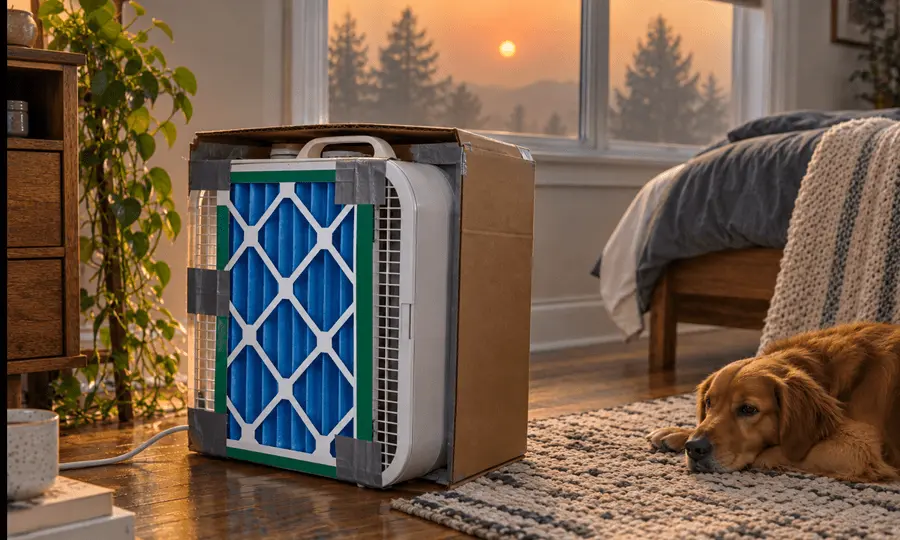
Does a Box Fan With a MERV 13 Filter Work for Wildfire Smoke?
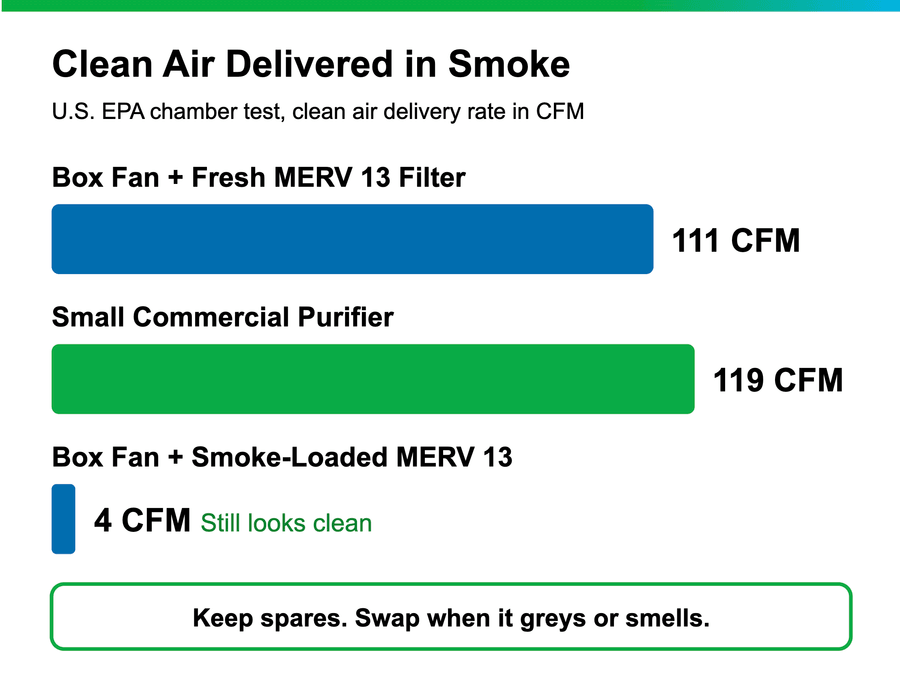
Yes. In U.S. EPA chamber testing, a 20-inch box fan with a 1-inch MERV 13 filter delivered 111 CFM of clean air against wildfire smoke on high. That's close to a small commercial purifier that measured 119 CFM and cost nearly three times as much.
There's one catch. A smoke-loaded filter dropped to about 4 CFM, and it still looked clean.
Use a 20x20x1 MERV 13 filter on a UL- or ETL-marked fan made in 2012 or later.
Tape all four sides onto the fan housing, not just the filter frame.
Add a free cardboard shroud for a 40% boost in measured clean air delivery.
Keep two or three spares ready, since filters sell out during fire season.
Find Your Filter Match
Answer a few quick questions and we'll match you to the right filter.
TL;DR
A 20-inch box fan with a 1-inch MERV 13 filter taped to the intake delivers a measured clean air delivery rate of 111 CFM against wildfire smoke at high speed, according to U.S. EPA chamber testing. Roughly the same as a commercial purifier costing nearly three times as much. Four upgrades push that as high as 401 CFM. One condition drops it to 4 CFM. Filterbuy manufactures the MERV 13 media this design runs on, so the section that matters most to us is the one explaining why a filter that still looks clean can already be finished.
Key Takeaways
A box fan with a single 1-inch MERV 13 filter has a measured smoke CADR of 111.2 CFM at high speed (U.S. EPA, Indoor Air, 2022).
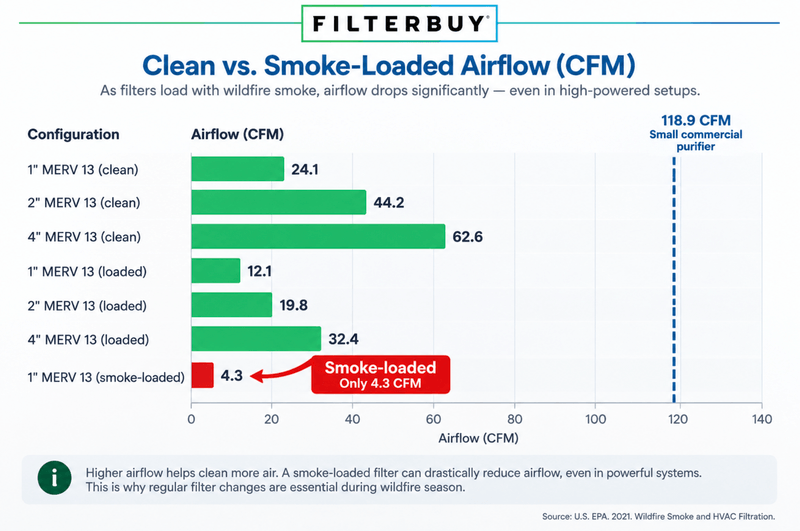
A smoke-loaded MERV 13 filter delivers 4.3 CFM, a 96% collapse, after only 10 milligrams of smoke. Airflow barely changes, so you can't detect it by feel.
A free cardboard shroud raises CADR by 40%, the best return on effort in the whole design.
The whole build takes about ten minutes. A 2012-or-newer box fan, one 20x20x1 MERV 13 filter, tape, and a cardboard shroud.
Match the build to the room. The basic build gives about five air changes an hour in a 12 x 14 bedroom but only two in a 20 x 20 living room. Most disappointment with this design is a sizing mistake, not a design failure.
MERV 11 isn't a substitute for MERV 13 in smoke. Swapping down cost 43% of the CADR in the same test.
Underwriters Laboratories found no unsafe temperatures across five box fan models with filters attached, even with both faces fully obstructed for seven hours. The EPA condition: use a certified fan, 2012 or newer.
What Does a Box Fan With a MERV 13 Filter Actually Do to Wildfire Smoke?
A box fan with a MERV 13 furnace filter taped to its intake is a DIY air cleaner. Depending on fan speed, it pulls fine smoke particles out of room air at 80 to 111 cubic feet per minute. That figure is the clean air delivery rate, or CADR. It's the only number that puts a homemade unit and a store-bought purifier on the same footing.
Filterbuy didn't run this test, and we aren't going to present someone else's chamber data as our own. The most rigorous measurement comes from Amara Holder and colleagues at the U.S. EPA Office of Research and Development, published in Indoor Air in 2022. The team burned pine needles to generate realistic wildfire smoke, injected it into a room-sized chamber, and measured decay using AHAM AC-1, the protocol commercial purifiers are certified against. Here are all of the configurations they measured, at high fan speed unless noted.
Source: Holder AL, Halliday HS, Virtaranta L. Impact of do-it-yourself air cleaner design on the reduction of simulated wildfire smoke in a controlled chamber environment. Indoor Air. 2022;32(11):e13163. Measured under AHAM AC-1 against simulated wildfire smoke. Costs are April 2022 U.S. retail prices as published.
Read the last two rows together and the story of this device becomes clear. Built well and kept clean, a $45 box fan matches a $123 purifier. Left running on a loaded filter, it does almost nothing.
Why Do Published Numbers for the Same Device Range From 80 to 330 CFM?
Different labs measure CADR different ways, and the method changes the answer by a factor of 1.5 to 3. Three published figures exist for a single MERV 13 filter on a box fan at high speed: 80, 300, and 330 CFM. All three are defensible, and none of them are measuring quite the same thing.
UC Davis researchers Tom Pistochini and Ryan McMurry measured airflow and multiplied by the rated efficiency of the filter, producing the lowest numbers. Devabhaktuni Srikrishna measured single-pass removal directly and produced the highest. The EPA measured decay against real smoke and landed between them at 111 CFM. Test aerosol matters as much as method. Salt, incense and pine-needle smoke all behave differently, and larger particles are easier to catch. When a DIY air cleaner is advertised at 300+ CFM, check what it was tested with.
The Failure Nobody Warns You About: A Smoke-Loaded Filter Is Nearly Useless
A MERV 13 filter loaded with wildfire smoke delivered 4.3 CFM in EPA testing, a 96% loss. The filter had collected only about 10 milligrams of smoke. Airflow was essentially unchanged and pressure drop rose only from 0.27 to 0.29 inches of water. Nothing about the device felt different. It had simply stopped cleaning the air.
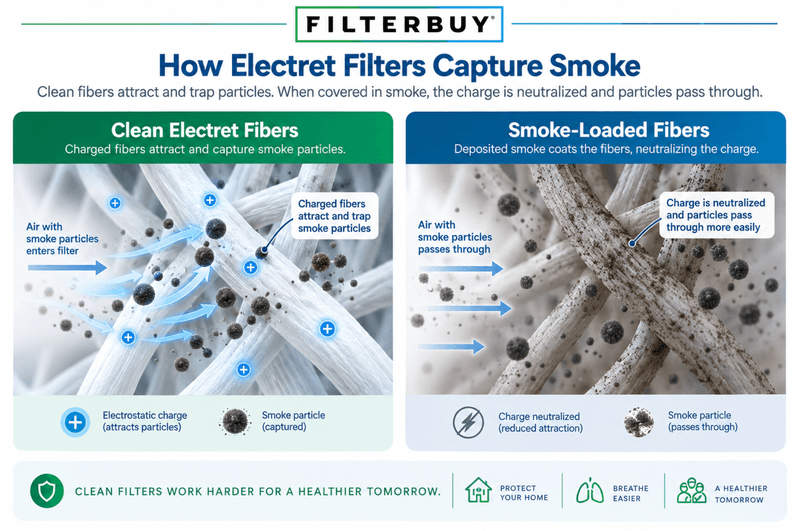
The cause is the media, and here we can speak from the factory floor rather than the literature. Filterbuy has produced pleated MERV 8, MERV 11 and MERV 13 media in the United States since 2013, so this particular failure is one we know from the production side. Most residential MERV 13 filters, Filterbuy's included, use electrostatically charged media: the synthetic fibers carry a static charge that pulls fine particles out of the airstream rather than relying on the weave alone to strain them out. That charge is applied during manufacturing. The filter doesn't generate it as it runs, and you can't restore it.
Fresh smoke particles carry a charge of their own. As they deposit they neutralize the fibers, then start repelling what follows. The mechanism that makes the filter good at catching smoke is the specific thing smoke destroys first.
That's why the usual filter check fails here. Holding a filter up to a light, or against a sheet of paper, tells you how much material is physically sitting in the pleats. It tells you nothing about whether the charge is still there. In the EPA test the filter had collected ten milligrams and was effectively finished, a quantity you would struggle to see at all. On a box fan during a smoke event, a filter that looks fine isn't evidence that it's working.
A dust-loaded filter in the same test still managed 22.9 CFM while carrying 5,300 times more mass. Smoke kills an electret filter at a loading you would never notice, and it does it fast.
During an active smoke event, change the filter when it greys or smells of smoke, not on a calendar. That's the EPA guidance too: check the filter daily during a smoke event and replace it once it turns dark brown or grey. Buy replacements before the smoke arrives, because filters sell out during fire season the way purifiers do. Two or three spare Filterbuy 20x20x1 MERV 13 filters cost less than a single commercial unit.
We make the media that goes into these filters, so the part of this build that worries me is the part you can't see. The charge that catches smoke is put into the fibers at the factory, and once smoke has neutralized it, it doesn't come back. The filter still looks fine. It still moves air. It just isn't cleaning anything any more. If you take one thing from this page, take that: during a smoke event, judge the filter by the calendar and by your nose, not by how it looks.
Michelle Wan, Brand Manager and Air Quality Writer at Filterbuy
How Do You Actually Build One?
Four things and about ten minutes: a 20-inch box fan carrying a UL or ETL mark and made in 2012 or later, one 20x20x1 MERV 13 filter, duct tape or bungee cords, and a piece of cardboard for the shroud. Tape the filter flat against the back of the fan, check the airflow arrow points toward the fan, switch on. The EPA publishes the same build as an infographic if you want a diagram to work from.
Check the fan first. Look for a UL or ETL mark and a date of 2012 or later. Older fans lack the fused plug and thermal cutoff, and EPA does not recommend building on them.
Put the filter on the back. That's the intake side, the one without the logo. Air goes through the filter first and out the front clean.
Follow the arrow. Every filter has an airflow direction printed on the frame. It points the way the air travels, so on a box fan it points toward the fan, not away from it. Backwards costs you efficiency for no reason.
Seal all four sides. Tape onto the fan housing, not just onto the filter frame. A 20x20x1 filter is really 19.5 inches square, so the gap is real and air will find it.
Add the shroud. Cut cardboard to cover the outlet past the blade tips. It costs nothing and adds 40% to the clean air delivery.
Then buy the spare filters. That step gets skipped more than any other, and it is the one that decides whether the build is still working on day four of a smoke event.
Four Upgrades, Ranked by Measured Gain
Once the basic build is running, four changes raise its output, and EPA measured all of them against the same 111.2 CFM baseline in the same chamber. Ranked by how much clean air they add: a free cardboard shroud, a thicker filter, a two-filter wedge, and the four-filter Corsi-Rosenthal box. Only the first is free, and it is the one most people skip.
Baseline is 111.2 CFM: one 1-inch MERV 13 filter taped to a 20-inch box fan at high speed. All figures from U.S. EPA chamber testing, Indoor Air 2022. The Corsi-Rosenthal box delivered the lowest cost per unit of clean air in the study at $0.18 per CADR.
How to do each one:
Shroud. Cut a cardboard ring that blocks the fan outlet past the blade tips, which stops air recirculating at the fan face. It costs nothing and takes up no extra space.
4-inch filter. More pleat surface, lower pressure drop, more airflow. Best for a small room with no floor space to spare.
Wedge. Two filters angled into a V, plus a shroud.
Corsi-Rosenthal box. Four filters forming a cube around the fan, plus a shroud. The trade-off is build time and floor space.
Two things made no measurable difference at all: moving the fan into a corner, and tape versus bungee cords. Filter choice and filter freshness matter far more than build quality.
Where Does the DIY Build Usually Go Wrong?
The two mistakes we see most often have nothing to do with the fan or the design. One is a sizing quirk built into every air filter sold in the U.S. The other is buying down a MERV rating to save a few dollars.
The filter is smaller than the number on the box.
A filter labeled 20x20x1 doesn't measure 20 by 20 inches. A Filterbuy 20x20x1 measures 19.5 by 19.5 by 0.75 inches. Every manufacturer undercuts the nominal size the same way, because a filter cut to a true 20 inches would bind in an HVAC slot instead of sliding into it. That undercut is deliberate, and in a filter rack it's fine: the rack is a fixed opening designed around it.
Taped to the back of a box fan, it isn't fine. You have roughly a quarter-inch of margin on each side and nothing holding the perimeter but adhesive. Air takes the lowest-resistance path it can find, and a gap at the tape line is a far easier route than the media. Run the tape onto the fan housing on all four sides, and check it again after the first hour once the adhesive has warmed and begun to lift. EPA found tape and bungee cords performed about the same, but the perimeter was sealed either way in that test. A leaky seal isn't a middle option between those two results; it is just unfiltered air taking the shortcut.
For smoke, MERV 11 is the expensive choice.
Filterbuy sells more MERV 11 than MERV 13, and for pets, pollen and everyday dust that's usually the right call. For smoke it isn't, and the gap is wider than the price difference suggests. MERV 11 measured 63.6 CFM against smoke versus 111.2 CFM for MERV 13. You give up 43% of the clean air to save a couple of dollars a filter. The reason sits in the standard. ASHRAE 52.2 asks a MERV 11 filter for only 20% efficiency on particles below one micron. Wildfire smoke averages around 0.3 microns, squarely inside the range MERV 11 was never obliged to catch.
If the budget only stretches so far, put it into a Filterbuy 20x20x4 MERV 13 rather than into more filters. It reached 247.9 CFM on its own, it holds far more smoke before the charge is gone, and it occupies the footprint of one filter instead of four. Filterbuy would rather sell you one deeper filter than talk you into a build you have nowhere to put.
What Size Room Will Each Build Actually Clean?
A CADR figure on its own doesn't tell you whether a build is right for your bedroom. The rule the EPA cites for wildfire smoke comes from the Association of Home Appliance Manufacturers: match the CADR number to the room's square footage. A 111 CFM build suits a room of about 110 square feet. Below is the same EPA data converted into rooms and air changes, which is the form most people actually need it in.
Room size uses the AHAM rule the EPA cites for wildfire smoke: match the CADR figure to the room's square footage. Air changes per hour assume a 12 x 14 ft room with 8 ft ceilings, calculated as CADR × 60 ÷ room volume. All figures assume a clean filter and a closed room.
Read down the last column and the practical advice writes itself. In a bedroom, the basic build is already enough. Five air changes an hour is solid, and the shroud takes it to seven for free. Put that same fan in a 20 by 20 living room and it drops to about two air changes an hour. That's usually the point where people decide the design doesn't work, when what actually happened is that a bedroom-sized device was asked to clean a living room.
So build to the room, not to the internet. One filter and a shroud for where you sleep. A 4-inch filter or a Corsi-Rosenthal box for open-plan space. And if you only have the parts for one, put it in the bedroom, because that's where you spend eight uninterrupted hours breathing.
How Loud Is It, and Does That Matter?
Loud enough that noise, not performance, is what usually stops people using one. The EPA measured the basic build at 55 dBA on high and 35 dBA on low. That 20-decibel gap is roughly a fourfold difference in perceived loudness: high is conversation across a table, low is a quiet library.
Here's the trade you're actually making. Dropping from high to low costs you 28% of the clean air, because 111 CFM falls to 80. What you buy with it's noise that goes from intrusive to nearly unnoticeable. For a bedroom, running it on low all night beats running it on high for the twenty minutes before you give up and switch it off. An air cleaner you turn off has a CADR of zero.
This also reframes the multi-filter builds. Filter count and design had almost no effect on measured noise in the EPA tests; fan speed did nearly all of the work. So the reason to build a Corsi-Rosenthal box isn't only that it hits 401 CFM on high. It's that it lets you run a lower, quieter fan speed and still clear more air than a single-filter build managed at full tilt. If noise is what has stopped you before, the bigger build is the fix, not the problem.
One Thing to Watch if It's Hot Outside
Smoke season and heat season are the same season, and the standard smoke advice to close every window and door is also a recipe for trapping heat in a house without air conditioning. EPA treats this as a genuine trade-off rather than a footnote: if it becomes too warm to stay inside with the windows shut, the guidance is to go somewhere else, not to tough it out, because heat turns dangerous faster than smoke does.
The workable middle ground is to open up at night when the outdoor air is cooler and usually cleaner, close the house in the morning, and run the box fan through the sealed daytime hours. Libraries, malls and community cleaner-air shelters exist for the days when that isn't enough. See EPA on creating a cleaner air room for how to concentrate both filtration and cooling in one space.
Is a Box Fan With a Filter on It Safe?
Underwriters Laboratories tested five box fan models with filters attached and found all temperatures below the thresholds in UL 507, the safety standard for electric fans. Testing covered clean, dust-loaded and smoke-loaded filters, fans sealed in plastic, and fans run face-down for seven hours. Exterior surfaces a person could touch stayed at or below 35 degrees C, against a first-degree burn threshold of 47.5 degrees C, and no test scenario produced ignition.
The EPA attaches one condition: use only certified box fans from 2012 or newer with a UL or ETL mark, which include the fused plugs and thermal cutoffs older fans lack. EPA doesn't recommend pre-2012 fans at all, and says that if one is used it should never run unattended or while you sleep. Don't use an extension cord, and don't use a damaged fan.
Should You Do This Instead of Upgrading Your HVAC Filter?
Do both. They solve different halves of the problem. A DIY box fan cleans one room. Your central system, running MERV 13 with the fan set to ON rather than AUTO, filters the whole house every time air circulates. Filterbuy makes filters for both jobs, in 600-plus standard sizes plus custom dimensions, so we have no reason to push you toward one over the other: during a bad smoke week you want them running together.
DIY and commercial CADR figures are from U.S. EPA chamber testing under AHAM AC-1. A central HVAC filter is not rated in CADR because it treats the whole house rather than a single room. Run a box fan and your HVAC filter together during a smoke event.
Not every system tolerates MERV 13. Blower capacity and duct design set the limit, not the MERV number, and the EPA guidance is MERV 13 or the highest rating your system will accommodate. If your air handler is older or your return is undersized, a 4-inch MERV 13 in a deep cabinet gives the same filtration at far less pressure drop than a 1-inch.
The box fan is the emergency tool for the room you're sleeping in tonight. The HVAC filter keeps the whole house lower all season. The build costs about forty-five dollars and an evening, and the thing that decides whether it works isn't which design you pick. It's whether you have spare filters on the shelf when the sky turns orange.
Related: what MERV 8, 11 and 13 actually filter out | best MERV filter for wildfire smoke | MERV 13 vs. HEPA for wildfire smoke | wildfire smoke and the Air Quality Index | live wildfire smoke map | Odor Eliminator carbon filters
Supporting Statistics
Three findings from U.S. government and public-health research that explain why this build is worth the trouble, and what it can and can't do.
1. Closing the windows only gets you about halfway.
During wildfire smoke events, indoor PM2.5 runs roughly 55% to 60% of outdoor levels in a home with the doors and windows shut and no air cleaner running, and the range across homes stretches from 30% to 100%. That last figure is the one to sit with: in a leaky house, shutting the windows can buy you almost nothing. Sealing up is the first step, not the whole plan, and the gap it leaves is what this box fan is built to close.
Source: U.S. Environmental Protection Agency, Strategies to Reduce Exposure Indoors, Wildfire Smoke and Your Patients Health.
2. The chamber numbers hold up in real houses.
Everything in the table above was measured in a sealed test chamber, which always raises the question of whether it survives contact with a real home. It does. In a house during an actual smoke event, a DIY box fan cleaner cut PM2.5 by about 56% in 90 minutes in a larger room, and by about 99% in 60 minutes in a smaller one. The gap between those two numbers is the whole argument for matching the build to the room: the same device that struggles in a living room can nearly clear a bedroom.
Source: May et al. 2021, as summarized by the U.S. Environmental Protection Agency, Strategies to Reduce Exposure Indoors.
3. Smoke days send people to the emergency room.
When Canadian wildfire smoke crossed into the United States between April and August 2023, CDC found asthma-related emergency department visits ran 17% higher than expected across the 19 days with measurable smoke. The increases were largest among people aged 5 to 17 and 18 to 64, and largest in the regions that got the most consecutive smoke days. Hospital visits are what that exposure looks like once it stops being a number on a chart.
Source: McArdle CE et al., Asthma-Associated Emergency Department Visits During the Canadian Wildfire Smoke Episodes, CDC MMWR 2023;72(34):926-932.
And the exposure is no longer regional. The American Lung Association counted 145 million people who lived through at least one red, purple or maroon particle-pollution day in its 2026 State of the Air report. That's up from 133.4 million the year before, with wildfire smoke named as a key factor, and it rose even as most other air quality measures improved.
Source: American Lung Association, State of the Air 2026: Short-Term Particle Pollution Trends.
Frequently Asked Questions
Does a Box Fan With a MERV 13 Filter Actually Work Against Wildfire Smoke?
Yes. U.S. EPA chamber testing measured a clean air delivery rate of 111.2 CFM against simulated wildfire smoke for a 20-inch box fan with a 1-inch MERV 13 at high speed, which puts a $45 build level with a $123 commercial unit.
Which Side of the Fan Does the Filter Go On?
The intake side, where air is pulled in. EPA testing found the outlet position gave a similar CADR, but the intake keeps dust and debris out of the motor housing.
Is MERV 11 Good Enough for Smoke?
No. MERV 11 delivered 63.6 CFM versus 111.2 CFM for MERV 13 in the same test, a 43% loss. The MERV 11 standard requires only 20% efficiency on particles under 1 micron, and wildfire smoke particles average around 0.3 microns. See our MERV rating chart for what each rating captures.
How Often Do I Change the Filter During a Smoke Event?
Far more often than you would expect. A smoke-loaded MERV 13 dropped to 4.3 CFM after collecting only 10 milligrams of smoke. Check daily during heavy smoke and replace as soon as it darkens or smells.
Which Filterbuy Filter Should I Buy for a Box Fan Build?
A 20x20x1 MERV 13 is the standard match for a 20-inch box fan and the size the EPA infographic specifies. If you have the depth for it, a 20x20x4 MERV 13 more than doubles the clean air delivery on its own. Buy two or three spares at the same time, because smoke loads a filter far faster than dust and stock moves quickly once a regional smoke event starts.
What Size Room Does a Box Fan Filter Actually Cover?
Match the CADR to the room square footage, which is the rule the EPA cites for smoke. The basic 111 CFM build suits about 110 sq ft and delivers roughly five air changes an hour in a 12 x 14 bedroom. In a 20 x 20 living room the same build drops to about two air changes an hour, which is why open-plan spaces need a 4-inch filter or a Corsi-Rosenthal box.
Should I Run It on High or Low?
Low, if it's going in a bedroom overnight. High gives 111 CFM at 55 dBA; low gives 80 CFM at 35 dBA. You lose 28% of the clean air and gain roughly a fourfold drop in perceived loudness, and an air cleaner you actually leave running beats a louder one you switch off.
Does This Remove the Smoke Smell?
Partly at best. MERV 13 captures particles, not gases. Smoky odor is largely volatile organic compounds, which pass straight through pleated media. An activated carbon Odor Eliminator filter addresses odor; MERV 13 addresses the particles that matter for health.
Glossary
CADR (Clean Air Delivery Rate): The volume of fully cleaned air an air cleaner produces per minute, in cubic feet per minute. A CADR of 111 means it delivers the equivalent of 111 cubic feet of particle-free air each minute.
MERV (Minimum Efficiency Reporting Value): The ASHRAE 52.2 scale rating a filter capture efficiency by particle size, from MERV 1 to MERV 16. Higher numbers capture smaller particles.
MERV 13: The filter rating the U.S. EPA recommends for wildfire smoke.
PM2.5: Airborne particles 2.5 microns in diameter or smaller. Wildfire smoke particles average roughly 0.3 microns.
DIY air cleaner (filter fan): A homemade air cleaner made by attaching one or more furnace filters to a box fan.
Corsi-Rosenthal box: A DIY air cleaner using four or five filters arranged as a cube around a box fan, developed by Richard Corsi and Jim Rosenthal in 2020.
Shroud: A cardboard cutout covering the part of a box fan outlet beyond the blade tips, preventing recirculation and raising airflow.
Electret filter: A filter whose synthetic fibers carry a static charge, applied during manufacturing, that attracts fine particles. The charge isn't renewable, and smoke neutralizes it faster than dust does. Most residential MERV 13 filters, including Filterbuy's, use electrostatically charged media.
Air changes per hour (ACH): How many times an air cleaner processes a volume of air equal to the whole room in one hour, calculated as CADR multiplied by 60 and divided by the room volume in cubic feet. Around five is a common target for a bedroom.
AHAM AC-1: The Association of Home Appliance Manufacturers protocol used to certify portable air cleaner CADR, and the method the EPA study followed.
AQI (Air Quality Index): The EPA scale for outdoor air pollution. Readings above 100 are unhealthy for sensitive groups.
Sources
Every measurement on this page comes from independent published research. Filterbuy did not conduct the testing described. URLs are shown as plain text because the Custom HTML block does not permit link tags.
About the Author
Michelle Wan is Brand Manager and Air Quality Writer at Filterbuy, where she works directly with the U.S. manufacturing team across factories in Alabama, Florida, Pennsylvania and Utah, so her writing comes from how filters are built and used rather than from spec sheets. She holds a B.A. in Sociology from UC Santa Cruz. Read more from Michelle Wan.
Technically reviewed by David Clark, Licensed HVAC Technician with Filterbuy HVAC Solutions.
About Filterbuy
Filterbuy is a family-owned American air filter manufacturer that has built pleated HVAC filters in the United States since 2013, from factories in Alabama, Florida, Pennsylvania and Utah. The catalog runs to 600-plus standard sizes plus made-to-order custom dimensions in MERV 8, MERV 11, MERV 13 and Odor Eliminator activated-carbon media, pleated in Talladega, Alabama and shipped factory-direct. Filterbuy is an independent manufacturer and isn't affiliated with the fan brands or the research institutions referenced on this page.
Disclosure: Filterbuy manufactures and sells the MERV 13 filters discussed on this page, so we have a commercial interest in the recommendation. Every CADR, noise, power and cost figure cited here comes from independent published research, not from us. Where we speak from our own experience, meaning electret media, filter dimensions and pleat depth, we have said so explicitly rather than letting it blend into the research.