
True HEPA vs. HEPA: What the Labels Really Mean | Filterbuy
November 18, 2026
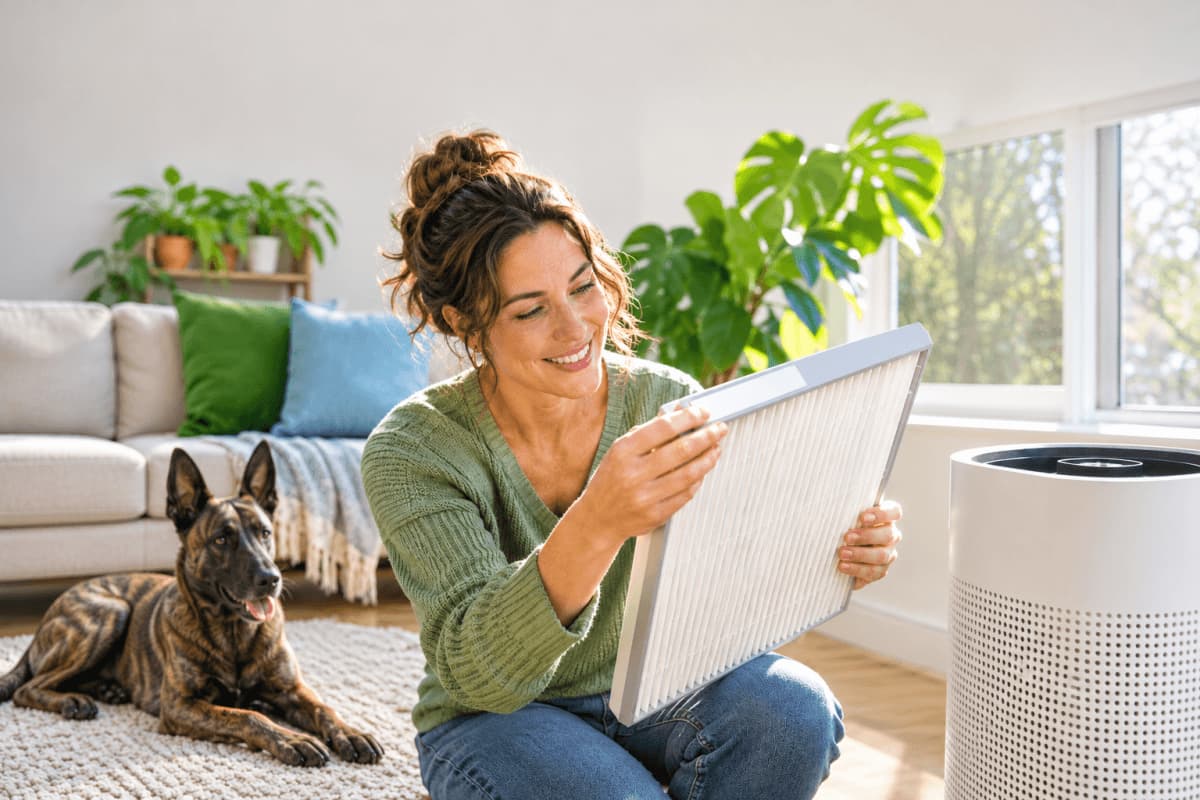
"True HEPA" and "HEPA" mean the same thing when a printed spec backs them up: at least 99.97% capture at 0.3 microns, the benchmark set by the U.S. Department of Energy. The labels that differ are "HEPA-type," "HEPA-like," and "HEPA-style," which carry no required efficiency.
I work with Filterbuy's manufacturing teams in Alabama, Florida, Pennsylvania, and Utah, and the habit that rubs off fastest: skip the adjective and read the number.
TL;DR
True HEPA and properly rated HEPA filters are the same: both must stop at least 99.97% of 0.3-micron particles, while "HEPA-type" has no standard. In European grading, H13 and H14 count as HEPA; "H11" is an old name for E11, which falls short. When your AQI tops 100, Filterbuy recommends a MERV 13 HVAC filter plus a HEPA purifier in each room.
Key Takeaways
True HEPA is a marketing phrase wrapped around a real standard: 99.97% capture at 0.3 microns.
"HEPA-type" and "HEPA-like" labels are unrated, so treat them as below HEPA.
"H11" is not a current HEPA grade. Today's EN 1822 standard calls it E11, a 95% filter.
The grade sets the quality of each pass, and clean air delivery rate (CADR) sets the speed. Choose the grade first, then enough CADR for the room.
AQI over 100? Upgrade both layers: a MERV 13 filter in your HVAC system and a HEPA purifier in each room.
What Is a True HEPA Filter?
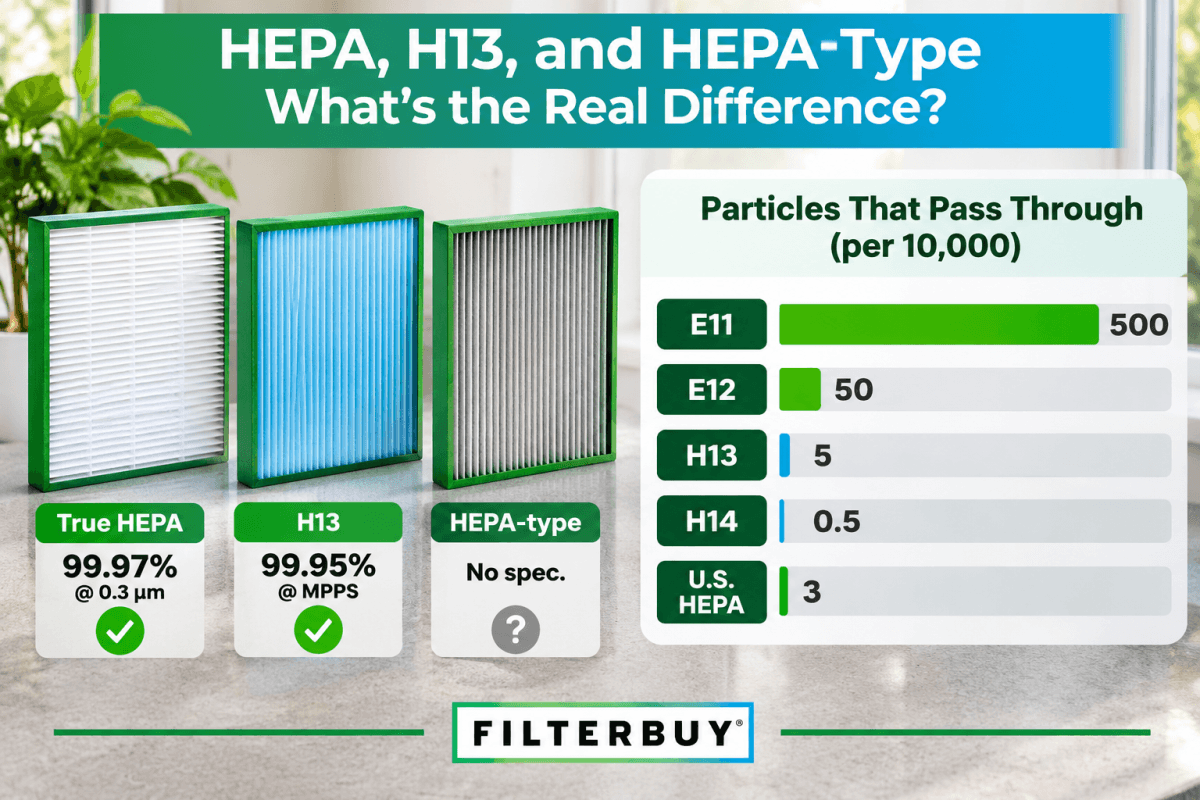
A True HEPA filter is a pleated mechanical filter that captures at least 99.97% of airborne particles 0.3 microns in diameter. The threshold comes from the Department of Energy's DOE-STD-3020 specification. At that efficiency, only 3 of every 10,000 particles at 0.3 microns get through.
No U.S. agency certifies "True HEPA," and the EPA doesn't certify HEPA filters, so the real proof is the printed efficiency spec. For the numbers in depth, see HEPA ratings explained.
True HEPA vs. HEPA vs. HEPA-Type: Side-by-Side
True HEPA and HEPA-type differ in one way: True HEPA must meet 99.97% at 0.3 microns, and HEPA-type has no required number.
Supporting Statistics: Why the Label Matters
We spend about 90% of our time indoors. The EPA adds that some pollutants run 2 to 5 times higher indoors than out. (U.S. EPA, Report on the Environment)
27.8 million Americans have asthma. That's 8.4% of the population (2023), and about 42% had an attack that year. (CDC, Most Recent National Asthma Data)
True HEPA beat HEPA-type in real homes. A 2018 randomized, double-blind trial tested both with 40 older adults in Detroit. (NIH PubMed Central, JAMA Internal Medicine, 2018)
Average personal fine-particle (PM2.5) exposure in that trial:
Sham filter: 15.5 µg/m³
HEPA-type: 10.9 µg/m³, about 30% lower
True HEPA: 7.4 µg/m³, about 52% lower
Percentages are calculated from the study's published means.
HEPA Filter Grades Explained: E10 Through U15
HEPA filter grades are efficiency classes from the European standard EN 1822 and its international counterpart, ISO 29463. EN 1822 tests each filter at its most penetrating particle size (MPPS), the size its media catches least well. Results fall into EPA (E), HEPA (H), or ULPA (U) groups.
What gets through a filter tells the story faster than what it catches, so Filterbuy added a pass-through column.
Pass-through counts are Filterbuy calculations from the minimum efficiencies in EN 1822-1. Real filters often beat their class minimum.
Genuine H13 and H14 filters are tested individually, often with a serial-numbered report. Filterbuy's guide to H13 HEPA filters covers H13 in depth.
H11 vs. H13 HEPA Filter: Why "H11" Isn't Really HEPA
H11 is not a HEPA grade under today's European standard. EN 1822's 1998 edition labeled classes H10 through H14, but its 2009 revision renamed H10–H12 as E10–E12, so "H11" is a retired name for an E11 filter.
The gap is bigger than the names suggest: at MPPS, E11 lets around 500 of every 10,000 particles through and H13 lets around 5, a 100-fold difference. E11 traps visible dust, but for allergies, asthma, pet dander, or smoke, choose H13 or True HEPA.
H13 vs. H14 HEPA Filter: Is the Upgrade Worth It?
H14 filters capture at least 99.995% of particles at MPPS, compared with 99.95% for H13, so about ten times fewer get through.
Filterbuy's view as a filter maker: denser media only helps if the machine can push air through it. Choose H13 for everyday use and H14 if your doctor advises it.
How We Read a HEPA Label in 30 Seconds
This is the checklist we would hand a neighbor in the purifier aisle:
Find the percentage. No number means no real claim.
Find the particle size or class. Look for "99.97% at 0.3 microns," "H13," or "H14."
Look for a named standard. DOE, EN 1822, ISO 29463, or IEST-RP-CC001 point to a real test.
Treat "type," "like," and "style" as a downgrade.
Check the fit and seal. Filterbuy cuts more than 600 filter sizes because air takes the easiest path, so a loose filter gets bypassed. Also confirm which way an air purifier filter goes.
Check the purifier's CADR. The AHAM Verifide mark means it was independently tested.
Which HEPA Filter Does Your Air Purifier Need?
Most purifiers need the grade their manufacturer specifies, usually True HEPA or H13. Match the model number first (our GermGuardian replacement filter guide shows how), then match the grade to your goal:
HEPA traps particles, not gases. The EPA recommends activated carbon for odors, and our carbon vs. HEPA guide explains both layers. For smoke, see running an air purifier during wildfire season.
Grade vs. Airflow: Why the Filter Is Only Half the Purifier
A filter's grade decides how clean each pass of air gets, and the purifier's fan decides how many passes the room gets. CADR reflects both, so Filterbuy never judges a purifier by its label alone.
A simplified single-pass example:
Purifier A: a True HEPA filter (99.97%) moving 100 cubic feet per minute (CFM) delivers roughly 100 CFM of clean air.
Purifier B: an E11 filter (95%) moving 160 CFM delivers roughly 152 CFM. It clears the room faster but lets more through on every pass.
When airflow is equal, grade wins: the Detroit trial above used the same purifier model with each filter, and True HEPA cut exposure most.
That leads to Filterbuy's rule: buy the grade first, then buy enough CADR. AHAM's air filtration standards recommend a smoke CADR of at least two-thirds of the room's square footage (with 8-foot ceilings), or equal to it for wildfire smoke. A 150 sq ft bedroom needs roughly 100 CFM, or 150 during smoke season, and the EPA's guide to air cleaners agrees.
Can You Put a HEPA Filter in Your HVAC System?
Most residential HVAC systems can't use a true HEPA filter without modification, because the media is too dense for a standard blower. Instead, the EPA recommends an HVAC filter rated at least MERV 13, or as high as the system can accommodate.
Will MERV 13 choke your system? It's the question Filterbuy customers ask most, and the answer is usually no. The bigger risk is neglect, as our reviewer puts it:
“A MERV 11 you actually replace beats a MERV 13 you leave in for six months.”
Filterbuy's guidance: when your local AQI climbs above 100, the EPA's "Unhealthy for Sensitive Groups" level, switch your HVAC system to an EPA-recommended MERV 13 air filter and run a HEPA air purifier in each room. MERV 13 cleans the air your system circulates, and the purifiers catch fine particles room by room. Check conditions on Filterbuy's live AQI and wildfire smoke map. If your system truly can't take MERV 13, MERV 11 air filters are the next step down. Compare options in our HEPA vs. MERV rating chart or learn how MERV ratings work.
Shop Filterbuy Filters Built to Spec
Filterbuy has made pleated filters in the USA since 2013, from Talladega, Alabama, and plants in Florida, Pennsylvania, and Utah, for more than 4 million households.
That's why our purifier lineup is narrow: we only list a replacement we can build to fit. Our GermGuardian-compatible air purifier replacement filters (Filter B, C, and E) pair True HEPA media, rated 99.97% at 0.3 microns, with activated carbon and ship free. See the GermGuardian Filter B (4x16) replacement for full specs.
Frequently Asked Questions
Is True HEPA Better than HEPA?
No. When both list "99.97% at 0.3 microns," they meet the same standard.
Is True HEPA the Same as H13?
Same tier, different tests: True HEPA must reach 99.97% at 0.3 microns, and H13 must reach 99.95% at the filter's most penetrating particle size.
How Often Should You Replace a HEPA Air Purifier Filter?
Most last 6 to 12 months; follow your manufacturer's schedule. See how long HEPA air purifier filters last, and replace sooner if you spot the warning signs of a clogged purifier filter.
Glossary
- HEPA (High Efficiency Particulate Air)
- 99.97% capture at 0.3 microns (U.S. DOE), or H13/H14 (EN 1822).
- True HEPA
- Marketing term for HEPA-standard filters.
- HEPA-type / HEPA-like / HEPA-style
- Unregulated labels with no minimum.
- DOE-STD-3020
- U.S. Department of Energy HEPA specification.
- EN 1822
- European standard grading E10–E12 (EPA), H13–H14 (HEPA), and U15–U17 (ULPA).
- ISO 29463
- International standard based on EN 1822.
- MPPS (Most Penetrating Particle Size)
- The size a filter catches least well.
- EPA filter (E10–E12)
- Efficient Particulate Air filter, a class below HEPA (not the Environmental Protection Agency).
- H11
- Retired EN 1822 name for E11 (95% minimum).
- CADR (Clean Air Delivery Rate)
- Clean air a purifier delivers per minute (ANSI/AHAM AC-1).
- AHAM Verifide
- Association of Home Appliance Manufacturers mark for tested CADR.
- MERV (Minimum Efficiency Reporting Value)
- ASHRAE 52.2's HVAC filter rating scale.
Sources
U.S. EPA, What Is a HEPA Filter?
U.S. EPA, Guide to Air Cleaners in the Home
U.S. EPA, What Is a MERV Rating?
U.S. Department of Energy, DOE-STD-3020-2015, Specification for HEPA Filters Used by DOE Contractors
MANN+HUMMEL, EN 1822 filter classification
AHAM, Air Filtration Standards
Morishita M, et al., Effect of Portable Air Filtration Systems on Personal Exposure to Fine Particulate Matter and Blood Pressure Among Residents in a Low-Income Senior Facility, JAMA Internal Medicine, 2018 (NIH PubMed Central)