
Air Purifier Filter Direction: Which Way Does The Filter Go?
September 16, 2026
By Michelle Wan, Brand Manager and Air Quality Writer, Filterbuy | Reviewed by David Clark, Licensed HVAC Technician
Published: September 16, 2026 | Updated: September 16, 2026
TL;DR
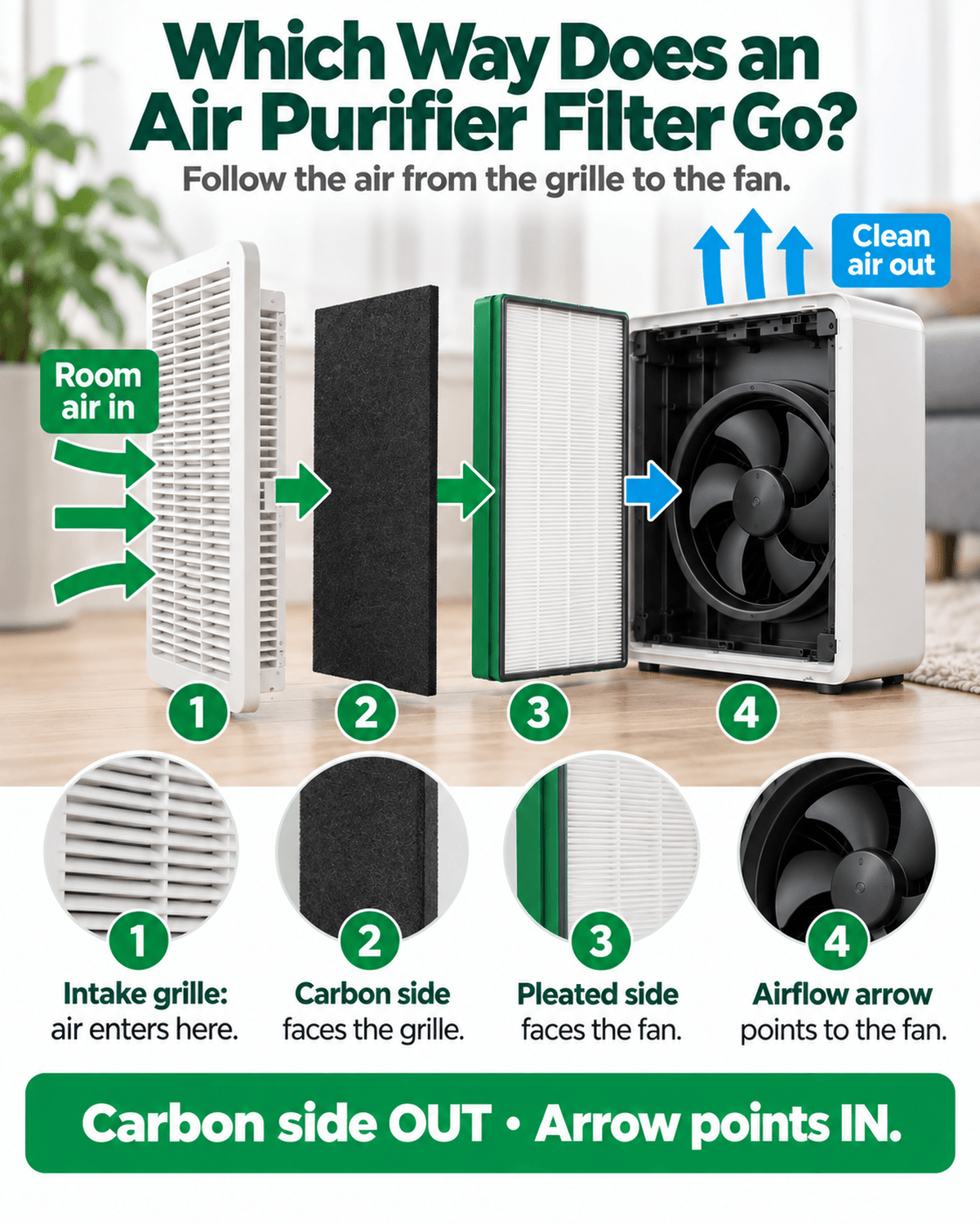
The airflow arrow on an air purifier filter points toward the fan, away from the grille that pulls in room air. The dark activated carbon pre-filter faces that intake grille, and the white pleated media faces the fan. Fit matters as much as direction, because any air that slips around the frame skips the filter.
Air purifier filter direction follows the air. Room air comes in through the intake grille and moves through the filter on its way to the fan, so the arrow on the frame points toward the fan. No arrow? Put the coarse or dark carbon side toward the intake and the white pleated side toward the fan. Check the old filter's arrow before you copy it.
At Filterbuy, we make the replacement filters that fit inside these units, so this guide comes straight from the people who build them.
Key Takeaways
The airflow arrow points toward the fan and away from the intake grille.
The activated carbon pre-filter is the outer layer, in front of the HEPA-style media, never behind it.
A backward filter keeps running, which is why the mistake is easy to miss.
Take off all packaging and seat the filter until the cover closes flush.
The Rule: Air Purifier Filter Direction Follows The Airflow
Every portable air purifier moves air along a single path. A fan draws room air in through the intake grille and pulls it through the filter media. The cleaned air then exits through the outlet. The correct air purifier filter direction follows that path, with the arrow pointing from the intake side toward the fan.
Filterbuy prints airflow arrows on the HVAC filters made in our U.S. plants, and they work the same way. If you have read our guide on which way a furnace filter goes in, the logic will feel familiar.
Can't tell which grille is the intake? Set the purifier to high and hold a tissue near each grille. The one that pulls the tissue in is the intake, and the one that blows it away is the outlet.
Which Way Do Air Purifier Filters Go? A Step-By-Step Guide
Air purifier filters go in with the airflow arrow pointing toward the fan and the carbon side facing the intake grille. The whole job takes a few minutes and needs no tools. Work through the steps below in order. Your old filter is a handy reference, as long as its dusty side was facing the intake.
Find the intake grille while the unit is running. Set the purifier to high and hold a tissue near each grille. The grille that pulls the tissue in is the intake. On GermGuardian AC4825 and AC5000 towers, for example, the air inlet grille is built into the rear cover you remove to reach the filter.
Turn off and unplug the purifier. Wait for the fan to stop spinning before you open anything.
Open the filter compartment and photograph the old filter. Note which face looks gray and dusty. That face took in room air. If the dusty face was pointing at the fan, the old filter was in backward, so don't copy it.
Remove the old filter and any used carbon pre-filter. While the compartment is empty, wipe out the dust with a dry cloth. Dust collects in the housing, not just on the filter.
Unwrap the new filter completely. Remove every piece of plastic and packaging. Air cannot pass through plastic, and packaging left on the media is an easy way to end up with weak airflow right after a change.
Line up the arrow and the carbon side. Hold the filter so the printed airflow arrow points into the purifier, toward the fan. The dark carbon face should look back toward the grille you opened, and the white pleated media should face into the unit. GermGuardian's manual gives the same instruction: follow the arrow on the filter.
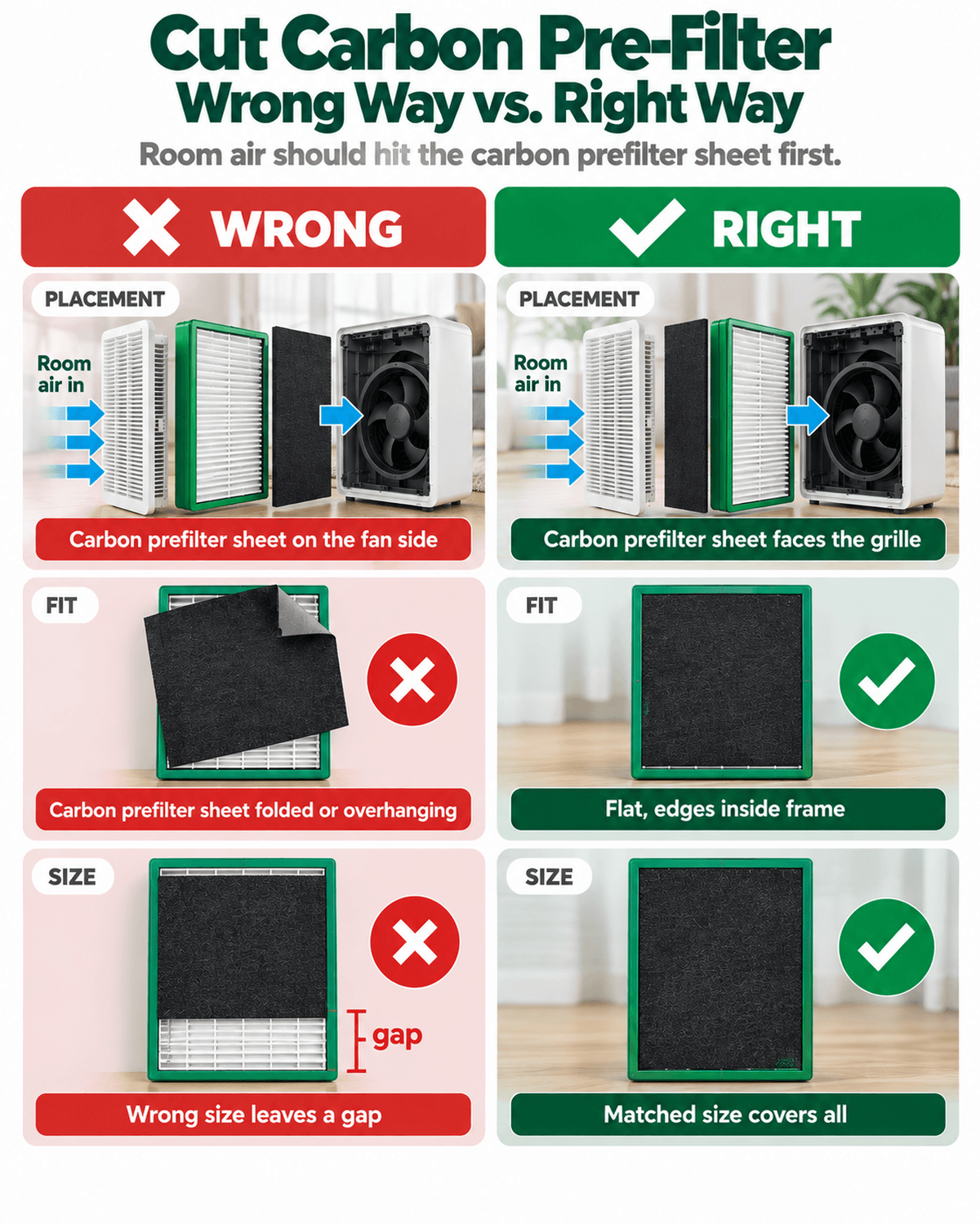
Place the carbon pre-filter on the intake face. If your filter uses a separate carbon sheet, such as a Cut Carbon pre-filter, set it flat over the intake side of the pleats. It's the outer layer, in front of the HEPA-style media, so it always faces the grille.
Slide the filter in and seat it fully. A model-matched filter drops in without trimming or force. Press gently around the frame so it sits evenly against the housing, and check that the carbon pre-filter stayed flat.
Close the cover, plug in, and reset the filter light. The cover should latch flush. Reset steps vary by model. On GermGuardian AC4825 and AC5000 units, you press and hold the UV button for five seconds.
Write the change date on the unit. A strip of tape on the back works. Our guide on how often to replace air purifier filters explains when each part is due.
How To Read The Air Purifier Filter Direction Arrow
Most replacement filters show an arrow or the words "Air Flow" printed on the frame or on a side label. Point that arrow toward the fan and into the purifier, never toward the room or the cover you took off.
No arrow on the filter? These clues point the way:
Carbon or pre-filter layer: The dark gray or black layer, or the coarse mesh sheet, faces the incoming air.
Pull tab: On many cartridge and cylinder filters, the tab faces out so you can lift the filter back out.
Gasket or foam seal: The seal presses against a matching surface inside the housing, and your owner's manual shows which side that is.
Dirt pattern on the old filter: The gray face is the one that took in air. If the old filter was in correctly, put the new one in the same way.
Air Purifier Filter Direction By Purifier Design
Where the intake sits depends on the purifier's shape, and that changes how the filter sits in the housing. The rule itself never changes: the arrow and the fine media always point toward the fan. Use the table below as a starting point and your owner's manual as the final word.
| Purifier Design | Where Air Enters | Filter Orientation |
|---|---|---|
| Cylindrical 360-Degree Tower | Sides or base | Air flows from the outer wall into the core. The open end usually faces the fan. |
| Box Purifier, Rear Intake | Back panel | Pre-filter faces the back cover. Arrow points in, toward the fan. |
| Box Purifier, Front Intake | Front panel | Pre-filter faces the front cover. Arrow points in, toward the fan. |
| Bottom Intake, Top Outlet | Lower grilles or base | Arrow points up, toward the fan. |
| Single Combination Cartridge | Intake grille | Carbon side faces the intake. Pleated media faces the fan. |
| Filter With A Separate Carbon Sheet | Intake grille | Carbon sheet goes on the outside, facing the grille. Arrow points toward the fan. |
Where Does The Carbon Pre-Filter Go In An Air Purifier?
The carbon pre-filter goes on the intake side of the main filter, where room air hits it first. The pre-filter catches hair and lint, its activated carbon holds onto odor and gas molecules, and the pleated HEPA-style media behind it traps fine particles before air reaches the fan. The Washington State Department of Health describes the same order: when a carbon filter is used as a pre-filter, air flows through the carbon first and then the HEPA filter.
The EPA Guide to Air Cleaners in the Home explains that most filters are built to catch either particles or gases, so many air cleaners carry one of each. Filterbuy's breakdown of what each layer in your air purifier does goes deeper into how the two jobs differ.
Two Filter Setups, One Rule For Carbon
Most purifiers use one of two setups, and in both of them the carbon faces the grille.
Complete filter assembly: One drop-in unit with pleated HEPA-style media and an activated carbon layer on the intake side. Filterbuy's replacements for GermGuardian Filter B (FLT4825), Filter C (FLT5000), and Filter E (FLT4100) work this way, and each ships with one Cut Carbon pre-filter. Replace the assembly every 6 to 8 months.
Separate carbon pre-filter: A thin carbon sheet that sits in front of a main filter you replace on its own schedule. Cut Carbon pre-filters come pre-cut for GermGuardian and Honeywell-compatible purifiers and are replaced every 90 days.
Layer Order From Intake Grille To Fan
Read the table from top to bottom in the same order air travels through the purifier.
| Layer | Faces | What It Catches | Replace |
|---|---|---|---|
| 1. Carbon Pre-Filter | The intake grille (outermost) | Hair, lint, and larger dust, plus odors and some gases | About every 90 days |
| 2. Pleated HEPA-Style Media | The fan | Dust, pollen, pet dander, mold spores, and smoke particles | Every 6 to 8 months |
| 3. Fan | Innermost | Nothing. It pulls air through each layer, and the airflow arrow points here. | Not replaced |
Replace sooner with heavy use or during wildfire smoke season.
HEPA media follows the same rule as any particle filter and faces the fan. The U.S. Department of Energy defines HEPA media as capturing at least 99.97% of 0.3-micron test particles. Filterbuy's guide on how to read a HEPA label explains what that rating does and does not promise, and our breakdown of how long HEPA air purifier filters last covers replacement timing.
How To Install A Cut Carbon Pre-Filter
A Cut Carbon pre-filter goes in as the outer layer, in front of the HEPA filter, so it's the first thing room air passes through. It takes about five minutes and no tools. Each pack also has a QR code that links to directions for your specific purifier.
Power off, unplug, and open the filter compartment. Use the same cover you'd open for a full filter change.
Remove the old pre-filter. It's the outer layer, in front of the HEPA-style media. GermGuardian's manual describes peeling the carbon layer back from the pleated filter on its AC4825 and AC5000 towers.
Check the pleats while they're exposed. If the pleated media is no longer white and is covered in gray dust, replace the whole filter, not just the pre-filter. Our list of signs your air purifier filter is clogged shows what else to look for.
Match the pre-filter to your filter. Cut Carbon Filter B, Filter C, and Filter E pre-filters pair with the GermGuardian filters of the same letter, and HRF-A100, HRF-A200, and HRF-A300 sizes pair with Honeywell-compatible filters.
Lay the new pre-filter flat on the intake face. Keep every edge inside the frame. Cut Carbon pre-filters come cut to size, so there's no trimming or folding.
Close the cover, plug in, and reset the indicator. Follow your manual's reset sequence if your model has a filter light.
Replace the pre-filter every 90 days. One 4-pack covers a full year. Our replacement schedule for each filter layer has the full breakdown.
What Happens If An Air Purifier Filter Is Installed Backwards?
A backward air purifier filter rarely stops the unit. The fan keeps spinning and air keeps moving, so the mistake can go unnoticed until the next change. The real cost is performance. Coarse debris hits the fine media first, and the carbon layer ends up behind the dust it was meant to block. A reversed filter can also sit unevenly against the housing.
The table below matches common signs to their likely cause:
| What You See | Likely Cause | What To Do |
|---|---|---|
| Arrow points at the grille | Filter is in backward | Turn it so the arrow points toward the fan. |
| Carbon sheet sits behind the filter | Pre-filter placed on the fan side | Move it to the intake face, in front of the pleats. |
| Cover will not close flush | Filter tilted or backward, or the wrong model | Check the model number, then reseat. |
| Weak airflow right after a change | Packaging left on the filter | Unplug and remove all plastic. |
| Unit shuts off or will not start | Filter not seated or cover not latched | Reseat the filter and latch the cover. |
| Filter light still on after a change | Indicator has not been reset | Follow your manual's reset sequence. |
| Old filter is gray on the fan side | It ran backward | Check the new filter's arrow before it goes in. |
Many filter lights run on a timer, so they need a manual reset after every change.
If odors linger even with a new filter, the cause is usually something else. Our guide to why an air purifier smells covers them.
Think your filter went in backwards? Unplug the unit and look at the face that was taking in air. If it still looks clean, turn the filter around and reseat it. If it has turned gray, replace it, since flipping it would put that dust on the clean-air side. For other airflow problems, our air purifier troubleshooting guide works through them symptom by symptom.
Common Air Purifier Filter Installation Mistakes
Most filter installation problems come down to a few easy-to-miss mistakes. A purifier often keeps running through them, so the drop in cleaning can go unnoticed for months.
Packaging left on the filter.
The filter in backward, with the arrow facing the grille.
The carbon pre-filter on the fan side, or the filter sitting at an angle so the cover won't close flush.
GermGuardian's manual for its AC4825 and AC5000 towers lists a filter that isn't firmly in place and a rear cover that isn't latched among the reasons a unit shuts off unexpectedly. If your purifier seems weak after a change, rule out these mistakes first.
Does Air Purifier Filter Direction Matter More Than Fit?
Direction and fit go hand in hand, and fit deserves just as much attention. Even a correctly oriented filter lets room air slip past the media if there is a gap around the frame, and that air leaves the outlet unfiltered. A model-matched replacement presses evenly against the housing seal, which keeps air moving through the filter where the capture happens.
ASHRAE's filtration FAQ makes the same point: a filter needs to be installed so all the air goes through it, because air that goes around the filter doesn't get cleaned. The EPA gives similar advice for furnace and HVAC filters, which should fit snugly so air doesn't leak around the edges.
Placement matters too. The EPA advises keeping air cleaners away from curtains and anything else that might block airflow, and GermGuardian recommends at least 1 foot of clearance from walls and furniture for its AC4825 and AC5000 towers. Our walkthroughs of what size air purifier you need and how long to run an air purifier in your bedroom cover the rest.
Supporting Statistics
Three U.S. findings show why a correctly installed filter is worth the minute.
Most time is spent indoors. In the EPA-sponsored National Human Activity Pattern Survey of 9,386 people, conducted from 1992 to 1994, respondents reported spending an average of 87% of their time in enclosed buildings, according to Lawrence Berkeley National Laboratory.
An installed filter set makes the difference. In a randomized crossover study of portable air cleaners in New Jersey and suburban New York homes, published in Aerosol and Air Quality Research, a purifier running with its pre-filter, HEPA, and activated carbon filter set installed cut average PM2.5 in the room by 78.8% compared with the same unit running with its filters removed. A second room in the home saw a 57.9% drop.
Particle pollution is widespread. The American Lung Association's State of the Air 2026 report found that 75.9 million people living in 84 counties across 21 states were exposed to year-round particle pollution that does not meet the annual standard.
Choosing The Right Replacement Filter
The right replacement filter matches your purifier's model number, which you'll usually find on a label on the back or underside of the unit. Combination filters typically need replacing every 6 to 8 months, or sooner with heavy use. Our replacement schedule for each filter layer has the full breakdown.
Filterbuy's complete filters cover GermGuardian Filter B, Filter C, and Filter E, and Cut Carbon pre-filters also come in sizes for Honeywell-compatible purifiers. For a wider look at your options, see our guides to HEPA air purifier replacement filters and air purification filters.
Shop Filterbuy air purifier replacement filters, made in the USA and shipped within 24 hours. Every Filterbuy purifier filter is sized to the model it replaces, so it drops in without trimming. If your purifier uses a separate carbon sheet, our Cut Carbon pre-filters come cut to size in packs of four, a year's supply at the 90-day interval.
Frequently Asked Questions
Which Way Does The Arrow Go On An Air Purifier Filter?
The arrow points toward the fan and into the purifier. It shows which way air moves, and air travels from the intake grille through the filter to the fan.
Which Side Of An Air Purifier Filter Faces Out?
The activated carbon pre-filter faces out toward the intake grille, and the white pleated particle media faces in toward the fan.
Where Does The Carbon Pre-Filter Go On An Air Purifier?
The carbon pre-filter goes on the intake side, as the outer layer in front of the HEPA-style media and closest to the grille. Room air should pass through the carbon first, then the pleated media, and then the fan.
How Often Should I Replace The Carbon Pre-Filter?
Replace a Cut Carbon pre-filter about every 90 days and a complete combination filter every 6 to 8 months. Change both sooner with heavy use or during wildfire smoke season.
Does It Matter Which Way A HEPA Filter Goes In?
Yes. HEPA and combination filters are built to take in air on one face, and manufacturers print an arrow to show which way. GermGuardian's manual, for example, tells owners to consult the arrow on the filter. Installed in reverse, the fine media meets coarse debris first, and the filter may not sit evenly in the housing.
Can I Wash An Air Purifier Filter And Reuse It?
Only if your manual says that layer is washable. Many separate pre-filters can be cleaned, but the Washington State Department of Health says HEPA and carbon filters can't be washed and must be replaced. Our guide on whether you can wash air purifier filters explains which types can be reused.
Glossary
Airflow Arrow: The arrow on a filter frame showing which way air should travel.
Intake Grille: The vented panel where a purifier pulls room air in. The filter's carbon side faces it.
Pre-Filter: A coarse first filter layer that catches hair and lint before air reaches finer media.
Cut Carbon Pre-Filter: Filterbuy's pre-cut activated carbon sheet that sits on the intake side, in front of the HEPA-style media, and is replaced about every 90 days.
Activated Carbon: A porous filter material that holds odor and gas molecules on its surface through adsorption.
HEPA (High Efficiency Particulate Air): A U.S. Department of Energy performance level for filter media that captures at least 99.97% of 0.3-micron test particles.
CADR (Clean Air Delivery Rate): A rating, typically measured at a purifier's highest speed, that reflects how much filtered air the unit delivers.
Sources
U.S. EPA, Guide to Air Cleaners in the Home.
U.S. Department of Energy, DOE-STD-3020, Specification for HEPA Filters Used by DOE Contractors.
ASHRAE, Filtration and Disinfection FAQ.
Washington State Department of Health, Choosing a Portable Air Cleaner and Using a Portable Air Cleaner.
Klepeis et al., The National Human Activity Pattern Survey (NHAPS), Journal of Exposure Analysis and Environmental Epidemiology, 2001.
Lu et al., Real-World Effectiveness of Portable Air Cleaners in Reducing Home Particulate Matter Concentrations, Aerosol and Air Quality Research, 2024.
American Lung Association, State of the Air 2026.
Guardian Technologies, GermGuardian AC4825 and AC5000 Series Use and Care Instructions.
Filterbuy air purifier filter and Cut Carbon pre-filter product pages.