
Replacement Filters Compatible With Honeywell Air Purifiers
September 9, 2026
TL;DR
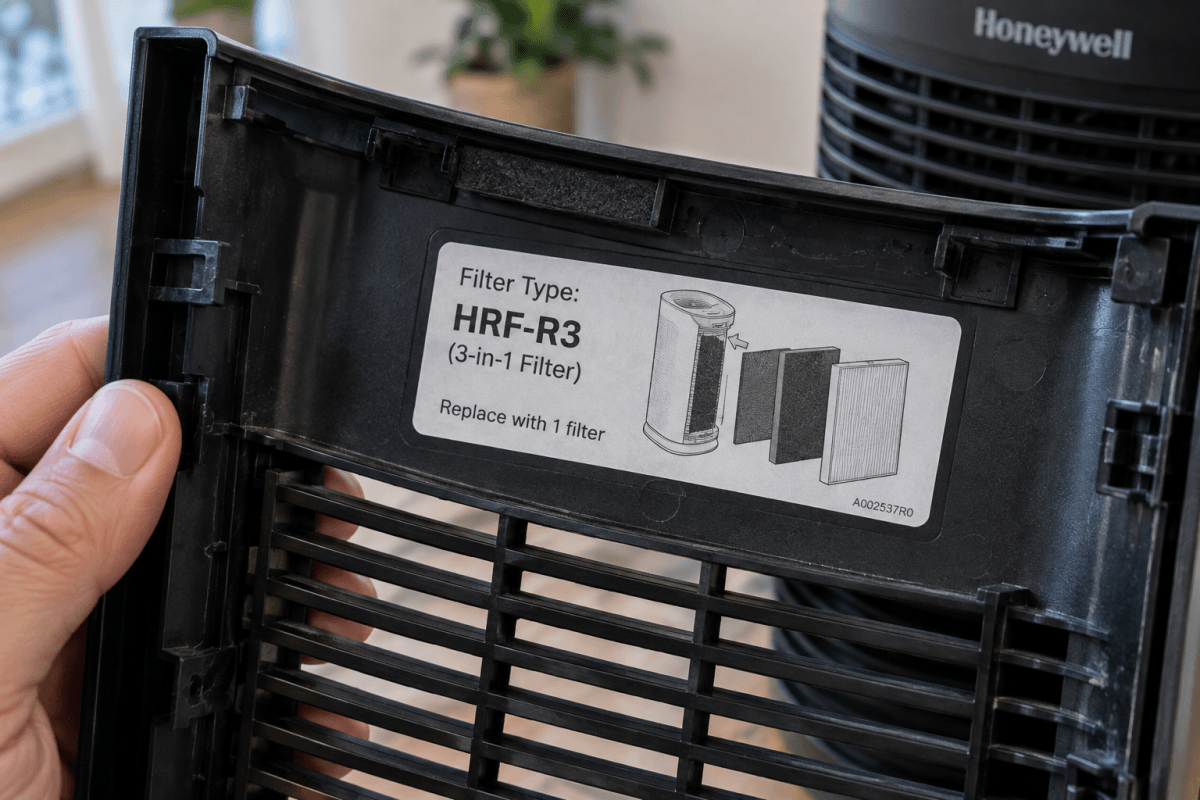
Honeywell air purifiers take lettered filters: R, H, and C are the HEPA filters, and A is the carbon pre-filter sitting in front of them. The letter is printed on a label inside your unit's front grille, which is a more reliable place to look than the model number on the box. Filterbuy manufactures the pre-cut A-series carbon pre-filters in the USA, and the HEPA filter behind them is a separate part.
Honeywell air purifier replacement filters are sold as lettered types, and it is the letter that determines what fits, not the model number on your unit. Match the letter, buy the right quantity, then put the carbon pre-filter on its own schedule. The chart below covers every current Honeywell purifier series.
Key Takeaways
The letter is the part number. An HPA100 and an HPA300 both take Filter R; the HPA300 just takes three.
HEPA filters last about 12 months. Carbon pre-filters last about 3 months. Different parts, different schedules, and the pre-filter is the one people forget.
Honeywell sells the A pre-filter two ways: the HRF-AP1 roll you cut with scissors, and the pre-cut HRF-A100, A200 and A300. Filterbuy’s Cut Carbon pre-filters are pre-cut.
A year of Filterbuy pre-filters costs $12.95 and protects a HEPA filter that costs up to seven times more.
Compatible filters don’t void your warranty. Federal law protects your right to use third-party parts, and the FTC has enforced it against air purifier brands specifically.
Which Replacement Filter Does My Honeywell Air Purifier Use?
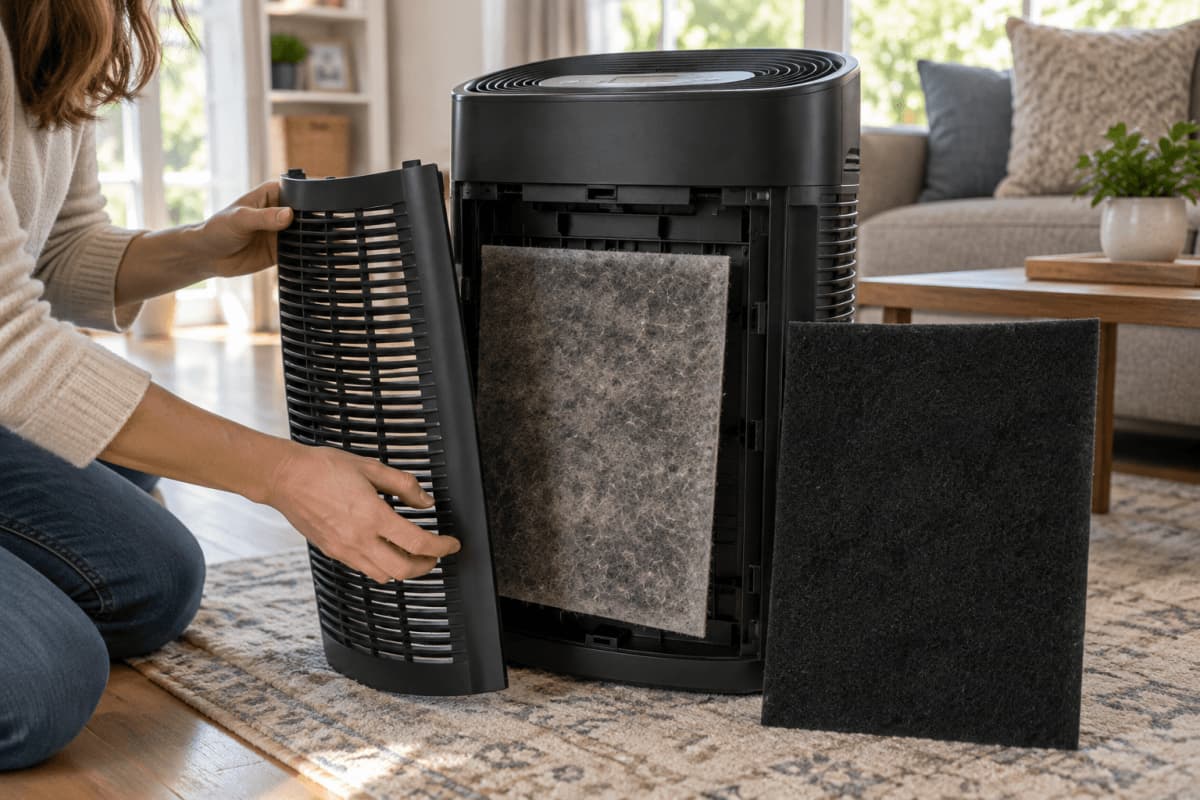
Open the front grille. Honeywell prints a label inside nearly every purifier naming the filter letters it takes and how many. That label beats searching a model number that may have three regional variants. If it’s worn off, the sticker on the back panel maps to the chart below. Quantities are per unit, per Honeywell’s published specifications.
Quantities and replacement intervals follow Honeywell's published product specifications. Filter B, Filter K and Filter U (HRF-201B) parts are matched the same way, by letter.
The numbers in the R and H part codes are pack quantities rather than different filters, so HRF-R1 is one filter, HRF-R2 is two and HRF-R3 is three, all identical apart from how many come in the box. The less common types work the same way: Filter B and Filter K pre-filters, and the Filter U (HRF-201B) in HHT270 and HHT290 units, are all matched by letter. If the filter looks fine but the room still isn’t clearing, check the common causes of weak purifier airflow first.
Every pack holds four pre-filters, a full year at the 90-day interval. Pre-cut to size, made in the USA, shipped free. Prices are list and may change; the product page shows current pricing.
Shop them directly from Filterbuy: Cut Carbon HRF-A100 for HPA100-series, HRF-A200 for HPA200-series, or HRF-A300 for HPA300-series. Each pack is four pre-filters cut to your series’ exact dimensions, so there is no trimming or measuring. The media is coconut shell carbon, thicker than the foam sheets most pre-filters use. Orders ship free within 24 hours, factory-direct from our own U.S. plants, and auto-delivery saves 5%.
Why Filterbuy Cuts Its Pre-Filters To Size Instead Of Selling A Roll
Honeywell’s HRF-AP1 is a universal roll with cutting templates printed on it, which you trim at the kitchen table with scissors. That works, and plenty of people do it. But a pre-filter cut a few millimeters undersize lets air slip around the edge instead of through the carbon, and once the grille is back on there is no way to see the gap: the unit sounds normal, so you assume it is working. Cutting to each series’ exact dimensions in the plant takes that variable out of your hands, and it is the same reason Filterbuy publishes the finished dimensions on every Cut Carbon listing, since a seller confident in the fit has no reason to hide the numbers.
Why The Carbon Pre-Filter Is Worth Staying On Top Of
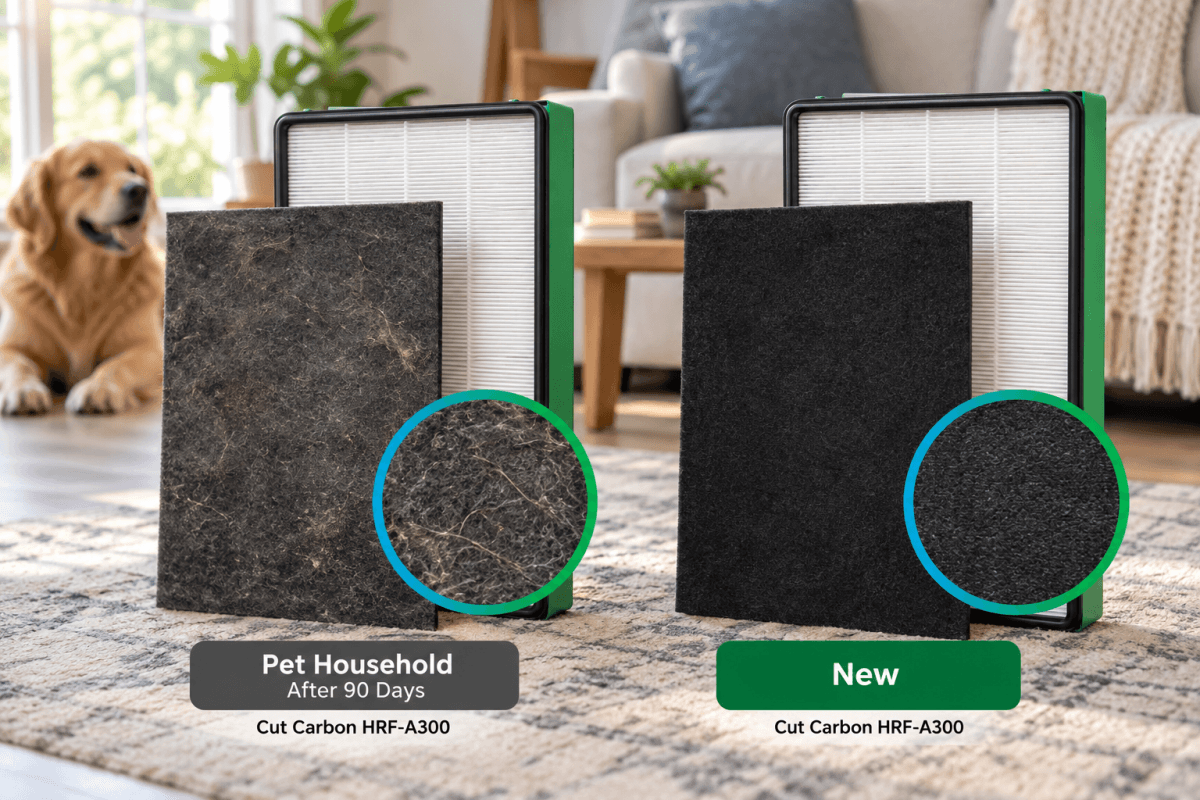
The pre-filter is the cheapest part in your purifier and the one doing most to protect your wallet. It sits on the intake side and catches hair, lint and bulk dust before any of it reaches the HEPA filter. Its carbon also handles odors from cooking, pets, smoke and VOCs, because HEPA media captures particles but does not adsorb gases. More on that split in carbon vs. HEPA: what each layer does.
Nobody publishes the whole number, so here it is. Running a Honeywell purifier costs one HEPA filter a year plus four pre-filters, and the table below adds both together for each series using the Honeywell Store’s own HEPA prices.
HEPA prices are the Honeywell Store's own listed prices for the HRF-R1, HRF-R2 and HRF-R3, checked September 2026. Assumes the published schedule: HEPA once a year, pre-filter every 90 days, so one Filterbuy four-pack covers twelve months. Excludes tax, shipping and any promotion.
On an HPA300 the pre-filter accounts for about 13% of the annual spend, and it is the part protecting the other 87%. The gap between models comes almost entirely from HEPA count, which is why an HPA300 costs roughly twice as much to run as an HPA100: it holds three filters rather than one. Skip the pre-filter and you replace the expensive part early. Keep up with it and you get the full twelve months, plus the odor control you were already paying for.
The pre-filter is the part people skip, and it is the one I find caked when someone tells me their purifier stopped moving air. A HEPA filter rated for a year gets thrown out at eight months because nothing was catching the dust in front of it.
David Clark, Licensed HVAC Technician
Honeywell prices are the Honeywell Store's own listed prices for the genuine HRF-A100, HRF-A200 and HRF-A300 four-packs, checked September 2026. Both columns cover the same thing: four pre-filters, one year at the 90-day interval.
What The Research Says About The Air In Your Home
Three federal findings explain why the pre-filter earns its keep.
You breathe indoor air about 90% of the time. Concentrations of some pollutants run 2 to 5 times higher indoors than outdoors. Source: U.S. EPA, Indoor Air Quality.
Indoor VOC levels run up to ten times higher than outdoors. VOCs come off paints, cleaners, adhesives and cooking. HEPA media does not adsorb gases. Carbon does. Source: U.S. EPA, Volatile Organic Compounds’ Impact on Indoor Air Quality.
Dog allergen is in 100% of U.S. homes, cat allergen in 99.9%. Only 49.1% of those homes had kept a pet. Allergens ride in on clothing. Source: NIEHS, Pet Allergens.
What that means for your Honeywell pre-filter:
The carbon layer handles odors and gases the HEPA filter cannot.
Pet dander is worth filtering even if you have no pet.
The pre-filter loads faster than the HEPA filter behind it. Hence 3 months, not 12.
Are Compatible Filters As Good As Genuine Honeywell Filters?
A well-made compatible filter does the same job, and buying one does not void your purifier’s warranty. Under the Magnuson–Moss Warranty Act, a manufacturer cannot condition a warranty on the use of its own branded parts unless it supplies them free. This is not a grey area in this industry: in July 2024 the FTC sent warning letters to eight companies over right-to-repair warranty terms, and four of the five cited for tying warranties to branded parts were air purifier sellers: aeris Health, Blueair, Medify Air, and Oransi.
The honest caveat: Honeywell will tell you that compatible filters aren’t guaranteed to match their fit or efficiency, and at the low end of the market that’s fair. A pre-filter cut a few millimeters undersize lets air slip around the edge instead of through the carbon. Judge a compatible filter on three things: published exact dimensions, a stated media spec, and a real return policy. Filterbuy prints the finished dimensions on every Cut Carbon listing, names the media as coconut shell carbon, and takes returns.
How To Change A Honeywell Pre-Filter And Reset The Light
Unplug the unit, open the compartment, slide the old pre-filter out and the new one in the same way round with the carbon side facing the intake, and wipe out the housing while you are in there. Illustrated steps are on Filterbuy’s Cut Carbon pre-filter page. The part people miss is the reset: changing the filter does not clear the light. With the unit running, press and hold the lit "Check Filter" or "Check Pre-Filter" button for about two seconds.
Glossary
Filter A: Honeywell’s activated carbon pre-filter, sold pre-cut as HRF-A100, HRF-A200 and HRF-A300, or as the HRF-AP1 universal roll. Replace every 3 months.
Filter R / Filter H / Filter C: Honeywell’s three True HEPA filter families, each fitting a different range of purifier series. Replace Filter R and Filter H every 12 months; Filter C every 6 to 12.
True HEPA: A filtration standard requiring capture of 99.97% of airborne particles at 0.3 microns, the most penetrating particle size. "HEPA-type" and "HEPA-style" are marketing terms with no such requirement.
Activated carbon: Carbon processed to be highly porous, used to adsorb odor-causing gas molecules and VOCs. It handles smells; HEPA media handles particles.
Pre-filter: The outer filtration layer on the intake side, which captures bulk debris and extends the life of the main filter behind it.
Micron / MPPS: A micron is one millionth of a meter, the unit used for particle size; a human hair is roughly 70 microns across. MPPS is the most penetrating particle size, the diameter a filter captures least efficiently, which is 0.3 microns for HEPA media.
VOC: Volatile organic compound, a class of gases released by paints, cleaners, adhesives and cooking, adsorbed by activated carbon rather than trapped by HEPA media.
OEM: Original equipment manufacturer; here, a filter made by Honeywell itself rather than a compatible manufacturer.
Magnuson–Moss Warranty Act: The U.S. federal law that prevents a manufacturer from voiding a warranty solely because a consumer used a third-party replacement part.
Frequently Asked Questions
Which Filter Does an HPA300 Take?
The Honeywell HPA300 takes three Filter R True HEPA filters and one Filter A carbon pre-filter. Filterbuy’s Cut Carbon HRF-A300 four-pack covers a full year of the pre-filter.
Do I Need The Carbon Pre-Filter, Or Just The HEPA Filter?
Both, on different schedules. The Filter A pre-filter catches hair and bulk dust before it loads the HEPA filter, and its carbon handles cooking smells, pet odor, and smoke. Skipping it shortens the life of the filter behind it.
Can I Wash And Reuse A Honeywell HEPA Filter?
No. Honeywell’s guidance is that its HEPA filters should not be washed or cleaned. Water and vacuum suction both damage the fiber matrix.
Honeywell® is a registered trademark of Honeywell International Inc. Filterbuy is not affiliated with, authorized by, or endorsed by Honeywell. Model and part numbers are referenced solely to indicate compatibility.
Sources
U.S. EPA, What is a HEPA filter? (updated January 13, 2026) · U.S. EPA, Indoor Air Quality (Report on the Environment) · U.S. EPA, Volatile Organic Compounds’ Impact on Indoor Air Quality · U.S. EPA, Guide to Air Cleaners in the Home · National Institute of Environmental Health Sciences (NIH), Pet Allergens · Federal Trade Commission, FTC Warns Companies to Stop Warranty Practices That Harm Consumers’ Right to Repair (July 3, 2024) · Magnuson–Moss Warranty Act, 15 U.S.C. §2302(c) · Honeywell Store air purifier filter specifications and pricing, accessed September 7, 2026.