
Saharan Dust Plumes and U.S. Air Quality: Timing, Reach, and Response
September 22, 2026
How Saharan Dust Affects U.S. Air Quality and Which Filter Handles It
Each summer, Saharan dust drifts about 5,000 miles to Puerto Rico, Florida, and the Gulf Coast, peaking from late June to mid-August. Most of it stays high overhead. When it sinks to ground level, it adds coarse PM10 and fine PM2.5 particles to the air — and a third to half of it is fine.
That fine share is why your filter rating matters during dust season:
MERV 8: captures larger debris, dust, and dust mites. It isn’t rated for the smallest dust particles.
MERV 11: captures finer particles, including 85%+ of 3–10 micron dust. The practical baseline for most homes.
MERV 13: captures microscopic particles, including at least half of sub-micron dust. The highest residential filtration, if your system can handle the airflow.
Not sure which one fits your home and HVAC system? The quick quiz below will match you.
Answer a few quick questions and we’ll match you to the right filter for dust season.
Already know your size? Filterbuy makes filters in the USA in more than 600 sizes.
TL;DR
Every summer, the Saharan Air Layer carries desert dust roughly 5,000 miles from West Africa to Florida and the Gulf Coast, with peak activity from late June to mid-August. Most of it stays high overhead, but when it sinks to ground level it adds coarse and fine particles to the air and can aggravate asthma and other breathing problems. At Filterbuy, a U.S. air filter manufacturer, we recommend a MERV 11 or MERV 13 HVAC filter to keep most of those particles out of your home's air.
Key Takeaways
The Saharan Air Layer (SAL) is a hot, dry, dusty air mass that rolls off West Africa every few days in summer.
Outbreaks peak from late June to mid-August and can travel as far west as Texas.
A third to half of the African dust reaching Florida is fine PM2.5; the rest is coarse PM10.
In a Miami study, COPD patients exposed to dust the day before had about 4.9 times higher odds of repeat flare-ups.
MERV 11 captures at least 85% of 3–10 micron particles; MERV 13 also captures at least half of sub-micron particles.
“Our filters end up in return vents all along the Gulf Coast, so we watch dust season closely. After more than a decade of making filters in the USA, we've settled on MERV 13 as the sweet spot for most Florida homes, as long as the system can handle the airflow.”
— Michelle Wan, Brand Manager & Air Quality Writer, Filterbuy
What Is the Saharan Air Layer?
The Saharan Air Layer, also called the Saharan dust plume, is a hot, dry air mass that forms over the Sahara Desert and drifts west across the tropical Atlantic. According to NOAA's Atlantic Oceanographic and Meteorological Laboratory, each outbreak fills a layer 2 to 2.5 miles thick, beginning about a mile above the surface.
In June 2020, a plume nicknamed "Godzilla" crossed all the way to North America. NASA scientists note that breathing dust is especially hazardous for children and older adults, as well as for people with asthma.
When Does Saharan Dust Reach the U.S.?
In the U.S., dust season runs from roughly late May through August. NOAA reports that activity builds in mid-June and peaks from late June to mid-August before fading quickly. At the peak, a new outbreak can leave Africa every three to five days, and each event typically lasts several days, so dusty spells come in waves.
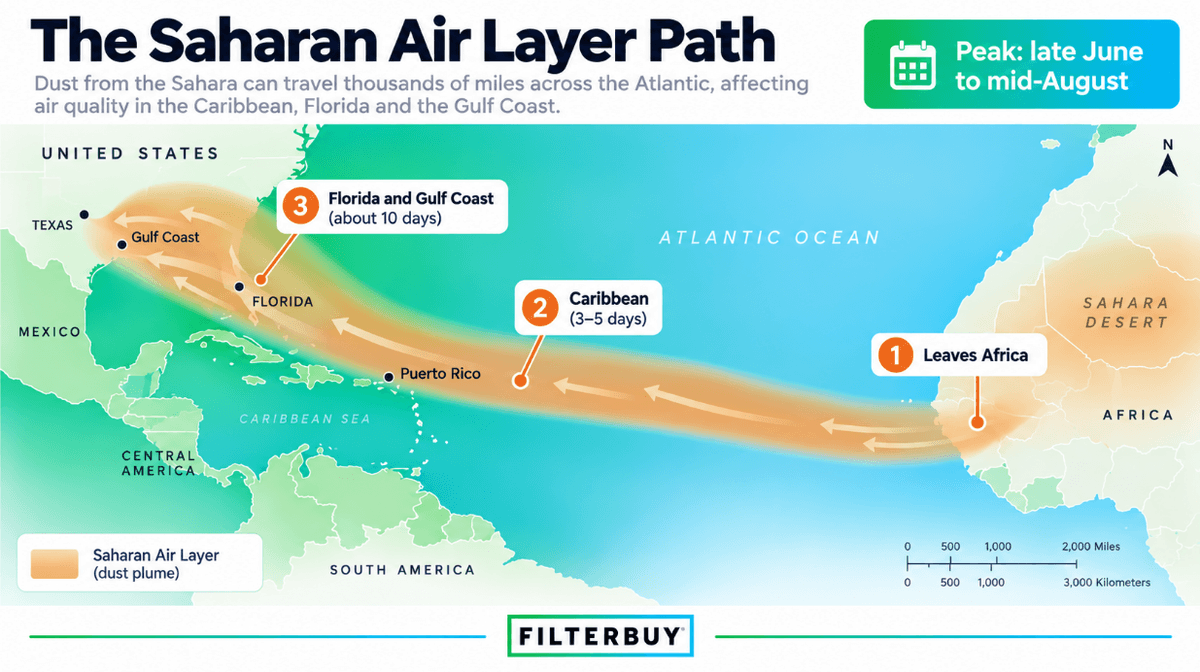
Puerto Rico researchers note that dust can reach the Caribbean within 3 to 5 days, while a University of Miami team puts a typical Atlantic crossing at about 10 days. In 2026, by May 31, a large plume had reached the Cayman Islands and Jamaica, and in early July, a heavy plume hazed Miami and the Everglades.
Where Does the Dust Plume Reach? A Regional Guide
Because the dust rides the trade winds west, Puerto Rico and the U.S. Virgin Islands usually see it first, followed by Florida and the Gulf Coast.
Saharan Dust Reach by Region
Sources: NOAA, 2026 news reports and Filterbuy AQI data. Reach varies by plume.
Check current conditions on Filterbuy's Miami, Orlando, Houston, and San Antonio air quality maps.
What We See in Dust Season: The Filterbuy View
Filterbuy sees what happens after dust arrives. Three patterns stand out:
Florida filters work harder. Our analysis of Florida filter replacement patterns shows particulate loads run 20–30% higher during peak AQI seasons, so a 90-day filter often performs like a 60-day filter.
Dust season shortens the calendar. Our Miami customer data shows households there change filters more often than the national average. We've seen photos of filters that looked six months old after two weeks of poor air quality.
Higher ratings add airflow resistance. In Filterbuy's lab testing at 1,000 CFM, our MERV 8 filters start at about 0.08–0.12 in. w.g., MERV 11 at 0.15–0.18 and MERV 13 at 0.22–0.28. See our air filter pressure drop chart.
Does Saharan Dust Affect Air Quality at Ground Level?
The dust usually travels thousands of feet up and only raises particulate matter (PM) readings when it mixes down to the surface.
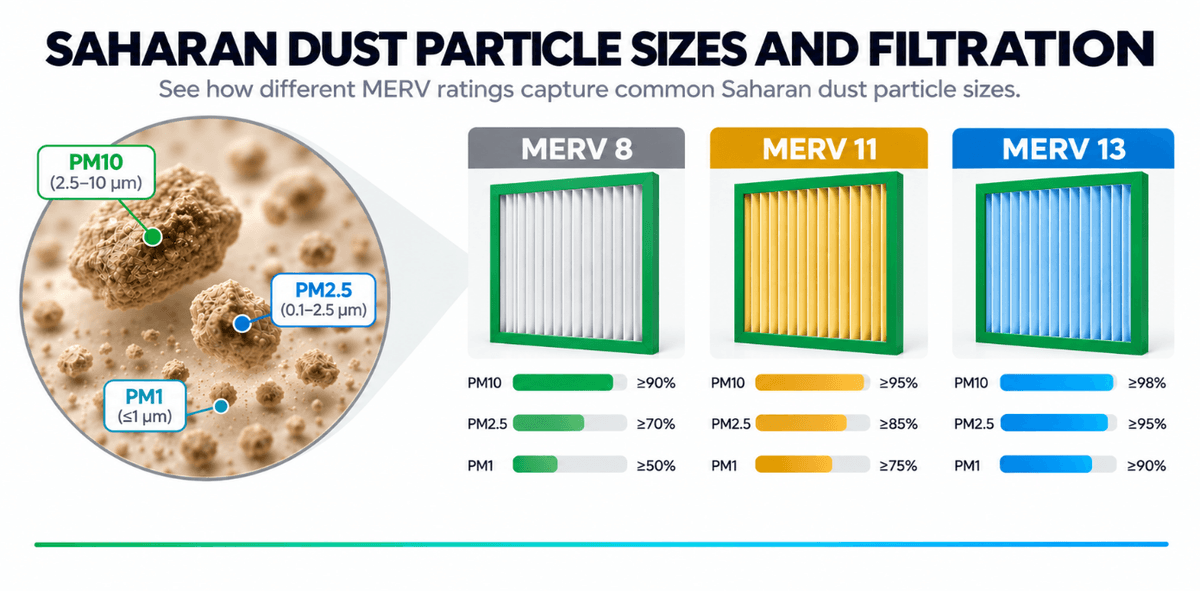
When it does, particle size matters more than most guides let on. Research near Fort Myers, Florida found that fine particles under 2.5 microns made up a third to half of the African dust, with the rest falling in the coarse 2.5 to 10 micron range.
University of Miami researcher Joseph Prospero found that African dust can account for as much as half of the breathable particles over Miami in summer. Combined with local pollution, it can push totals above the EPA's limit on some days.
Is It Saharan Dust, Wildfire Smoke, or Ozone? How to Tell
Summer haze has several causes, and a filter only helps with some. Four quick checks:
Look at the main pollutant. Filterbuy's live AQI map shows which pollutant is driving the reading. Dust shows up as PM10 or PM2.5, while ozone is a gas that particle filters cannot remove.
Look at the calendar. Saharan dust peaks from late June to mid-August, while wildfire smoke can drift in any time a large fire burns upwind.
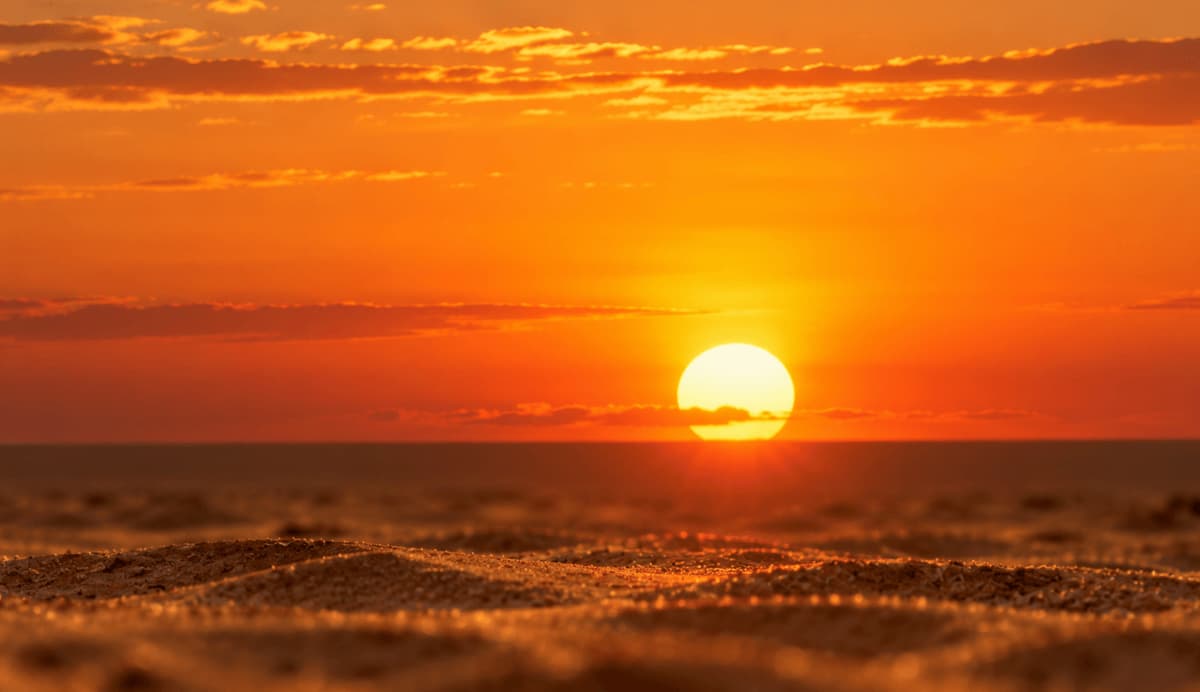
Look at the sky. NOAA says dust turns the midday sky a hazy white and gives sunsets an orange glow. Smoke looks grayer and often smells of burning.
Look at your car after it rains. A tan film on your windshield usually means a Saharan plume is overhead.
Saharan Dust Health Effects: Who Reacts?
Those who feel dust most tend to have asthma, COPD, allergies, or heart and lung conditions, as are young children and older adults.
A Miami study of 296 COPD patients found that PM2.5 rose about 25% during dust events. Patients exposed to dust the day before had roughly 4.9 times higher odds of repeat flare-ups, and that higher risk lasted up to 15 days.
Dr. Samuel Gurevich, a pulmonologist with Cleveland Clinic in Florida, summed up the concern in an interview with The Palm Beach Post: "These tiny particles can travel deep into the lungs and cause significant inflammation." He advises getting care right away for wheezing or chest tightness, or an inhaler that stops working as well as usual.
Can Saharan dust cause allergies? African dust isn't an allergen like pollen, but it irritates the airways and can carry microbes and endotoxins, so people with allergies often feel worse on dusty days. See our guide to the best air filters for allergies, and talk with your doctor if symptoms worsen.
Which Air Filter Rating Handles Saharan Dust?
For most homes, a MERV 11 filter is the practical baseline for Saharan dust. If someone in your household has a lung condition or severe allergies, a MERV 13 filter is the stronger choice because it also captures at least half of sub-micron particles.
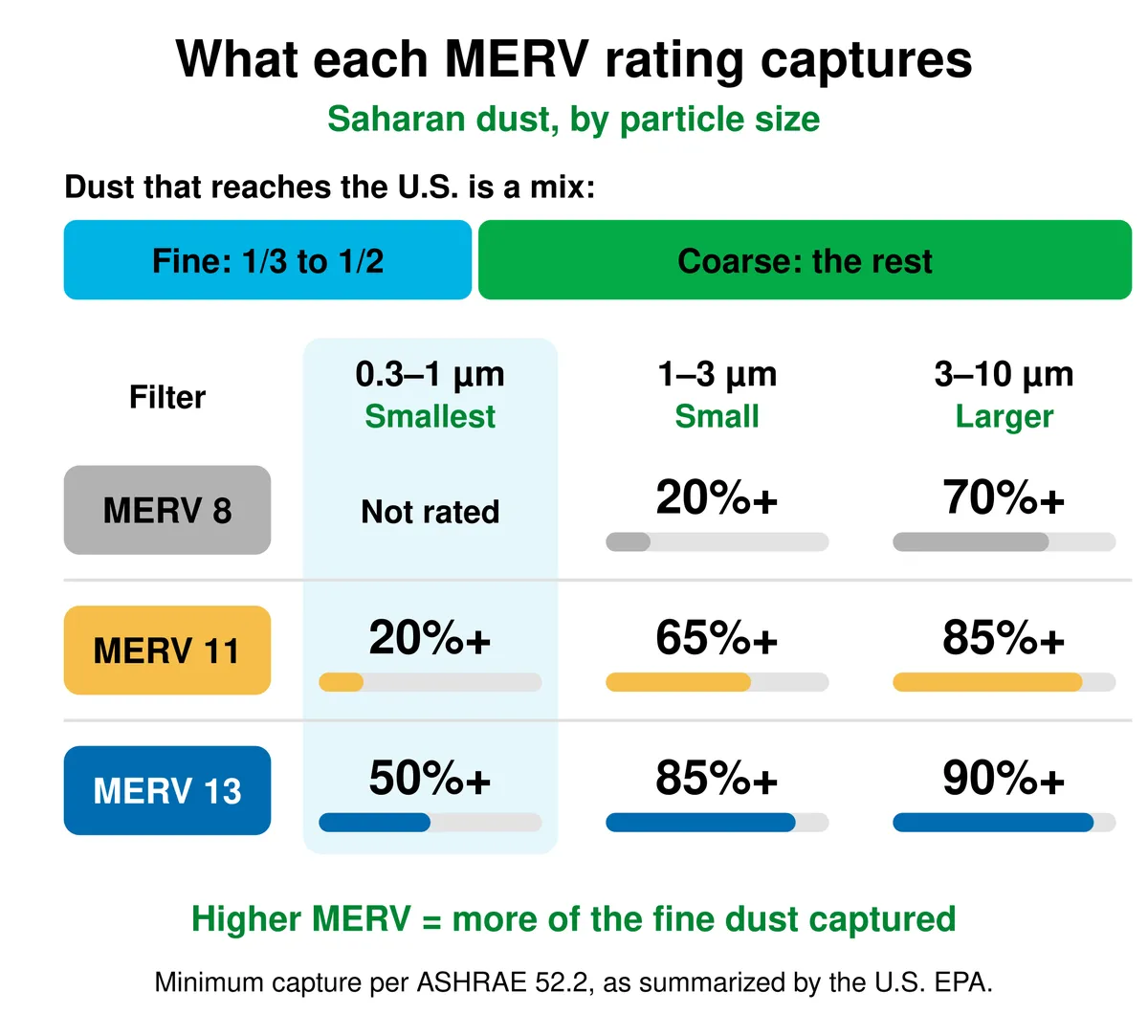
Filterbuy matched each rating to the particle sizes African dust delivers, using the EPA's summary of ASHRAE Standard 52.2:
MERV Rating vs. Saharan Dust Particle Size
Minimum capture efficiency by particle size under ANSI/ASHRAE Standard 52.2, as summarized by the U.S. EPA. Higher MERV filters add airflow resistance, so confirm your system is compatible.
Since a third to half of incoming dust is fine particulate, a MERV 8 filter lets a meaningful share slip through. MERV 11 closes most of that gap, and MERV 13 closes nearly all of it.
Pro Tip: Denser filters fill faster, so plan on changing a MERV 13 filter more often during dust season. Filterbuy's MERV rating chart walks through every rating.
Which Setup Fits Your Home? A Quick Decision Guide
Filterbuy matches the setup to your household like this:
Healthy household with standard central air: Use a MERV 11 filter and check it after each major plume.
Sensitive family members at home (asthma, COPD, infants, older adults): Step up to MERV 13. The EPA says most furnaces and HVAC systems can run MERV 13 without problems as long as the filter is replaced frequently. Add a portable HEPA air cleaner to the bedroom, sized by clean air delivery rate (CADR); the EPA suggests at least 130 CFM for a 200-square-foot room.
Older or restrictive system: If airflow drops or the system struggles with MERV 13, stay with MERV 11 and let a portable HEPA unit handle fine particles.
No central air (window or ductless units): The EPA notes these units have limited filtration, so a properly sized portable HEPA air cleaner will do most of the work.
How to Prepare for a Saharan Dust Event: The Filterbuy Plume Playbook
Watch (5 to 10 days out). When a plume leaves West Africa, start following National Weather Service dust forecasts and Filterbuy's live AQI map.
Prep (2 to 3 days out). Replace your filter if it's more than halfway through its schedule, and refill asthma medications.
Seal (during the event). Close windows and doors and run your HVAC fan. Sensitive family members should limit time outdoors.
Reset (after the plume clears). If your filter looks gray or dusty, replace it early. In Filterbuy's experience, that's often weeks ahead of schedule.
Filterbuy makes its filters in the USA in more than 600 sizes, and Filterbuy auto-delivery can ship your exact size before dust season peaks.
Supporting Statistics: The Numbers Behind the Dust
60+ million tons of dust a year
NASA estimates that upwards of 60 million tons of Saharan mineral dust rise into the atmosphere each year.
Source: NASA Goddard Space Flight Center
Nearly 14.3 million people with asthma
The "State of the Air" 2026 report found that nearly 2.4 million children and 11.9 million adults with asthma live in counties graded F for at least one pollutant.
Source: American Lung Association, "State of the Air" 2026
Less than 25% HVAC runtime
Most people spend about 90% of their time indoors, but home HVAC systems usually run less than 25% of the time during heating and cooling seasons.
Source: U.S. EPA, Guide to Air Cleaners in the Home
Frequently Asked Questions
Should I wear a mask during Saharan dust?
Yes, for sensitive people who must be outside during heavy dust. A fresh, well-fitted N95 filters fine particles best. See Filterbuy's MERV 13 vs. HEPA guide for indoor options.
How long does Saharan dust stay in the air?
A single dust event usually lasts several days, and the American Lung Association notes that dust particles can linger a few hours to 10 days.
How do I protect my family and pets during a dust event?
Stay indoors on high-dust days, close doors and windows, and bring pets inside. The American Lung Association also advises setting your AC to recirculate at home and in the car.
Does Saharan dust affect hurricanes?
Yes. NOAA explains that the Saharan Air Layer's dry air, warmth, and strong winds can suppress tropical storm formation and strengthening.
Does Saharan dust reach Texas?
Yes, during strong outbreaks. In July 2026, a plume spread across the Gulf and reached coastal Texas and Louisiana.
Glossary
Saharan Air Layer (SAL): A hot, dry, dusty air mass that crosses the Atlantic from the Sahara in late spring through early fall.
PM10: Inhalable particles 10 microns or smaller, including coarse dust.
PM2.5: Fine particulate matter 2.5 microns or smaller, small enough to reach deep into the lungs.
Air Quality Index (AQI): The EPA's color-coded 0–500 scale for daily air pollution.
MERV: Minimum Efficiency Reporting Value, the ASHRAE 52.2 rating (1–16) for how well a filter captures particles by size.
Endotoxins: Bacterial molecules that can travel on dust and trigger airway inflammation.
CADR: Clean air delivery rate, the airflow rating used to size portable air cleaners.
HEPA: High-efficiency particulate air, a filter standard used in portable air cleaners.
CFM and in. w.g.: Cubic feet per minute (airflow) and inches of water gauge (airflow resistance).
COPD: Chronic obstructive pulmonary disease, a group of lung conditions that restrict airflow.