
AQI Near Me: How to Check Your Local Air Quality Index
June 17, 2026
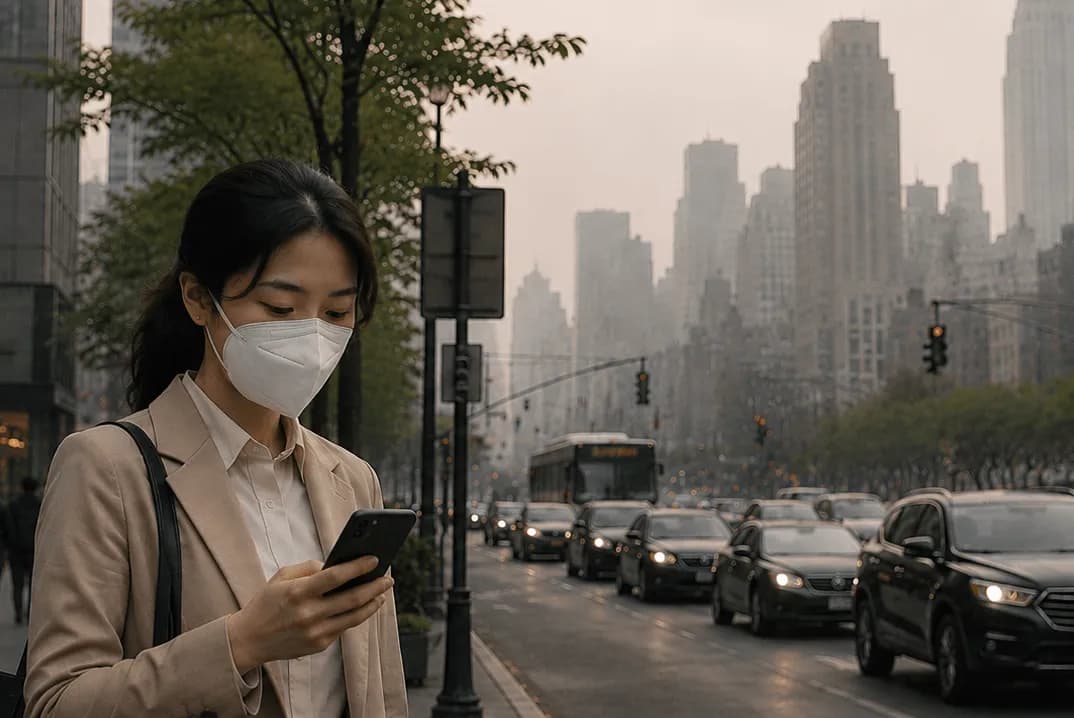
You searched "AQI near me" because you want to know one thing: is the air outside okay right now? This page gets you to your live reading in one click, then tells you what that number means for your plans today and what to do inside your home if it's high.
Get your live AQI in one click
Open Filterbuy's live USA air quality map and type your city or ZIP code. You'll see your current number, its color, the pollutant driving it, and which cities near you are cleaner or worse.
Open the live USA AQI mapSmoke in the area? Use the live wildfire and smoke map instead.
Check the AQI in your state
Each state map shows current readings for cities across the state, plus local causes of bad air days.
Don't see your state? Use the USA map and search your ZIP code. It covers the whole country.
Popular city maps: Houston, Dallas–Fort Worth, Atlanta, Riverside, Reno, Buffalo
What your AQI number means
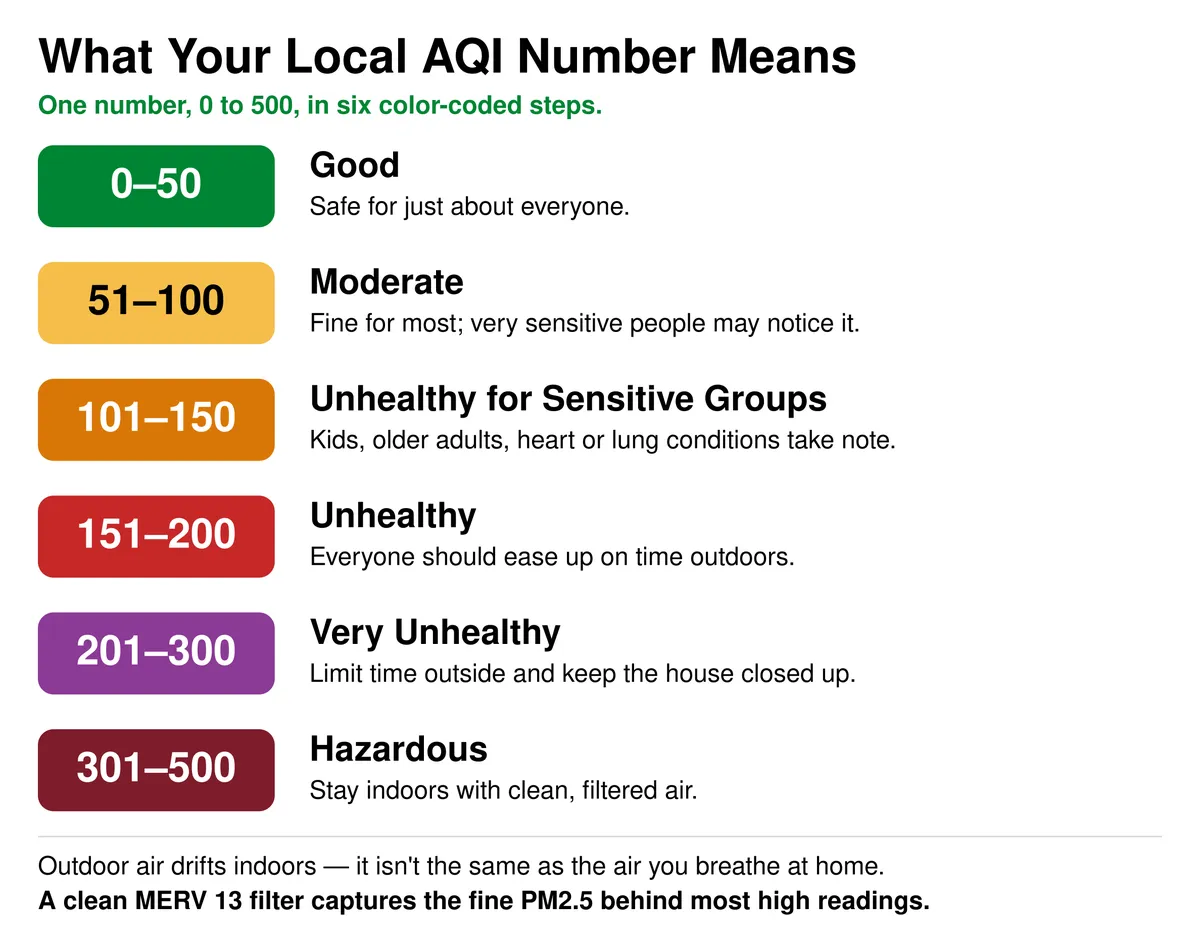
The Air Quality Index runs from 0 to 500. Lower is cleaner. The EPA splits it into six color bands, and the color on the map tells you which one you're in. Activity guidance below follows AirNow, the EPA's air quality site.
| AQI | Level | What it means for your day |
|---|---|---|
| 0–50 | Good (green) | Normal plans. Open the windows if you like. |
| 51–100 | Moderate (yellow) | Fine for most people. Unusually sensitive people may want to shorten long, hard workouts. |
| 101–150 | Unhealthy for sensitive groups (orange) | AirNow advises children, older adults, and people with heart or lung disease to cut back on long or heavy outdoor activity. |
| 151–200 | Unhealthy (red) | Everyone should consider shorter, easier time outside. Close up the house. |
| 201–300 | Very unhealthy (purple) | Avoid long or heavy outdoor activity. Focus on your indoor air. |
| 301+ | Hazardous (maroon) | Stay indoors and follow local health officials. See what to do at AQI 301+. |
Want the full breakdown of each color? See the AQI color chart.
How to read your reading on the map
When you open the live AQI map, look at three things:
- The number. This is your current AQI. Match it to the table above.
- The main pollutant. Usually fine particles (PM2.5) or ozone. It tells you why the air is bad, which changes what helps.
- Nearby cities. Readings can differ a lot a few miles apart. Compare before you pick a park, a run route, or a drive.
Why your AQI can change by the afternoon
Air quality moves like weather. Wind can push wildfire smoke into town in a few hours. Ground-level ozone builds on hot, sunny afternoons, even under a clear blue sky. Rush-hour traffic and temperature inversions can trap pollution near the ground. A green morning can turn orange by 3 p.m., so check again before evening plans.
What to do at home when your AQI is high
Outdoor air gets inside through open windows, door gaps, and your HVAC system. Here's what to do at each level. For the full walkthrough, see air quality alert: what to do at home.
| If your AQI is… | At home | Filter to run |
|---|---|---|
| 0–100 | Normal routine. Windows open is fine. | MERV 8 for everyday dust, lint, and pollen |
| 101–150 | Close windows. Run the HVAC fan so air keeps moving through the filter. | MERV 11 for finer dust and pet dander |
| 151+ | Keep doors and windows shut. Set HVAC to recirculate if you have it. Check your filter and swap it if it looks dirty. | MERV 13 for fine particles like PM2.5, if your system allows it |
If wildfire smoke is driving your reading
The EPA recommends upgrading to a MERV 13 filter, or the highest MERV rating your HVAC system can handle, during smoke events. MERV 13 filters are designed to capture the fine particles in smoke as air circulates through your system. Check your HVAC manual first to make sure your system keeps normal airflow with a higher-efficiency filter. Smoke loads filters fast, so check yours often and replace it when it looks dark. More detail: best MERV filter for wildfire smoke and the live wildfire and smoke map.
Why fit matters
A filter that's too small lets air slip around the edges, past the filter media. Filterbuy makes filters in standard sizes and custom sizes so you can match your return exactly. Not sure which one you need? Answer 3 quick questions and we'll match you.
Quick AQI checklist before you head out
- Open the live AQI map and search your city or ZIP.
- Note the number, the color, and the main pollutant.
- Think about who's going: kids, older adults, or anyone with heart or lung conditions.
- Orange or worse? Shorten or move the plan indoors.
- Close windows and check your HVAC filter when the air is bad.
- Check again if wind, heat, haze, or smoke changes.
More AQI tools and guides
- Live USA AQI map: current readings plus the most polluted and cleanest cities right now
- Live wildfire and smoke map: track active fires and smoke drift
- AQI color chart: what each color band means
- Hazardous air quality (AQI 301+): what to do on the worst days
- After the smoke clears: a homeowner's checklist
Frequently asked questions
What's the fastest way to check the AQI near me?
Open Filterbuy's live USA AQI map and enter your city or ZIP code. You can also jump to your state's map above.
What AQI is safe to go outside?
AirNow considers 100 or below satisfactory for most people. From 101 to 150, it advises sensitive groups to limit long or heavy outdoor activity.
What AQI is bad for asthma?
AirNow lists people with asthma among sensitive groups, and advises them to reduce outdoor exertion once the AQI passes 100. For personal guidance, talk to your doctor.
Why is my AQI different from a nearby city?
Local traffic, terrain, wind, and temperature all vary, so readings can differ a lot a few miles apart. Compare nearby cities on the live map.
Should I change my air filter during wildfire smoke?
Check it often. Smoke loads a filter with fine particles faster than normal dust. Replace it when it looks dark or clogged.
Can I use a MERV 13 filter for smoke?
The EPA recommends MERV 13, or the highest rating your system can handle, during smoke events. Check your HVAC manual first to confirm your system keeps normal airflow with it.
Check your air before you open the windows
Your number changes through the day. See it now, then pick the right steps for your home.
Open the live USA AQI mapWhat's the AQI Near Me Right Now?
You can check the AQI near you for free in under a minute — open AirNow.gov or your phone's weather app and enter your location. The Air Quality Index runs from 0 to 500, and the higher it climbs, the dirtier the air; anything from 0 to 50 is Good and safe for nearly everyone.
Once your local reading passes 100, children, older adults, and people with heart or respiratory conditions should pay closer attention. Because outdoor air drifts inside, a clean MERV 13 filter captures the fine particles (PM2.5) behind most high readings.
Not sure which filter fits your home? Answer 3 quick questions and we'll match you to the right one.
Are you getting ready to go for a walk? Maybe you want to send the kids outside to play, or you notice a thick haze on your commute. You need to know if the outdoor air is safe to breathe.
The Air Quality Index gives you a fast, reliable way to understand how clean or polluted the air is right now. It is basically a weather report for the air you breathe. You do not need a science degree to understand it. You just need to know where to look and what the colors mean.
Check your area now with Filterbuy’s real-time AQI map.
Key Takeaways
The Air Quality Index (AQI) provides a simple and quick way to determine how clean or polluted the air is.
Understanding the AQI does not require specialized knowledge—just knowing where to check and how to interpret the colors is enough.
Using tools like Filterbuy’s real-time AQI map can help you make informed decisions about outdoor activities for yourself and your family.
What Is the Air Quality Index (AQI)?
The Air Quality Index is a number and color system created by the Environmental Protection Agency (EPA). It helps people understand outdoor air quality and potential health concerns.
The scale runs from 0 to 500. Higher numbers mean more air pollution and a greater risk to your health. According to AirNow, an official government resource, an AQI of 50 or below is good. An AQI over 300 is hazardous.
Which Specific Pollutants Are Included in the AQI?
The EPA uses the AQI to track five major outdoor air pollutants regulated by the Clean Air Act. These include ground-level ozone, particle pollution (like PM2.5 and PM10), carbon monoxide, sulfur dioxide, and nitrogen dioxide. You do not need to memorize these chemicals. Just know that the AQI measures the worst offender in your area on any given day.
How Can I Check the AQI Near Me Today?
Knowing your local air quality is easy. You just need a smartphone or a computer.
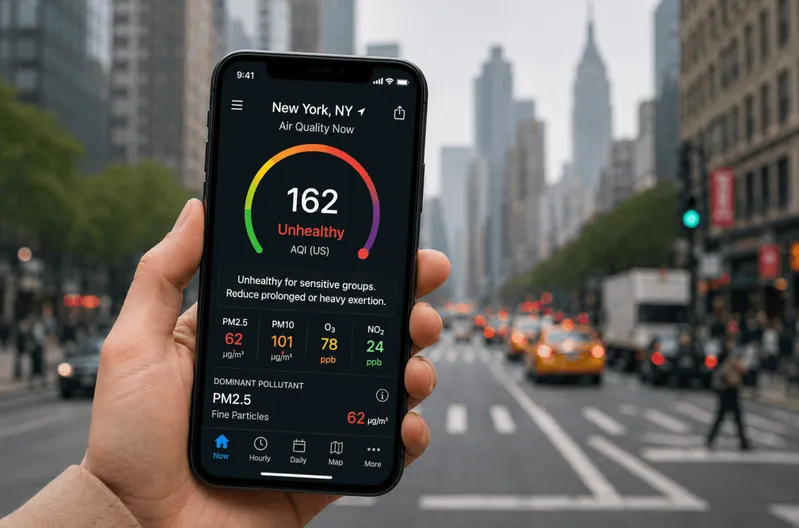
Use a Live AQI Map for Real-Time Data
A live AQI map is the most accurate tool available. It lets you search by city or ZIP code. You can easily compare conditions in your neighborhood with surrounding areas.
Use Filterbuy’s live AQI map to check your area now.
Search “AQI Near Me” or “Air Quality Near Me”
You can type "AQI near me" into any major search engine or weather app. These tools will usually show you a quick number. When you see that number, make sure to check the color category and the main pollutant driving the score.
Check the Air Quality Again if Conditions Are Changing
Air quality can shift from hour to hour. Wildfire smoke can move quickly with the wind. Rush-hour traffic can cause sudden pollution spikes. Heat and visible haze can also change the air quality throughout the afternoon. If the weather changes, check the live AQI map again.
What Does My AQI Number Actually Mean?
The EPA divides the AQI into six simple, color-coded categories. Here is what the numbers mean for your daily routine.
| AQI Range | Air Quality Level | Outdoor Activity Guidance |
|---|---|---|
| 0–50 (Green) | Good | Normal outdoor activity is perfectly fine. |
| 51–100 (Yellow) | Moderate | Most people are okay. Unusually sensitive people may want to reduce long outdoor workouts. |
| 101–150 (Orange) | Unhealthy for Sensitive Groups | Children, older adults, pregnant people, and individuals with asthma or heart disease should reduce outdoor exertion. |
| 151–200 (Red) | Unhealthy | Everyone should consider limiting prolonged outdoor activity. Sensitive groups should stay indoors more. |
| 201–300 (Purple) | Very Unhealthy | Avoid strenuous outdoor activity completely. Focus on keeping your indoor air cleaner. |
| 301+ (Maroon) | Hazardous | Stay indoors as much as possible and follow all local health guidance. |
Why Does the Air Quality Index Change So Fast?
Local air quality changes just like the weather. Sometimes it changes hour by hour. Wind can blow wildfire smoke into your town very quickly. Ground-level ozone often spikes on hot, sunny afternoons.
Traffic and industrial pollution can build up during the morning commute. Temperature inversions can even trap cold, polluted air near the ground. This is why a green AQI in the morning can easily turn red by the afternoon.
Which Specific Air Pollutants Should I Watch Out For?
While the AQI tracks five main pollutants, two of them cause the most problems for homeowners.
What Is PM2.5 Particle Pollution?
PM2.5 refers to tiny, inhalable particles that are 2.5 micrometers in diameter or smaller. These particles come from wildfire smoke, soot, and exhaust fumes. According to the EPA, PM2.5 particles are small enough to get deep into your lungs. Some can even enter your bloodstream.
Why Is Ozone a Problem on Hot, Sunny Days?
Many people assume bad air quality always looks like visible smoke or haze. But ground-level ozone can be very high even when the sky looks clear blue. Ozone forms when heat and sunlight react with vehicle and industrial emissions.
What Should I Do at Home When the AQI Is High?
Knowing your AQI is only the first step. You need to know how to respond to protect your home and your health.
What to Do if the AQI Is 0 to 100
Most people can continue their normal routines. You can leave your windows open and enjoy the breeze. If you are highly sensitive to air pollution, just pay attention to any mild symptoms like a scratchy throat.
What to Do if the AQI Is 101 to 150
Reduce your long outdoor workouts. Close your windows to keep the outdoor air from getting inside. Run your HVAC system fan to keep your home air filter circulating and cleaning the indoor air.
What to Do if the AQI Is 151 or Higher
Move all of your activities indoors. Keep your doors and windows completely closed. Set your HVAC system to recirculate mode if you have that option. This is also the perfect time to check your home air filter and replace it if it looks dirty.
What to Do if Wildfire Smoke Is Causing Bad Air Quality
Wildfire smoke requires extra protection. The EPA recommends upgrading to an HVAC filter rated MERV 13 or higher during smoky periods. A MERV 13 filter captures fine particle pollution from the smoke. Make sure your HVAC system can handle a high-efficiency filter. You will also need to replace dirty filters more often during smoke events.
How Does My Home Air Filter Help When Outdoor AQI Is Bad?
When outdoor air is poor, your filter becomes part of your home’s first line of defense. Outdoor air easily makes its way indoors through open windows, door gaps, roof leaks, and HVAC ventilation.
A properly fitted air filter captures airborne particles as air circulates through your system. Filterbuy offers MERV 8, MERV 11, and MERV 13 air filters to help you manage different levels of pollution. Choose a MERV 8 filter for basic dust control. Choose a MERV 13 filter if you need to block fine smoke particles.
Exact fit matters. If a filter is too small, air will simply bypass the filter media and blow dirt right back into your house. Filterbuy provides standard and custom sizes to guarantee a perfect fit. We recommend replacing most pleated furnace filters every 90 days. You should change them even more frequently during heavy smoke or allergy seasons.
Quick AQI Checklist Before You Go Outside
Use this simple checklist before you head out the door:
Search your ZIP code or city on a live AQI map.
Note the number, the color, and the main pollutant.
Check whether you or someone in your home belongs to a sensitive group.
Adjust your outdoor plans if the AQI is orange, red, purple, or maroon.
Keep windows closed and upgrade your HVAC filtration when outdoor air is poor.
Recheck the map later if smoke, wind, heat, or haze changes.
Check Your Area Now and Protect Your Indoor Air
The fastest way to know what is happening near you is to check the live number. Before you open the windows, go for a run, or send the kids outside, check your local AQI first.
Use Filterbuy’s real-time AQI map to see today’s air quality in your area. Check your AQI, then choose the right steps to protect your home and your air.
Frequently Asked Questions
What AQI is safe to go outside?
An AQI of 100 or below is generally safe for outdoor activities. If the AQI is between 101 and 150, sensitive groups should limit their time outside.
What AQI is bad for asthma?
An AQI over 100 (the Orange category) is unhealthy for sensitive groups, including people with asthma. Asthmatics should move activities indoors and run a high-quality home air filter when the AQI reaches this level.
Should I change my air filter during wildfire smoke?
Yes. Wildfire smoke fills your home air filter with fine PM2.5 particles much faster than regular dust. You should check your filter weekly during smoke events and replace it as soon as it looks dark or clogged.
Can I use a MERV 13 filter for smoke?
Yes. A MERV 13 air filter is highly effective at capturing the fine PM2.5 particles found in wildfire smoke. Always check your HVAC manual first to ensure your system has enough airflow to use a MERV 13 filter safely.