
Air Quality (AQI) Alert: What to Do at Home Right Now
June 2, 2026
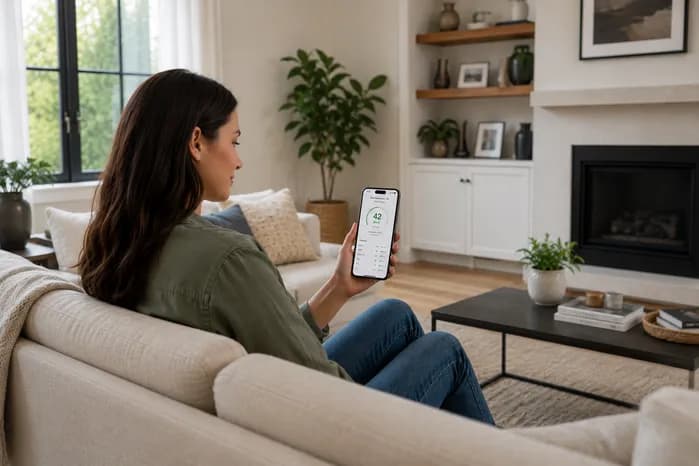
The smoke or smog behind today's alert is made of particles so small you'll never spot them, and right now they're working their way into your house. You have more say over that than almost anyone realizes. At Filterbuy, we've spent years obsessed with this exact problem, turning invisible air into something you can see and act on. This guide walks you through the moves that matter the moment an alert hits, from your thermostat settings to a two-minute filter check, so your family keeps breathing easy while the air outside sorts itself out.
Quick Answers: What to Do First During an Air Quality Alert
When local officials issue an alert, the fastest way to protect your home is to keep the outdoor air out and clean the air you already have inside. Close up the house, switch your system to recirculate, run a portable cleaner in one room, and make sure a clean, well-rated filter is doing its job. Start with these:
Close all windows and exterior doors.
Set your central system to recirculate, then run the fan so it keeps filtering.
Make sure a clean, higher-rated filter is installed correctly.
Run a portable air cleaner in the room where your family spends the most time.
Skip anything that adds particles indoors, like frying, vacuuming, or burning candles.
Top Takeaways
An air quality alert is your cue to act indoors, not a reason to panic.
Your AQI alert checklist stays simple. Seal the house, recirculate, run a good filter, and limit indoor particles.
Your central-system filter and a portable air cleaner are your two strongest tools on alert days.
Sensitive family members, including kids, older adults, and anyone with heart or lung conditions, need extra attention.
When the readings improve, open up and air out the house.
Your Alert-Day Action Steps
Acting fast makes a real difference, and you don't need special gear to start. Those alerts come from the Air Quality Index, a scale that turns pollution levels into a color and number you can read at a glance. Once you know where the air stands, work through these steps the moment an alert reaches you.
Check the current reading and the forecast, so you know how bad the air is and how long it'll last.
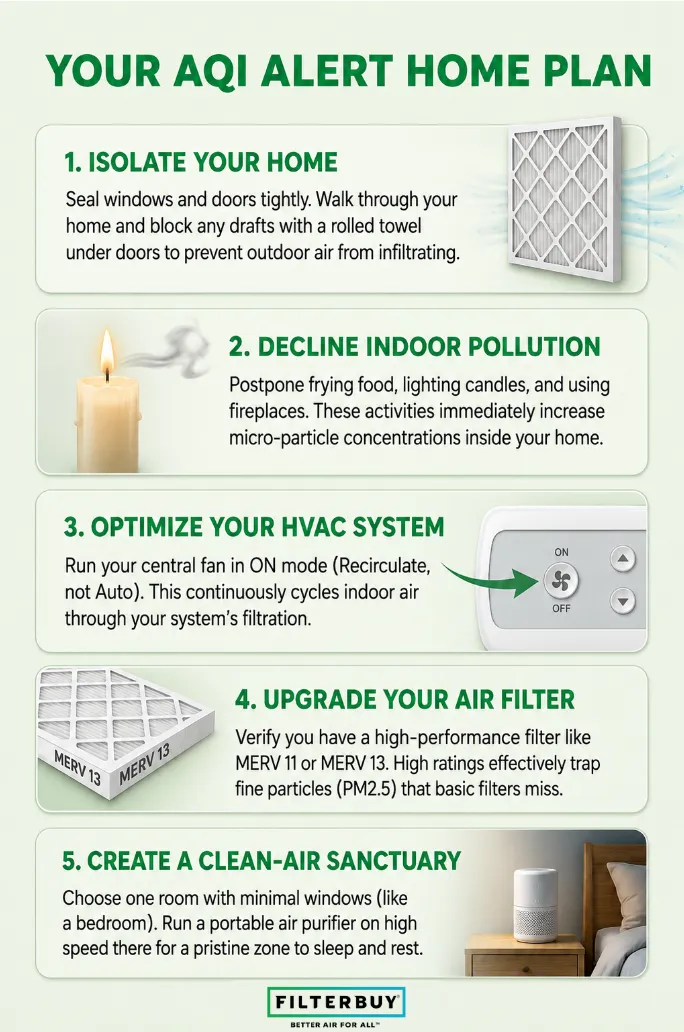
Close every window and exterior door, and seal the obvious gaps where outdoor air sneaks in.
Switch your central heating and cooling system to recirculate, then run the fan so it keeps pulling your indoor air through the filter.
Make sure a clean, correctly seated filter with a strong rating is already in place.
Pick one room as your cleaner-air space and run a portable air cleaner sized for it.
Hold off on anything that adds particles inside, including frying, vacuuming, candles, and anything that burns.
Keep an eye on sensitive family members, and follow the guidance from your local health officials.
HVAC Settings During an Alert
Your central system can pull outdoor air in or recirculate the air you already have. During an alert, you want it on recirculate, so it isn't inviting polluted air through a fresh-air intake. Run the fan continuously instead of only when heating or cooling kicks on, and the filter gets far more chances to catch fine particles. Filter quality matters here, too. A higher-rated filter traps more of the tiny stuff that slips past basic filters, which is exactly what you want when smoke or smog is in the air. If the numbers still feel confusing, you can understand what the Air Quality Index measures on our resource hub before you decide anything.
Sealing the Home
Most homes leak air around windows, doors, and a few usual suspects like worn weatherstripping or the gap under an exterior door. On an alert day, walk through and close everything, then tuck a rolled towel or some temporary weatherstripping wherever you feel a draft. You don't need a perfect seal. Even small fixes cut how much outdoor pollution drifts in, and they let your filter and air cleaner keep up.

Choosing a Cleaner-Air Room
Pick a room your family actually likes being in, ideally one with few windows and no fireplace. Set up a portable air cleaner rated for that room's size and let it run on a higher setting. In a well-sealed home, a good filter in your central system cleans the air everywhere, while the portable unit keeps that one room extra clean for sleeping or resting.
When the Air Clears
Once the alert lifts and the readings drop back to a healthy range, open the windows and let some fresh air through. Switch your system back to its normal settings, and check your filter. Heavy smoke or dust can load a filter fast, so a quick look tells you whether it's time for a fresh one.
“After manufacturing filters for over a decade and serving more than two million households, we've seen how much calmer alert days feel when a family already has a plan. Clean indoor air is one of the most direct ways you protect the people under your roof, and a good filter quietly doing its job in the background is its own kind of peace of mind.”
— Filterbuy Team
7 Resources We Recommend For Taking Charge On Air Quality Alert Days
At Filterbuy, we're obsessed with the air inside your home, and we want you to feel like the hero of your household the second an alert lands. You can't always see what's floating around you, but you can absolutely do something about it. These are the seven sources we lean on, each one a clear next step toward protecting the people you love.
1. See What You're Breathing In Real Time
We always start here, because you can't protect your family from what you can't see. AirNow, run by the EPA, makes the invisible visible with your local, real-time Air Quality Index and forecast, so you know how serious the air is and how hard to work at home.
Source: Real-Time Air Quality Index (EPA AirNow)
2. Turn A Confusing Alert Into A Clear Game Plan
Those color codes and numbers can feel like a foreign language, and we get it. The American Lung Association lays out what each AQI level means and the steps to take, so you go from worried to confident in a couple of minutes.
Source: Air Quality Index Guide (American Lung Association)
3. Build One Clean-Air Haven For Your Family
When the air outside turns unhealthy, you don't have to clean the whole house at once. This EPA guide shows you how to set up a single sealed room with the right settings and a portable cleaner, giving your family one comfortable spot to ride out the alert.
Source: Create a Cleaner-Air Room (EPA)
4. Choose An Air Cleaner That Actually Fits Your Room
We think about filtration more than anyone probably should, and we know size and fit make all the difference. ENERGY STAR walks you through matching a portable air cleaner to your room with its Clean Air Delivery Rate, so you get real protection without paying for power you won't use.
Source: How to Choose a Room Air Cleaner (ENERGY STAR)
5. Protect The People Who Feel It First
Some of the people you love feel bad air before anyone else does. The CDC explains the warning signs, who's most at risk, and how to keep everyone safe indoors during smoke, so you can step in early instead of guessing.
Source: Stay Safe During Wildfire Smoke (CDC)
6. Stay Ahead Of Asthma And Allergy Flare-Ups
If someone in your home lives with asthma or allergies, alert days call for extra care. The Asthma and Allergy Foundation of America has guidance built for exactly these moments, helping you head off symptoms before they take hold.
Source: Air Pollution and Asthma (Asthma and Allergy Foundation of America)
7. Have A Plan For When An Alert Becomes A Wildfire
Sometimes an air quality alert is the first sign of something bigger. Ready.gov helps you prepare ahead and evacuate safely if a wildfire threatens your area, so your family already knows the plan before you ever need it.
Source: Wildfire Preparedness and Evacuation (Ready.gov)
Bookmark the ones that fit your home, and the next alert won't catch you flat-footed. That's what taking charge of your air looks like, and we're right here to help you do it.
Supporting Statistics
We read the research closely. Here's what the data says, and what years of working with indoor air have taught us.
1. Fine Particles Take A Bigger Toll Than Most Families Realize
The stat: Researchers have linked human-caused PM2.5 pollution to about 107,000 premature deaths in the US in 2011.
Why it matters: These particles are invisible, so they're easy to ignore.
Our take: In our experience, a number that big is why we treat every alert day as worth acting on.
Source: Fine Particle Pollution Mortality Study (National Library of Medicine, NIH)
2. This Is One Of The Few Heart Risks You Can Control
The stat: The American Heart Association reports that PM2.5 causes cardiovascular disease and death and calls it a modifiable risk factor.
What that means: You can lower your exposure indoors today.
Our take: From what we've seen, families who manage their indoor air feel calmer, especially when someone has a heart or lung condition.
Source: Air Pollution and Cardiovascular Disease Fact Sheet (American Heart Association)
3. The Smallest Particles Worry Experts Most
The stat: The California Air Resources Board links PM2.5 to the greatest share of pollution-related health effects.
Why it matters: These particles lodge deep in the lungs and reach the bloodstream.
Our take: The tiniest particles are the hardest to catch, which is why sealing your home and running a strong filter pays off.
Source: Inhalable Particulate Matter and Health (California Air Resources Board)
Final Thoughts and Opinion
After years of obsessing over indoor air, we've noticed a pattern. The families who handle alert days well usually aren't the ones with the fanciest equipment. They're the ones who had a simple plan ready and a clean filter already in place. You don't have to memorize every number on the index to keep your home safe. You need a short routine you trust and the right filter already doing its quiet work. Treat clean air as part of everyday home care instead of an emergency scramble, and the next alert will feel a lot smaller for everyone you're looking out for.
Next Steps
Here's your plan, today and beyond.
Take Action Today
Check your local AQI. Know your level and how long it'll last.
Seal the house. Close up, set the system to recirculate, and run the fan.
Check your filter now. Make sure it's clean, correctly sized, and well-rated.
Make a cleaner-air room. Run a portable cleaner in a one low-window room.
Cut indoor pollution. No frying, vacuuming, candles, or burning until it clears.
Get Ready For The Next Alert
Sign up for air quality alerts. Get the heads-up on your phone.
Stock a spare filter. Keep a well-rated one ready to swap.
Plan for a sensitive family. Know who watches symptoms and when to call a doctor.
Build the habit. Treat it like checking your smoke detectors.
Do these, and the next alert is just another day you've already handled.
Frequently Asked Questions
Q: What Should I Do at Home During an Air Quality Alert?
Keep the outdoor air out and clean the air inside. Close your windows and doors, set your system to recirculate with the fan running, make sure a clean filter is in place, and run a portable air cleaner in one room. Then ease off any indoor activities that create particles until the alert lifts.
Q: How Do I React to an Air Quality Alert Fast?
Run a short checklist the second you see it. Seal the house, switch to recirculate, check your filter, and start a portable cleaner. Those four moves take a few minutes and make a real difference in how clean your indoor air stays.
Q: Should I Close My Windows During an Air Quality Advisory at Home?
Yes. During an air quality advisory at home, closing your windows and exterior doors is one of the simplest, most effective things you can do. It keeps a big share of outdoor pollution from drifting in, which leaves your filter and air cleaner far less to handle.
Q: What HVAC Settings Help on an AQI Alert Day?
Set your central system to recirculate so it isn't pulling in outdoor air, and run the fan continuously so the filter keeps cleaning. Pair that with a higher-rated filter to catch more of the fine particles in smoke and smog. Turn off any fresh-air intake or economizer mode until the air clears.
Q: Does My Filter Rating Matter During an Alert?
It matters a lot. Higher-rated filters catch more of the tiny particles that basic filters let slip through, which is exactly what you want during a smoke or smog event. Just make sure the filter is the right size, seated correctly, and clean enough to let air flow freely.
Q: Who Is Most at Risk When There Is an Air Quality Warning?
Kids, older adults, pregnant individuals, and anyone with asthma, COPD, heart disease, or another chronic condition face a higher risk during an air quality warning. Watch them closely for coughing, shortness of breath, or other symptoms, and follow your local health guidance. If symptoms get serious, call a medical professional.
Better Air, Every Day
Clean indoor air shouldn't be something you only think about on alert days. With the right filter in place, you're protecting your family every day of the year. That steady, everyday protection is the confidence we love helping households build.