July 16, 2026
Author: Michelle Wan | Reviewed by: David Clark, Licensed HVAC Technician | Published July 16, 2026 // Updated July 16, 2026
Change your HVAC filter to a MERV 13 right away, then physically clean every surface you can reach, because filtration and cleaning solve two different problems. Filtration clears airborne smoke particles in hours to a few days. Surface cleaning removes the residue that lingers on walls, floors, and fabrics for days, weeks, or months. Answer a few quick questions below and we will match you to the right filter for the job.
Answer 3 quick questions and we will match you to your perfect filter.
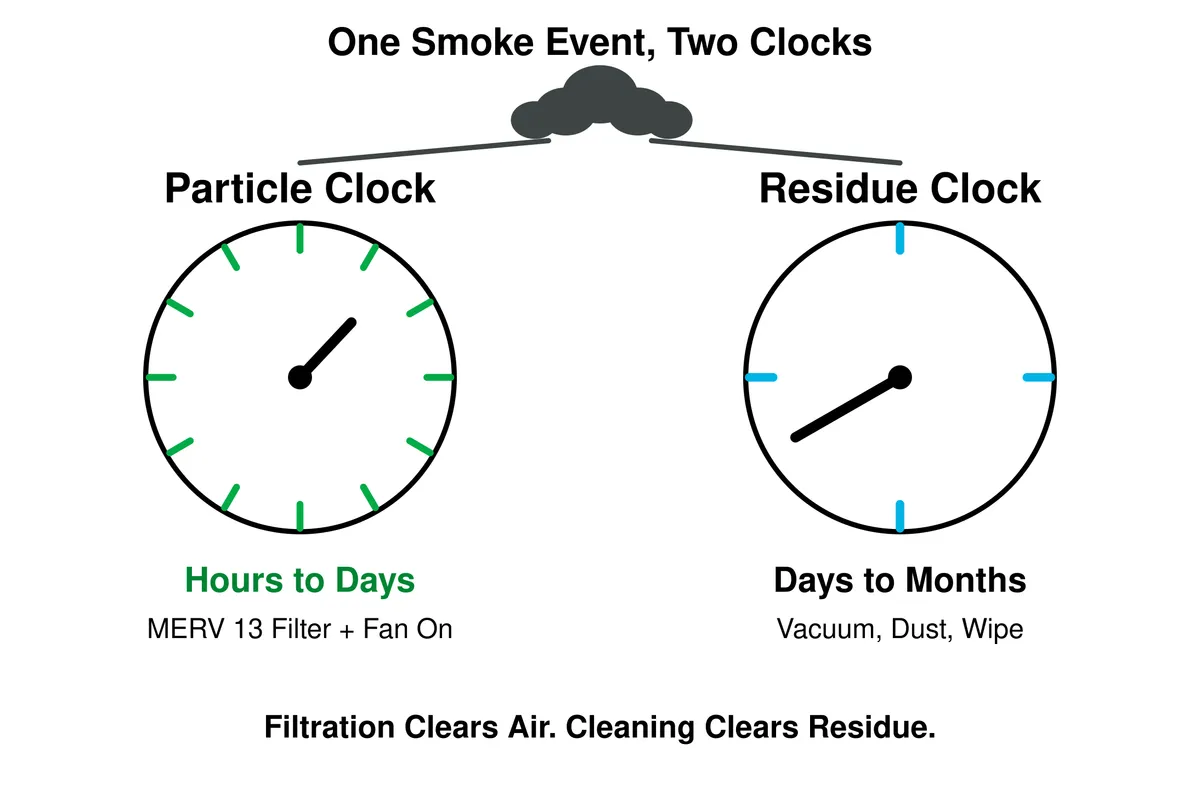
Recovering from wildfire smoke exposure means clearing two different things on two different timelines: airborne particles, which filtration removes in hours to days, and settled residue, which only physical cleaning removes over days to weeks. Change your HVAC filter, run the fan continuously, then vacuum, dust, and damp-wipe every surface you can reach, because research shows surface cleaning cuts lingering smoke gases better than an air purifier does. If ash is visible inside, soot is greasy, or the smell will not quit after a thorough cleaning, stop and call a professional.
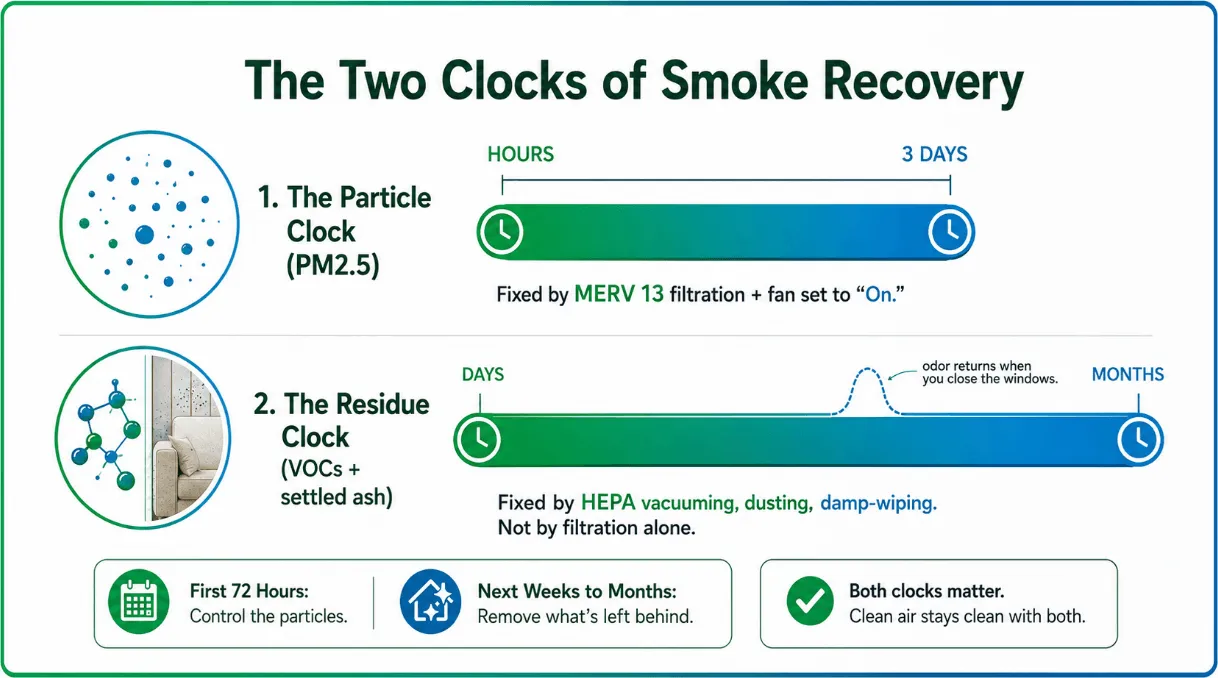
Wildfire smoke leaves two problems behind, not one. Fine particles (PM2.5) clear quickly with good filtration. Smoke gases (VOCs) soak into walls, floors, and fabrics and re-release for days to months.
Surface cleaning beats air cleaning for the smell. In a controlled test-house study published in Science Advances, vacuuming, mopping, and dusting reduced indoor smoke VOC levels more effectively than portable air cleaners and more durably than opening the windows.
Airing out the house is temporary relief, not a fix. In that same study, several hours of full ventilation dropped airborne smoke gases by about 82%, but stripped only 3.4% of the residue stored on surfaces, which is why the odor returns once you close up.
A MERV 13 filter is the EPA’s recommendation for smoke, or the highest rating your system is rated to handle. During and after a smoke event, expect to replace it in weeks or even days, not months.
Ash inside the house is a signal to slow down. After Colorado’s Marshall Fire, residents who found ash indoors were three times as likely to report headaches at the six-month mark than those who did not.
Skip the ozone generator. Public health agencies advise against ozone generators, ionizers, and plug-in fragrances after a fire. They mask or chemically alter odor rather than remove the residue causing it.
Here is the direct answer. Wildfire smoke recovery runs on two clocks, a framework Filterbuy calls the two-clock model. The particle clock is short: fine particulate matter stays airborne for hours to a few days, and a clean MERV 13 filter with the fan running knocks it down fast. The residue clock is long: smoke gases and ash settle onto drywall, flooring, upholstery, and inside your ductwork, then slowly release back into your air for days, weeks, or months. Filters do not touch the second clock. Cleaning does.
That single distinction explains the complaint that reaches us most after a smoke event: I changed the filter, I ran a purifier for a week, and my house still smells like a campfire. Nothing failed. You solved the fast problem and left the slow one sitting on your walls.
We have a particular view on this, and it is worth stating before you spend a week acting on it. Filterbuy has manufactured air filters in the United States for over a decade and shipped them into more than two million households. That vantage point is narrow, but it is specific: we see what filters catch, and we see what they miss. This page is mostly about what they miss.
The checklist below is sequenced by those two clocks: first 24 hours, days 2 through 7, then weeks 2 through 6. Work it in order. Skipping to the end is how homes end up smelling smoky in October.
Your goal in the first day is to stop new smoke from coming in and get the airborne particle load down. Do not start deep cleaning yet. Confirm it is safe to be there, check the outdoor air, close the house up, put a clean high-efficiency filter in, and run the system fan continuously. Cleaning too early just stirs settled ash back into air you cannot yet ventilate.
Confirm the house is safe to occupy. If you evacuated, do not go back until officials clear your area. The CDC’s post-wildfire safety guidance is unambiguous on this. Structural, electrical, and ember hazards outlast the flames.
Check your actual air quality before you plan anything. Pull up the AQI for your address on the Filterbuy live air quality and wildfire smoke map or the AirNow Fire and Smoke Map, and see how to read a wildfire smoke map if the colors are new to you. Smoke can linger in the air for days after a fire is contained, and it travels hundreds of miles. The smoke affecting you may be from a fire you cannot see.
Keep the house closed while the AQI is still elevated. Windows and doors shut. If your HVAC has a fresh-air intake, close the damper or set the system to recirculate. Per the California Air Resources Board, do not run swamp coolers or whole-house fans during smoke conditions. Both pull unfiltered outdoor air straight through your living space.
Change the HVAC filter. Today. A filter that ran through a smoke event is loaded, and a loaded filter is a poor filter. The EPA recommends MERV 13, or as high a rating as your system fan and filter slot can accommodate. If you have never run above MERV 8, see how MERV 8, 11, and 13 compare, then check your equipment documentation or ask an HVAC tech before jumping. Filterbuy MERV 13 filters come in 600+ sizes, plus custom sizes if yours is odd. Some older residential systems are not rated for the pressure drop.
Set the fan to "On," not "Auto." This is the step almost everyone misses. On "Auto," the fan only moves air when the system is actively heating or cooling, so your filter sits idle most of the hour. CARB and EPA both recommend running the fan continuously during and after smoke events so air keeps cycling through the filter.
Add a portable air cleaner in the room you sleep in. Size it to the room, run it on high, and choose a model that does not produce ozone. The California Air Resources Board maintains a list of air cleaners certified not to emit meaningful ozone, a useful screen no matter where you live. Our guide to running an air purifier during wildfire season covers placement and sizing.
Do not add to the problem. No candles, no gas or wood fireplaces, no aerosol sprays, no frying or broiling, and for now, no vacuuming. EPA lists vacuuming among the activities to avoid while smoke levels are still high unless you use a vacuum with a HEPA filter, because an ordinary vacuum re-suspends settled particles into air you cannot currently ventilate. Vacuuming becomes your best tool in about 48 hours. Just not yet.
Once outdoor air quality has recovered, the job changes completely. Now you physically remove what smoke left behind, because that residue is now the source. Ventilate on a good-air day, then HEPA vacuum, dust, and damp-wipe every surface you can reach, including the ones you would normally skip. This phase does more for lingering smoke odor than any filter or purifier will.
This is the part that runs against common advice, and it is a strange thing for a filter manufacturer to tell you. Filterbuy is telling you anyway, because it is what the evidence says.
Researchers led by Colorado State University’s Delphine Farmer piped wood smoke into an instrumented test house and tracked what happened next, publishing the results in Science Advances in 2023 (Li et al., The persistence of smoke VOCs indoors, free to read via NIST). Smoke particles settled out quickly. The gases did not behave nearly as well: they adsorbed onto walls, floors, and furnishings, then desorbed back into the air for days afterward. The team then tested the fixes head to head.
Source: Li et al., Science Advances 9, eadh8263 (2023). Table compiled by Filterbuy.
The field data agrees. After the Marshall Fire tore through Boulder County in December 2021, a CU Boulder team measured 50 gases inside a surviving home for five weeks and found aromatic VOCs (benzene, toluene, naphthalene) at levels comparable to 1990s Los Angeles smog, declining more slowly than anyone expected (Dresser et al., ACS ES&T Air, 2024). Box-fan filter rigs pulled the numbers down. The numbers went back up when the rigs were turned off.
The takeaway is not that filters do not work. Filters work extremely well on the particle clock. That is exactly what they are built for, and it is why we tell you to run MERV 13. The takeaway is that nothing removes residue except removing it.
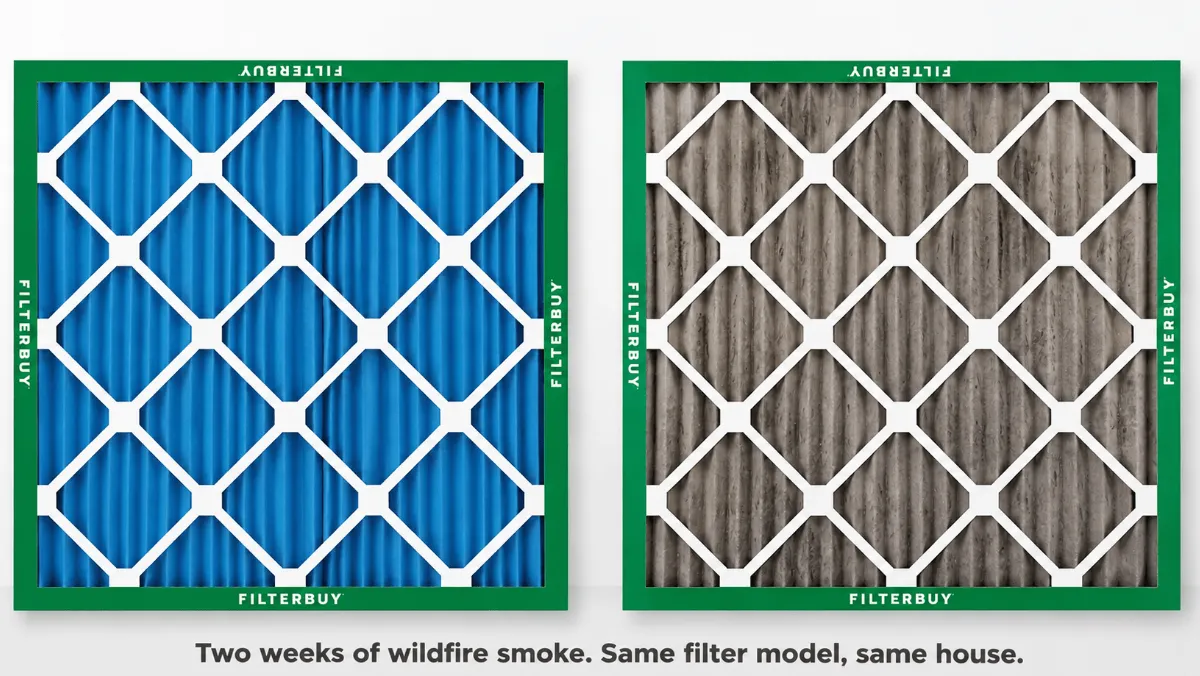
“Every smoke season the filters come back to us visibly darker and heavier than the ones from clean-air months. That gray is the part we can catch, and we are good at catching it. What this study measures is the part we cannot: the gases that soaked into the drywall while the filter was busy doing its job. No filter reaches those. A vacuum does.” — Filterbuy Team
Air out the house on the first genuinely clear day. EPA advises opening up when smoke clears, even temporarily. It will not fix the residue, but it flushes the gas phase and buys you cleaner air to work in. Check the AQI first. You do not want to trade indoor residue for a fresh delivery of outdoor smoke.
Gear up before you touch anything. Ash from a wildland-urban fire is not campfire ash. Because vehicles, electronics, paint, and building materials burned, LA County Public Health notes ash may contain asbestos, arsenic, lead, and other heavy metals. Wear gloves, long sleeves, long pants, closed shoes and socks, safety goggles rather than glasses, and a NIOSH-approved N95 fitted with a seal check. An N95 with gaps around the edges is the same as no mask at all, and it will not protect you from gases. Children, older adults, and people with heart or lung conditions should not do cleanup work at all. That is EPA guidance, not caution for caution’s sake.
Vacuum with a HEPA-filter vacuum. Not a broom, and not your regular vacuum. LA County is blunt about this: shop vacuums and ordinary household vacuums are not recommended for ash, because they do not filter small particles and blow them back into the air where you breathe them. HEPA-filter vacuums can. Cover floors, rugs, upholstery, curtains, and the tops of things nobody looks at: door frames, blinds, baseboards, ceiling fan blades.
Then go wet. Wipe surfaces indoors and out with damp cloths, and gently hose down outdoor furniture, walkways, windowsills, and doorsills. Both EPA and LA County warn against dry sweeping, which relaunches the particles you are trying to capture. If you must sweep a hard surface, mist it lightly with water first and follow with wet mopping, using as little water as you can. Never use a leaf blower on ash. The CASA researchers used a commercial non-bleach solution to lift residue. LA County mentions bleach only for disinfecting, which is a different job from removing smoke residue.
Launder or professionally clean the soft stuff. Curtains, bedding, throw pillows, slipcovers, and anything upholstered are VOC sponges. This is where the smell hides.
Bag the ash properly. Collect it in sealed plastic bags and put them in covered trash bins so it cannot blow away when the can is emptied. Keep kids and pets away from ash entirely, and shampoo pets who have been in it. Shower regularly through a cleanup day.
Change the filter again. Yes, again. During and after a smoke event, EPA notes filters may need changing every few weeks, or every few days. Change it when it looks dirty or when it starts smelling like smoke, which is your filter telling you it is saturated and has become an odor source of its own.
EPA’s exclusion is not a footnote: children, older adults, and people with heart or lung disease should not do post-fire cleanup work. That is the same list of people the residue harms most. So the checklist above has a gap for exactly the households that need it. Here is how to close it.
Someone else does the work. A household member, a friend, or a hired cleaner. This is vacuuming, dusting, and damp-wiping, not remediation, so an ordinary cleaning service can do it at a fraction of a restoration contractor’s price. For light to moderate exposure it is the same physical task.
Leave while it happens. This is the part almost nobody says out loud. Cleaning temporarily makes the air worse. Vacuuming and dusting lift settled particles back into the air on purpose. That is the whole reason EPA tells you not to vacuum while smoke is still heavy. If you are in the sensitive group, be somewhere else during the cleaning and for a few hours after, with the fan running and a clean filter catching what got kicked up.
Come back to a finished room, not a work in progress. Let the air settle before you return. The filter needs time to clear what the vacuum raised.
If nobody can do it, triage to the bedroom. You spend roughly a third of your life in there, stationary, breathing the same air for eight hours at a stretch. One properly cleaned bedroom beats a half-cleaned house.
By now the house should smell like a house. If it does, your job is maintenance: keep changing filters on a shortened schedule until the smell stays gone, and re-clean anything you skipped. If it does not, you have a reservoir you have not reached.
Keep the filter cadence short. Do not slide back to a 90-day habit yet. Inspect monthly at minimum until the odor is fully gone and stays gone. Auto-delivery is the low-effort way to not think about this during fire season.
Look at your vents and registers. Visible soot or dust at the supply registers, or particles actually blowing out when the system kicks on, is a real signal.
Be skeptical about duct cleaning, and know the number first. EPA recommends cleaning air ducts only as needed: when they are clogged with excessive dust and debris, or when particles are visibly releasing from the registers. Post-fire genuinely can meet that bar. It is also a situation where it gets sold to people whose bar is not met. EPA puts typical duct cleaning at $450 to $1,000 per system. Know that figure before someone quotes you at your kitchen table with ash still on the windowsill.
Re-clean what you could not reach. Ceilings, the tops of cabinets, inside closets, the garage. The CASA researchers were candid that surface cleaning improved but did not eliminate house-wide VOC levels, for the simple reason that you cannot vacuum a ceiling. Reach further on round two.
Track your own symptoms. Six months after the Marshall Fire, 55% of surveyed residents of surviving homes still reported at least one symptom they attributed to the fire. Most commonly itchy or watery eyes (33%), headaches (30%), dry cough (27%), sneezing (26%), and sore throat (23%). Those symptoms tracked closely with whether the home smelled different when they returned. Your nose is a legitimate data point.
DIY handles light to moderate smoke exposure. It does not handle a home that took heavy soot, wet ash, or structural-fire residue. Use the wipe test to decide honestly.
The wipe test. Run a clean white cloth along a wall, a windowsill, and a horizontal surface in a room you did not clean. LA County’s framing is useful: if there is no visible soot or ash, no suspended particles, and no smoke odor, no specific remediation is needed.
Photograph everything before you clean. Your insurance claim depends on it.
Washington State’s Department of Health puts it plainly: if smoke or indoor air quality does not improve, bring in a professional smoke remediation contractor. LA County recommends asking any contractor for certifications from the IICRC or the Restoration Industry Association, confirming state or county licensing and insurance, and getting a detailed written estimate before any work starts. It also makes an honest point worth repeating: no laboratory test can declare your property safe, so treat anyone selling you that certainty with caution. FEMA’s Homeowner’s Guide to Risk Reduction and Remediation of Residential Smoke Damage, developed after the Marshall Fire, covers DIY limits and how to select and monitor a contractor. Photograph everything before you clean. Your insurance claim depends on it.
The residue clock does not care about your lease, but the work splits. Roughly:
Yours: the surface cleaning. Vacuuming, wiping, laundering. Nobody else is coming to do it, and it is the part that decides whether your home smells like a home.
Usually your landlord’s: the HVAC filter, the ductwork, and any remediation. In most states, significant soot or a persistent smoke odor can fall under the implied warranty of habitability, which obliges a landlord to restore a unit to livable condition.
Put it in writing. Photograph everything before you clean, request repairs in writing, and keep the thread. A verbal request is not a record.
We are a filter company, not a law firm, and we are not going to pretend otherwise. Habitability rules vary a great deal by state and city. For what yours actually requires, contact your local housing authority or a tenant rights organization in your area.
These are the moves that feel productive and set your recovery back. Each one is specifically advised against by a public health authority.
Do not run an ozone generator or an ionizer. Washington DOH advises against ozone generators, ionizers, air fresheners, plug-ins, and fragranced products after a fire. Ozone is a lung irritant, and it reacts with what is already on your surfaces to make new compounds. It does not remove residue. It changes the smell of it.
Do not dry sweep ash, and never use a leaf blower. Both take a settled hazard and hand it back to your lungs. LA County names both explicitly. Wet methods outdoors, HEPA vacuum indoors.
Do not mask the odor. If you can smell smoke, residue is still there. Fragrance is a report you are choosing not to read.
Do not run whole-house fans or swamp coolers while the AQI is elevated. CARB is explicit. You are bulk-importing the thing you are trying to remove.
Do not leave the fan on "Auto" and assume the filter is working. A filter only filters air that moves through it.
Most healthy adults recover from short-term smoke exposure once the exposure stops. Give it time, rest, and fluids, and keep your indoor air clean while your airways settle. Some people should not simply wait it out: the CDC flags children, older adults, and people with asthma, COPD, heart disease, diabetes, chronic kidney disease, or who are pregnant as needing to be especially careful about breathing wildfire smoke.
Get medical care promptly for trouble breathing, chest tightness or pain, dizziness or confusion, a cough that is getting worse rather than better, or any significant flare of an existing heart or lung condition. If you have asthma or another chronic respiratory condition, talk to your provider about a smoke plan before the next event rather than during it.
Filterbuy makes air filters. We are not your doctor, and this page is not medical advice. For anything beyond mild, improving irritation, call one.
Seven sources cover the whole recovery, and every one is a government agency or public health authority. No product pitches, no contractor lead-gen. Filterbuy keeps these open during smoke season, and they are ordered the way you will actually need them.
The AirNow Fire and Smoke Map, run jointly by the EPA and the U.S. Forest Service, shows live PM2.5 readings, active fire locations, and smoke plumes across North America. This is the gate on Phase 2: do not open the windows or start cleaning until this map says the outdoor air has genuinely recovered.
Source: AirNow (EPA and U.S. Forest Service), Fire and Smoke Map
The CDC spells out what has to be true before you re-enter a home after a fire, and which protective gear to wear once you do. It also names who should stay out of the cleanup entirely: children, older adults, and anyone with heart or lung disease.
Source: CDC, Safety Guidelines: After a Wildfire
This is the EPA page behind the MERV 13 recommendation, the fan-on-not-auto rule, and the guidance to change filters in weeks rather than months during a smoke event. If you read only one government page on filtration, read this one.
Source: U.S. EPA, Wildfires and Indoor Air Quality
Los Angeles County Public Health explains why ash from a fire that burned houses is not the same as campfire ash, naming asbestos, arsenic, and lead among what it can carry. It is also the source of the wipe test, the simplest honest way to tell whether you have a problem at all.
Source: Los Angeles County, Returning After a Fire
Washington State’s Department of Health has the most complete post-fire cleanup protocol published by any state agency, down to bagging ash and shampooing pets. It is also the page that tells you plainly not to reach for an ozone generator, an ionizer, or a plug-in air freshener.
Source: Washington State Department of Health, Post-Fire Cleanup Guidance
The EPA states that duct cleaning is warranted only as needed, and it publishes the typical range: $450 to $1,000 per system. Read it before a contractor is standing in your kitchen with ash still on the windowsill.
Source: U.S. EPA, Should You Have the Air Ducts in Your Home Cleaned?
FEMA built this guide after the Marshall Fire specifically for homeowners with light to moderate smoke damage. It covers what you can remediate yourself, when you cannot, and how to select and monitor a professional cleaning contractor.
Source: FEMA, Homeowner’s Guide to Risk Reduction and Remediation of Residential Smoke Damage (PDF)
Three numbers make the case.
Up to 10x more harmful than the same dose of ordinary PM2.5.
1.3–10%: hospitalization rise per 10 µg/m³ of wildfire PM2.5.
0.67–1.3%: the same rise from non-wildfire PM2.5.
14 years of hospital data. Scripps, UC San Diego.
Why it matters: "The AQI dropped, so we are fine" is the wrong read.
Source: Aguilera et al., Nature Communications (2021)
90% of your time is spent indoors.
2–5x higher indoors: concentrations of some pollutants.
Most at risk, most exposed. Kids, older adults, and heart and lung patients stay in longest.
Why it matters: A green map stops new smoke. Not your exposure.
Source: U.S. EPA, Report on the Environment
61.5 million live in counties graded "F" for particle spikes.
2022–2024 EPA-verified data behind the grade.
Wildfire smoke is named as a driver.
Why it matters: A smoke event is a spike. Recovery is a seasonal skill.
Source: American Lung Association, "State of the Air" 2026
Do the work. Smoke earns a real week.
Do it indoors. That is where exposure happens.
Do it again next season. Stock filters early.
“The number everyone watches is the one outside. The number that decides how your family actually feels is the dust still sitting on your baseboards three weeks later. I see the same split every smoke season: the households that clean move on, and the ones that only wait are still smelling it in October.”
Michelle Wan, Brand Manager and Air Quality Writer, Filterbuy
Airborne particles clear within hours to a few days once outdoor air improves and you are filtering. Smoke residue on surfaces is the long pole: research after the Marshall Fire found harmful gases still elevated indoors five weeks on, and lingering odor is common for weeks to months in heavily exposed homes. Thorough surface cleaning is what shortens that second timeline.
Until you physically remove the residue producing it. Smoke VOCs bind to walls, floors, and fabrics and re-release over days to months, especially in warm conditions. If the smell keeps returning after you close the windows, the reservoir is still there. Vacuum, dust, and damp-wipe rather than air out again.
Yes, immediately, and then more often than usual. EPA notes that during smoke events filters may need replacing every few weeks or even days. Change it when it looks dirty or when it starts releasing a smoke smell.
EPA recommends MERV 13, or the highest rating your system fan and filter slot are rated to handle. MERV 13 is the residential standard for capturing PM2.5, the fine particulate that makes up the biggest health threat in smoke. Check your equipment specs, or ask an HVAC tech, before going higher.
Only while they are running, and only partially. Portable air cleaners are effective against particles. Against smoke gases they underperform surface cleaning, and levels rebound once the unit is off. Use one and clean your surfaces.
Once your local AQI has recovered, yes. EPA advises airing out the home when smoke clears, even temporarily. Check the AQI first. Understand that ventilation is temporary relief: it flushes airborne gases but strips only a few percent of what is stored on your surfaces.
Only if they need it. EPA recommends duct cleaning as needed, when ducts are clogged with excessive dust and debris, or particles are visibly releasing from the supply registers. A post-fire home can genuinely meet that bar. Inspect before you buy.
Ash from burned vegetation is mostly an irritant to eyes, skin, nose, and throat, and it can trigger asthma. Ash from burned structures is a different matter. LA County notes it can contain asbestos, arsenic, lead, and other heavy metals. Treat any indoor ash with gloves, an N95, and wet or HEPA methods, and keep children and pets away from it.
AQI (Air Quality Index): The U.S. EPA’s 0 to 500 scale for reporting outdoor air quality, color-coded from green (good) to maroon (hazardous). During smoke events it is driven primarily by PM2.5.
PM2.5 (fine particulate matter): Airborne particles 2.5 micrometers in diameter or smaller. PM2.5 is the pollutant of greatest concern in wildfire smoke for short-term exposure. The particles reach deep into the lungs and the smallest can cross into the bloodstream.
VOCs (volatile organic compounds): Carbon-based gases that evaporate at room temperature. Wildfire smoke VOCs include benzene, toluene, formaldehyde, and naphthalene. Several are toxic, and benzene is a known carcinogen. VOCs adsorb onto indoor surfaces and re-release over time.
PAHs (polycyclic aromatic hydrocarbons): A class of compounds formed by incomplete combustion, found at elevated levels in wildfire ash. Some are toxic to humans.
MERV (Minimum Efficiency Reporting Value): The 1 to 16 industry scale rating how effectively an HVAC air filter captures particles. Higher captures more. MERV 13 is the EPA’s recommended rating for wildfire smoke in homes.
HEPA (High-Efficiency Particulate Air) filter: A filter certified to capture at least 99.97% of 0.3-micron particles. Common in portable air cleaners and vacuums. Most residential HVAC systems are not built to accommodate true HEPA media.
Adsorption / desorption (partitioning): The process by which airborne gas molecules attach to indoor surfaces with weak chemical bonds, then release back into the air as air concentrations fall. This is the mechanism behind the residue clock.
Surface reservoir: The mass of smoke residue stored on and in a home’s walls, floors, fabrics, and furnishings, which acts as an ongoing emission source into indoor air after the smoke outside is gone.
WUI (wildland-urban interface) fire: A fire burning where development meets vegetation. WUI fires consume vehicles, electronics, plastics, and building materials as well as plants, producing a chemically different, and generally more hazardous, smoke and ash than a purely vegetative fire.
Remediation: Professional removal of smoke, soot, and combustion residue from a structure, its contents, and its mechanical systems, as distinct from deodorizing.
Recirculate mode: An HVAC setting that closes the fresh-air intake and recirculates indoor air through the filter instead of drawing in outdoor air.
Fan "On" vs. "Auto": On "Auto," the blower runs only during active heating or cooling. On "On," it runs continuously, so air passes through the filter regardless of whether the system is conditioning.
U.S. EPA: Wildfires and Indoor Air Quality (IAQ)
U.S. EPA: Strategies to Reduce Exposure Indoors
California Air Resources Board: List of CARB-Certified Air Cleaning Devices
California Air Resources Board: Smoke Ready California
Li, J., Link, M.F., Farmer, D.K., et al. (NIST / CSU): The persistence of smoke VOCs indoors, Science Advances 9, eadh8263 (2023) - free full text via NIST
Dresser, W., de Gouw, J., Wiedinmyer, C., et al.: ACS ES&T Air (2024), summarized by CIRES / CU Boulder
CDC: Safety Guidelines: Wildfires and Wildfire Smoke (at-risk groups)
IICRC: Institute of Inspection, Cleaning and Restoration Certification
Restoration Industry Association: Contractor certification and member directory
Reid, C.E., et al.: Marshall Fire resident health survey, ACS ES&T Air (2024), summarized by CU Boulder Today
About the author. Michelle Wan is Brand Manager and air quality writer at Filterbuy, where she turns MERV ratings, filtration, and HVAC efficiency into plain-English advice and fronts much of the brand’s educational video content (B.A., University of California, Santa Cruz). She works directly with Filterbuy’s U.S. manufacturing team across factories in Alabama, Florida, Pennsylvania, and Utah, and writes from how filters are actually built, tested, and used in real homes.
Reviewed by. David Clark is a Licensed HVAC Technician with Filterbuy HVAC Solutions. His review covers the HVAC, filtration, and airflow guidance on this page. The health guidance follows CDC, EPA, CARB, and county public-health consensus and is not a substitute for medical advice.
Disclosure. Filterbuy manufactures air filters in the USA and sells them factory-direct. This page recommends a product category we sell, and it also states plainly where filtration does not solve the problem.
