July 16, 2026
Author: Michelle Wan | Reviewer: David Clark, CEO of Filterbuy HVAC Solutions and Licensed HVAC Technician | Publish Date: July 16, 2026 | Updated Date: July 16, 2026
An AQI reading between 301 and 500 is the Hazardous category, the highest and most severe level on the EPA's Air Quality Index. At this point the risk applies to everyone, not only sensitive groups, and the EPA advises staying indoors and avoiding outdoor exertion until conditions improve. Running your HVAC fan continuously through the highest-efficiency filter your system can handle is one of the most effective ways to protect the air inside your home.
Answer a few quick questions below and we will match you to the right filter for your system.
Answer 3 quick questions and we'll match you to your perfect filter.
Already know what you need? Shop Filterbuy's full lineup of air filters, shipped free from our own U.S. factories.
Why can you trust this page?
Filterbuy has manufactured air filters in the United States since 2013, in our own plants in Alabama, Florida, Pennsylvania, and Utah, and we ship them factory-direct to homes across the country, including the wildfire-prone counties that account for most of this country's Hazardous AQI days. That vantage point shapes what follows. This page was written against the EPA's current 2024 breakpoints rather than the older figures still circulating, reviewed by the CEO of Filterbuy HVAC Solutions, a licensed technician whose crews take service calls during smoke events, and sourced to a primary federal or state authority for every health claim it makes. Where our own experience adds something the agencies do not cover, we say so and label it as ours.
AQI values between 301 and 500 fall into the Hazardous category, the highest and most dangerous level on the Air Quality Index. At this range, the risk of health effects rises for the entire population, not only for people in sensitive groups. The Environmental Protection Agency revised the AQI's Hazardous-level breakpoints in May 2024, so the fine-particle concentration that now triggers a reading of 301 is lower than it was before the update. When the AQI reaches Hazardous, everyone should move indoors, run their HVAC fan continuously through the highest-efficiency filter their system allows, and avoid outdoor exertion until conditions improve.
AQI 301 to 500 is the Hazardous category, marked maroon on every EPA-based air quality map.
The Environmental Protection Agency updated the AQI's PM2.5 breakpoints on May 6, 2024, lowering the concentration that now qualifies as Hazardous.
At Hazardous levels, the Environmental Protection Agency advises everyone, not only sensitive groups, to avoid outdoor exertion.
Readings above 500 fall outside the official 0-500 scale but carry the same Hazardous-level warnings.
The real-time AQI on your phone is a weighted average of recent hours, not a live measurement, so it lags the air in both directions.
A sealed room with a high-efficiency filter and the fan running continuously is one of the most effective ways to lower indoor particle levels during a Hazardous event.
Children, older adults, pregnant people, and anyone with heart or lung disease face the highest risk at this level.
"The word 'Hazardous' doesn't mean a bad air day. It means the agencies that built this scale ran out of room to make exceptions for anyone. Once that clicked for me, I stopped treating the AQI number on my phone as background noise and started treating it like a weather alert," says Michelle Wan, Brand Manager and Air Quality Writer at Filterbuy.
AQI 301 to 500 is the Hazardous category, the sixth and final tier on the Environmental Protection Agency's Air Quality Index. Every AQI map marks this range in maroon. A Hazardous reading means pollution levels pose a serious health risk to the entire population, and the Environmental Protection Agency advises everyone, not just sensitive groups, to avoid outdoor exertion until the air clears. The pattern in the questions homeowners send us is consistent: the first orange or red reading of the season gets treated as the emergency, and everything after it fades into background noise. Hazardous works the other way around. It is the one tier where health agencies stop carving out exceptions for otherwise healthy adults, because the scale has run out of gentler advice to give.
The AQI scale runs from 0 to 500 and converts pollutant concentrations (fine particle pollution, ozone, and others) into a single number. The higher the number, the greater the health concern. The table below shows all six categories so you can see exactly where Hazardous sits relative to the others.
A reading above 500 does not get its own separate category. The same formula that produces a 500 keeps going past it, and the Hazardous-level warnings go with it. If a local monitor or a consumer sensor ever shows you a number like 620, treat it exactly as you would a 500. It is off the standard chart, not outside the warning.
If the AQI chart you are comparing a reading against is more than two years old, the math behind it has changed. On May 6, 2024, the EPA finalized a revision to the AQI's fine-particle (PM2.5) breakpoints, tightening the concentrations that trigger the Very Unhealthy and Hazardous categories. The change means some days that would have registered as Very Unhealthy under the old math now register as Hazardous. This is the change we get asked about most, and the confusion behind it is fair. Nothing changed about the smoke outside the window. What changed is the line the EPA draws through it. A household watching the same monitor in the same living room can see a Hazardous reading on a day that would have read Very Unhealthy the year before, and reasonably conclude the sensor is broken. It isn't. The scale moved because the health evidence moved first.
The table below compares the pre-2024 and current PM2.5 breakpoints at the AQI values that matter most for the upper end of the scale.
This revision reflects PM2.5 health-science evidence the EPA gathered over the last two decades. If you are comparing a current reading to something you read even a year or two ago, the underlying math has shifted.
Here is something that changes how you should read a Hazardous number, and almost no page on this topic explains it: the AQI on your phone right now is not a measurement of the air in front of you. It is a weighted average.
The official daily AQI for fine particles is built on a 24-hour average. Nobody can wait 24 hours to decide whether to keep the kids inside, so for real-time reporting the EPA uses a separate calculation called the NowCast. NowCast draws on the last 12 hours of monitoring data and weights the most recent hours more heavily when conditions are changing quickly. In a fast-moving event, it behaves roughly like a three-hour average.
That design is sensible. It also has a consequence worth internalizing: the number lags the air, in both directions.
When smoke arrives fast, the reading understates it. The displayed value is still blended with the cleaner hours behind it. The air can already be worse than the number says while the number is still climbing toward the truth.
When smoke clears, the reading overstates it. For the same reason, the number stays elevated for a while after the sky starts to open up.
This is the mechanism underneath the overnight jumps described later on this page. The smoke did not arrive at six in the morning when the app finally read 340. It arrived around two, and the average spent four hours catching up to it.
So during a fast-moving event, treat a climbing number as a floor rather than a verdict, and give more weight to the direction it is moving than to the value itself. If it is rising through the 200s while the horizon disappears, plan for Hazardous instead of waiting for your app to agree with your eyes.
Why your sensor and the official reading disagree. If your home monitor says 380 and AirNow says 240, neither is necessarily broken. Consumer sensors count particles with a laser and infer mass from an assumed density, and straight out of the box that estimate is not comparable to a regulatory-grade monitor. EPA researchers built a correction equation for exactly this problem and apply it to crowdsourced sensor data on the AirNow Fire and Smoke Map, which is the closest thing to an apples-to-apples view of both. It is also worth remembering that the nearest official monitor may be miles away, which is no small thing when a plume settles into one valley and skips the next.
Everyone faces elevated risk at AQI 301+, but the following groups face the highest risk of serious health effects, according to the CDC:
Children and teens, whose lungs are still developing and who breathe more air relative to body weight than adults
Adults age 65 and older
Pregnant people
People with heart disease, including a history of heart attack or stroke
People with diabetes or chronic kidney disease
Outdoor workers who cannot avoid time outside during the event
The Michigan Department of Health and Human Services also notes that people without stable housing, people with limited mobility, and people who cannot access air filtration equipment face added risk during a Hazardous event, independent of any underlying health condition.
David Clark, CEO of Filterbuy HVAC Solutions and the licensed HVAC technician who reviewed this page, adds a pattern from the service calls his crews run. The households that struggle most during a Hazardous event are not always the ones with the highest on-paper risk. They are often the ones running an older system that was never sized for the static pressure a MERV 13 filter adds. Guidance pages hand you that upgrade in a single sentence. In those homes, it is a real question about whether the blower can pull air through it, and the time to answer it is on a clear day with your manufacturer's specifications in front of you, not at ten at night with smoke against the windows.
Most guides assume you already have a reading in hand. If your phone is dead or you are somewhere without signal, state environmental agencies use a visibility check as a rough field estimate. Face away from the sun, pick the farthest landmark you can normally see on a clear day, such as a hill, a building, or a tree line, and see how far away things disappear into haze.
We keep this table on the page because of where the question actually comes from. Nobody asks how to eyeball the air on an ordinary Tuesday. They ask during evacuations and power outages, when the app is precisely the thing they do not have. So use it, and know its limits. It only works in dry air, since humidity above about 65 percent scatters light the same way smoke does and will make air look worse than it is. It also will not catch ozone-driven Hazardous days, since ground-level ozone is invisible. Treat it as a stopgap, not a replacement for an actual reading, and switch back to a live source like AirNow as soon as you have one. Source: Nevada Division of Environmental Protection.
Treat a Hazardous reading as an indoor day for everyone in the household. These steps, drawn from EPA-aligned state health guidance, are the most effective ways to lower your exposure and keep indoor air cleaner while the event lasts.
Move indoors and stay there. Close all windows and doors and avoid unnecessary trips outside.
Close the fresh-air intake, if you have one. Most guides give this as a universal command, and it is worth knowing why the EPA phrases it conditionally. Plenty of standard residential systems have no fresh-air intake at all. They already recirculate your indoor air, and there is no recirculate button to find. If you go hunting for one mid-event and come up empty, nothing is wrong with your system. Find out which kind you have on a clear day. If you do have an intake or a damper, close it. If you have a window unit, close its outdoor damper. Evaporative (swamp) coolers and single-hose portable ACs pull outdoor air inside by design, so do not run them during a Hazardous event.
Switch the HVAC fan from Auto to On. This is the step that does the work, and it is the one most people miss. On Auto, the blower only runs when the system is actively heating or cooling, so between cycles your air sits still and your filter catches nothing. On, it runs continuously, and every pass sends the room through the filter.
Run the highest-efficiency filter your system can handle. The California Air Resources Board recommends a MERV 13 filter or higher, based on your manufacturer's specifications. Because we manufacture these filters ourselves rather than resell them, we can tell you that fit causes more trouble than rating does. A filter sitting loose in the track lets smoky air slip around the edges no matter how high the number on the box reads, and on a Hazardous day that bypass is the whole ballgame. Measure your return before you buy. It is the reason Filterbuy's MERV 13 filters ship in more than 600 sizes, including custom dimensions for odd returns.
Create one sealed clean room if whole-home filtration isn't an option. Choose a room with few windows, close the door, and run a portable air cleaner sized for that room.
Cut indoor sources of particles. Skip candles, frying, wood-burning appliances, and vacuuming without a HEPA filter while the AQI is elevated.
Wear a properly fitted N95 if you must go outside. The Wisconsin Department of Health Services notes that N95 respirators filter fine particle pollution but do not filter ground-level ozone.
Watch for symptoms. Call a medical provider if you or a family member develops chest tightness, difficulty breathing, dizziness, or a persistent cough.
Employers with outdoor crews should also review OSHA's wildfire smoke guidance, which covers scheduling changes, respirator provision, and rest-break requirements when the AQI reaches unhealthy-and-above levels.
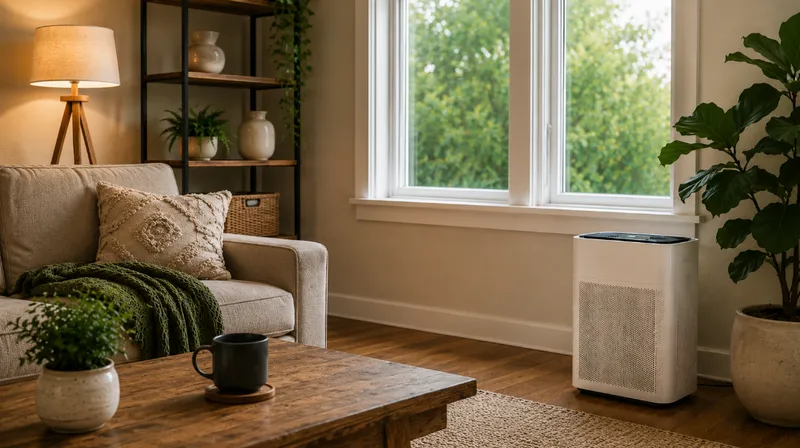
We manufacture air filters, so read this section with that in mind. We are going to tell you anyway that a box fan and a filter are one of the best-value moves available during a Hazardous event, because the EPA's own research says so, and because commercial air cleaners sell out in the first 48 hours of a serious smoke event, every time.
EPA's Office of Research and Development built these designs and tested them in a chamber filled with simulated wildfire smoke, measuring the clean air delivery rate (CADR) of each: the volume of filtered air the unit actually produces per minute. Higher is better.
Source: EPA Office of Research and Development chamber study of DIY air cleaner designs.
Three things the EPA is specific about, and we would underline all three:
Use a certified box fan, 2012 model or newer, carrying a UL or ETL mark. Fans built before that safety standard are the fire risk you may have heard about. EPA's safety testing found modern certified fans safe to run even in an extreme scenario with both sides of the fan blocked.
MERV 13 is the rating that matters here. The filter's rating drives CADR more than almost any other variable, because smoke particles are fine enough that lower-rated media simply pass them through. This is the same reason MERV 13 shows up in the CARB guidance above.
Change the filter once it loads up. The EPA study found CADR drops steeply on filters heavily loaded with smoke. Keep spares on hand before the event, because a DIY cleaner running a clogged filter is mostly just a loud fan. The basic build takes a standard 20x20x1 MERV 13, which is a stocked size for us and worth buying two or three of at once. Filters are the one part of this you cannot improvise mid-event.
One honest caveat: it is loud. EPA's field work in smoke-affected homes found fan noise was the main reason people stopped using them. If your clean room is your bedroom, that is a real trade-off, and a quieter commercial unit may be worth the money if you can get one. Full build instructions and safety notes are on the EPA's DIY air cleaner research page.
Every smoke event sends the same wave of questions to our support team. These four mix-ups are behind most of them, and each one is easy to undo once you can name it.
Judging air quality by smell alone. PM2.5 can sit at Hazardous levels with only a faint smell, especially once your nose adjusts to it after an hour indoors. Go by the reading, not your nose.
Cracking a window to air out a stuffy house. During a Hazardous event, any outdoor air you let in adds particles faster than normal ventilation clears stale indoor air. Keep the house sealed until the event passes.
Running exhaust fans while the house is sealed. This is the one nobody warns you about. A bathroom or kitchen exhaust fan pushes air out of the house, and that air has to be replaced from somewhere. With the windows shut, it gets replaced by outdoor air pulled in through every gap around your doors, windows, and outlets, unfiltered. Run them only as long as you need to, and skip the extended post-shower cycle until the event passes.
Assuming clean air returns the moment the AQI drops. Settled dust and soot on indoor surfaces do not disappear when the outdoor reading improves. Run your HVAC fan for a few extra hours after the event, then check your filter. Replace it if it looks visibly gray, even if it has not hit its usual schedule. We would say this even if we did not sell filters: the EPA's chamber testing found that a filter heavily loaded with smoke delivers sharply less clean air than a fresh one. A gray filter looks like it has been working hard, but by that point it has mostly stopped.
There is no fixed duration for a Hazardous event. Wildfire smoke can push a region into the Hazardous range for a few hours or for several consecutive days, depending on fire size, wind direction, and atmospheric conditions, while temperature inversions and industrial events tend to resolve faster. Track your local reading in real time on AirNow, or check conditions for any U.S. city on Filterbuy's live USA AQI map, rather than relying on a forecast from the previous day, since Hazardous-level events can shift quickly. In our experience tracking air quality alerts across the wildfire-prone regions we ship to most, the events that catch households off guard are rarely the ones where AQI climbs steadily over a day. They are the overnight jumps, when a wind shift pushes smoke in while everyone is asleep and the reading is already Hazardous by the time anyone checks their phone.
These are the primary sources behind this page's guidance. Each is a distinct federal or state authority, so you can verify any claim above at the source. We leaned on state health departments alongside the federal pages on purpose. The states that live through smoke season every year publish the practical detail the national guidance leaves out: what an N95 will not do, how to read visibility when your phone is dead, what actually counts as a clean room.
AirNow: AQI Basics. The EPA's official reference for how the AQI scale and all six categories work, including Hazardous. Read the AQI Basics page.
EPA: 2024 AQI Update Fact Sheet. The EPA's own explanation of the May 2024 PM2.5 breakpoint revision, including the pre- and post-update thresholds. Read the fact sheet.
CDC: Wildfire Safety Guidelines. Federal guidance on protecting yourself from wildfire smoke, the leading cause of Hazardous AQI events. Read the CDC guidelines.
Michigan Department of Health and Human Services. State guidance on who faces the highest health risk during a Hazardous event, beyond the standard sensitive groups. Read the guidance.
California Air Resources Board: Smoke Ready California. Practical MERV 13 filtration and indoor clean-air-space guidance during smoke events. Read the Smoke Ready guide.
Wisconsin Department of Health Services. Official guidance on N95 respirator use and its limitations during Hazardous events. Read the DHS guidance.
OSHA: Wildfires. Federal guidance for employers protecting outdoor workers when the AQI reaches unhealthy-and-above levels. Read the OSHA guidance.
EPA: Research on DIY Air Cleaners. The chamber testing, CADR figures by design, and box-fan safety findings behind the DIY section above. Read the EPA research.
AirNow Fire and Smoke Map. Regulatory monitors and corrected crowdsourced sensor data on one map, which is the fastest way to settle a disagreement between your sensor and the official reading. Open the map.
We chose these three because each one answers an objection we actually hear: that smoke is just smoke, that this is a West Coast problem, and that Hazardous days are a fluke.
1.3 to 10 percent. That is how much respiratory hospitalizations rise for every 10 microgram-per-cubic-meter increase in wildfire-specific PM2.5. It is roughly double the effect of the same increase in PM2.5 from other sources. Source: Nature Communications, indexed by the National Institutes of Health (Aguilera et al., 2021).
61.5 million people. That many Americans lived in counties that earned a failing grade for unhealthy short-term spikes in particle pollution. These are the same spikes that push AQI into the Hazardous range. Source: American Lung Association, "State of the Air" 2026.
8.9 million acres. Wildfires burned that much land nationwide in 2024, above both the five-year and ten-year averages. Wildfire smoke is the leading cause of Hazardous AQI events in the continental U.S. Source: National Interagency Fire Center.
"On a Hazardous air day, most people set one of the two settings that matter and stop there. They close the fresh-air intake, then leave the fan on Auto, so the filter only ever sees air when the system happens to be cooling. Both have to move: intake closed, fan switched to On. Do that with the highest-rated filter your equipment is rated for, and you have done more for the air in that house than anything else available to you without professional equipment," says David Clark, CEO of Filterbuy HVAC Solutions.
An AQI reading of 301 to 500 is considered Hazardous, the highest category on the Environmental Protection Agency's Air Quality Index. At this level, the entire population, not just sensitive groups, faces an increased risk of serious health effects.
Maroon is the color the EPA assigns to the Hazardous category, AQI 301 to 500. It is the darkest and most severe color on the standard AQI chart.
A: No. The EPA advises that everyone avoid outdoor exertion when the AQI reaches Hazardous. If you must go outside briefly, a properly fitted N95 respirator reduces exposure to fine particles, though it does not filter ozone. In our experience, the real question behind this one is narrower than it sounds: can I do the school run, can I let the dog out?. The EPA's advice is built around exertion, so a short, slow, N95-covered errand is not the same exposure as a run. Keep it brief, and skip it entirely if the person going is in one of the sensitive groups above.
Very Unhealthy covers AQI 201 to 300 and triggers a health alert for the general population, with more serious effects for sensitive groups. Hazardous covers AQI 301 to 500 and represents a health emergency in which the entire population is likely to be affected, not only sensitive groups.
Yes. A portable air cleaner sized for the room, or a central HVAC system running a high-efficiency filter with the fan set to On, can meaningfully reduce indoor fine-particle levels during a Hazardous event, especially in a single sealed room if whole-home filtration is not available. The mistake we see is buying by square footage alone. A unit rated for 300 square feet is rated for that room with the door shut. Open it into a hallway, and the number stops meaning much, so size for the room you will actually seal. If you are running whole-home filtration instead, the same logic applies to the filter itself: we ship more than 600 sizes precisely because a filter that does not fit the return is a filter that gets bypassed.
Hazardous readings are uncommon outside of major wildfire smoke events, large-scale industrial incidents, or severe temperature inversions. Most U.S. metro areas rarely see AQI values above 300, though wildfire-prone regions have seen Hazardous readings more frequently in recent years.
Yes. Pets breathe the same PM2.5 people do, and short-snouted breeds, older pets, and those with existing heart or lung conditions face higher risk. Keep pets indoors during a Hazardous event and skip long walks or strenuous outdoor play until conditions improve.
Partially. A cabin air filter reduces particle infiltration but will not fully block it, especially if the filter is older or worn. Keep windows closed and set the climate system to recirculate while driving through a Hazardous event, and replace the cabin air filter more often if you regularly drive through smoke.
The households that get through a Hazardous event comfortably are, almost without exception, the ones that made their decisions before it started. Confirm the highest MERV rating your system is actually rated for while the air is clear. Measure your return and write the size down. Decide now which room becomes the clean room, and keep one spare filter in the closet so a change during a smoke event does not become an errand. None of that takes more than twenty minutes on a good-air day, and none of it is possible to do well at eleven at night with the reading at 340. If you are not sure what size you need, our team can help you find it: browse Filterbuy MERV 13 filters in more than 600 sizes, including custom dimensions, shipped free from our factories.
If you landed here mid-event, these are the two pages worth having open alongside this one.
Live USA AQI map: current conditions for any U.S. city, so you can watch the trend rather than a single reading.
MERV 13 air filters: the rating the EPA and CARB both point to for smoke, in more than 600 sizes plus custom dimensions, shipped free from our own U.S. factories.
AQI (Air Quality Index): The EPA's 0-500 scale for reporting daily outdoor air quality and its associated health risk.
PM2.5: Fine particulate matter measuring 2.5 micrometers or smaller in diameter, small enough to reach deep into the lungs and bloodstream.
NAAQS: National Ambient Air Quality Standards, the EPA's health-based limits for major air pollutants under the Clean Air Act.
Breakpoint: The pollutant concentration at which the AQI shifts from one category to the next.
MERV Rating: Minimum Efficiency Reporting Value, a 1-16 scale rating of how well an air filter captures particles. Higher numbers capture smaller particles. MERV 13 is the rating both the EPA and the California Air Resources Board point to for wildfire smoke, and it is the specification Filterbuy builds its smoke-season filters around.
N95 Respirator: A NIOSH-approved mask that filters at least 95 percent of airborne fine particles when properly fitted. It does not filter ozone.
Sensitive Groups: Populations at elevated risk from air pollution, including children, older adults, pregnant people, and people with heart or lung disease.
Recirculate Mode: An HVAC setting that recycles indoor air instead of drawing in outdoor air. Worth knowing that many residential central systems have no fresh-air intake and therefore no recirculate setting at all; they already recycle indoor air by default. Cars are the more common place you will actually find the button.
