
AQI Color Chart: What Green to Maroon Air Quality Means
July 7, 2026
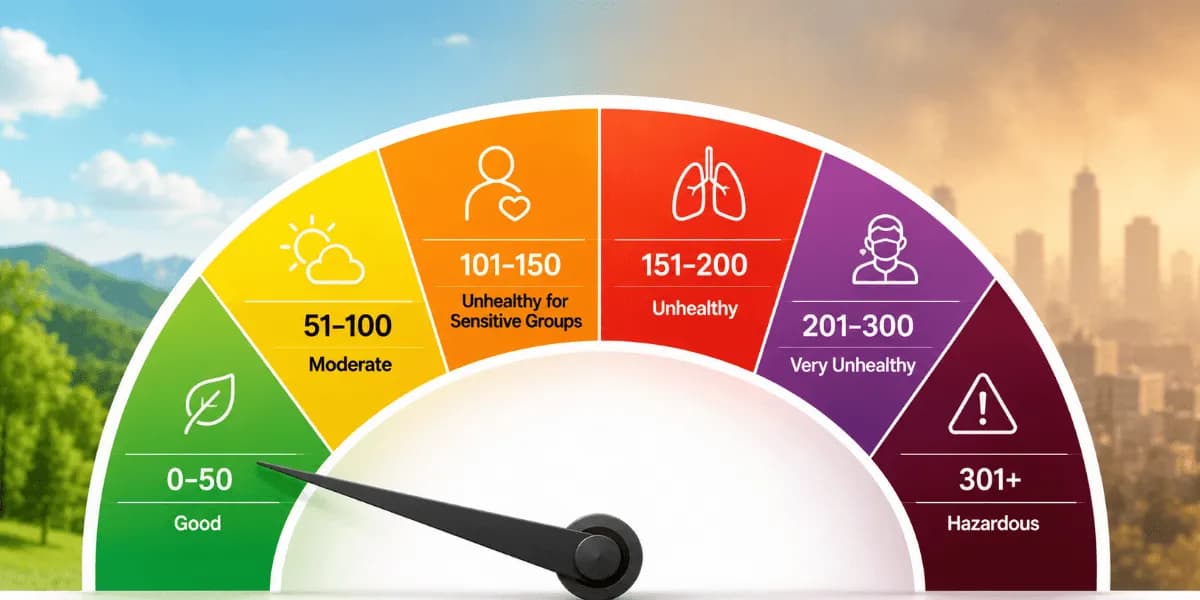
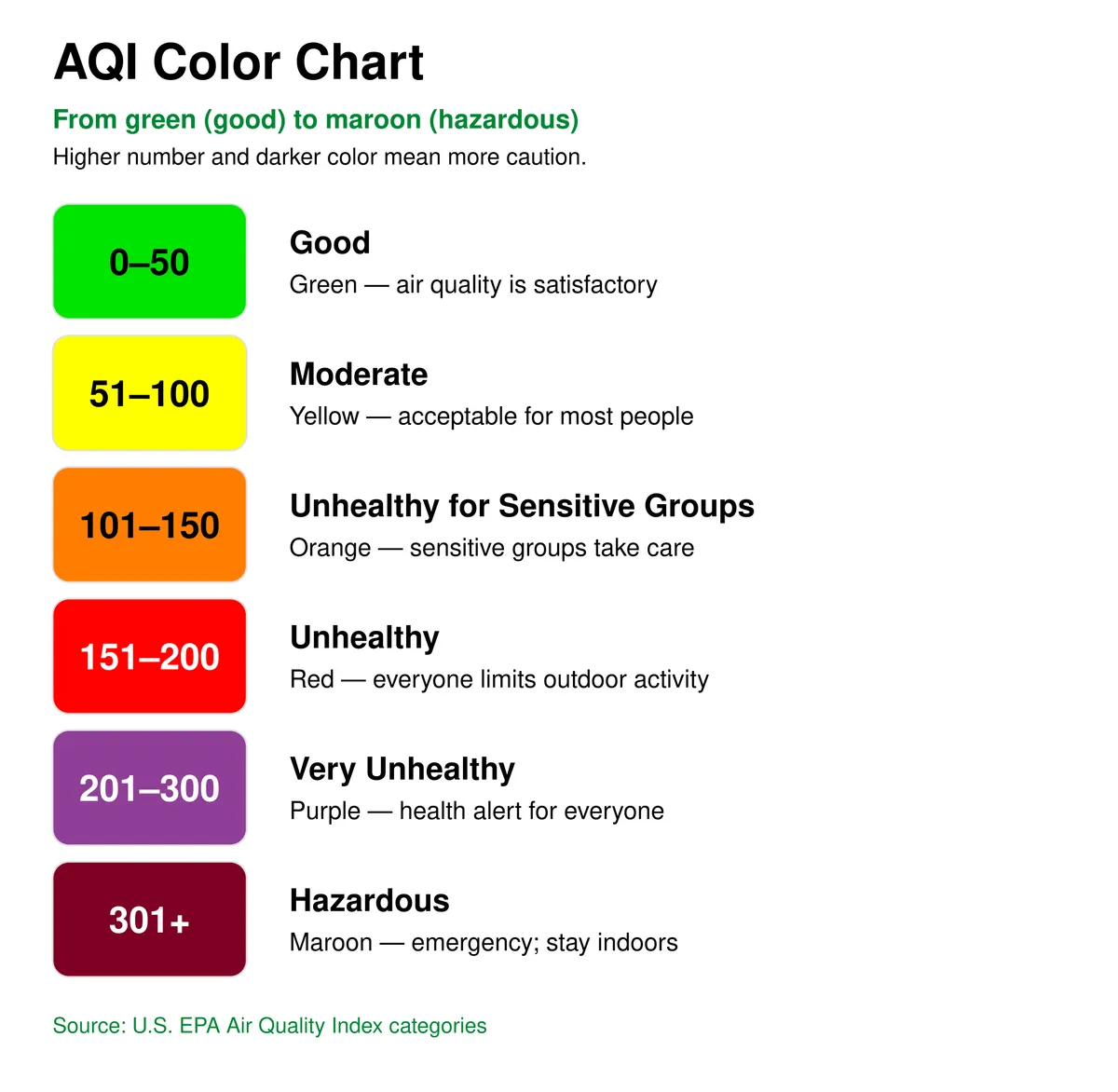
The AQI color chart is a six-step scale that runs from green (good air) to maroon (hazardous air). It works like a traffic light: the higher the number and the darker the color, the more caution you should take. Green and yellow are fine for most people, orange means sensitive groups should take care, and red, purple, or maroon mean everyone should limit time outdoors.
- Green · 0–50 · Good — air quality is satisfactory.
- Yellow · 51–100 · Moderate — acceptable for most people.
- Orange · 101–150 · Unhealthy for Sensitive Groups — sensitive groups take care.
- Red · 151–200 · Unhealthy — everyone limits outdoor activity.
- Purple · 201–300 · Very Unhealthy — health alert for everyone.
- Maroon · 301+ · Hazardous — emergency; stay indoors.
When outdoor air spikes, the right air filter captures more of the fine particles that drift indoors. Find your match with the quick quiz below.
Answer 3 quick questions and we'll match you to the right filter for your home.
Prefer to browse first? Shop air filters at Filterbuy.
Have you ever stepped outside and noticed a hazy sky or a strange smell in the air? You probably wondered if it was safe to go for a run or let the kids play in the yard. That is exactly why the Air Quality Index exists.
The AQI color chart turns complex air pollution data into a quick, easy-to-read health signal. It works a lot like a traffic light. Green means you are good to go. Maroon means stop and stay indoors. The higher the number gets, the more caution you should take.
Because outdoor air easily finds its way inside your home, knowing these colors helps you make smart choices about your HVAC system, your air filters, and your daily plans.
Want to know today’s air quality where you live? Check the Filterbuy AQI map for real-time local conditions.
Key Takeaways
The Air Quality Index (AQI) simplifies complex air pollution data into an easy-to-understand scale, similar to a traffic light system.
Green indicates safe air quality, while maroon signifies hazardous conditions where staying indoors is recommended.
Knowing the AQI can help you make informed decisions about your HVAC system, air filters, and daily activities.
Outdoor air pollution can impact indoor air quality, making it essential to stay updated on local AQI levels.
Use tools like the Filterbuy AQI map to monitor real-time air quality in your area and plan accordingly.
The Official EPA AQI Color Chart
Here is the simple version. The Environmental Protection Agency (EPA) breaks air quality down into six color-coded categories.
| AQI Color | AQI Range | Level | What It Means |
|---|---|---|---|
| Green | 0–50 | Good | Air quality is satisfactory and pollution poses little or no risk. |
| Yellow | 51–100 | Moderate | Air quality is acceptable, but unusually sensitive people may notice symptoms. |
| Orange | 101–150 | Unhealthy for Sensitive Groups | Sensitive groups may experience health effects; most others are less likely to be affected. |
| Red | 151–200 | Unhealthy | Some people may experience health effects; sensitive groups may experience more serious effects. |
| Purple | 201–300 | Very Unhealthy | Health alert: risk increases for everyone. |
| Maroon | 301+ | Hazardous | Emergency-level warning: everyone is more likely to be affected. |
What Is the Air Quality Index (AQI)?
Think of the Air Quality Index (AQI) as a yardstick that runs from 0 to 500. It measures how clean or polluted your outdoor air is.
The EPA calculates the AQI based on five major air pollutants regulated by the Clean Air Act. These include ground-level ozone, particle pollution, carbon monoxide, sulfur dioxide, and nitrogen dioxide. Whichever pollutant has the highest level on a given day determines the official AQI number for your area.
What Does a Green AQI Score Mean?
Green AQI: 0–50, Good
Green means outdoor air quality is good. When the AQI is green, air pollution levels are low enough that the air is considered satisfactory for the general public.
This is the perfect day for walking, running, biking, or outdoor play. You can comfortably open your windows to let fresh air into your home. People with asthma or other lung conditions usually do not need to change their routines, unless they have specific medical guidance telling them otherwise.
What Does a Yellow AQI Score Mean?
Yellow AQI: 51–100, Moderate
Yellow means the air quality is still acceptable for most people. However, people who are unusually sensitive to air pollution may want to pay attention.
Yellow does not mean the air is dangerous for everyone. It means some people may start noticing symptoms, especially if they are unusually sensitive to ozone or particle pollution. Most people can continue normal outdoor routines without worry. Sensitive individuals should simply watch for coughing, throat irritation, or shortness of breath.
If you see a yellow rating and you know there is a wildfire nearby, check the AQI again later. Conditions can quickly get worse.
What Does an Orange AQI Score Mean?
Orange AQI: 101–150, Unhealthy for Sensitive Groups
Orange is the first AQI level where air quality is officially considered unhealthy for certain people. AirNow describes orange AQI as "Unhealthy for Sensitive Groups."
Members of sensitive groups may experience health effects, while the general public is less likely to be affected. These sensitive groups include children, older adults, and people with heart or lung conditions like asthma or COPD.
If the AQI is orange, sensitive groups should reduce long or intense outdoor activity. It is a good idea to move workouts indoors. You should also keep your home's windows closed if the outdoor air is smoky or polluted.
Before heading outside, check the Filterbuy AQI map to see whether your neighborhood is in the orange zone or worse.
What Does a Red AQI Score Mean?
Red AQI: 151–200, Unhealthy
Red means the air is unhealthy for everyone, not just sensitive groups. AirNow states that at a red AQI, some members of the general public may experience health effects. Sensitive groups may experience much more serious effects.
When the air is red, everyone should reduce heavy outdoor activity. Sensitive groups should avoid prolonged outdoor exertion entirely. Consider moving exercise, sports, or heavy yardwork indoors. Watch for symptoms like coughing, wheezing, irritated eyes, or chest tightness.
What Does a Purple AQI Score Mean?
Purple AQI: 201–300, Very Unhealthy
Purple means the air has reached a health alert level. At this point, the risk of health effects increases for everyone.
You should avoid long or intense outdoor activities entirely. Sensitive groups should stay indoors as much as possible. Keep your indoor air clean by closing all windows and doors. This is a great time to rely on your HVAC system, especially if you have a high-quality air filter installed, like a MERV 11 or MERV 13, which can trap fine smoke particles.
What Does a Maroon AQI Score Mean?
Maroon AQI: 301+, Hazardous
Maroon is the most serious AQI color. It indicates emergency-level conditions where everyone is more likely to be affected by the polluted air.
Stay indoors as much as possible. Avoid all outdoor exercise or heavy activity. Keep your windows and doors tightly closed, and use high-efficiency HVAC filtration to scrub your indoor air. Always follow local public health alerts or emergency guidance when the air quality reaches this hazardous level.
Quick Rule of Thumb: When Should You Worry About the AQI?
Here is a simple way to remember AQI colors without overthinking it:
Green: Good to go.
Yellow: Fine for most people.
Orange: Sensitive groups should be careful.
Red: Everyone should reduce heavy outdoor activity.
Purple: Avoid long outdoor activity.
Maroon: Stay indoors and treat it as an emergency-level air quality day.
Who Should Pay Closest Attention to AQI Colors?
Everyone benefits from checking the AQI, but some people are far more vulnerable to poor air quality. According to the EPA, when the AQI rises above 100, air quality becomes unhealthy first for sensitive groups.
You should pay close attention to the daily AQI if you fall into any of these categories:
People with asthma or COPD
People with heart disease
Children and teenagers
Older adults
Pregnant people
Outdoor workers
Athletes and people exercising outside
Why Do AQI Colors Change So Quickly During the Day?
AQI is not a fixed number for the whole day. Wind, wildfire smoke, heavy traffic, and changing weather patterns can alter air quality by the hour.
Because a full day of data is not always available, real-time reporting uses a NowCast calculation. This estimates the current air quality based on the most recent hourly data. Because the AQI can shift throughout the day, use the Filterbuy AQI map before outdoor exercise, school pickup, yardwork, or opening your windows.
How Does the AQI Chart Connect to PM2.5 Pollution?
You might hear the term "PM2.5" mentioned alongside the AQI. PM2.5 stands for fine particle pollution. These are tiny particles in the air that are two and one half microns or less in width. It is one of the most common reasons the AQI rises, especially during wildfire smoke events.
In 2024, the EPA strengthened the annual PM2.5 standard from 12.0 µg/m³ to 9.0 µg/m³ to better protect public health. They also updated the AQI breakpoints for particulate matter. Because PM2.5 particles are so small, they can easily travel into your home. This is why using a pleated air filter with a strong MERV rating is essential for maintaining healthy indoor air when the outdoor AQI spikes.
How to Check the Local AQI Near Your Home
Knowing the color chart is helpful, but the AQI is highly local. One side of a city can have much cleaner air than another, especially during a wildfire or changing winds.
Do not guess about the air you are breathing. Check your local AQI now with the Filterbuy AQI map. Before opening windows or exercising outside, use the map to see exactly what color zone your neighborhood is in.
Plan Your Day With Local Air Quality Insights
The AQI color chart is designed to make air quality easy to understand at a single glance. Green and yellow usually mean the air is acceptable for most people. Orange means sensitive groups should take care. Red, purple, or maroon means outdoor activity should be reduced or avoided entirely.
Because air quality can change quickly, the best next step is to check current conditions in your area. Use the Filterbuy AQI map to see your local AQI before planning outdoor activities.
Frequently Asked Questions
What are the six AQI colors?
The six AQI colors are green, yellow, orange, red, purple, and maroon. They range from good air quality (green) to hazardous air quality (maroon).
What AQI color is safe?
Green is the safest AQI color. It means the AQI is between 0 and 50, and air pollution poses little or no risk for most people.
What does a yellow AQI mean?
Yellow means moderate air quality. The air is acceptable for most people, but unusually sensitive people may notice symptoms like coughing or throat irritation.
What does an orange AQI mean?
Orange means the air is unhealthy for sensitive groups. Children, older adults, people with heart or lung conditions, and people active outdoors should reduce prolonged or heavy outdoor activity.
What does a red AQI mean?
Red means unhealthy air. Some people in the general public may experience health effects, and sensitive groups may experience more serious symptoms.
What does a purple AQI mean?
Purple means very unhealthy air. The risk of health effects increases for everyone, so outdoor activity should be severely limited.
What does a maroon AQI mean?
Maroon means hazardous air quality. It is an emergency-level warning where everyone is much more likely to be affected by the pollution.
At what AQI should I stay inside?
People in sensitive groups should consider staying inside or reducing outdoor activity when the AQI reaches orange. When the AQI is red, purple, or maroon, everyone should move activities indoors and limit outdoor exposure.
Why does the AQI change so quickly?
AQI can change rapidly due to wind, wildfire smoke, traffic, industrial pollution, sunlight, and weather patterns. That is why checking a live AQI map is much more useful than relying on yesterday’s reading.