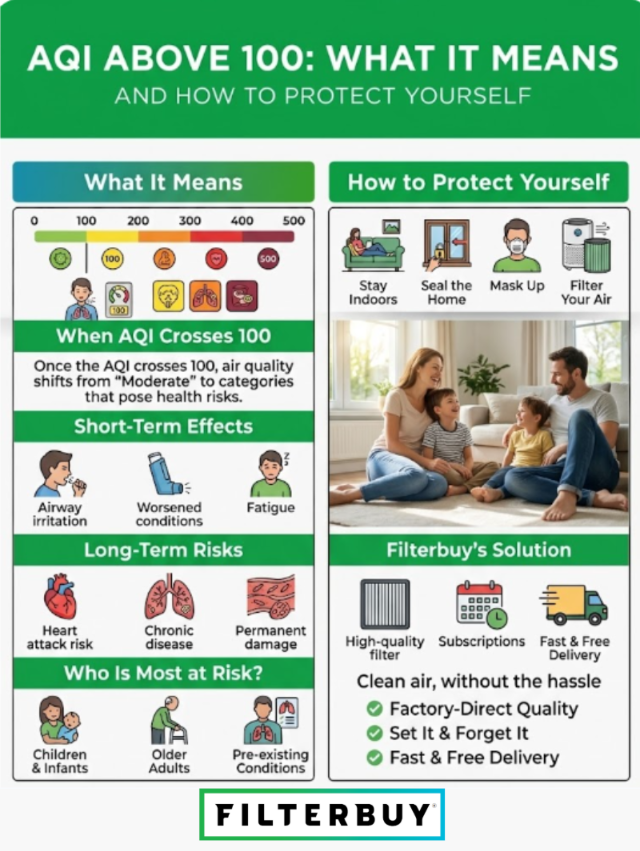
AQI Above 100: What It Means and How to Protect Yourself
May 18, 2026
AQI Above 100? Here’s What to Do
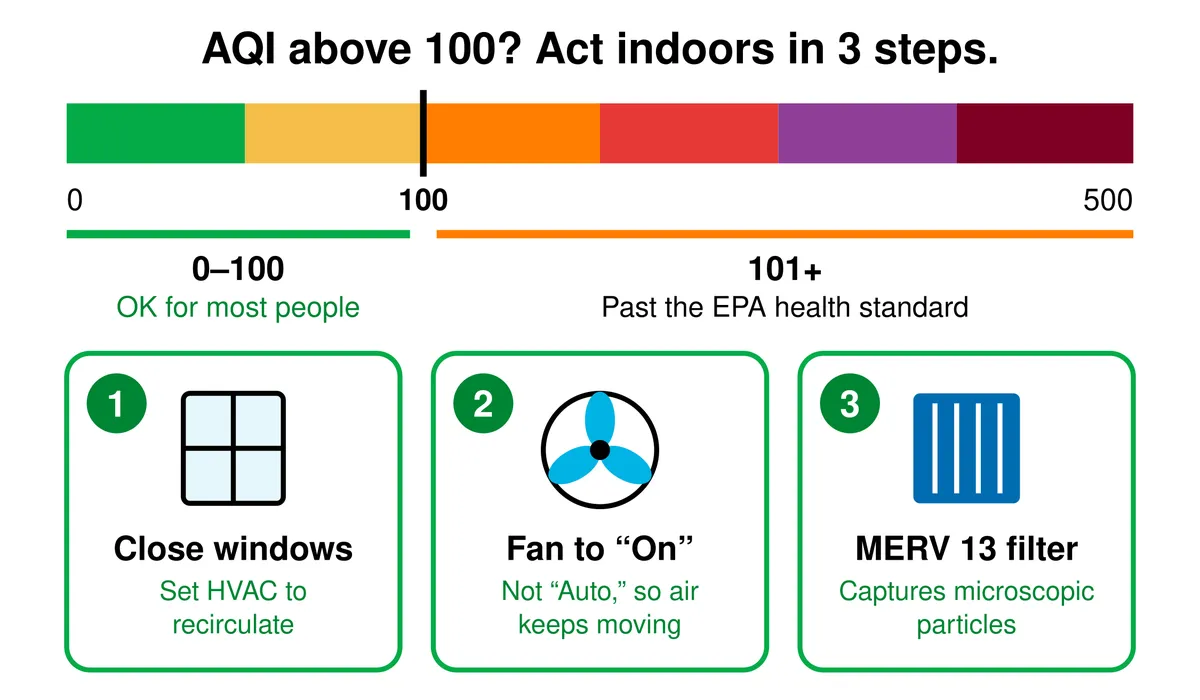
An AQI above 100 means outdoor air has passed the EPA’s health standard for at least one pollutant. Your fastest move is indoors: close the windows, set your HVAC fan to “On,” and use a MERV 13 filter. From 101 to 150, sensitive groups feel it first. Above 150, everyone does. Take the quick match quiz below to find the filter that fits your system.
Find my filter match Shop Filterbuy filters
Made in Talladega, Alabama · 600+ sizes
Answer a few quick questions and we’ll match you to the right filter for your home.
Already know your size? Shop filters at filterbuy.com
TL;DR
An AQI above 100 means outdoor air has passed the EPA’s national health standard for at least one pollutant. Between 101 and 150, it is unhealthy for sensitive groups, and above 150 for everyone. Your fastest protection is indoors: close the windows, set your HVAC fan to “On,” and use a MERV 13 filter to capture fine particles behind high readings.
Key Takeaways
A good AQI level is 0 to 50, and the 51 to 100 Moderate band is fine for most people. Every category above 100 is unhealthy to some degree.
PM2.5, the fine particle pollution small enough to reach the bloodstream, drives most high readings. Wildfire smoke is nearly all PM2.5.
Closing the windows only gets you partway. A MERV 13 filter with the HVAC fan set to “On” does the rest, and both the EPA and AirNow recommend it during smoke.
What Does An AQI Above 100 Mean?
An AQI above 100 means at least one pollutant has exceeded the EPA’s short-term health standard. The Air Quality Index is a 0-to-500 scale that the U.S. Environmental Protection Agency uses to report outdoor air pollution, and 100 is the threshold at which air quality is no longer satisfactory, first for sensitive groups and then for everyone.
That threshold is deliberate. AQI 100 corresponds to the National Ambient Air Quality Standard (NAAQS) for whichever pollutant is highest that day, so the AQI 100 meaning, plainly, is the federal health limit exactly met. A reading of 118 means it was exceeded.
Most explainers skip one detail: the AQI is not an average. The EPA scores each pollutant individually and reports the highest, so if ozone reads 65 and PM2.5 reads 118, your AQI is 118, driven by PM2.5 alone. Agencies have to name that driving pollutant, and it is worth finding, since ozone days and particle days call for different responses. See how the AQI is calculated for the arithmetic.
One limit is worth knowing. The AQI comes from the nearest official monitor, which may be miles away, and real-time values are NowCast estimates based on recent hours rather than a reading at your address. Treat it as a signal for your area, not a measure of your air.
AQI Levels Chart: The Scale Explained
The full AQI scale from 0 to 500 runs across six color-coded categories, from Good (0–50, green) through Unhealthy for Sensitive Groups (101–150, orange) to Hazardous (301+, maroon). Anything past 100 counts as an unhealthy air quality index reading.
Source: U.S. EPA, May 2024 AQI update for particulate matter.
Those concentrations follow the EPA’s May 6, 2024 revision, which dropped the “Good” ceiling from 12.0 to 9.0 micrograms per cubic meter. Any chart still showing 12.0 predates the change.
Is An AQI Above 100 Dangerous?
An AQI above 100 is dangerous for sensitive groups and, on a single day, usually not for healthy adults. The 101–150 band is called Unhealthy for Sensitive Groups because children, older adults, pregnant people, and anyone with asthma or heart disease feel it first. Past 150, everyone.
Two things change that answer. The first is how long it lasts, since an hour in the 100s is a different exposure from four straight days at 130. The second is which pollutant drives it. Ozone forms when sunlight hits traffic and industrial emissions, peaking on hot afternoons, while wildfire smoke pushes PM2.5 to levels that seep into homes and linger. A smoke day at 130 warrants more caution than an ozone day.
PM2.5 health effects arrive quickly and build slowly. In the short term, you may notice airway irritation, coughing, chest tightness, breathlessness on exertion, and asthma flare-ups. Over the years, the EPA has linked repeated exposure to cardiovascular strain, because particles that small cross into the blood.
What To Do When The AQI Is High
Check the AQI near you first, then act indoors, because outdoor air becomes indoor air within hours. Close the windows, switch your HVAC to recirculate, set the fan to “On” rather than “Auto,” and run a MERV 13 filter. Move workouts inside and skip the candles.
Close the envelope. If your HVAC or window unit has a fresh-air option, EPA’s clean room guidance is to turn it off or switch to recirculate. It costs nothing, so start there.
Fit a MERV 13 filter. The smoke-ready guidance from AirNow, the EPA’s public air quality service, recommends a high-efficiency filter rated MERV 13 or higher if your system can accommodate it. MERV 13 filters capture down to 0.3 microns, where fine particles and wildfire smoke live.
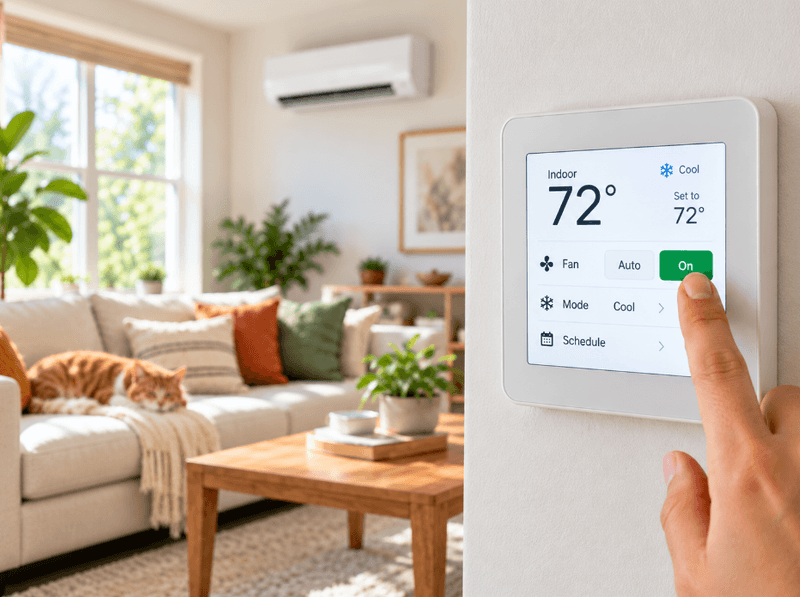
Set the fan to “On,” not “Auto.” A filter only cleans the air that passes through it, and on “Auto,” the blower runs only when the system is heating or cooling, which is why the EPA recommends running it continuously during smoke.
Check the filter often. EPA advises replacing filters more often than normal during heavy smoke and checking daily, so swap yours when it looks dark or smells of smoke.
Open up when the number drops. As soon as the AQI falls back under 100, even briefly, open the windows or the fresh-air intake and run the kitchen and bath fans. A sealed house collects whatever you generate inside.
“Most people upgrade the filter and stop there. If the thermostat is still on Auto, that filter only works when the system happens to run, which on a mild smoky day might be twenty minutes an hour.”
— David Clark, Licensed HVAC Technician
Best Air Filter For Poor Air Quality (And Where A Hepa Purifier Fits)
MERV 13 is the best air filter for poor air quality in a home HVAC system, and the rating the EPA names for wildfire smoke. A true HEPA filter catches more, but almost no residential system can move air through one, so HEPA belongs in a portable purifier for a single room alongside your ductwork filter. Fiberglass misses fine particles entirely.
Confirm MERV 13 compatibility with your HVAC system.
When portable air cleaners sell out, EPA’s DIY air cleaner research has a workaround: a box fan with a 20x20 MERV 13 filter taped to the intake side, arrow toward the blades. A cardboard shroud raised clean air delivery about 40% at no cost, while a dirty filter left it almost useless. Use a fan from 2012 or newer.
If You Have No Central Air
No ductwork changes the plan, not the goal. Without a central system, there is no filter slot to upgrade, so the room becomes the unit: pick the smallest space you can spend the day in, close it off, and run a portable or DIY cleaner inside. If you have a window air conditioner, shut its fresh-air vent or set it to recirculate. Ductless mini-splits carry their own filters, which Filterbuy also makes, and are worth swapping before smoke season rather than during it.
Where Filterbuy Lands On This
Filterbuy builds these filters in Talladega, Alabama, in more than 600 sizes, and size is the variable we think the category underrates. A MERV 13 that does not fit the return is worse than a MERV 8 that does, because air takes the easy path around a loose filter instead of through it. Bypass is the difference between real filtration and the look of it, so measure the opening before you shop ratings.
The rest of our position points at the cheaper answer, which is why we are comfortable stating it. A MERV 13 in the ductwork with the fan running beats any portable unit for a whole house, because it reaches every room the ducts do. A box-fan build is a second layer, never a replacement.
Supporting Statistics
Three findings back the advice here: two from the EPA, one from the American Lung Association.
61.5 million people in the U.S. live in counties graded F for short-term particle pollution spikes.
Those spikes are the days the AQI passes 100. Source: American Lung Association, State of the Air 2026
With windows closed and no air cleaner running, indoor PM2.5 still sits at 55–60% of outdoor levels, and in some homes 100%.
Sealing the house helps, but it does not finish the job. Source: U.S. EPA, Strategies to Reduce Exposure Indoors
A high-efficiency filter with the fan on “On” may cut indoor PM2.5 by about 50%. A low-efficiency filter, about 24%.
The fan matters. So does the filter. Source: U.S. EPA, citing Fisk and Chan 2017
Read the last two together and a picture emerges that neither source states outright. Closing the house brings indoor particles to roughly 55–60% of outdoor levels, and a good filter with the fan running removes about half of what remains. Neither is enough alone, but together they close most of the gap.
Does A Mask Help When Air Quality Is Unhealthy?
A NIOSH-approved N95 or P100 respirator is the best mask for air pollution, because it filters fine particles that cloth and surgical masks let past. EPA’s respirator guidance is specific: two straps above and below the ears, never ear loops, which cannot seal.
A respirator seals at the bridge of the nose and under the chin, and EPA is blunt that a good seal is not possible with facial hair. Check the fit each time, because a leak at the edge pulls unfiltered air straight in. A mask covers your hours outside; filtration covers the rest.
Frequently Asked Questions
Can I exercise outside when the AQI is 120?
If you are healthy, light activity is generally fine at 120, though it is worth shortening the session or moving it to the morning when ozone is lower. Exercise multiplies exposure because you breathe harder. Sensitive groups should avoid heavy exertion, and anyone should stop if they experience coughing or chest tightness.
Does high outdoor AQI affect indoor air quality?
Yes. Fine particles pass through gaps around windows and doors and through fresh-air intakes, so indoor levels rise along with outdoor ones. To improve indoor air quality during a high AQI event, close the envelope and filter what is already inside, adding a portable air cleaner to one room if you have one. Houseplants, despite how often they come up, do not help.
Glossary
Air Quality Index (AQI): a 0-to-500 scale the U.S. EPA uses to report outdoor air pollution. Higher numbers mean dirtier air and more risk.
PM2.5: fine particulate matter 2.5 microns or smaller, produced by combustion sources such as traffic and wildfire smoke, and small enough to reach the bloodstream.
Unhealthy for Sensitive Groups: the orange AQI category from 101 to 150, covering children, older adults, pregnant people, and anyone with asthma or heart disease.
MERV: Minimum Efficiency Reporting Value, the 1-to-16 scale for how well an HVAC filter captures particles. MERV 13 is what the EPA and AirNow recommend for wildfire smoke.
Get Ahead Of The Next Alert
The filter that protects you at an AQI of 150 has to be in place before the number climbs. Filterbuy makes MERV 8, MERV 11, and MERV 13 filters factory-direct in 600+ sizes. Find your exact filter size, or set up auto-delivery and let a clean one arrive before you need it.