
Utah Live Wildfire Smoke Map
Get Alerts For Wildfires In Your Area
The moment a wildfire starts near you, you'll get an instant alert and simple tips to reduce your smoke exposure.
What's In The Smoke
30xSmaller than a human hair
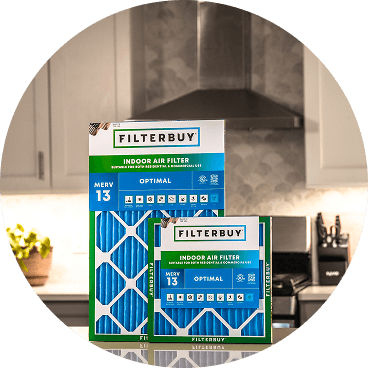
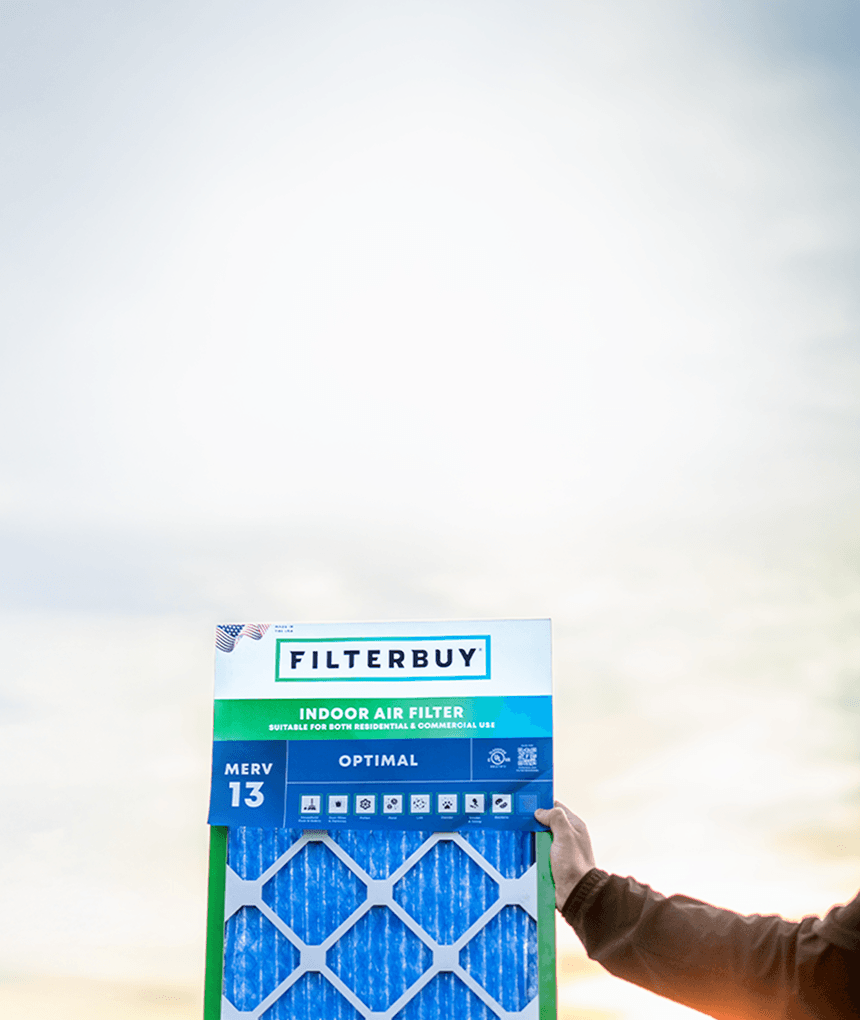
Fine enough to reach deep into the lungs. A MERV 13 is built to capture it.
How Far It Travels


It Doesn't Stay Local
Smoke rides the wind far downwind — you can get smoky air with no fire nearby.
What To Do During A Smoke Event
Simple steps to reduce indoor exposure.
- Stay In, Close UpShut windows and doors to keep smoke out.
- Set Fan To "On"Keeps air cycling through your filter, not just when heating or cooling.
- Recirculate AirSwitch off fresh-air intake so you're not pulling smoke in.
- Run A MERV 13Built to capture the fine PM2.5 in smoke.
- Add A PurifierExtra filtration for the room you use most.
- Wear an N95 if OutsideFits snug to block fine particles — a cloth mask won't.


The Best Air Filter For Wildfire Smoke
During smoke events, the EPA recommends upgrading to a MERV 13 filter — or the highest-rated filter your system can handle — to help reduce the fine particles smoke brings indoors. MERV 13 is the level most home HVAC systems can run while still capturing PM2.5, the fine particulate that makes up the bulk of wildfire smoke.
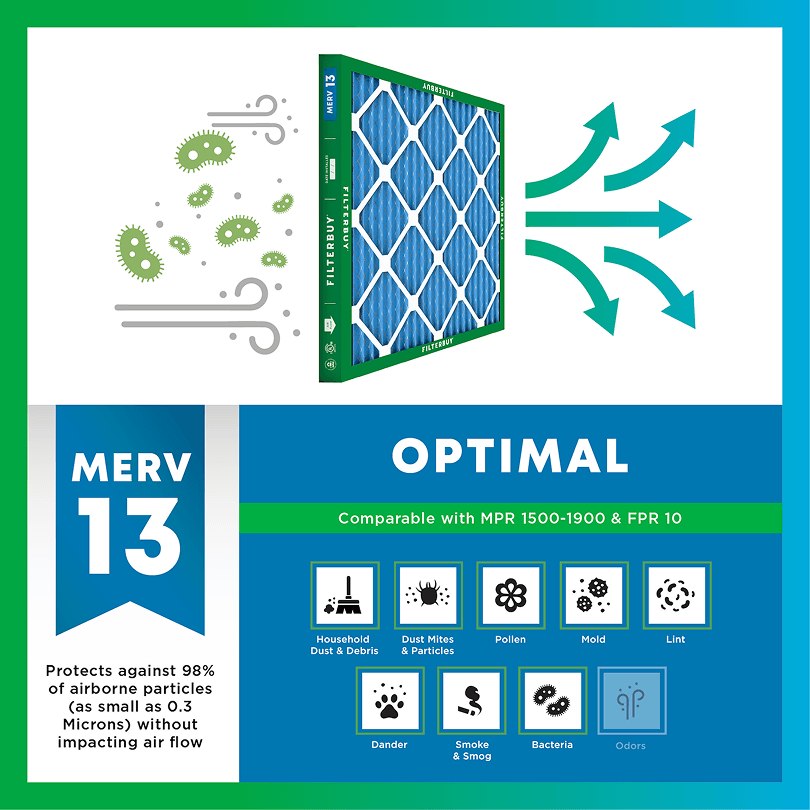
- Captures PM2.5 particles
- Blocks ash, soot, and smoke odor
- Keeps your indoor air safe—even when the outdoor air is dangerous
- Meets the EPA's recommended rating for filtering fine wildfire smoke particles.

Wildfire Smoke FAQs
Facts About Wildfires
Over 70,000 wildfires burn in the U.S. every year.
Wildfire smoke can travel 1,000+ miles, affecting states that aren't even near the blaze.
Exposure to wildfire smoke can worsen asthma, trigger heart issues, and lead to ER visits.
Indoor air can hold more fine particles during wildfire events unless it's properly filtered.
The EPA advises using MERV 13 filters or portable HEPA air cleaners during wildfire smoke events.
Don't Wait Until The Smoke's Inside.
Use the live wildfire smoke tracker and upgrade your air filters today to protect your lungs and your home.
Shop Filters For Smoke Protection
Current Live Forest Wildfire and Smoke Map Today in Utah: Track Active Fires, Air Quality Alerts, and Evacuation Zones to Protect Your Family
Don't take your indoor air for granted — especially during Utah's wildfire season. Most families watch the flames on the news. What they can't see is the invisible threat already inside their homes: fine smoke particles small enough to slip past standard HVAC filters, settle into ductwork, and circulate through every room where their families eat, sleep, and breathe.
We know this because we manufacture the filters designed to stop them. After over a decade of American-made air filter production and millions of customer conversations, we've tested firsthand how wildfire smoke overwhelms standard filtration — and we've engineered solutions specifically for it. That hands-on manufacturing experience is exactly why we built this live Utah wildfire and smoke tracking resource. Other wildfire maps show you where fires burn. We go further, connecting real-time fire data to the indoor air quality threat most families overlook.
TL;DR Quick Answers
Current Live Forest Wildfire and Smoke Map Today in Utah
The two most reliable real-time wildfire and smoke maps for Utah are:
Utah Fire Info (utah-fire-info-utahdnr.hub.arcgis.com) — The official interagency dashboard where state and federal fire officials publish confirmed active fire locations, acreage burned, containment percentages, road closures, and restriction orders in real time.
EPA AirNow Fire and Smoke Map (fire.airnow.gov) — Overlays satellite-detected smoke plumes with real-time PM2.5 readings from over 1,700 air quality monitors, showing exactly where smoke is drifting and what concentration levels are reaching your community.
Why both matter: Utah Fire Info tells you where the fire is. AirNow tells you where the smoke is going. From our experience as air filter manufacturers tracking wildfire conditions across every state we ship to, there's a critical difference between the two — a fire can be 200 miles from your home and still send PM2.5 levels in your valley into the unhealthy range within hours, especially when Utah's mountain-ringed geography traps smoke in populated corridors through atmospheric inversions.
Our recommendation: Bookmark both tools on your phone now. Check them daily during fire season. When smoke plumes appear heading toward your area on the AirNow map, you have a 12–24 hour window to seal your home, switch your HVAC to recirculate mode, and confirm your air filter is rated MERV 13 or higher — because once you can smell smoke indoors, it's already in your lungs.
Top Takeaways
Wildfire smoke is an indoor air crisis, not just an outdoor hazard. 52% of all PM2.5 pollution in the United States now comes from wildland fires. Those particles don't stop at your front door — they infiltrate through cracks, gaps, ducts, and open vents, contaminating the air your family breathes inside your home 24 hours a day during smoke events.
The standard filter in most Utah homes provides almost zero protection against wildfire smoke. Most residential systems still run MERV 1–4 filters designed for dust and pollen. After manufacturing millions of filters and testing them against smoke-particle-sized contaminants, we can tell you firsthand — those filters have no meaningful ability to capture sub-2.5-micron smoke particles. Upgrading to MERV 13 captures up to 85–95% of PM2.5 and is the single lowest-cost, highest-impact protective action most families can take.
Staying indoors only works if your HVAC filter can actually capture smoke. Respiratory emergency visits surge 30–110% after extreme smoke days — even though people are sheltering inside. The data suggests what our testing confirms — homes without adequate filtration aren't providing the protection families assume they are.
Utah's wildfire threat is unpredictable and closer to home than most families realize. In 2025, 72% of Utah's wildfires were human-caused. 114,000 acres burned. $103 million in suppression costs. A state of emergency declared. The question isn't whether smoke will reach your home — it's whether you'll be prepared when it does.
Preparedness starts before fire season, not during it. Check your filter. Know your MERV rating. Upgrade to MERV 13. Bookmark your monitoring tools. Build smoke supplies into your emergency kit. The families who fare best aren't the ones who react fastest — they're the ones who prepared earliest.
How to Use the Utah Wildfire and Smoke Map
The live wildfire and smoke map on the top right uses real time information about any active fires burning in Utah, and broadcasts them as red dots on the map as they are detected by satellite thermal detector cameras, or other interagency fire reporting networks. The fire markers have the name of the fire, the acreage that the fire is currently containing and the agency that is handling the suppression efforts. Where the smoke is drifting and concentrating indicates smoke plume, and this is significant since, as years of monitoring air quality has shown us, smoke regularly pollutes the indoor air in communities 200 or further in a direction aways the nearest flame.
The map is very easy to navigate, by typing either your city or zip code in the search bar to have the view centered on your location. Scout red fire icons, which are an active incident, layers of smoke plume that have been shaded with the drifting patterns, and any layer of evacuating zone that are colored in any color near your locality.
Active Wildfires Burning in Utah Right Now
Wildfire activity in Utah varies by the seasons, however, the most dangerous time is between July and October when dry fuels, high temperatures and wind interact to form volatile conditions. The season of 2025 was a vivid wakeup call to how fast it can get: more than 160,000 acres of the state were on fire in over 1,100 fires, the most since 2020 and more than the last three years combined. Monroe Canyon Fire alone burned up more than 73,000 acres in Sevier and Piute Counties, burned homes and cabins, and led to the declaration of the first wildfire-related emergency in years in the state.
What drove that intensity was a combination most Utah residents didn't see coming — a wet prior winter grew abundant vegetation, followed by record drought that dried it all into prime fuel. By the close of summer 2025, almost 80 percent of the state will be in severe drought or worse, and 60 percent of fires will be anthropogenic. State fire officials have reported that the fuel loads have already accumulated once again with the approach towards 2026 and that the numbers are still mixed with the quantity of early snowpack, so that conditions may again become hazardous within a short period of time. The current fire information on the map above is updated regularly to ensure that you are aware of any new ignition, containment efforts, and change in fire behavior as it occurs.
Utah Air Quality Alerts and Smoke Conditions
Wildfire smoke is a complicated blend of gases and small particles of materials, and its effects on the quality of air in Utah are far more extensive than the counties nearest to the fire. The Utah Division of Air Quality measures the hourly PM 2.5 and ozone in 12 counties, such as Salt Lake, Utah, Davis, Weber, Washington, and Cache, and displays real-time data on their monitoring site, as well as a three-day forecast. In the season of 2025, PM2.5 was recorded to have high levels in the unhealthy range in several counties, and this was enhanced by the presence of ozone pollution during the summer. Salt Lake CityProvoOrem region is now among the poorest in the country with ozone pollution, which is fueled by the interaction of wild fire smoke and transportation, and industrial emissions in the mountain-encircled valleys of Utah.
From our perspective as air filter manufacturers, here's what those readings mean for your home: when outdoor PM2.5 levels climb above 35 micrograms per cubic meter (the federal 24-hour standard), smoke particles are actively infiltrating indoor spaces through every gap, crack, and air intake your home has. Your HVAC system becomes your family's first line of defense — but only if the filter inside it can actually capture particles that small. We'll cover exactly what that takes in the indoor air protection section below.
For real-time air quality data specific to your county, check the Utah Division of Air Quality's monitoring site at air.utah.gov, download the UtahAir app, or use the EPA's AirNow Fire and Smoke Map at fire.airnow.gov for a national view with Utah-specific layers.
Utah Wildfire Evacuation Zones and Emergency Resources
Knowing your evacuation zone before a fire starts is one of the most important things you can do to protect your family. Several Utah communities — including areas along Salt Lake City's east side, the wildland-urban interface corridors in southern Utah, and neighborhoods near Provo Canyon and Ogden's foothills — have pre-established evacuation zones with designated routes. As of January 2026, Utah's Division of Forestry, Fire, and State Lands released an updated high-risk wildland-urban interface boundary map that places approximately 60,000 structures in the state's top risk tier under House Bill 48. If your property falls within that boundary, you're now subject to new annual assessment fees and should already have an evacuation plan in place.
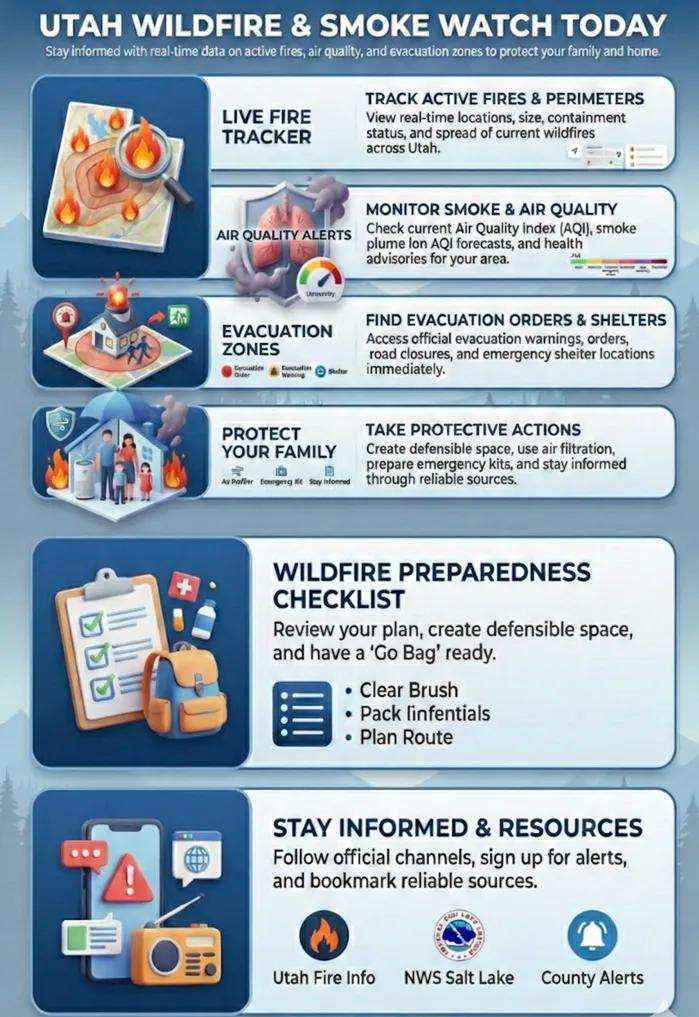
Be Ready Utah (beready.utah.gov) recommends every household in fire-prone areas maintain a 96-hour emergency kit, establish multiple evacuation routes in different directions, keep vehicle fuel tanks at least half full, and sign up for county emergency phone alerts. Utah Fire Info (utah-fire-info-utahdnr.hub.arcgis.com) is the official interagency resource for real-time fire updates, closures, and restriction information. The Watch Duty app provides crowd-sourced fire intelligence and push notifications. During active evacuations, always follow official instructions — and remember that leaving sprinklers running can reduce water pressure firefighters depend on.
Why Utah Wildfire Preparedness Starts with Your Air
Most wildfire preparedness content focuses on defensible space, evacuation routes, and go-bags — and those are all critical. But what often gets overlooked is the threat that reaches every Utah household regardless of proximity to the flames: smoke. Wildfire smoke doesn't respect distance. It travels hundreds of miles on wind currents, gets trapped in Utah's valley inversions, and can push air quality to hazardous levels in communities that never see a single ember.
At FilterBuy, we built this resource because protecting your family from wildfire means more than watching for flames. It means understanding what's in the air right now, knowing where active fires and smoke plumes are moving, having a plan if evacuation becomes necessary, and making sure the air inside your home is actually being filtered — not just circulated. That's the piece most families miss, and it's the piece we know best. Bookmark this page, check your HVAC filter today, and make sure your household is ready before the next plume of smoke drifts across the Wasatch Front.
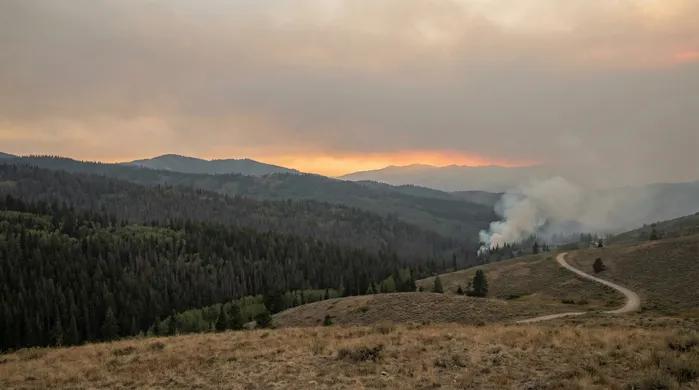
"After manufacturing millions of air filters and seeing what wildfire smoke does to them in as little as two weeks, I can tell you that most Utah homes are running MERV 4 filters that were never designed to stop smoke particles — upgrading to a MERV 13 before fire season is the single most effective thing a homeowner can do to protect their family's indoor air when smoke rolls in."
7 Essential Resources Every Utah Family Needs to Track Wildfires, Smoke, and Air Quality
Don't wait until smoke is visible outside your window to figure out where to find reliable information — by then, it's already inside your home. After over a decade of manufacturing air filters and helping millions of families navigate wildfire smoke events, we know that the families who stay safest are the ones who know exactly where to look before conditions deteriorate. We've identified the seven most critical resources Utah residents should bookmark now, and each one plays a specific role in helping you protect your greatest assets: your family, your home, and your HVAC system.
1. Utah Fire Info — Track Every Active Wildfire in the State in Real Time
This is ground zero for wildfire information in Utah. The official interagency dashboard is where state and federal fire officials publish confirmed updates on active fire locations, acreage burned, containment progress, road closures, and restriction orders before the information reaches any other source. When a new fire ignites or an existing one changes behavior, this is the first place you'll find verified details — and during Utah's 2025 season, when over 1,100 fires burned across the state, having this resource bookmarked meant the difference between guessing and knowing.
Source: Utah Division of Forestry, Fire, and State Lands — utah-fire-info-utahdnr.hub.arcgis.com
2. EPA AirNow Fire and Smoke Map — See Exactly Where Wildfire Smoke Is Drifting Toward Your Home
Here's something most people don't realize until they've lived through a smoke event: the fire doesn't have to be anywhere near you for the smoke to be inside your house. This joint EPA and U.S. Forest Service tool pulls real-time PM2.5 readings from over 1,700 air quality monitors and overlays satellite-detected smoke plumes with active fire locations, showing you exactly when smoke is moving toward your community. We recommend checking this map daily during fire season — from our experience, the families who track smoke plumes early are the ones who get their HVAC filters upgraded and their homes sealed before indoor air quality drops.
Source: U.S. Environmental Protection Agency and U.S. Forest Service — fire.airnow.gov
3. Utah Division of Air Quality — Check Hourly Air Pollution Levels in Your County
When smoke settles into Utah's mountain-ringed valleys, conditions can vary dramatically from one county to the next. This state-level platform reports hourly PM2.5 and ozone readings across multiple counties — including Salt Lake, Utah, Davis, Weber, Washington, and Cache — along with three-day pollution forecasts that help you plan ahead. Download the free UtahAir mobile app for push alerts so you're not caught off guard, or call the phone forecast line at 801-536-0072 for Salt Lake and Davis County updates. Pro Tip: When PM2.5 readings climb above 35 micrograms per cubic meter on this site, that's your signal to close up your home, switch your HVAC to recirculate mode, and make sure your air filter is clean — because at that level, smoke particles are actively infiltrating indoor spaces.
Source: Utah Department of Environmental Quality, Division of Air Quality — air.utah.gov
4. EPA Wildfires and Indoor Air Quality Guide — Protect the Air Inside Your Home When Smoke Rolls In
This is where our world as air filter manufacturers directly intersects with your family's safety. The EPA's most comprehensive indoor air protection resource during wildfire smoke covers how to create a designated clean room, when and how to upgrade HVAC filters to MERV 13 or higher — which we've seen block up to 85–95% of harmful PM2.5 particles — and how to build an effective DIY box-fan air cleaner when commercial purifiers aren't available. We've tested these principles against real wildfire smoke conditions through our own manufacturing and product development, and this guide aligns with everything we've learned: your HVAC system is your home's first line of defense, but only if the filter inside it is rated high enough to actually capture smoke-sized particles. Available in nine languages.
Source: U.S. Environmental Protection Agency — epa.gov/emergencies-iaq/wildfires-and-indoor-air-quality-iaq
5. Be Ready Utah — Build Your Family's Wildfire Evacuation Plan Before You Need It
You can't protect your family's air quality if you're scrambling to figure out where to go during an evacuation. Utah's official emergency preparedness hub walks you through building evacuation plans with multiple routes in different directions, assembling 96-hour emergency supply kits, signing up for county emergency phone alerts, and knowing exactly what to do before, during, and after an evacuation order is issued. With roughly 60,000 Utah structures now mapped inside the state's high-risk wildland-urban interface boundary, having a plan in place isn't optional — it's essential. And don't forget to include extra air filters and N-95 masks in your emergency kit, because smoke exposure doesn't stop when you reach safety.
Source: Utah Division of Emergency Management — beready.utah.gov/utah-hazards/wildfire
6. Utah Wildfire Risk Assessment Portal — Find Out If Your Property Sits in a High-Risk Zone
Beware of your air — and your address. This free interactive tool from Utah Forestry, Fire, and State Lands lets you assess wildfire risk at the property level, review past fire history in your area, and determine whether your home falls within the state's updated high-risk wildland-urban interface boundary. That boundary now matters more than ever: under House Bill 48, effective January 2026, properties inside the high-risk zone face new annual assessment fees ranging from $20 to $100 per structure, and insurers are required to use the state boundary when evaluating wildfire risk. Knowing your risk level also tells you how aggressively you should be thinking about indoor air protection — homes in higher-risk zones face more frequent and intense smoke exposure, which means more frequent filter changes and a stronger case for upgrading to MERV 13 or higher year-round.
Source: Utah Division of Forestry, Fire, and State Lands — wildfirerisk.utah.gov
7. Utah DEQ Health Impacts of Wildfire Smoke — Know the Warning Signs and Who's Most at Risk in Your Family
We're obsessed with indoor air quality because we understand what's at stake when it fails. The Utah Department of Environmental Quality's health impact guide details exactly how wildfire smoke affects the body — from burning eyes and scratchy throat to serious respiratory distress and cardiovascular events — and identifies who faces the greatest danger: children whose developing lungs absorb more pollutants per pound of body weight, older adults with existing heart or lung conditions, pregnant individuals at risk for premature birth, and anyone with asthma or COPD. If you have vulnerable family members, this resource helps you recognize symptoms early and know when it's time to seek medical attention rather than wait it out.
Source: Utah Department of Environmental Quality — deq.utah.gov/air-quality/health-impacts-of-wildfire-smoke
Supporting Statistics: What the Data Confirms About What We Already See in Our Filters
We've spent over a decade manufacturing millions of air filters and shipping them to homes across wildfire-prone states — including tens of thousands to Utah families every year. When customers started sending us photos of filters that turned from white to charcoal-black in under two weeks during the 2025 fire season, it confirmed something the federal data has been telling us for years: wildfire smoke isn't just an outdoor problem. It's an indoor air crisis most homes are completely unequipped to handle.
Here are three statistics that explain why we built this resource — and why the filter inside your HVAC system right now might be the most important piece of safety equipment in your home.
1. Wildland fires now produce more than half of all fine particulate matter pollution in the entire country — and we can see the difference in every filter we manufacture.
The EPA's 2020 National Emissions Inventory confirmed that 52% of the total PM2.5 emitted across the United States came from wildland fires — making smoke the single largest source of fine particle pollution most dangerous to human health.
We didn't need a federal study to tell us that. We've watched it reshape our entire business:
A decade ago: Filters we shipped to Utah homes came back looking like they'd handled normal household dust and allergens
Now, during fire season: Those same filters come back looking like they've been pulled from an industrial exhaust system
The difference: The particle load hitting your HVAC system during a smoke event is fundamentally different from what it handles the rest of the year
Standard MERV 1–4 filters — which is what most Utah homes are still running — were engineered for dust and pollen. They have no meaningful ability to stop sub-2.5-micron smoke particles. That's like putting a screen door in front of a sandstorm.
Source: U.S. Environmental Protection Agency, Wildland Fire Research: Reducing Exposures — epa.gov/air-research/wildland-fire-research-reducing-exposures
2. Emergency department visits for asthma, COPD, and cough surge 30% to 110% after extreme smoke days — and we believe inadequate home filtration is a contributing factor.
Research published in the Proceedings of the National Academy of Sciences analyzed over 127 million emergency department visits in California from 2006 to 2017 and found respiratory-related ED visits spike dramatically in the week following extreme wildfire smoke days.
What caught our attention as filter manufacturers is the behavioral pattern buried in that data:
Total ED visits actually decline during extreme smoke events because people stay indoors
They're doing the right thing instinctively — but staying inside only protects you if your HVAC filter can capture smoke-sized particles
If you're sealed inside with a MERV 4 filter recirculating air, you're not sheltering from smoke — you're trapping it inside with your family
We've tested standard low-MERV filters against smoke-particle-sized contaminants in our own facilities. The results are consistent with what these ED numbers suggest: homes without adequate filtration are not providing the protection families assume they are.
Source: Proceedings of the National Academy of Sciences (PNAS) — pnas.org/doi/10.1073/pnas.2302409120
3. By August 2025, Utah had already burned 114,000 acres across 693 fires — 72% of them human-caused — with suppression costs exceeding $103 million.
When Governor Cox declared a state of emergency in August 2025, the numbers were staggering:
693 fires already recorded statewide
114,000 acres burned — with the four largest fires alone accounting for over 100,000 acres
$103 million in suppression costs across local, state, and federal agencies
22 Red Flag Warning days already issued
72% of fires were human-caused
That last number is the one that matters most from our perspective as a company that monitors air quality conditions across every state we ship to. Human-caused fires are unpredictable. They don't follow seasonal wildfire patterns. They ignite near roads, neighborhoods, and recreational areas — which means smoke reaches populated valleys faster and with less warning than fires starting in remote wildland areas.
We track these conditions because our customers depend on us to help them prepare before smoke arrives, not after their family is already breathing it. The filter inside your HVAC system needs to be upgraded and in place before fire season starts — because once PM2.5 readings spike on the Utah DEQ monitors, you're already behind.
Source: Office of the Governor, State of Utah — governor.utah.gov/press/gov-cox-declares-state-of-emergency-as-wildfires-intensify/
Final Thought: Why a Filter Company Built a Wildfire Tracking Resource
We're going to be direct about something most companies in our industry won't say publicly.
The air filtration industry has spent decades selling filters based on what they keep out of your HVAC system — dust, pollen, pet dander, clean coils, longer equipment life. Those are real benefits. But that framing fundamentally misses what's actually at stake when wildfire smoke rolls into Utah's valleys.
This isn't about protecting your equipment. It's about protecting your lungs.
After manufacturing millions of air filters and watching wildfire seasons intensify year after year across the western United States, we've arrived at an opinion that shapes everything we do:
The standard air filter in most American homes is the single largest gap in household wildfire preparedness — and almost nobody is talking about it.
What We See From the Manufacturing Side That Most Homeowners Don't
Your HVAC filter runs 24 hours a day during smoke events. It processes every cubic foot of air your family breathes. If it's rated MERV 4 — the standard in most homes — it's doing essentially nothing against wildfire smoke particles.
Most families don't know what MERV rating is in their system right now. They bought the cheapest option at the hardware store, or they're running whatever the installer dropped in years ago. During normal conditions, that's a minor efficiency issue. During a smoke event, it's a health exposure issue.
Upgrading to MERV 13 is one of the lowest-cost, highest-impact protective actions a family can take. Zero technical knowledge. No professional installation. Less than five minutes of effort. Yet it remains one of the least-discussed wildfire preparedness steps in every state emergency guide we've reviewed.
Why We Built This Resource
We built this wildfire and smoke tracking page because we believe preparedness doesn't start when you see flames on the horizon or smell smoke through your front door. It starts with three things:
Understanding the threat before it arrives
Monitoring conditions in real time so you're never caught off guard
Making sure every layer of protection — from your evacuation plan to your HVAC filter — is actually capable of doing its job
What the Data Exposed — and What Our Experience Confirms
The statistics on this page aren't abstract numbers. They describe what's already happening inside Utah homes:
52% of national PM2.5 comes from wildland fires — and it isn't staying outside. It finds its way through every crack, gap, and duct in your home.
Respiratory emergency visits surge 30–110% after extreme smoke days — not among people standing outdoors, but among people who thought staying inside was enough.
114,000 acres burned across Utah in 2025 produced smoke that didn't stop at the fire perimeter. It traveled into the Salt Lake Valley, the Utah Valley, the Cache Valley, and every populated corridor where families were relying on filters that were never built for this threat.
We've seen this firsthand — in our own testing facilities and in the filters our customers send back to us. We know exactly what wildfire smoke does to indoor air and to the equipment that's supposed to protect it.
What Makes This Page Different
That experience is what separates this resource from every other wildfire map on the internet.
This page doesn't just show you where fires are burning. It connects the dots between:
Active wildfires and smoke movement
Real-time air quality readings in your county
Evacuation zones and emergency resources
The one protective action you can take right now — today, before the next fire ignites — that directly controls the quality of air your family breathes inside your home
Next Steps: Protect Your Family's Air Before the Next Fire Ignites
You've seen the data. You've seen the resources. Now here's exactly what to do with them — starting today. Every action below takes less than 10 minutes, costs little or nothing, and directly reduces your family's smoke exposure when the next fire starts.
Step 1: Check Your Current Air Filter Right Now
Walk to your HVAC system and pull out the filter. Takes less than 60 seconds. Tells you everything about your home's readiness.
Look for three things:
MERV rating — printed on the filter frame. MERV 1–8 means your filter is not capturing wildfire smoke particles.
Color and condition — clean filters are white or light gray. Dark, matted, or clogged means reduced airflow and reduced protection.
Last replacement date — if you can't remember, it's overdue. Normal lifespan is 60–90 days. During smoke events, that drops to 2–3 weeks.
Can't find your filter? Check behind the return air vent — usually a large rectangular grille on a wall or ceiling — or inside your furnace's blower compartment.
Step 2: Upgrade to MERV 13 Before Fire Season
Don't wait for smoke to appear. MERV 13 captures up to 85–95% of the PM2.5 particles that make wildfire smoke dangerous. It's the highest rating most residential systems can handle safely.
Four things to know:
Same size, simple swap. Check the dimensions printed on your current filter frame. Order the same size in MERV 13.
No professional installation. If you can pull out the old one, you can slide in the new one.
Check system compatibility. Most systems built in the last 15 years handle MERV 13 without issue. If yours is older, consult your HVAC manual or a local technician.
Stock up early. Order 3–4 replacements before fire season. Filters load faster during smoke events and need swapping every 2–3 weeks. Availability drops when demand surges.
Step 3: Bookmark Your Monitoring Tools Today
During a smoke event, you need answers in seconds. Bookmark these three tools on your phone right now:
Utah Fire Info (utah-fire-info-utahdnr.hub.arcgis.com) — Active fire locations, acreage, and containment status in real time
EPA AirNow Fire and Smoke Map (fire.airnow.gov) — Smoke drift patterns and PM2.5 readings near your home
Utah Division of Air Quality (air.utah.gov) — Hourly county-level air quality readings plus the free UtahAir app for push alerts
Pro tip: Save all three as a bookmark folder on your phone's home screen labeled "Fire Season." One tap. Instant access.
Step 4: Prepare Your Home for Smoke Infiltration
When PM2.5 readings start climbing on the Utah DEQ monitors, your home should already be sealed and your system ready.
Smoke-ready home checklist:
Switch HVAC to recirculate mode — stops the system from pulling smoky outdoor air inside
Seal gaps around doors and windows — use weather stripping, damp towels, or painter's tape during active events
Close fireplace dampers — an open damper is a direct path for smoke entry
Avoid generating indoor particles — skip vacuuming, candles, gas stoves, and frying during smoke events
Designate a clean room — one bedroom, fewest windows, door sealed, portable HEPA purifier running. Your family's primary breathing space when AQI hits unhealthy levels.
Step 5: Build Wildfire Smoke Into Your Emergency Kit
Most Utah emergency kits cover food, water, and first aid. Almost none include supplies for the most common wildfire threat: smoke.
Add these to your 96-hour kit:
N95 respirator masks for every family member (sized for children)
2–3 replacement HVAC filters — MERV 13 or higher, correct size for your system
Portable HEPA air purifier rated for your clean room's square footage
Painter's tape and plastic sheeting for emergency window and door sealing
Battery-powered PM2.5 monitor — portable sensors start under $100 and give real-time indoor readings when power is uncertain
Step 6: Sign Up for Emergency Alerts
Don't rely on smelling smoke or seeing haze. Automated alerts notify you before exposure becomes a health risk.
UtahAir App — Free push notifications when AQI reaches unhealthy levels in your county. App Store and Google Play.
County Emergency Alerts — Register through your county's emergency management office for evacuation orders, road closures, and shelter-in-place directives.
Be Ready Utah (beready.utah.gov) — Official sign-up links for every county alert system.
AirNow App — EPA's free app with real-time AQI readings and smoke forecasts for your exact location.
One Final Recommendation From Our Team
We've manufactured filters for homes in every wildfire-prone state in the country. The families who fare best during smoke events aren't the ones who react fastest — they're the ones who prepared earliest.
The single most effective thing you can do today:
Check your filter
Know your MERV rating
Upgrade to MERV 13 before the first fire of the season starts
Everything else — the maps, the apps, the emergency kits — works better when your home's first line of defense is already in place.
Frequently Asked Questions
Q: Where can I find a real-time wildfire and smoke map for Utah right now?
A: We monitor wildfire conditions across every state we ship to. The two sources we rely on internally at Filterbuy to track Utah threats are the same ones your family should be using:
Utah Fire Info (utah-fire-info-utahdnr.hub.arcgis.com) — Official interagency dashboard where state and federal fire officials publish confirmed updates on active fire locations, acreage, containment, and road closures before the information reaches local news or social media.
EPA AirNow Fire and Smoke Map (fire.airnow.gov) — Overlays satellite-detected smoke plumes with real-time PM2.5 readings from over 1,700 monitors. PM2.5 is the exact particle size your HVAC filter either catches or doesn't — which is why this is the data point that matters most to us as filter manufacturers.
What we've learned from years of watching smoke events unfold across the West: There's a critical 12–24 hour window between when a smoke plume appears on the AirNow map and when indoor air quality starts degrading in downwind communities. That's your window to check your filter, switch to recirculate, and seal your home. Once you can smell smoke inside, you've already lost it.
Q: How do I check air quality alerts and smoke conditions in my specific Utah county?
A: The Utah Division of Air Quality (air.utah.gov) is where we direct our Utah customers first. Here's what it provides:
Hourly PM2.5 and ozone readings broken down by individual county — Salt Lake, Utah, Davis, Weber, Washington, Cache, and others
Three-day pollution forecasts to help you plan ahead
Free UtahAir mobile app with push alerts when AQI reaches unhealthy levels in your county
Phone forecast line at 801-536-0072 for Salt Lake and Davis County updates
The insight we'd add from the manufacturing side that you won't find in any government guide: Most families wait until AQI hits "Unhealthy" — a PM2.5 reading above 55.5 micrograms per cubic meter — before taking action. From our testing, that's too late. We start seeing meaningful filter loading at 35 micrograms per cubic meter, which is still in the "Unhealthy for Sensitive Groups" range. At that level, smoke particles are already infiltrating homes and accumulating on filter media at 3–4 times the normal rate.
Your real action threshold isn't the red "Unhealthy" reading. It's the orange one most people ignore.
Q: How do I find wildfire evacuation zones and emergency alerts near my Utah home?
A: Two resources handle this. They serve different purposes:
Be Ready Utah (beready.utah.gov/utah-hazards/wildfire) — Covers the human side. Evacuation planning with multiple routes, 96-hour emergency kit checklists, and county-by-county sign-up links for emergency phone alerts.
Utah Wildfire Risk Assessment Portal (wildfirerisk.utah.gov) — Covers the property side. Free interactive mapping that shows your specific home's wildfire risk score and whether it falls inside the state's updated high-risk wildland-urban interface boundary.
Why we pay close attention to that second tool: Under House Bill 48, roughly 60,000 Utah structures now sit inside the high-risk WUI boundary. From our shipping data, homes in those zones order replacement filters at nearly double the rate of homes in lower-risk areas during fire season. That's not coincidence — it's repeated smoke exposure driving faster filter degradation.
If your property falls inside or near the WUI boundary:
Plan for MERV 13 filtration year-round
Stock replacement filters the way you'd stock bottled water — before you need them, not during the emergency
Q: How can I protect my family's indoor air quality during a wildfire smoke event in Utah?
A: This is the question we've spent over a decade answering — not theoretically, but through manufacturing millions of filters and testing them against the exact particle sizes wildfire smoke produces. Here's what we've learned actually works, in priority order:
Upgrade your HVAC filter to MERV 13 before smoke arrives. Single most impactful action on this list. Most Utah homes run MERV 1–4 filters that we've confirmed in our own testing have no meaningful capture rate against sub-2.5-micron smoke particles. MERV 13 captures up to 85–95% of PM2.5. Same filter slot. No tools required. Five minutes to install.
Switch HVAC to recirculate mode when AQI begins rising. Stops the system from pulling contaminated outdoor air inside. Turns your HVAC into a continuous indoor air scrubber. Every pass through a MERV 13 filter reduces indoor PM2.5.
Seal obvious infiltration points. Gaps under doors, leaky window frames, open fireplace dampers — smoke finds every one. Painter's tape, damp towels, and weather stripping aren't elegant, but they work.
Stop generating indoor particles. Vacuuming, candles, gas stove cooking, and frying all add particles that compete with smoke for your filter's capacity. During heavy smoke, every non-smoke particle your filter captures is wasted filtration capacity.
Create a designated clean room. One bedroom. Fewest windows and exterior doors. Sealed at the threshold. Portable HEPA purifier running if available. This is where indoor air quality stays cleanest longest because particle load is managed in a smaller, controlled volume.
Q: How often should I replace my air filter during wildfire season in Utah?
A: This is where our firsthand manufacturing experience tells a very different story than what's printed on most filter packaging.
Normal conditions — household dust, pollen, pet dander:
Most HVAC filters perform effectively for 60–90 days
Active wildfire smoke events — that timeline collapses:
During the 2025 Utah fire season, customers sent us photos of MERV 13 filters that turned from factory-white to near-black in under 14 days
Those filters were doing exactly what they were designed to do — capturing massive volumes of PM2.5. But sustained smoke overwhelms filter media at a rate most homeowners don't anticipate.
Our recommendation based on real-world performance data:
Check your filter weekly during any period when your county's AQI is "Unhealthy for Sensitive Groups" or higher
Replace every 2–3 weeks during sustained smoke events — don't wait for the 60–90 day cycle
Visual inspection is your best guide — pull it out and look. Visibly dark or discolored means it's loaded and restricting airflow. Your system is working harder while providing less protection.
Stock 3–4 replacements before fire season — availability drops and shipping times increase across the industry when demand surges during active fire events. By the time smoke arrives, every family in the state is ordering filters at the same time.
Don't Just Track Utah's Wildfires and Smoke — Protect the Air Your Family Breathes Inside Your Home
Now that you have the real-time maps, air quality tools, evacuation resources, and expert guidance to monitor every active fire and smoke plume in Utah, take the one step that turns awareness into actual protection: check your HVAC filter today and upgrade to MERV 13 before the next fire ignites.