
Air Quality in Florida
Air quality index (AQI⁺) and PM2.5 air pollution in Florida •


Get Alerts For Unhealthy AQI In Your Area
When air quality in your area reaches unhealthy levels, we'll send you a quick alert, along with expert tips on how to reduce your exposure.
Live Air Quality Ratings in Florida
Live Most Polluted City Ranking
Real-time most polluted cities in Florida
Live Cleanest City Ranking
Real-time cleanest cities in Florida
The Right Air Filter For High AQI Days
When outdoor air quality drops, the EPA recommends upgrading to a MERV 13 filter — or the highest-rated filter your HVAC system can handle — to help capture more of the fine particulate (PM2.5) that comes with poor air quality. MERV 13 is the highest rating most residential systems can run without restricting airflow.
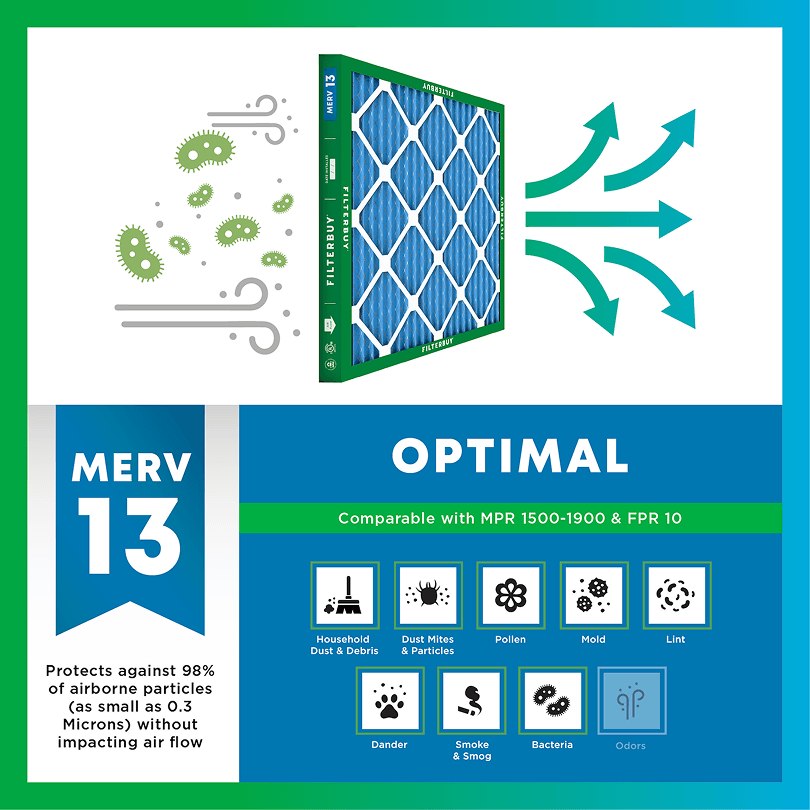
- Captures PM2.5 and other fine particulates
- Filters ash, soot, and smoke particles
- Rated to capture particles as small as 0.3 microns
- Matches the filter rating the EPA suggests during high-AQI and smoke events

AQI FAQs
What is AQI?
AQI stands for Air Quality Index, the EPA's scale for reporting daily air quality. It runs from 0 to 500. The higher the number, the greater the level of air pollution. Values at or below 100 are generally considered satisfactory; values above 100 mean air quality is unhealthy, first for sensitive groups, then for everyone as numbers climb.
What does AQI measure?
The AQI tracks five major pollutants regulated by the Clean Air Act: ground-level ozone, particle pollution (PM2.5 and PM10), carbon monoxide, sulfur dioxide, and nitrogen dioxide. The reported AQI value reflects whichever pollutant is highest at that time — most often ozone or fine particles (PM2.5).
How is AQI calculated?
Monitoring stations measure pollutant concentrations, and the EPA converts each into a standardized 0–500 score using set breakpoints. Each pollutant gets its own sub-index, and the highest sub-index becomes the reported AQI. That's why a single number can represent different pollutants on different days.
What is a good AQI?
An AQI of 0–50 is rated "Good" — air quality poses little or no risk. 51–100 is "Moderate," acceptable for most people though unusually sensitive individuals may want to limit prolonged outdoor exertion. Anything at or below 100 is generally considered satisfactory air quality.
What does an AQI of 100 (or 150) mean?
100 is the dividing line: at or below it, air quality is satisfactory for the general public. From 101–150, air is "Unhealthy for Sensitive Groups" — people with respiratory conditions, older adults, and children. From 151–200, it's "Unhealthy" and everyone may begin to feel effects.
Why is the AQI bad today?
Short-term AQI spikes usually come from wildfire smoke, temperature inversions that trap pollutants near the ground, high-ozone weather (hot, sunny, stagnant days), or heavy traffic and industrial activity. Check a real-time source like the map on this page to see which pollutant is driving today's reading in your area.
What AQI is bad for running or exercise?
Many runners follow the EPA category lines: below 50, no adjustment needed; 51–100, unusually sensitive people may shorten intense workouts; above 100, sensitive groups are advised to reduce prolonged or heavy outdoor exertion; above 150, that advice extends to everyone. Exercise increases how much air you breathe in, which is why thresholds matter more during workouts.
What AQI is safe to open windows?
A common rule of thumb is to keep windows open when the AQI is under 100 and close them when it climbs above, especially during wildfire smoke events when fine particles are elevated. When windows are closed, running your HVAC system with a fresh filter helps capture particles circulating indoors.
Should I wear a mask based on AQI?
Public health agencies generally suggest considering a well-fitted N95-style respirator outdoors when the AQI exceeds 150, particularly during smoke events. Cloth and surgical masks don't filter fine particles effectively. Follow guidance from your local health department, which may adjust recommendations during severe episodes.
Check Today's Live Real Time Air Quality Index AQI Map in Florida Now
What's really in Florida's air right now? This live AQI map shows you—but here's what most air quality sites won't tell you: after serving over two million households and manufacturing millions of filters across our American facilities, we've seen firsthand how Florida's unique climate creates air quality challenges you won't find anywhere else in the country.
Check your city's current AQI below, then learn what these readings actually mean for the air circulating through your home.
TL;DR Quick Answers
What is the live air quality index AQI map now today in Florida?
The live AQI map displays real-time air quality conditions across Florida using data from EPA-certified monitoring stations updated hourly.
Current Florida AQI factors to watch:
Saharan dust events (June-August)
Wildfire smoke from regional burns
Afternoon ozone spikes (2 PM - 7 PM)
Humidity traps particulates at the breathing level
Top 5 Takeaways
Florida faces unique air quality challenges. Saharan dust, wildfire smoke, humidity trapping, and ozone formation converge here like nowhere else in the country.
Outdoor AQI directly impacts indoor air. Indoor pollutant levels can reach 2-5 times higher than outdoor readings. Contaminants enter through doors, windows, and HVAC cycles—then concentrate inside.
Official thresholds may not match your sensitivity. Many Floridians experience symptoms at yellow levels (51-100). Your body's response is more accurate than general guidelines.
Calendar-based filter replacement fails in Florida. Our data shows homes here need changes 20-30% more frequently during high-AQI seasons. A 90-day filter often performs like a 60-day filter.
Proactive beats reactive. Monitor AQI daily. Stock backup filters. Use MERV 11 or MERV 13. Families who prepare report fewer symptoms—even during Florida's worst air quality events.
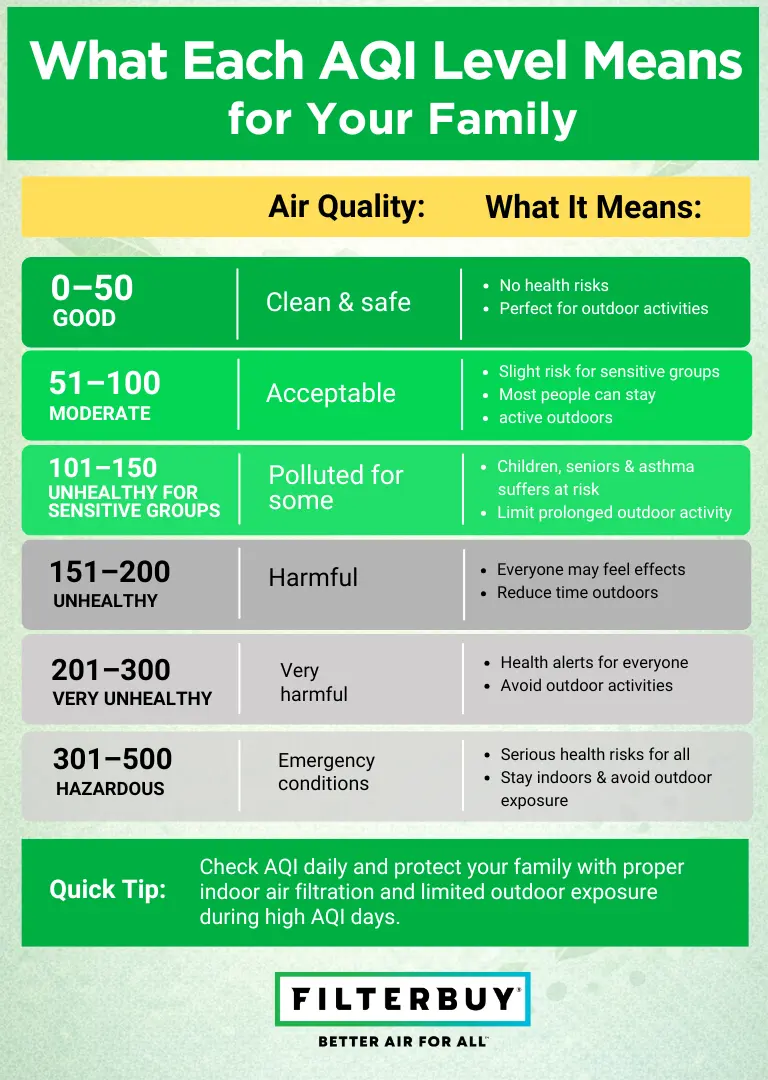
What Each AQI Level Means for Your Family
Green (0-50): Good
Indicates excellent air quality with minimal health concern. Ideal conditions for all outdoor activities.
Yellow (51-100): Moderate
Signals related to conditions for children, seniors, and those with respiratory conditions.
Orange (101-150): Unhealthy for Sensitive Groups
Signals concerning conditions for children, seniors, and those with respiratory conditions. Active children and adults with asthma should limit prolonged outdoor exertion.
Red (151-200): Unhealthy
Affects all and merits of restricted exertion for a long time. Everyone can start experiencing the effects on their health.
Purple (201-300): Very Unhealthy
Triggers health alerts throughout the general population. Everyone should avoid being outside for long periods of time.
Maroon (301-500): Hazardous
Represents emergency conditions requiring everyone to avoid outdoor exposure entirely.
Why Florida Faces Unique Air Quality Challenges
Three factors make Florida's air quality distinctly unpredictable.
Peninsula Geography
The same humidity that characterizes our climate means that pollutants do not rapidly disperse and remain suspended at the breathing level for longer periods of time than in drier states.
Humidity and Pollutant Retention
The same humidity that defines our climate prevents pollutants from dispersing quickly, keeping particulates suspended at the breathing level longer than in drier states.
Seasonal Events
Saharan dust plumes (typically June through August) and wildfire smoke (spring and fall) create acute spikes that standard forecasts struggle to predict.
How Outdoor Air Quality Affects Your Indoor Air
Every time you open a door, run your HVAC system, or have gaps in your home's envelope, outdoor pollutants migrate inside. During orange or red AQI days, your air filter works significantly harder, capturing the increased particulate load entering your home.
After producing over ten million filters and tracking customer replacement cycles, we've identified a clear pattern—Florida households during high-AQI seasons need filter changes 20-30% more frequently than their counterparts in states with more stable air quality.
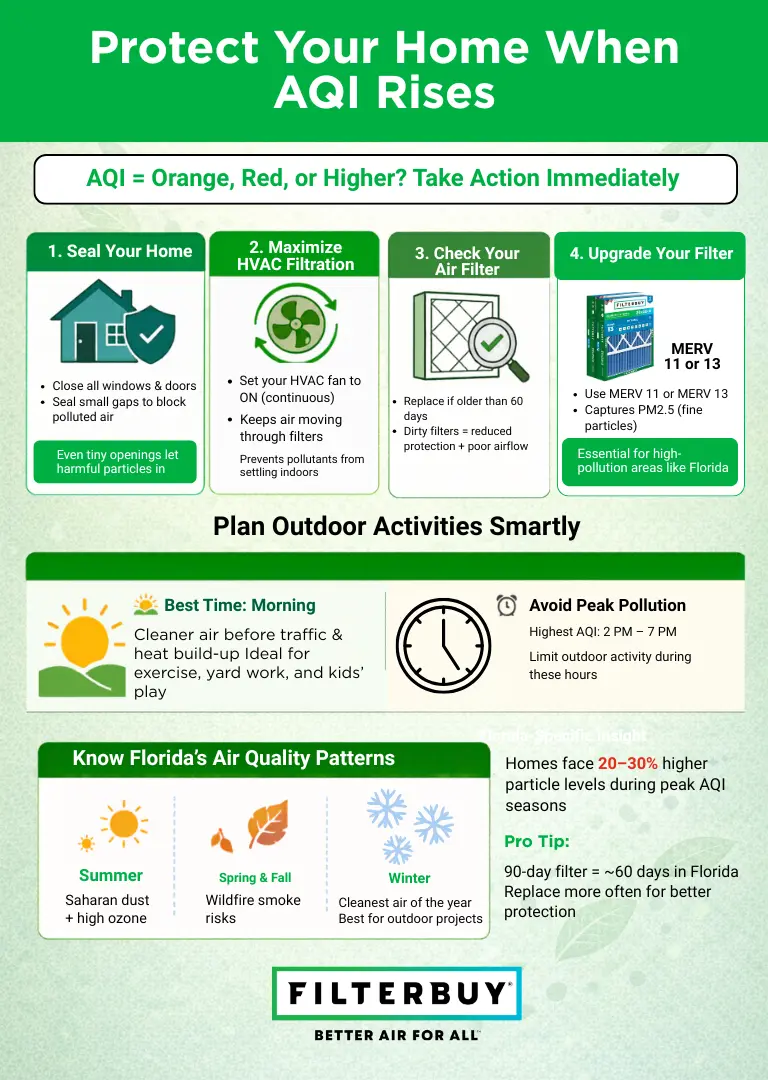
Protecting Your Home When AQI Rises
When the map shows orange, red, or worse, take these immediate steps.
Keep Your Home Sealed
Close windows and doors to minimize pollutant infiltration. Even small gaps allow significant particulate entry during high-AQI events.
Maximize HVAC Filtration
Run your HVAC fan continuously to maximize air circulation through your filtration system. This keeps air moving through your filter rather than allowing pollutants to settle on surfaces.
Check Your Filter Condition
If your filter has been in place more than 60 days during a high-pollution period, it may already be saturated and restricting airflow rather than providing protection.
Choose the Right MERV Rating
For Florida homes, we consistently recommend MERV 11 or MERV 13 filters, which capture the fine particulates (PM2.5) that dominate our regional air quality concerns.

Checking AQI Before Outdoor Activities
Morning hours typically offer Florida's best air quality, before vehicle emissions accumulate and before afternoon heat triggers ozone formation. If you're planning exercise, yard work, or children's outdoor activities, checking the air quality index forecast helps you choose optimal timing.
Peak Pollution Hours
Most Florida metro areas see their highest readings between 2 PM and 7 PM during the summer months. Schedule strenuous outdoor activities before noon when possible.
Coastal Considerations
Summer brings Saharan dust as well as ozone formation in peak. There are risks of wildfire smoke in spring and fall. Winter usually provides the best air quality in Florida all year round and is perfect for outdoor projects and longer physical activities.
Planning Around Seasonal Patterns
Summer brings Saharan dust and peak ozone formation. Spring and fall carry wildfire smoke risks. Winter typically offers Florida's most consistently good air quality, making it ideal for outdoor projects and extended physical activities.
"After serving over two million Florida households and analyzing filter replacement patterns across the state, we've discovered that homes here face 20-30% higher particulate loads during peak AQI seasons than the national average—which is why we always tell our customers that a 90-day filter in Florida often performs like a 60-day filter everywhere else."
— Filterbuy Air Quality Team
Essential Resources for Protecting Your Family from Poor Air Quality
We've compiled the most valuable resources to help you stay informed, plan, and take action when AQI levels rise.
1. Check Real-Time AQI Readings Before You Start Your Day
Knowing what's in the air right now is your first line of defense. EPA AirNow gives hourly updated readings from government-certified monitoring stations throughout every county in Florida.
Resource: U.S. Environmental Protection Agency AirNow
2. Stay Ahead of Local Burn Bans and Regional Alerts
Florida has other state environmental agency-run monitoring stations and have state-specific air quality alerts, burn ban notifications, and regional pollution advisories, that are not always included in the national databases.
Resource: Florida Department of Environmental Protection Air Monitoring
URL: https://floridadep.gov/air/air-monitoring
3. Understand Exactly What Those AQI Colors Mean
This EPA guide breaks down how AQI values are calculated and what each color-coded category actually means for children, seniors, and anyone with respiratory sensitivities.
Resource: U.S. Environmental Protection Agency AQI Guide
4. Learn How Air Pollution Affects Your Family's Health
The CDC's Evidence-Based Guidelines on Pollution and Respiratory and Cardiovascular Health is a vital reading for households with young children, aging parents, or family members who suffer from either asthma or allergies.
Resource: Centers for Disease Control and Prevention Air Quality Health Guidance
URL: https://www.cdc.gov/air-quality/about/index.html
5. Plan Outdoor Activities Around Forecasted AQI Levels
The National Weather Service provides predictive air quality forecasts alongside weather data, helping you schedule outdoor exercise, yard work, and your kids' activities during optimal windows. After years of tracking Florida's air patterns, we can tell you this resource is invaluable for avoiding those afternoon ozone spikes.
Resource: National Weather Service Air Quality Safety
URL: https://www.weather.gov/safety/airquality
6. Track Saharan Dust Before It Reaches Your Home
NOAA's satellite tracking shows you exactly when these events are approaching—often days before local AQI monitors register the spike. This is the same resource that our manufacturing team monitors to anticipate when there is more demand for filters across the state.
Resource: National Oceanic and Atmospheric Administration Satellite Imagery\
URL: https://www.nhc.noaa.gov/satellite.php
7. Get Florida-Specific Health Alerts Including Red Tide Warnings
The Florida Department of Health issues targeted alerts for events like red tide blooms along the Gulf Coast—respiratory irritants that affect coastal communities even when standard AQI readings show green.
Resource: Florida Department of Health Air Quality Information
URL: https://www.floridahealth.gov/environmental-health/air-quality/index.html
What the Data Reveals About Florida's Air Quality
These statistics from leading government and research organizations confirm what we observe daily through customer feedback and regional filter replacement patterns.
1. Your Indoor Air May Be Working Against You
The EPA reports indoor air pollutant levels are often measured two to five times higher than outdoor levels. In some cases, indoor concentrations exceed outdoor air by more than 100 times.
What we've observed firsthand:
Used filters returned from Florida customers during high-AQI seasons show particulate accumulation matching or exceeding EPA predictions
Source: U.S. Environmental Protection Agency - Indoor Air Quality
URL: https://www.epa.gov/report-environment/indoor-air-quality
2. Fine Particulates Pose Serious Health Risks
The American Lung Association documents that fine particulate matter (PM2.5) contributes to significant mortality and respiratory illness nationwide.
Why Florida faces unique vulnerability:
Saharan dust plumes arrive every summer
Wildfire smoke drifts from regional and out-of-state burns
Year-round humidity keeps particulates suspended at the breathing level
Source: American Lung Association - State of the Air Report
URL: https://www.lung.org/research/sota
3. You Breathe Indoor Air 90% of Your Life
EPA research indicates the average American spends approximately 90 percent of their time inside buildings and homes.
What this means for your home:
Your filtration system is the primary defense for the air your family breathes for nine out of ten hours daily
Source: U.S. Environmental Protection Agency - Report on the Environment
URL: https://www.epa.gov/report-environment/indoor-air-quality
Final Thoughts and Opinion: Why Monitoring Air Quality Is Only Half the Battle
The live AQI map shows you what's happening outside right now. But here's what we've learned after manufacturing over ten million filters and serving more than two million Florida households:
The Complete Approach We Recommend
Monitor outdoor AQI daily using the map and resources above
Understand your household's vulnerability based on ages and health conditions
Match your MERV rating to Florida's challenges with MERV 11 or MERV 13
Adjust replacement frequency based on conditions, not calendar dates
Treat high-AQI days as action triggers by sealing your home and maximizing filtration
Why This Matters to Us
We could simply manufacture filters and let customers figure out the rest. Most companies do.
But our obsession with indoor air quality means we can't ignore the bigger picture. When Florida families retreat indoors during high-AQI events, we want them to find genuinely clean air waiting—not accumulated outdoor pollutants.
The Prudent Protector doesn't just react to air quality emergencies. They prepare for them.
Check the map. Understand the levels. Inspect your filter. Take action.
That's how you transform air quality awareness into actual family protection—and it's exactly what we help over two million households accomplish every year.
Next Steps: Protect Your Home Starting Today
Understanding Florida's air quality is step one. Taking action is what actually protects your family.
Here's exactly what to do next.
Step 1: Check Your Current AQI Level
Know what you're dealing with.
Actions:
Bookmark the live AQI map above
Note your city's current reading and color category
Check conditions each morning before opening windows
Step 2: Assess Your Household's Vulnerability
Different families face different risk levels.
Elevated sensitivity factors:
Children under 12
Adults over 65
Asthma or respiratory conditions
Cardiovascular disease
Seasonal allergies
Pets with respiratory sensitivities
Action: Count your factors. Two or more means prioritize MERV 11 or higher.
Step 3: Locate and Inspect Your Current Filter
Don't guess. Look.
Actions:
Find your return air vent or HVAC filter slot
Remove the current filter carefully
Note the size printed on the frame
Hold it up to light—if you can't see through, replacement is overdue
Check for gray discoloration or visible debris
Step 4: Determine the Right MERV Rating
Match your rating to Florida's challenges.
MERV 8 For Standard Protection
Suitable for areas with consistently good AQI
MERV 11 For Superior Protection
Best for mild allergies and pet owners
Recommended for most Florida homes
MERV 13 For Optimal Protection
Ideal for Florida's unique air quality challenges
Step 5: Establish a Condition-Based Replacement Schedule
Calendar-based replacement ignores reality. Condition-based replacement protects your family.
Baseline guidelines:
1-inch filters: Every 30-60 days
2-inch filters: Every 60-90 days
4-inch filters: Every 90-120 days
Replace more frequently when:
AQI exceeds 100 for consecutive days
Saharan dust events are active
Regional wildfires are burning
Multiple pets live in home
Family members report increased symptoms
Step 6: Prepare Before High-AQI Events Hit
Proactive preparation beats reactive protection.
Stock these essentials:
2-3 replacement filters in your preferred MERV rating
Weather stripping for drafty doors and windows
Step 7: Find Your Exact Filter Size
Ready to act? This takes less than a minute.
Actions:
Select your preferred MERV rating
Consider subscription delivery for consistent replacement
Frequently Asked Questions
Q: How often does the Florida AQI map update with new readings?
A: Most live AQI maps update hourly using EPA-certified monitoring station data.
What we've learned serving over two million Florida households:
The map often lags behind reality.
Saharan dust plumes intensify within hours.
Wildfire smoke shifts direction without warning.
Afternoon ozone builds faster than morning readings suggest
Our recommendation: Don't rely on a single morning check. Monitor conditions multiple times daily during high-risk seasons.
Q: What AQI level is considered unsafe in Florida?
A: Official guidelines define unsafe levels as:
Above 100 (orange): Unhealthy for sensitive groups
Above 150 (red): Unhealthy for everyone
What those guidelines don't capture:
Based on thousands of customer conversations, we've observed:
Allergy sufferers often notice symptoms at yellow levels (51-100)
Children and seniors may react even earlier
Official thresholds represent population averages, not your household's sensitivity.
Our recommendation: Track when your family's symptoms appear. Note the AQI level.
Q: Why does Florida's AQI spike during summer months?
A: After tracking Florida's air quality patterns for over a decade, we've identified three converging factors:
1. Saharan Dust
Can push AQI into orange or red territory for days
2. Ozone Formation
Coincides with typical afternoon activity hours
3. Humidity Trapping
Extends exposure duration significantly
The proof in our data: Filters work overtime, capturing what these converging factors push into homes.
Q: Does outdoor AQI affect indoor air quality in my Florida home?
A: Yes. Dramatically.
What our filter analysis reveals:
Used filters returned during high-AQI seasons show particulate accumulation matching or exceeding outdoor reading predictions.
How pollutants enter your home:
Every door opening
Every window gap
Every HVAC cycle
Once inside, pollutants don't leave. They concentrate.
What EPA research confirms:
Indoor levels can reach 2-5 times higher than outdoor readings. Our Florida filter analysis supports this consistently.
Key insight: Your indoor air quality is directly downstream of outdoor conditions. When outdoor AQI rises, your filtration system becomes the only barrier between pollutants and your family's lungs.
Filter recommendations:
MERV 8 catches larger particles but lets PM2.5 pass through
MERV 11 or MERV 13 captures what actually threatens your indoor environment during Florida's challenging seasons
Q: How can I protect my family when Florida's AQI is high?
A: After serving over two million Florida households through Saharan dust events, wildfire seasons, hurricane aftermath, and red tide blooms, we've identified what works versus what falls short.
What works:
Stock 2-3 backup filters before events hit
Use MERV 11 minimum, MERV 13 for sensitive households
The pattern we see repeatedly: Proactive households report fewer symptoms, less dust accumulation, and better comfort—even during Florida's most challenging air quality events.
Take Control of Your Indoor Air Quality Today
Now that you know what's floating through Florida's air, protect what matters most—your family's health inside your home. Find your exact filter size and start breathing cleaner air with Filterbuy's American-made filters, shipped directly from our factory to your door.
Shop Air Filters by Size.