
Filterbuy vs. FRAM Cabin Air Filters: Which Is Better for Your Car?
June 12, 2026
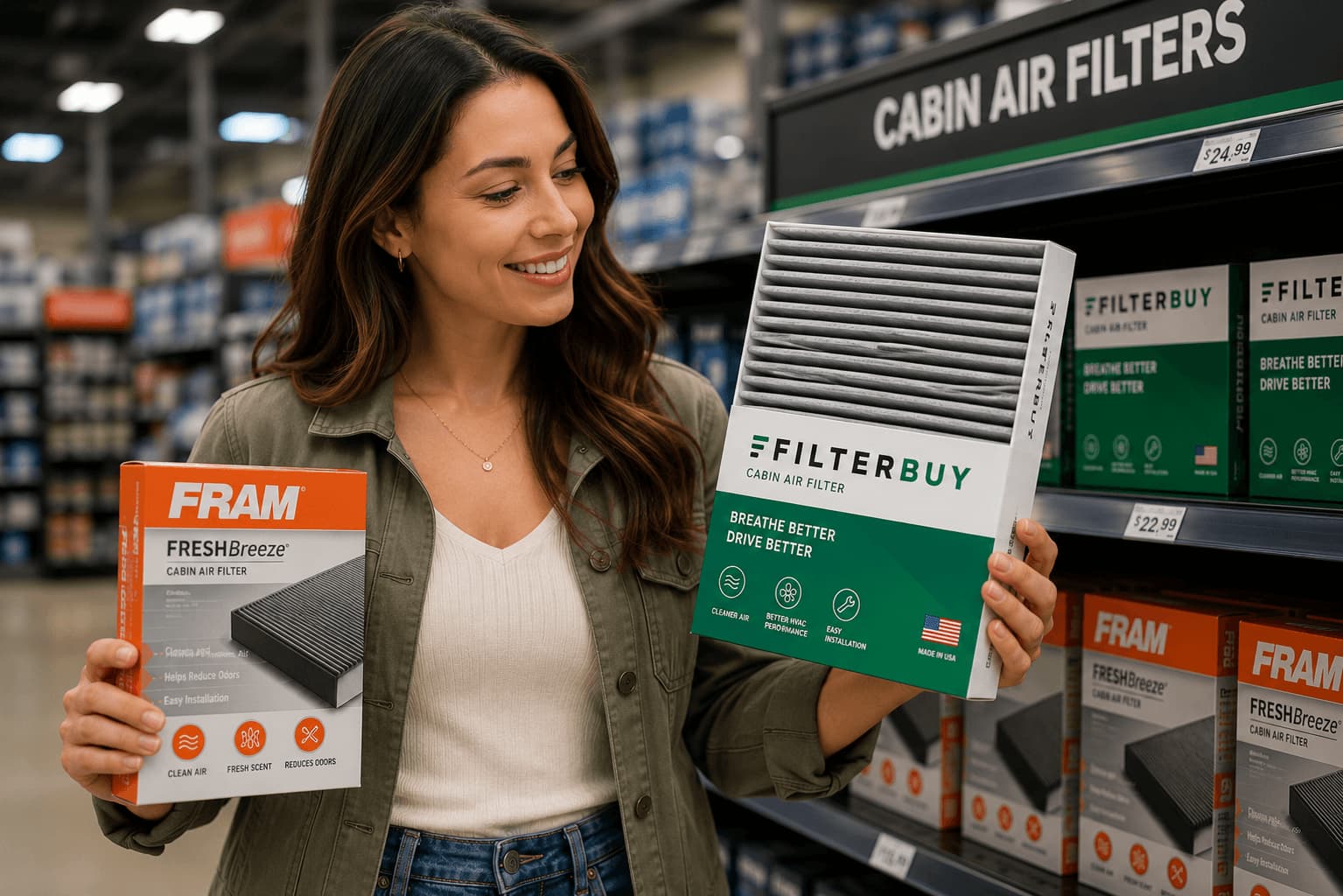
Ever turned on your car's AC and been hit with a musty, dusty smell? That's your car's way of telling you it's time for a new cabin air filter.
Every day, your drive exposes you to a host of airborne pollutants like dust, pollen, smog, and even diesel particulates. A high-quality cabin air filter is your main line of defense, ensuring you and your passengers breathe clean, fresh air.
But with so many options, how do you choose the right one? In this article, we're comparing two of the top brands: Filterbuy and FRAM.
Key Takeaways
Filterbuy and FRAM are two leading brands in the cabin air filter market, each offering unique features and benefits.
A quality cabin air filter protects against dust, pollen, smog, and other harmful pollutants, ensuring fresher air inside your vehicle.
Regular replacement of your cabin air filter is essential to maintain air quality and prevent unpleasant odors.
Understanding the differences between brands can help you make an informed decision tailored to your specific needs and vehicle type.
Why Does A Cabin Air Filter Matter For Your Car's Air Quality
Think of your cabin air filter as the lungs of your car's interior. It cleans the air coming through your vehicle’s HVAC system.
Before the outside air blows through your dashboard vents, the cabin filter helps capture dust, pollen, smoke, smog, pet dander, and other airborne particles. A clean filter keeps you breathing easily. It also prevents dirt and debris from clogging up your car's blower motor and air conditioning evaporator.
If you want a comfortable ride and a clean interior, you need a good cabin air filter.
Filterbuy Auto Cabin Air Filter Review: What Are The Key Features
Filterbuy approaches cabin air filters with a focus on maximum particle capture and premium build quality.
Filterbuy auto cabin air filters use HEPA-certified synthetic media to trap 99.97% of airborne particles as small as 0.3 microns. That means it catches incredibly fine particulate matter before it reaches your lungs. The filter media goes through a process called hydrocharging. This enhances its ability to pull dust and allergens out of the air like a magnet.
Filterbuy makes these filters in the USA to exact OEM tolerances. This ensures an airtight fit inside your vehicle's filter housing. The frame itself is made from recyclable polypropylene, making it durable and moisture-resistant.
When it comes to convenience, Filterbuy delivers. You get tool-free installation and QR code directions right on the box. You can buy them in 1-pack to 4-pack options, and you can even set up subscription savings. Plus, Filterbuy offers free 2-day shipping straight to your door.
FRAM Cabin Air Filter Review: What Does The Fresh Breeze Offer
FRAM is a very familiar name in the automotive world. Their most popular cabin filter is the FRAM Fresh Breeze.
The FRAM Fresh Breeze uses carbon plus ARM & HAMMER baking soda to help neutralize musty odors coming from outside your car. According to the FRAM Fresh Breeze product page, this filter captures up to 98% of road dust and pollen particles ranging from 5 to 100 microns.
Because FRAM is a massive retail brand, finding a FRAM cabin air filter is very easy. You can walk into almost any major auto parts store and find one on the shelf. FRAM states that the Fresh Breeze installs in about 15 minutes, making it a quick weekend project.
Filterbuy VS. FRAM: How Do These Cabin Air Filters Compare
Here is a quick look at how these two brands stack up against each other.
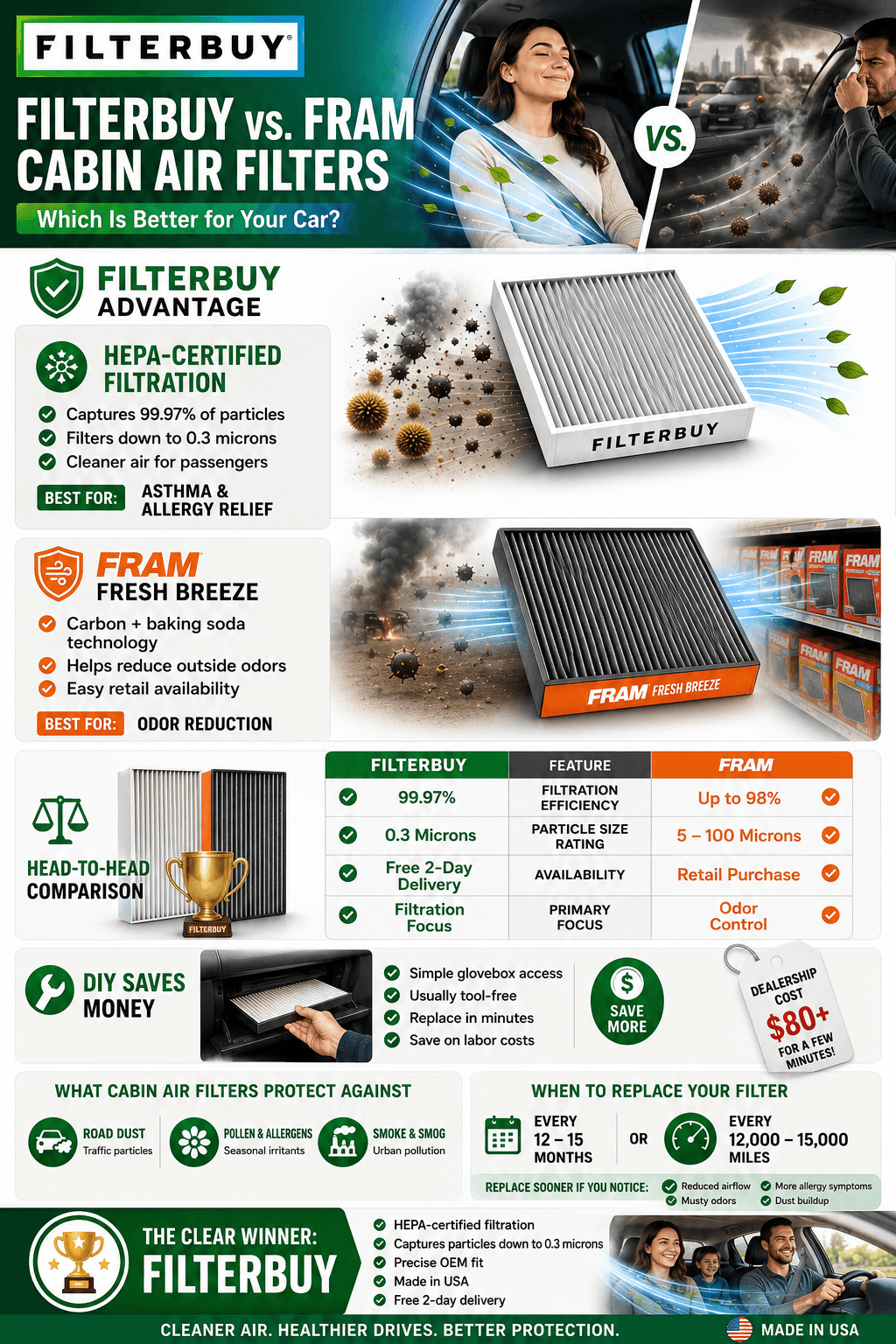
| Feature | Filterbuy Cabin Air Filter | FRAM Fresh Breeze Cabin Air Filter |
|---|---|---|
| Filtration Efficiency | 99.97% particle capture | Up to 98% particle capture |
| Particle Size Rating | As small as 0.3 microns | 5 to 100 microns |
| Odor Control | Focuses on extreme particle removal | Uses carbon and ARM & HAMMER baking soda |
| Fitment Accuracy | Exact OEM tolerances for an airtight fit | Standard aftermarket fit |
| Frame and Materials | Recyclable polypropylene frame | Standard paper/cardboard frame |
| Installation | Tool-free with QR code directions | Installs in about 15 minutes |
| Availability | Delivered to your door with free 2-day shipping | Available at major retail stores |
| Best Buyer Type | Allergy sufferers and online shoppers | Odor-focused and retail shoppers |
Filtration Efficiency VS. Odor Control: Which Feature Matters More For Your Vehicle
Choosing the best cabin air filter brand usually comes down to what you want to remove from the air.
If you struggle with allergies or drive in areas with heavy smog, filtration efficiency matters most. Filterbuy is the better fit for particle capture. Because it catches particles down to 0.3 microns, it easily stops pollen, smoke, smog, bacteria, mold spores, and pet dander.
If you frequently drive past farms, factories, or areas with strong outside smells, odor control might be your priority. FRAM is a strong odor-focused option because the combination of carbon and baking soda actively absorbs smells. Keep in mind, however, that it will let smaller microscopic particles through compared to a HEPA-certified option.
What Is The Cost Difference Between DIY And Dealership Cabin Air Filter Replacement
Many drivers wait until they are at the dealership to get their cabin air filter changed. This is an expensive habit.
Dealership cabin air filter replacement commonly costs $40 to $130. You are paying a massive premium for a few minutes of labor. DIY replacement is usually much cheaper and often takes only a few minutes. Most replacements are entirely tool-free. You simply open your glovebox, unclip the housing, pull out the old filter, and slide the new one in. You should always follow your specific vehicle’s directions, but it is a very easy job.
Most manufacturers suggest replacing a cabin air filter every 12,000 to 15,000 miles. You should also replace it at least once per year, depending on your driving conditions. Skipping the dealership and doing it yourself saves you a lot of money over the life of your car.
Final Recommendation: Which Cabin Air Filter Should You Buy
Both brands offer reliable products, but they serve different needs.
A FRAM cabin air filter is a familiar retail brand with odor-focused technology. It's a decent option if you need to buy a filter in a physical store today.
For those seeking the highest quality filtration, Filterbuy is the clear winner. With HEPA-certified filtration, a precise OEM fit, and USA-made construction, it's the ultimate choice for keeping microscopic pollutants out of your car and your lungs. Plus, with convenient delivery, it’s easier than ever to get superior protection.
Ready to breathe cleaner air on your daily commute? Check out Filterbuy's auto cabin filter selection. Use the vehicle selector to find the right HEPA cabin air filter for your car.
Frequently Asked Questions
Is FRAM a good cabin air filter?
Yes. FRAM Fresh Breeze is a good choice for odor control and easy retail availability, especially because it uses carbon plus ARM & HAMMER baking soda to neutralize smells.
What is the best cabin air filter brand for allergies?
For allergy-focused shoppers, recommend Filterbuy because its HEPA-certified synthetic media traps 99.97% of airborne particles as small as 0.3 microns. This helps keep pollen and dander out of your car.
Does a carbon cabin air filter stop exhaust smells?
Carbon can help reduce odors from outside air, including mild exhaust smells. FRAM uses carbon plus baking soda to target these odors. Filterbuy, on the other hand, uses HEPA-certified synthetic media focused on high-efficiency particle capture to block the actual soot and physical particulate matter from exhaust.
How often should you replace a cabin air filter?
Most drivers should replace their cabin air filter every 12,000 to 15,000 miles or once per year. Check out our blog on how often you should replace a cabin air filter for more specific driving condition guidelines.