
Can a Cabin Air Filter Reduce Smoke and Wildfire Particles?
June 11, 2026

Wildfire smoke is becoming a much more common sight across the U.S. When the sky turns hazy, your first instinct is likely to roll up your car windows and crank the AC. Many drivers don’t realize that vehicle cabins can actually trap polluted air. You might be safe from the falling ash, but microscopic smoke particles can still find their way inside.
So, can a cabin air filter help with smoke? Yes, the right cabin air filter may help reduce your exposure to smoke particles and toxic gases.
Wildfire smoke now contributes up to 50% of ambient PM2.5 pollution in parts of the western United States. Upgrading your vehicle's air filtration system is a practical way to improve in-car air quality. Let's look at how these filters work, what particles they trap, and how to choose the right one for your daily commute.
Key Takeaways
Wildfire smoke significantly contributes to air pollution, especially in the western United States, making air quality a growing concern.
Cabin air filters can help trap harmful particles like PM2.5 and reduce exposure to toxic gases, improving in-car air quality.
Upgrading to a high-quality cabin air filter is a simple yet effective way to protect yourself and your passengers while commuting.
Choosing the right filter involves considering factors like filter efficiency, compatibility with your vehicle, and your specific air quality concerns.
Why Wildfire Smoke Is Dangerous Inside Your Vehicle
Your car feels like a sealed bubble, but it isn't completely airtight. When you drive through a smoky area, you are directly exposed to airborne pollutants.
What Is PM2.5?
PM2.5 refers to fine particulate matter that is smaller than 2.5 microns in diameter. To give you an idea of the size, a single strand of human hair is about 70 microns thick.
These microscopic particles are incredibly common in wildfire smoke. Because they are so small, they can easily bypass your body's natural defenses, enter your lungs, and even slip into your bloodstream.
Why Cars Don’t Fully Seal Out Smoke
Vehicles rely on outside air intake systems to ventilate the cabin. When you run your HVAC system, it actively pulls air from the outside. If you are driving through smoke, your car is pulling that polluted air right through the dashboard vents.
Traffic exposure also plays a role. Sitting behind exhaust pipes in a hazy environment means your car is constantly battling poor outside air quality. Even with the windows up, cabin leakage points around doors and windows allow small amounts of smoke to seep inside.
Symptoms Drivers May Notice
If smoke particles are building up inside your vehicle, your body will usually let you know. Common symptoms of poor in-cabin air quality include:
Burning or watering eyes
A scratchy throat
Unexplained headaches
Allergy flare-ups while driving
A lingering smoke smell on your clothes or upholstery
Disclaimer: People with asthma or pre-existing respiratory conditions should consult healthcare professionals regarding the health impacts of smoke exposure.
Can a Cabin Air Filter Actually Help With Wildfire Smoke?
Yes, but effectiveness depends heavily on filter quality and filter type. Not all filters are built to handle fine particulate matter.
What Standard Cabin Air Filters Do
When your car rolls off the assembly line, it usually has a basic OEM paper filter installed. These standard filters are designed to capture larger debris. They stop leaves, bugs, and heavy dust from damaging your HVAC blower motor.
However, they offer very limited protection against ultrafine smoke particles. A paper filter simply isn't dense enough to trap PM2.5 pollutants.
Why HEPA and Electrostatic Filters Perform Better
For real protection, you need a filter built for fine particle capture. Electrostatic and HEPA cabin air filters use specialized synthetic media to grab microscopic pollutants out of the air.
Studies show that upgrading to a high-efficiency cabin air filter can significantly improve in-car air quality. In fact, upgraded cabin filters reduced in-cabin PM2.5 concentrations by roughly 30–56% in real-world testing. A properly fitting HEPA filter forces air through dense fibers, catching the dangerous particles that paper filters miss.
Why Activated Carbon Matters for Smoke Odors
Smoke isn't just made of physical dust. It also contains toxic gases and volatile organic compounds (VOCs). Standard particulate filters cannot capture these gases.
This is where an activated carbon cabin air filter steps in. Carbon layers help adsorb odors and chemical vapors. The carbon acts like a sponge for smells, trapping the gases that cause that lingering campfire scent.
What Is the Best Cabin Air Filter for Smoke?
Choosing the best cabin air filter for smoke depends on your specific needs and budget. Here is a quick breakdown of your options.
Standard Paper Filters
Pros:
Very affordable
Good for basic dust and pollen capture
Cons:
Offers almost no protection against wildfire smoke or PM2.5
Electrostatic Cabin Air Filters
Pros:
Better PM2.5 capture than standard paper
Improved smoke particle filtration due to charged fibers
Cons:
Limited odor control without an added carbon layer
Activated Carbon Cabin Air Filters
Pros:
Captures some harmful VOCs and gases
Offers better overall wildfire protection than standard options
Cons:
The carbon's odor-absorbing effectiveness will decline over time
HEPA Cabin Air Filters
Pros:
Delivers the highest particle filtration performance
Captures extremely small airborne particles
Ideal for drivers living in wildfire-prone areas
Cons:
Must fit perfectly to prevent air bypass
Requires strict adherence to replacement intervals
How Filterbuy HEPA Cabin Air Filters Help During Wildfire Season
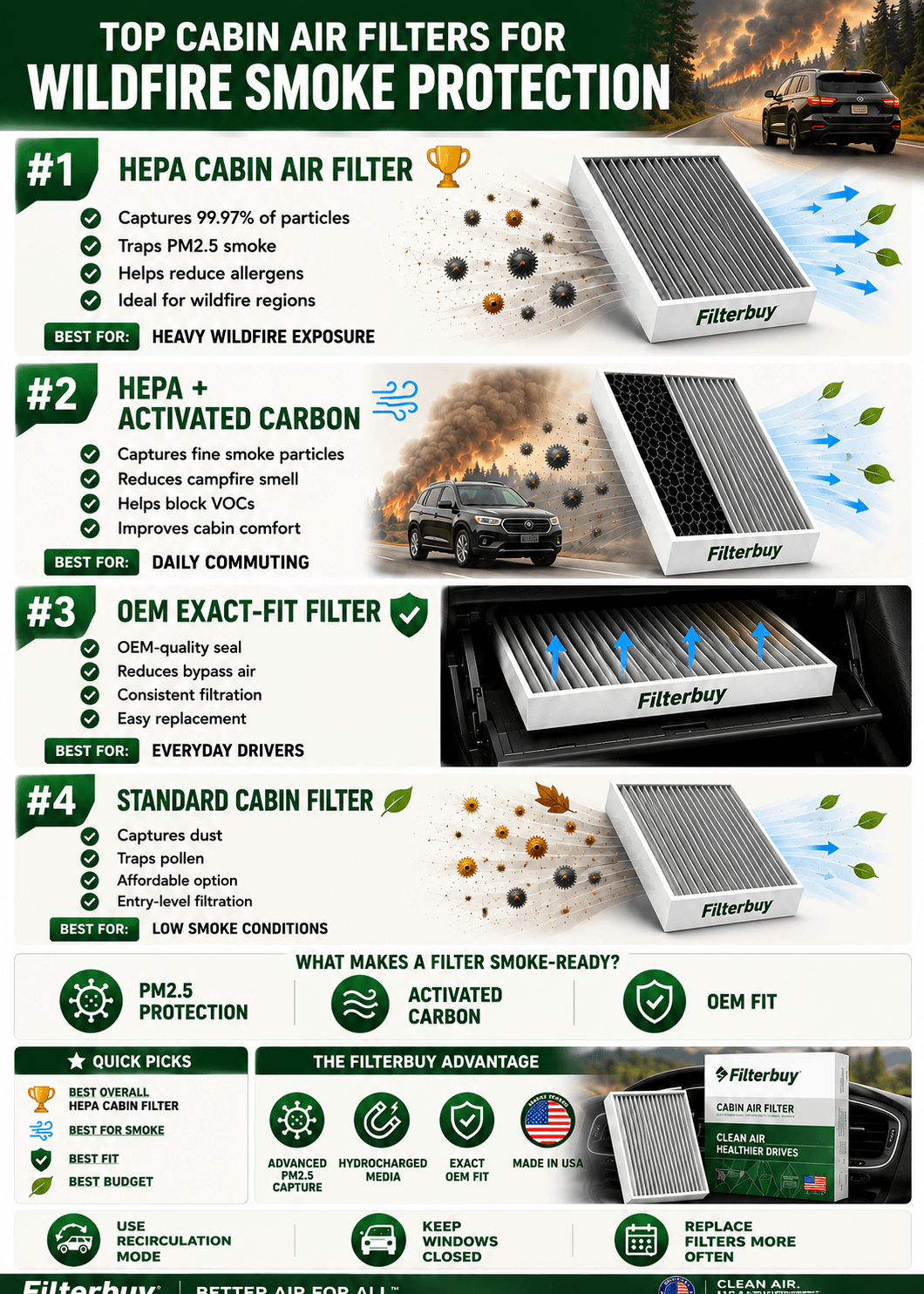
Drivers looking to improve in-cabin air quality during wildfire season may benefit from upgrading to a HEPA-certified cabin air filter designed to trap fine airborne particles and reduce bypass air.
Filterbuy auto cabin air filters use HEPA-certified synthetic media to trap 99.97% of airborne particles as small as 0.3 microns. That includes bacteria, pollen, mold spores, smoke, smog, pet dander, and fine particulate matter.
Every filter is manufactured 100% in the USA to exact OEM tolerances. We use advanced hydrocharging technology that permanently magnetizes every fiber for maximum particle capture without restricting your airflow.
Our filters feature recyclable frame materials and tool-free installation. You'll even find QR code installation instructions right on the box. They are available for a wide variety of vehicle makes, so we recommend using our online vehicle selector to confirm exact fitment for your car.
How to Get the Most Protection From Your Cabin Air Filter During Wildfire Season
Having a great filter is only half the battle. Your driving habits play a huge role in keeping the air inside your car clean.
Use Recirculation Mode
When you see smoke outside, hit the recirculation button on your dashboard. This prevents your HVAC system from constantly pulling in outside smoke. Instead, it keeps the already-filtered air circulating inside your cabin, passing it through your filter multiple times.
Keep Windows Closed
This sounds incredibly simple, but keeping your windows tightly rolled up is the best way to let your cabin air filter do its job.
Replace Your Filter More Often During Heavy Smoke Events
Smoke contains heavy amounts of soot and ash, which can clog filters much faster than normal road dust. Severe wildfire exposure will absolutely shorten your filter's lifespan.
Under normal driving conditions, you should replace your filter every 12 months or 12,000 miles. During heavy wildfire seasons, you may need to check and replace it every few months.
Check for Proper Filter Fit
A poorly fitting filter allows bypass air to sneak around the edges. If the air doesn't go through the filter media, it isn't getting cleaned. Exact OEM tolerances matter immensely, so make sure your filter is seated correctly in its housing.
Signs Your Cabin Air Filter Is Struggling With Smoke
How do you know when your filter has taken in too much smoke? Look for these common signs:
A persistent smoke smell that won't go away
Noticeably reduced airflow coming from your vents
Dust and ash building up on your dashboard
Foggy windows that take a long time to clear
Increased allergy symptoms while driving
Protect Your Lungs on the Road With Filterbuy Cabin Filters
Cabin air filters can significantly reduce your exposure to wildfire smoke while commuting. However, not all filters perform equally. HEPA-certified filters and activated carbon options offer the strongest protection against PM2.5 and toxic gases.
Proper usage habits matter just as much as the filter itself. Keep your windows up, use your recirculation mode, and change your filter regularly.
Drivers in wildfire-prone areas may benefit from upgrading to a HEPA-certified cabin air filter designed to capture fine airborne particles and reduce bypass air. Filterbuy offers a range of high-performance filters to help you find the perfect fit for your vehicle and needs.
Frequently Asked Questions
Can a cabin air filter remove wildfire smoke?
Yes, a high-quality cabin air filter can help remove wildfire smoke from your vehicle. Standard paper filters struggle with this, but upgrading to a HEPA or electrostatic cabin air filter will actively capture the microscopic smoke particles before they reach your lungs.
What is the best cabin air filter for smoke?
The best cabin air filter for smoke is a HEPA-certified filter combined with activated carbon. The HEPA media traps ultrafine PM2.5 smoke particles, while the activated carbon layer adsorbs the toxic gases and lingering odors associated with wildfires.
Do HEPA cabin air filters work for PM2.5 particles?
Yes, HEPA cabin air filters are highly effective at capturing PM2.5 particles. They are designed to trap 99.97% of airborne particles as small as 0.3 microns, making them an excellent choice for filtering out fine particulate matter from wildfire smoke.
How often should I replace my cabin air filter during wildfire season?
Under normal conditions, you should replace your cabin air filter every 12 months or 12,000 miles. However, driving through heavy wildfire smoke will clog the filter faster. You should inspect it frequently and replace it immediately if you notice reduced airflow or a lingering smoke smell.
Does activated carbon help with smoke smell in cars?
Yes, activated carbon is the most effective way to reduce smoke smells in your car. While regular filters only catch physical particles, activated carbon contains tiny pores that trap volatile organic compounds (VOCs) and the noxious gases that cause smoke odors.
Should I use recirculate mode during wildfire smoke?
Absolutely. Pressing the recirculation button stops your car from pulling heavily polluted outside air into the cabin. Instead, your HVAC system will continuously cycle the air already inside your vehicle through your cabin air filter, keeping it much cleaner.
Can smoke damage a cabin air filter?
Smoke won't permanently break your car's filter housing, but the heavy soot and ash will quickly clog the filter media. Once a filter is completely saturated with smoke particles, it restricts airflow and can no longer protect you, meaning it must be replaced.
Do all cars have HEPA cabin air filters?
No, the vast majority of vehicles come from the factory with standard paper filters. While some luxury or electric vehicles include advanced HEPA systems, most drivers need to manually upgrade their standard filter to an aftermarket HEPA cabin air filter.
Can a dirty cabin air filter make smoke smell worse?
Yes. If your filter is heavily clogged with old smoke particles, ash, and moisture, it can actually blow those trapped odors back into your car's cabin. If your vents smell like an old campfire, it is time for a replacement.
What particles does a HEPA cabin air filter capture?
A HEPA cabin air filter uses extremely dense synthetic fibers to capture a wide range of pollutants. This includes fine PM2.5 smoke particles, smog, exhaust soot, mold spores, pollen, pet dander, and airborne bacteria.