
OEM vs. Aftermarket Cabin Air Filters: What's the Difference?
May 26, 2026
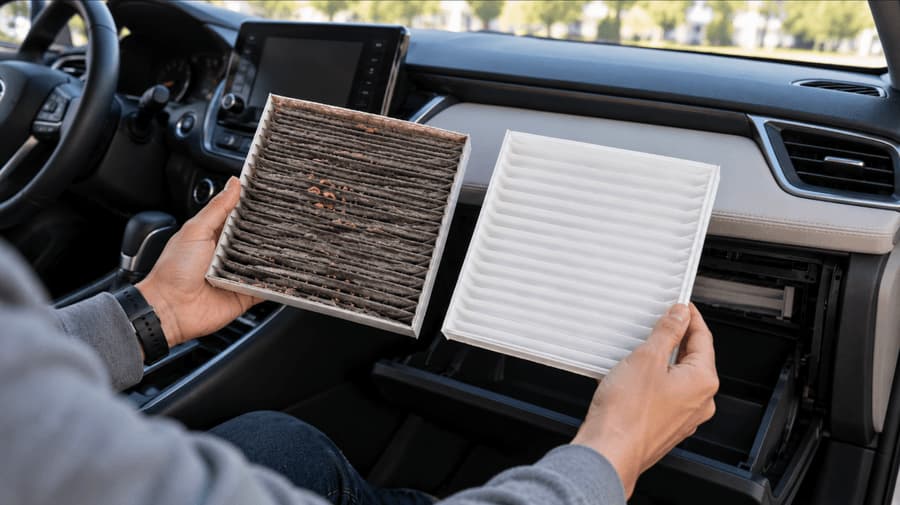
An OEM cabin air filter is the factory-spec part sold under your automaker’s part number, while an aftermarket filter comes from an independent brand and ranges from thin paper to HEPA-grade media. OEM guarantees a factory match at dealer pricing; a premium aftermarket filter cut to the same tolerances usually costs less and captures finer particles.
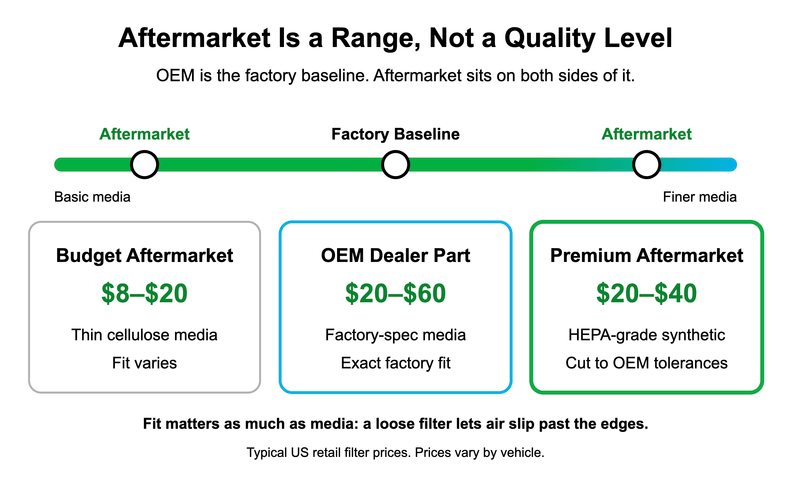
OEM (dealer part): exact factory fit, typically 20–60.
Budget aftermarket: lowest upfront cost at 8–20, but fit varies.
Premium aftermarket: HEPA-grade media cut to OEM tolerances, typically 20–40.
An aftermarket filter won’t void your car’s warranty. Take the quick quiz below to find your filter match.
Find Your Filter Match
Answer a few quick questions and we’ll match you to the right filter.
TL;DR
An OEM cabin air filter is the factory-spec part sold under your automaker's part number, usually built by a supplier such as Mann+Hummel, Mahle or Denso. An aftermarket filter comes from an independent brand and ranges from thin paper to HEPA-grade media. OEM guarantees a factory match at dealer pricing; a premium aftermarket filter cut to the same tolerances usually costs less and captures finer particles.
Key Takeaways
Aftermarket is a price range, not a quality level. A $9 paper rectangle and a HEPA-grade filter both count.
Fit decides how much air gets filtered. A loose filter lets bypass air around the edges.
Labor is usually half the bill. A shop charges $60 to $130; DIY, $15 to $50.
Aftermarket does not void your warranty. A manufacturer must prove the part caused the failure.
What Is an OEM Cabin Air Filter?
An OEM cabin air filter is built to the vehicle manufacturer's specification and sold under the automaker's part number, normally at a dealer parts counter. What rarely gets said there is that automakers almost never make filters themselves; they contract suppliers such as Mann+Hummel, Mahle, Denso and Bosch.
Several of those suppliers also sell filters under their own labels, so three things are on the table when you shop:
OEM (also called OES): the automaker's part number, sold through dealers.
Supplier-branded: the same manufacturer's filter under its own name, usually cheaper.
Independent aftermarket: thin cellulose through to HEPA-grade media that beats the factory part.
Whatever the automaker specified when the car was designed is what an OEM filter still delivers, and most of those specs aim at dust and pollen rather than fine particulate. The factory part is a baseline, not a ceiling.
What Is an Aftermarket Cabin Air Filter?
An aftermarket cabin air filter is made by a company other than your automaker, and Filterbuy, a US air filter manufacturer, is one of them. The range inside that one word is the whole problem: a $9 filter with thin cellulose shares a shelf with HEPA-grade media in a frame cut to factory tolerances.
OEM vs. Aftermarket Cabin Air Filters: Side-by-Side Comparison
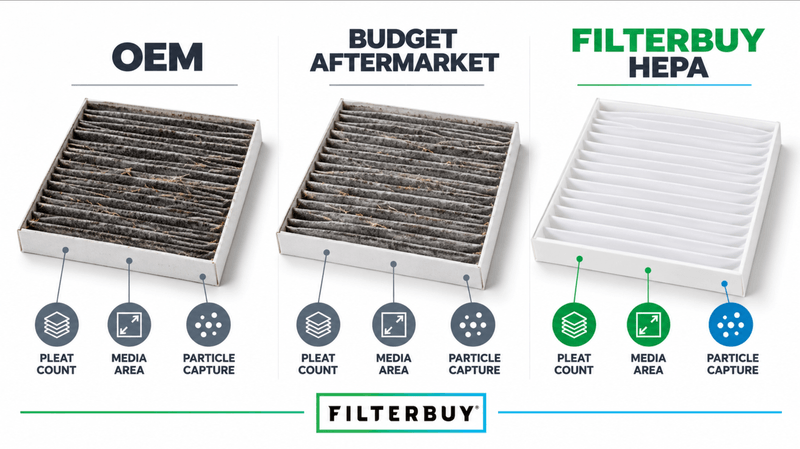
A fair comparison runs three ways, since budget and premium filters share little but the shelf.
HEPA describes media that captures at least 99.97% of particles at 0.3 microns, the hardest size to catch (U.S. EPA). Prices are typical US retail and vary by vehicle.
Why Does Cabin Air Filter Fit Matter So Much?
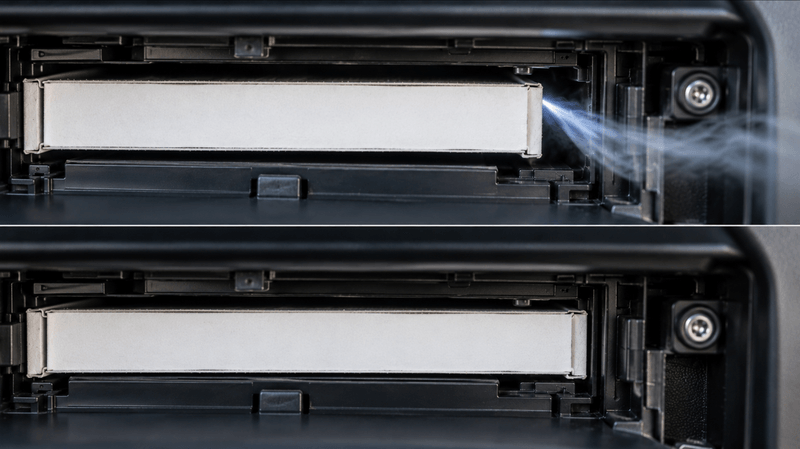
Fit decides how much of the air entering your HVAC system passes through the media at all. The filter has to seal against its housing, because air takes the easiest path available, so when one runs small or its frame flexes, air slips around the edges instead. That is bypass air, and it carries dust, pollen and soot straight into the vents.
This is why a filtration rating alone can mislead: a high-efficiency filter that seals badly delivers dirtier cabin air than an ordinary one that seals well.
We build these filters, which is why fit is the thing we keep coming back to. Cutting a frame to OEM tolerances is the expensive, invisible half of the job: it never shows up on the box, no rating describes it, and it is the first thing a cheap filter gives away. Filterbuy has manufactured in the USA since 2013 and cuts every cabin filter to those tolerances, so the frame seats as the vehicle was designed.
Efficiency ratings describe the media. Fit decides how much of your air ever touches it.
Michelle Wan, Brand Manager, Filterbuy
The 60-Second Fit Check Anyone Can Do
Nobody sells a tool for this, so here is Filterbuy's bench check, adapted for a glovebox:
Measure the old filter before you bin it. Length, width and depth should match within a millimeter or two.
Point the airflow arrow the way the old one pointed, usually toward the blower.
Seat it with no trimming, bending or forcing. If it needs persuasion, it is the wrong part.
Close the housing, run the fan on high and listen. A whistle at the edge means air is finding a gap.
Are Aftermarket Cabin Air Filters Good?
The good ones are excellent and the cheap ones are not, which makes the label useless alone. After a decade building this part at Filterbuy, here is what we check on any brand, ours included:
Media type. Synthetic media captures fine particles better than thin cellulose and holds it as the filter loads.
A published efficiency number. "HEPA-grade" means nothing without a capture rate, particle size and test.
Fit tolerance. It should seat with no trimming, no bending, no gap at the seal.
Pleat count and media area. More media means more capture surface, less restriction.
Clear all four and it will match or beat the OEM part; miss most and no price is low enough.
What the Research Shows
We are not the only ones measuring this. In a NIOSH-funded study of 17 Los Angeles taxis in PLOS ONE, closed windows plus a high-efficiency cabin filter cut in-cabin PM2.5 by 37% and ultrafine particles by 47%.
PLOS ONE: high-efficiency cabin filters and roadway particulate exposure
Can an Aftermarket Filter Actually Filter Better Than OEM?
Yes, though the reason has more to do with priorities than quality. An OEM filter balances cost, airflow and dust capture across a model line, while Filterbuy builds for air quality first, with HEPA-grade media for fine particulate and carbon for odors.
That upgrade earns its money in wildfire smoke, spring pollen, heavy traffic or a car that carries pets. On a short commute in clean air, the factory filter replaced on schedule is enough, and we would rather say so than sell an upgrade you will not feel.
Is an OEM Cabin Air Filter Worth It?
Sometimes, though where you buy it matters more than the badge on the box. Professional replacement runs $60 to $130, about half of that labor on a ten-minute job; doing it yourself costs $15 to $50.
OEM is right when you want a factory match without research, or your car is new and you want every part on the dealer's record. It is wrong when you are paying markup for filtration you could beat for the money.
RepairPal puts the national average at roughly $86 to $114. Filterbuy manufactures the part and does not install it, so we bill nothing for the labor half of that invoice, though we do sell the other.
Cabin air filter replacement cost
Aftermarket Cabin Air Filter Brands Compared
Filterbuy manufactures aftermarket cabin air filters.
Filterbuy makes aftermarket filters, so treat this as an interested source. Several brands above supply automakers and we do not, a fair point against us.
Filterbuy vs. Bosch cabin air filters
Does an Aftermarket Cabin Air Filter Void Your Car Warranty?
No. An aftermarket cabin air filter does not void your new-vehicle warranty. Under the federal Magnuson-Moss Warranty Act, a manufacturer cannot deny coverage because you fitted a part that did not come from the dealer; to deny a claim, it has to show the aftermarket part caused the failure.
The FTC puts it plainly: your warranty stays in effect when you use aftermarket parts. Keep the receipts anyway and note the date and mileage of each change, since a record settles most disputes early.
FTC: auto warranties and service contracts
What a Cabin Air Filter Cannot Do
Before you spend up, it helps to know where a cabin air filter runs out of road:
It only filters air coming through the vents. A window down bypasses it. In smoke or traffic, close the windows and switch to recirculate.
Particle media does not capture gases. Exhaust, ozone and VOCs need activated carbon. HEPA-grade media alone, ours included, will not touch them.
It cannot clean what is already inside. If mold has taken hold on the evaporator core, a new filter stops new debris but the smell stays until the system is cleaned.
How Often Should You Replace a Cabin Air Filter?
Most automakers call for a new cabin air filter every 12,000 to 15,000 miles, or about once a year, and sooner if you drive dusty roads, sit in traffic or live through wildfire season. Weak airflow, a musty smell when the fan starts and dust on the dashboard mean it is overdue.
How often to change a cabin filter
Signs your cabin filter needs replacing
Cabin air filters for wildfire smoke
How to replace a cabin air filter
Cabin air filter vs. engine air filter
Do activated carbon filters work?
Supporting Statistics
Three numbers put this part in context.
More than 45 million Americans live within 300 feet of a major road, where vehicle emissions push pollutant concentrations higher (EPA air research).
U.S. EPA: near-roadway air pollution research
152.3 million Americans, 44% of the country, live in counties with failing grades for ozone or particle pollution (American Lung Association, 2026).
American Lung Association: State of the Air 2026
The average U.S. driver covers 13,476 miles a year (Federal Highway Administration), inside that 12,000-to-15,000-mile window, so one filter a year suits most people.
FHWA: average annual miles per driver
Glossary
Cabin air filter: the filter cleaning outside air before it reaches your vents.
OEM / OES: a part built to the automaker's specification and sold under its part number.
Aftermarket: a replacement part from a company other than the automaker.
Bypass air: air slipping around the edges of a poorly fitting filter instead of through the media.
HEPA: High Efficiency Particulate Air: capture of 99.97% of particles at 0.3 microns.
Activated carbon: a porous layer that adsorbs gases and odors such as exhaust and ozone.
Hydrocharging: charging filter fibers electrostatically to raise capture without packing the media.
Frequently Asked Questions
Is OEM or Aftermarket Better for Allergies?
A premium aftermarket filter is usually better for allergies, because factory specs aim at dust and grit while HEPA-grade media captures pollen, mold spores and particulate down to 0.3 microns.
Who Makes OEM Cabin Air Filters?
Suppliers do, not automakers. Mann+Hummel, Mahle, Denso and Bosch build to an automaker's drawing, and the filter is sold under the automaker's part number.
Does a HEPA Cabin Air Filter Reduce Airflow?
Higher-efficiency media does work harder for the same airflow, which is why its design matters. Hydrocharging captures particles electrostatically rather than by packing fibers tighter, so the filter catches finer particles without choking the vents.
Clear the Air in Your Car With Confidence
OEM buys certainty, the factory part with no research required. A premium aftermarket filter buys filtration, finer capture and carbon for odors, usually at a lower price.
Find your Filterbuy cabin filter by year, make and model, and subscribe so the next arrives on time.
Shop Filterbuy cabin filters by vehicle
About the Author
Michelle Wan is Filterbuy's Brand Manager and air quality writer (B.A., UC Santa Cruz). She works with the manufacturing team across Filterbuy's four U.S. factories, so her guidance comes from how filters are built and used. Reviewed by David Clark, Licensed HVAC Technician.