May 19, 2026
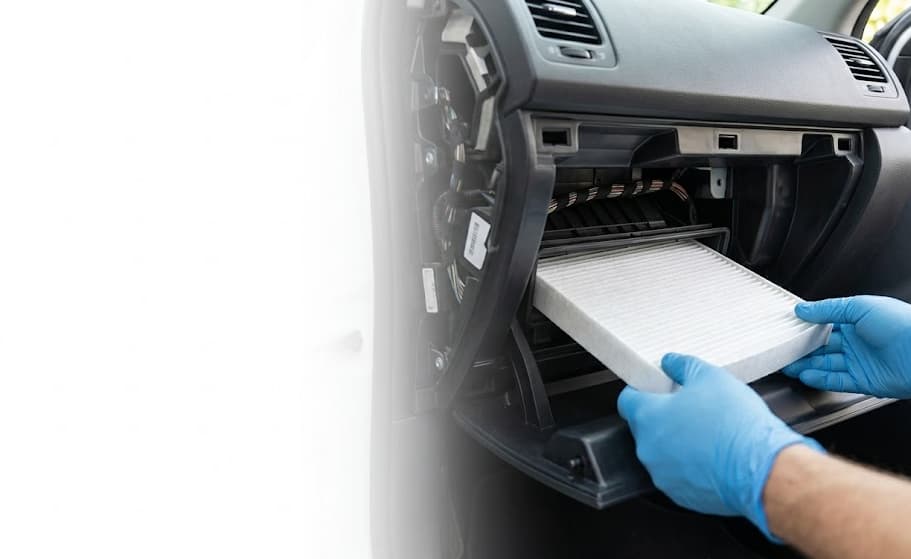
The cabin air filter in most cars is located in one of three places: behind the glove box, under the hood near the windshield, or behind the dashboard. The exact location depends on your vehicle’s make and model.
If you are noticing weak airflow from your AC vents, it is probably time for a replacement. A musty smell in your car is another common warning sign. Your cabin air filter works hard to block dust, pollen, and exhaust fumes from entering your vehicle. Over time, it gets clogged and needs to be swapped out.
Replacing this filter is one of the easiest DIY car maintenance tasks you can do. You rarely need special tools. You just need to know where to look. Let's explore exactly where the cabin air filter is in your vehicle so you can get back to breathing clean air.
A musty smell in your car could indicate that your cabin air filter needs to be replaced.
The cabin air filter prevents dust, pollen, and exhaust fumes from entering your vehicle.
Replacing the cabin air filter is a simple DIY task that rarely requires special tools.
Knowing the filter's location in your vehicle is essential for easy replacement.
Automakers generally place the cabin air filter in areas connected to the HVAC system. Here are the top three spots you should check.
This is the auto cabin air filter location for about 70% to 80% of modern vehicles. You will often find this setup in popular brands like Honda, Toyota, Ford, and Chevrolet.
Automakers put it here because it sits directly in front of the blower motor. This makes it incredibly easy for you to access from the passenger seat.
Here is how you typically reach a cabin air filter behind the glove box:
Open the glove box and empty out the contents.
Release the tension arm or squeeze the sides of the box to let it drop down completely.
Look for a rectangular plastic cover with tabs on the sides.
Unclip the cover and slide the old filter out.
Some vehicles keep the filter under the hood. You will usually find it near the base of the windshield on the passenger side. This location is covered by a plastic panel called the cowl.
This placement is more common in larger SUVs, European luxury cars, and some older models. You might need to lift the hood, remove a weatherstripping seal, and pop off a few plastic clips to lift the cowl and reveal the filter housing.
This is the least common location, but it does happen. If your filter is behind the dashboard, it is usually located deep in the passenger-side footwell or near the center console.
Getting to this filter can be a little tricky. You may have to lie on your back in the footwell and remove a plastic trim panel. Some drivers prefer to let a mechanic handle the replacement at this spot, but it is entirely possible to do it yourself with a little patience.
Still wondering, "Where is my cabin air filter?" Check this quick reference table for a few of the most popular vehicles on the road.
| Vehicle | Cabin Air Filter Location |
|---|---|
| Honda Civic | Behind the glove box |
| Toyota Camry | Behind the glove box |
| Ford F-150 | Behind the glove box |
| Honda CR-V | Behind the glove box |
| Toyota RAV4 | Behind the glove box |
Always check your owner’s manual for the exact placement in your specific year and trim.
If your car is not on the list above, you can track down your filter using a few simple methods.
First, check your owner’s manual. Look in the index under "Maintenance" or "Cabin Air Filter." The manual usually provides diagrams and step-by-step instructions.
You can also do a quick online search. Just type your car's year, make, and model,passenger-side dash, and trace the plastic ductwork followed by "cabin air filter location."
Finally, use your eyes. Look for the airflow housing near your HVAC system. If you peek under the passenger-side dash and trace the plastic ductwork ,from the blower motor, you will usually spot the rectangular access door.
Most manufacturers recommend replacing your cabin air filter every 12,000 to 15,000 miles, or about once a year. However, your actual driving conditions play a massive role in this schedule.
You should replace it sooner if:
You drive in pollution-heavy urban areas with high exhaust fumes.
You live on a dirt road where rural dust clogs filters quickly.
You notice weak airflow coming from your air conditioning vents.
There is a lingering musty or dirty smell inside the car.
Filterbuy auto cabin air filters use HEPA-certified synthetic media to trap 99.97% of airborne particles as small as 0.3 microns, including bacteria, pollen, mold spores, smoke, and pet dander.
Every filter is manufactured 100% in the USA to exact OEM tolerances, with advanced hydrocharging technology that permanently magnetizes every fiber for maximum particle capture without restricting airflow. Available for hundreds of vehicles across all major makes and models, use the vehicle selector at filterbuy.com to find the right fit for your car.
Most cabin air filters catch the obvious stuff. Filterbuy goes further.
Replacing your cabin filter is a cheap and easy way to keep your car's interior fresh. Remember, the filter is almost always located behind the glove box, under the hood, or tucked under the dashboard.
Make it a habit to check your filter at least once a year. A fresh Filterbuy cabin filter makes every commute better, keeps your HVAC system running smoothly, and protects your lungs from outside pollutants.
In the vast majority of modern cars, the cabin air filter is located right behind the passenger-side glove box. You can usually access it by dropping the glove box down and removing a small plastic cover over the filter housing.
No, it is not always behind the glove box. While that is the most common spot, some vehicles place the filter under the hood near the base of the windshield. Others hide it under the dashboard in the passenger footwell.
Yes, replacing your cabin air filter is a very simple DIY job. It usually takes less than 10 minutes and does not require any special tools. You simply locate the housing, pull out the old filter, and slide in the new one.
If you do not change it, the filter becomes completely clogged with dirt, pollen, and debris. This severely restricts airflow from your AC and heating vents. It can also cause foul odors and put unnecessary strain on your car's blower motor.
You will know the filter is dirty if your air conditioning or heater seems weak, even on the highest fan setting. A dusty, musty, or moldy smell coming from your vents is another major indicator that it is time for a replacement.
