
How to Choose a Cabin Air Filter: A No-Nonsense Guide
May 26, 2026

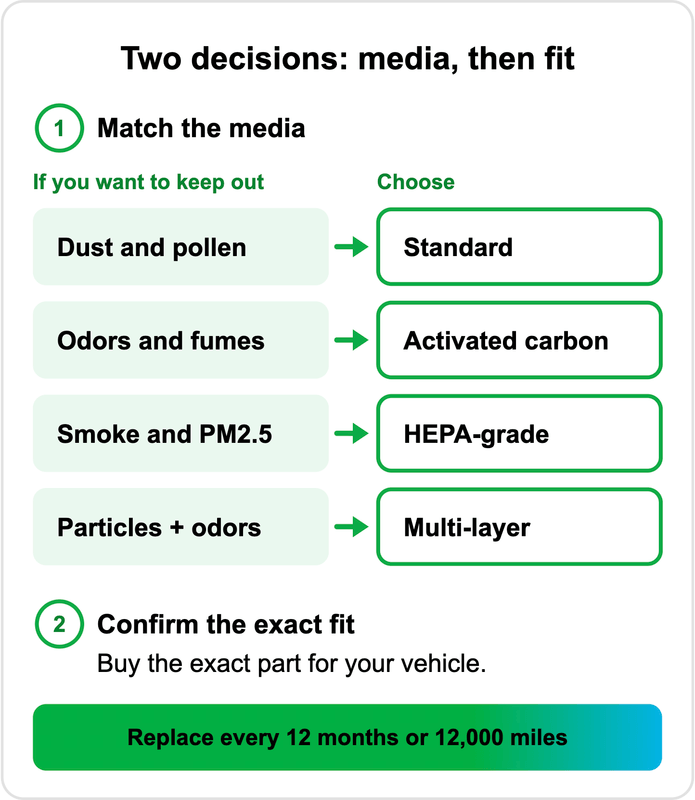
Pick the filter media that matches what you want to keep out, then buy the exact part for your vehicle’s year, make, and model. Fit matters as much as media, because gaps let unfiltered air slip past the filter.
Standard: traps dust, pollen, and road debris.
Activated carbon: adds a charcoal layer for odors and exhaust fumes.
HEPA-grade: captures fine particles like smoke and PM2.5.
Multi-layer: pairs HEPA-grade media with carbon for fine particles and odors.
Replace it every 12 months or 12,000 miles. Have a ductless mini split at home? The quick quiz below matches you to the right filter for it.
Find Your Mini Split Filter Match
Answer a few quick questions and we’ll match you to the right filter for your mini split.
TL;DR
Choosing the right cabin air filter comes down to two decisions: the filter media and the fit. Standard filters trap dust and pollen, activated carbon adds control of odors and exhaust fumes, and HEPA-grade media captures wildfire smoke and fine PM2.5. Buy the exact part for your year, make, and model, and replace it every 12 months or 12,000 miles.
Key Takeaways
Fit matters as much as media. A filter that leaves gaps lets unfiltered "bypass air" slip into the cabin.
High-efficiency cabin filters work. In a UCLA study of 17 taxis, closed windows and high-efficiency filters cut in-cabin PM2.5 by 37%.
No U.S. body certifies cabin air filters, so look for brands that publish ISO 11155 lab results.
Replace every 12 months or 12,000 miles, or sooner in smoke, dust, or heavy traffic.
I don’t want anyone to feel like they need an HVAC license just to pick the right filter. My job is to give you the straight answer, explain why it matters, and let you get back to your day.
Michelle Wan, Brand Manager and Air Quality Writer, Filterbuy
How Do You Choose a Cabin Air Filter?
Choosing a cabin air filter takes five steps: decide what you want to keep out, match the filter media to it, check the brand's test evidence, confirm the exact fit, and set a replacement date.
Filterbuy has manufactured air filters in the U.S. since 2013. That experience shapes this cabin air filter buying guide: a filter is only as good as its seal and only as honest as its label.
If you want to know how to pick a cabin air filter without overthinking it, match the media to your drive using the tables below, then confirm the exact part. At Filterbuy, we would rather you trust a published test result than a bigger number on the box.
What Is a Cabin Air Filter, and How Does It Work?
A cabin air filter is a pleated filter in your vehicle's heating, ventilation, and air conditioning (HVAC) system that cleans outside air before it reaches the vents.
So how do cabin air filters work? Pleated fibers catch dust and pollen, charged fibers pull in smaller particles without adding density, and activated carbon adsorbs fumes and odors. Learn more about what a cabin air filter does.
Cabin Air Filter Types: A Side-by-Side Comparison
There are four cabin air filter types: standard particulate, activated carbon, HEPA-grade, and multi-layer filters that pair HEPA-grade media with carbon. The cabin air filter comparison below shows what each one removes.
HEPA Cabin Air Filters
A HEPA cabin air filter uses high-efficiency media designed to capture very fine particles like smoke and PM2.5. The HEPA benchmark itself comes from U.S. Department of Energy standards, which call for 99.97% capture at 0.3 microns.
Activated Carbon Cabin Air Filters
An activated carbon cabin air filter adds a charcoal layer that adsorbs gases, which cuts exhaust fumes and pet odors. Once its pores fill, the filter stops removing odors even if it still looks clean, so replace it on schedule. Browse Filterbuy activated carbon cabin air filters.
HEPA vs. Carbon Cabin Air Filter: Which Is Better?
Neither HEPA-grade nor activated carbon wins for every driver, because each removes a different kind of pollutant. A HEPA cabin air filter captures particles such as smoke and pollen, while a carbon cabin air filter adsorbs gases such as exhaust fumes and VOCs.
What Is the Best Cabin Air Filter for Your Driving?
The best cabin air filter is the one matched to where you drive and what bothers you most.
Best Cabin Air Filter for Allergies
The best cabin air filter for allergies is a HEPA-grade filter that seals tightly in its housing. Replace it before pollen season and keep windows closed. A cabin filter reduces exposure, but it doesn't treat allergies. See Filterbuy's cabin air filters for allergy relief.
Best Cabin Air Filter for Wildfire Smoke
The best cabin air filter for wildfire smoke is a HEPA-grade or multi-layer filter, used with the windows closed and recirculation on, as the EPA recommends. Because recirculation traps exhaled carbon dioxide, Filterbuy's rule is to let fresh air in for about 60 seconds every 20 to 30 minutes. See our tips for driving in wildfire smoke and our wildfire smoke cabin filter guide, and check the local AQI map before long drives.
Do High-Efficiency Cabin Air Filters Really Work?
Yes. Peer-reviewed road studies show that high-efficiency cabin air filters sharply reduce the fine and ultrafine particles drivers breathe. The findings cover high-efficiency filters generally.
37% less PM2.5 and 47% fewer ultrafine particles: closed windows plus high-efficiency filters in 17 taxis on real roads (UCLA study, PLOS ONE, 2017).
85–96% PM2.5 filtration: high-efficiency filters in a 2023 on-road study of passenger cars in China, versus about 77% for new factory filters and 45% for in-use ones.
About 93% fewer ultrafine particles: a high-efficiency cabin filter in fresh-air mode (Lee and Zhu, Environmental Science & Technology, 2014).
Supporting Statistics: Why Cabin Air Quality Matters
U.S. data shows how many drivers benefit from better cabin filtration.
Sources: CDC allergy data, EPA near-road research, State of the Air 2026.
OEM vs. Aftermarket Cabin Air Filters
An OEM cabin air filter is made by or for your vehicle's manufacturer, while an aftermarket cabin air filter comes from a third-party brand and often adds carbon or HEPA-grade media. OEM parts guarantee fit, but their media is usually basic. In the 2023 China on-road study, in-use factory filters cut PM2.5 by only about 45%. In the U.S., the Magnuson-Moss Warranty Act generally prevents an aftermarket filter from voiding your warranty unless the part causes damage. Compare OEM vs. aftermarket cabin air filters.
How to Compare Cabin Air Filter Brands and HEPA Claims
No single cabin air filter brand is best for every driver, because no U.S. body certifies cabin filter performance. Two lab tests do exist, ISO/TS 11155-1 for particles and ISO 11155-2 for gases, and the best cabin air filter brand for you publishes results against them and makes your exact part.
Filterbuy's shorthand for shoppers is simple: judge the label, not the logo. When Filterbuy read every page K&N publishes about its cabin filter line in July 2026, it found three different warranty statements for the same product, so get terms and specs in writing (K&N vs. Filterbuy cabin filters). Lists of top rated cabin air filters often rank by review volume, not media or fit. The best HEPA cabin air filter has published efficiency data and a gap-free seal. See the best cabin air filter brands.
Are Premium Cabin Air Filters Worth It?
A premium cabin air filter is worth it if you commute in traffic, drive for rideshare, have allergies or asthma, carry young kids, or live where wildfire smoke is common. When Filterbuy reviewed cabin air filter listings on Amazon, prices ran about $10 to $45, so even a $45 filter works out to about 12 cents a day over a year. The best sellers there were mostly carbon multipacks rather than HEPA-grade filters. Compare cheap vs. quality cabin air filters.
How Often Should You Replace a Cabin Air Filter?
Filterbuy recommends replacing your cabin air filter every 12 months or 12,000 miles, or as your owner's manual directs. If you drive through heavy traffic, wildfire smoke, dust, or pollen season, check it every 6 months instead. Worn filters lose ground: in a 2023 Chalmers University and Volvo Cars modeling study, 70% recirculation cut cabin PM2.5 by 55% with a new filter but only 39% with an aged one.
What Does Your Old Cabin Air Filter Tell You?
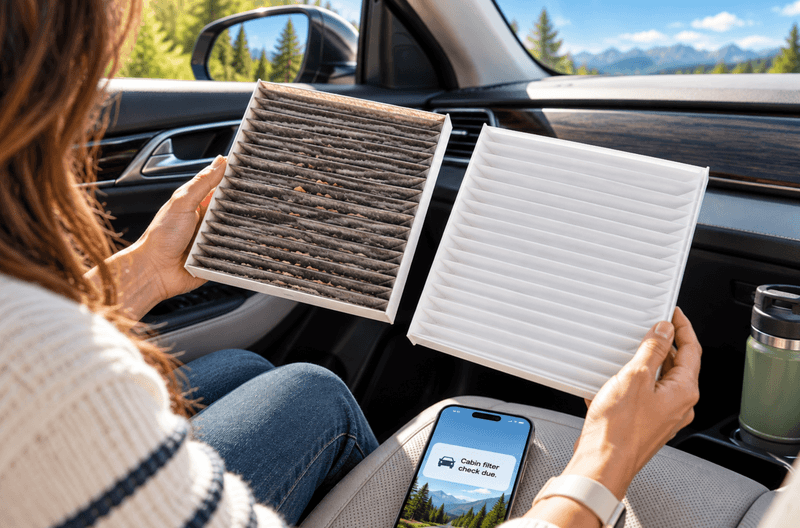
Your used cabin air filter can tell you more than whether it is time for a new one. Before you toss it, check the dirt pattern for signs that air slipped around the edges or that a smell is coming from elsewhere in the HVAC system.
Where Filterbuy Cabin Air Filters Fit
Filterbuy makes cabin air filters, so we have a stake here. We name competitors and their prices anyway, because a guide that only works if you buy from us is not a guide. This is what goes into a Filterbuy cabin air filter:
Media: HEPA-grade synthetic media rated to capture 99.97% of particles down to 0.3 microns
Hydrocharged fibers capture fine particles without choking airflow
Made in the USA to exact OEM dimensions, which reduces bypass air
Find your exact fit with the Filterbuy vehicle selector.
Frequently Asked Questions
Where Is the Cabin Air Filter Located?
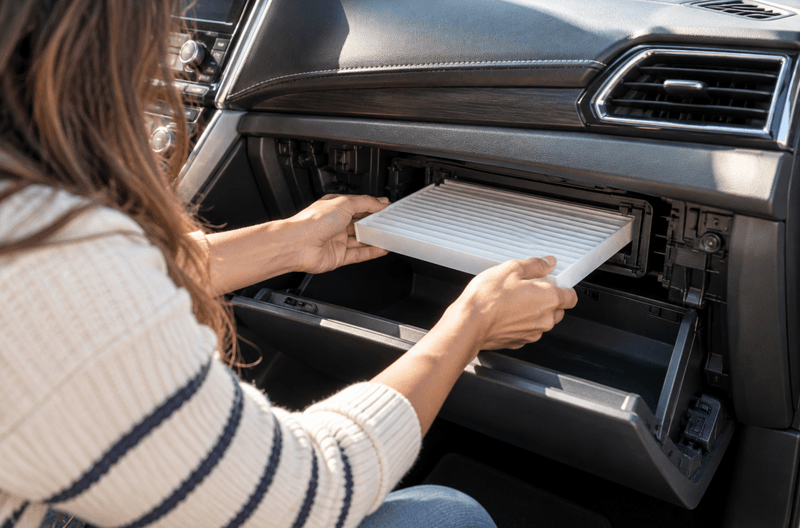
The cabin air filter usually sits behind the glove box or under the passenger-side dashboard, and most swaps take a few minutes without tools. Before closing it, check that the airflow arrow matches and no gap shows.
Can You Wash and Reuse a Cabin Air Filter?
Only if it is sold as washable; most cabin air filters are built to be replaced. Washable filters save money only if every cleaning actually happens, and Filterbuy found that K&N keeps its activated carbon filters on its disposable line.
Does MERV Apply to Cabin Air Filters?
No. MERV is a home HVAC filter rating set by ASHRAE Standard 52.2, while cabin air filters are tested under ISO/TS 11155-1 and ISO 11155-2.
Glossary
Cabin air filter: A vehicle HVAC filter that cleans air entering the passenger compartment.
HEPA: High-efficiency particulate air; a U.S. Department of Energy benchmark of 99.97% capture at 0.3 microns.
HEPA-grade media: High-efficiency media modeled on HEPA; not a regulated cabin filter label.
HVAC: Heating, ventilation, and air conditioning.
Activated carbon: Porous charcoal that adsorbs gases and odors.
PM2.5: Fine particles 2.5 microns or smaller, found in smoke and exhaust.
Ultrafine particles (UFPs): Particles smaller than 0.1 micron, concentrated near busy roads.
VOCs: Volatile organic compounds; gases from fuel, exhaust, and materials.
Hydrocharged (electret) media: Fibers with a lasting electrostatic charge that attracts fine particles; used in Filterbuy cabin filters.
OEM: Original equipment manufacturer; parts made for the vehicle's maker.
MERV: Minimum Efficiency Reporting Value; a home HVAC filter rating.
ASHRAE: The engineering society whose Standard 52.2 defines MERV.
ISO/TS 11155-1: The international lab test for cabin filter particle efficiency.
ISO 11155-2: The international lab test for cabin filter gas and odor removal.