
The Complete Buyer’s Guide to Cabin Air Filters
May 25, 2026
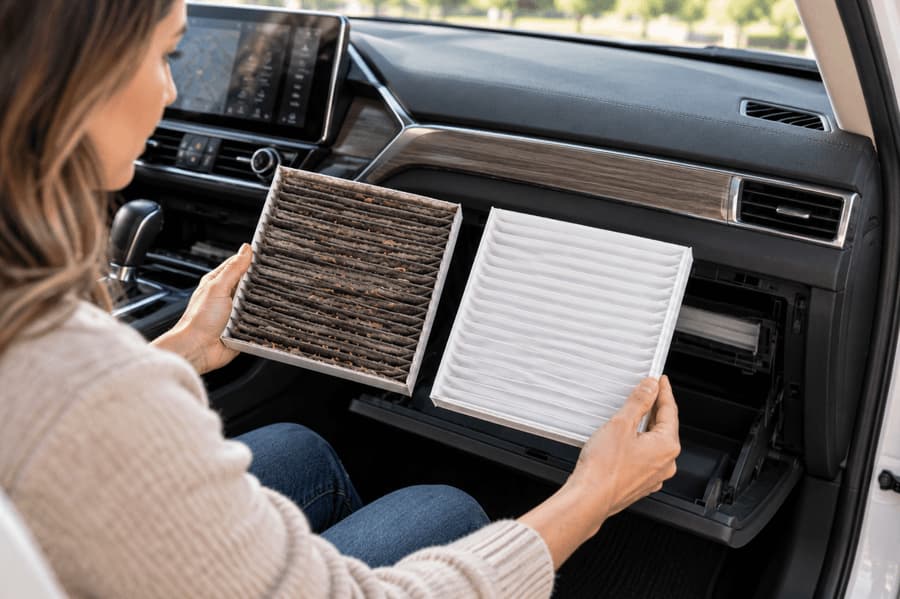
Which Cabin Air Filter Is Right for Your Car?
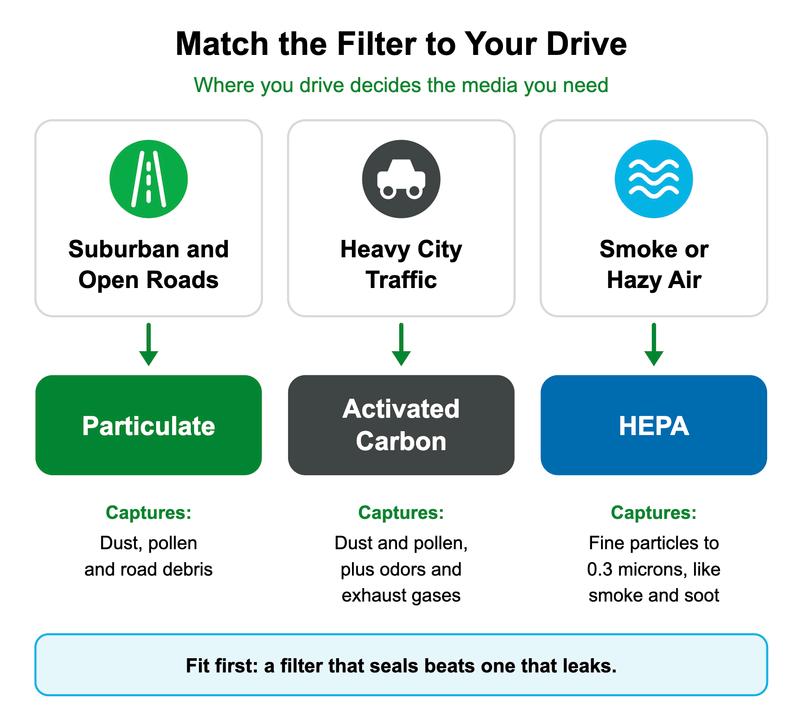
Choose by where you drive: particulate for suburban and open roads, activated carbon for heavy city traffic, and HEPA for smoke or hazy air. Fit matters just as much, because air slips around a filter that doesn’t seal to its housing.
Particulate: catches dust, pollen and road debris.
Activated carbon: adds odor and exhaust-gas control.
HEPA: rated to capture 99.97% of particles at 0.3 microns, like smoke and soot.
Most sit behind the glove box and swap out in about ten minutes, no tools needed. Filterbuy recommends a fresh one every 12 months or 12,000 miles.
Have a Mini Split at Home, Too?
Answer a few quick questions and we’ll match you to the right mini split filter.
TL;DR
A cabin air filter is a pleated panel inside your vehicle’s heating and air conditioning system that cleans outside air before it reaches you through the vents, trapping pollen, road dust, mold spores, exhaust soot and wildfire smoke. Most sit behind the glove box and swap out in ten minutes with no tools. Published intervals run from 10,000 to 22,500 miles, so check your manual. Pick particulate media for clean-air commuting, carbon for traffic odors, HEPA for allergies and smoke.
Key Takeaways
Three media types, one decision. Standard particulate catches dust and pollen, activated carbon adds odor and exhaust-gas control, and HEPA is rated to capture 99.97% of particles down to 0.3 microns, the band that includes wildfire smoke.
Fit matters as much as media. Air takes the easiest path, so a panel cut a fraction small lets unfiltered air slip around the frame. A modest filter that seals beats a premium one that does not.
Carbon quits before the filter looks dirty. Once it saturates it stops adsorbing odors, though the particulate layer keeps catching dust.
What Does a Cabin Air Filter Do?
A cabin air filter removes airborne particles from outside air before it enters the passenger compartment through your vents. It sits between the fresh-air intake and the evaporator, so every cubic foot your climate system pulls in passes through it first. It protects two things at once: your lungs, and the blower motor behind the dash.
How much that matters depends on your commute. EPA research on near-roadway air pollution puts more than 45 million Americans within 300 feet of a major road, where vehicle pollutants are most concentrated.
What it traps:
Pollen, mold spores and pet dander, the common allergy triggers behind the wheel
Road dust, brake dust, tire particulate and diesel exhaust soot
Wildfire smoke, largely PM2.5, fine enough to reach deep into the lungs
What it cannot do:
It does nothing with a window down. The filter only cleans air pulled through the climate system.
It does not touch carbon dioxide. Carbon adsorbs odors and gases, not the CO₂ you exhale.
Cabin Air Filter vs. Engine Air Filter
These two get confused constantly, and the distinction is simple: one cleans the air you breathe, the other cleans the air the engine burns. They sit in different places on different schedules, so replacing one does nothing for the other. Our full cabin air filter vs. engine air filter breakdown covers both.
Where Is the Cabin Air Filter Located?
On most modern vehicles the cabin air filter sits directly behind the passenger-side glove box, behind a rectangular access door. The other common spots are under the dashboard and under the cowl panel at the windshield base.
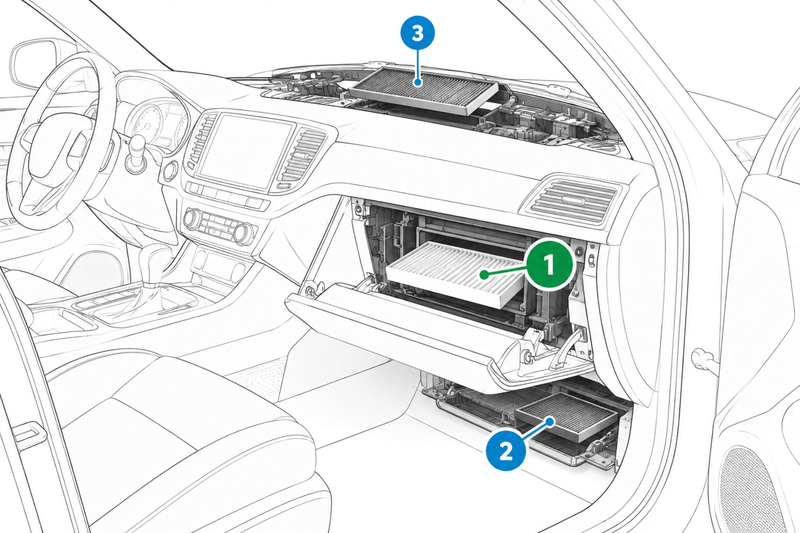
What trips owners up more than the location is the name. Only Toyota and Ford print "cabin air filter" in the manual, while Honda calls it a dust and pollen filter and Nissan an in-cabin microfilter. Search your manual for your maker’s term instead, and if nothing turns up, check whether your car has one at all. For the full walkthrough, see where the cabin air filter is located.
What Are the Types of Cabin Air Filters?
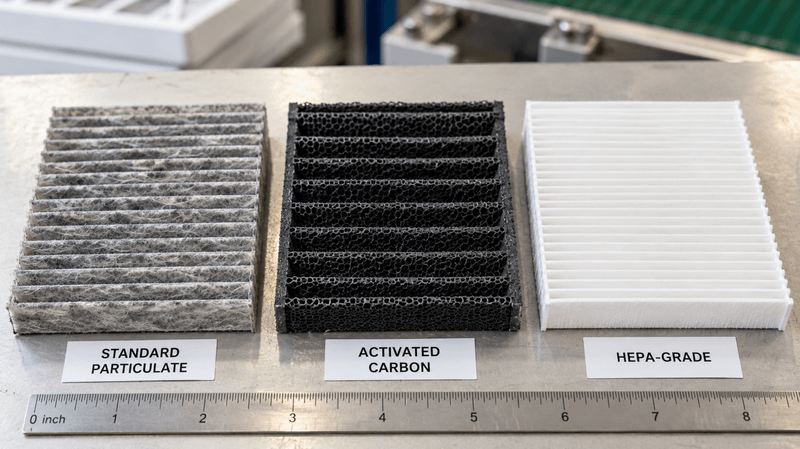
Cabin air filters come in four media types, and the right one depends on where you drive. Filterbuy activated carbon cabin air filters add odor control for urban traffic, while HEPA media captures the fine particulate in smoke. Only one of the four tolerates washing, so check before you try to clean the one you have.
Common U.S. retail ranges for a single filter, checked September 2026.
How Do You Choose the Right Cabin Air Filter?
Choose a cabin air filter on four things, in order: exact fitment to your housing, media matched to where you drive, airflow the filter does not choke, and a routine you will keep. Fitment comes first because unfiltered air routing around the frame defeats any media.
Fitment. A few millimeters of gap gives unfiltered air a path around the media, which is why OEM versus aftermarket fitment drives real performance.
Environment. Urban commuters want carbon for smog and exhaust, while wildfire country and allergy sufferers want the highest-efficiency media their housing will take.
Airflow. Denser media raises pressure drop. Filterbuy hydrocharges its media instead, charging each fiber so it pulls particles from the airstream without a tighter weave.
Routine. The filter you actually change on time is the one that protects you, which is why tool-free installation and subscription delivery exist. Our guide to how to choose a cabin air filter goes further.
What Building the Filter Taught Us About Airflow
The obvious way to make a cabin filter catch more is to pack the pleats tighter. That raises capture and chokes the blower in the same move. Filterbuy hydrocharges the fibers instead, so the media pulls particles in by attraction rather than by squeezing the air path shut. Capture and airflow are separate levers, and a filter that wins the first by giving up the second eventually costs you a motor.
Airflow restriction is the trade nobody mentions. A high-capture filter left past its interval restricts more than a standard one, because it loads faster. Higher efficiency raises the cost of forgetting.
David Clark, Licensed HVAC Technician and Technical Reviewer for Filterbuy
That is the uncomfortable version for a company selling high-efficiency media: upgrading shortens the safe interval rather than extending it. The filters that disappoint drivers are rarely the cheap ones. More often they never seal, which is why Filterbuy cuts every panel to the vehicle’s housing rather than to a size chart.
How Often Should You Replace a Cabin Air Filter?
There is no single interval. Published manufacturer figures run from 10,000 to 22,500 miles. Ford Owner Support lists 15,000 to 20,000 miles by model, General Motors 22,500 or two years, and Honda gives no normal-condition mileage at all. We built that chart from each maker’s owner documents, not from other guides. The Filterbuy approved interval is 12 months or 12,000 miles.
Severe service is more common than the label suggests. Ford names dirt roads, dust and heavy pollution, and adds allergies. Hyundai counts more than half your driving in heavy city traffic in hot weather. Most metro commuters already meet someone’s severe definition, and wildfire smoke appears in no schedule we reviewed. The full chart of replacement intervals by manufacturer shows what each brand prints and where to find it.
What Are the Signs of a Bad Cabin Air Filter?
Five symptoms point to a clogged cabin air filter: weak airflow at any fan speed, a musty smell when the fan starts, windows that fog and clear slowly, dust on the dashboard, and a straining blower motor. It is also the likeliest reason your AC feels weak.
The slow defrost is the symptom drivers miss most often. A restricted filter cuts the dry air reaching the windshield, which is the usual reason car windows fog up and will not clear.
Waiting is not free. When air cannot move through the media the blower works harder against it, and a blower motor replacement averages $387 to $440.
The Sixty-Second Check Before You Pay a Diagnostic Fee
If airflow is weak at every fan speed, test the filter before you let anyone test the motor. Shops commonly charge $75 to $150 to reach the same conclusion.
Run the fan on high with recirculate off, and note the air at the vents.
Pull the filter out, leaving the housing empty.
Run the fan on high again. If the airflow jumps, the filter was the restriction and your blower is fine. If nothing changes, the fault is downstream and a diagnostic is worth paying for.
Put a fresh filter in before you drive away. An empty housing sends everything it used to catch straight into the blower cage and the evaporator.
How Much Does a Cabin Air Filter Replacement Cost?
A cabin air filter replacement costs $60 to $130 at a shop and $15 to $50 yourself. RepairPal’s cost estimator puts the national average at $86 to $114. About half of a shop bill is labor on a job that takes ten to fifteen minutes, and access is what moves the number: a filter behind the glove box is a quick swap, one behind trim panels is not.
Ask to see the old filter, and for parts and labor separately. Some vehicles take two cabin filters that must be changed together, which doubles the parts line. The Filterbuy cabin air filter replacement cost guide breaks it down by vehicle; our step-by-step glove-box swap removes the labor line entirely.
Do Cabin Air Filters Help With Allergies and Wildfire Smoke?
A HEPA cabin air filter helps meaningfully with both. The EPA names PM2.5 the pollutant in wildfire smoke that most threatens health, and says even one smoky day can affect you. The 0.3-micron band HEPA is rated for covers that particulate plus pollen fragments, mold spores and dander.
How Does Filterbuy Compare to Other Cabin Air Filter Brands?
Filterbuy manufactures cabin air filters in Talladega, Alabama, so read this knowing we have a stake in the answer. Here is where each option wins.
Lowest ten-year outlay: a washable filter wins, provided you complete every wash and dry cycle. Most publish no capture percentage, so their filtration cannot be compared on paper.
A published, consistent capture rating: this is where Filterbuy competes. One number across the catalog is deliberate: every Filterbuy panel carries the same HEPA-certified 99.97% at 0.3 microns, so nobody buys down a tier by mistake. See the best cabin air filter brands compared.
No review count tells you what a filter stops. When yours is due, find the Filterbuy cabin air filter that fits your vehicle.
Supporting Statistics
25.2% of U.S. adults have a diagnosed seasonal allergy. One driver in four is already reactive to the pollen this part catches. CDC, National Center for Health Statistics, Data Brief 545, January 2026.
152.3 million Americans, 44% of the country, live in counties with failing air quality grades. Pollution runs heaviest along the roads people commute on. American Lung Association, State of the Air 2026.
56,651 wildfires burned 8,542,800 acres by September 21, 2026. Smoke season reaches well beyond the West, and no replacement schedule accounts for it. National Interagency Fire Center.
Glossary
Cabin air filter: the filter in a vehicle’s HVAC system that cleans outside air before it reaches the passenger compartment.
HEPA-certified media: media independently verified to capture 99.97% of particles at 0.3 microns, the hardest size to filter.
PM2.5: fine particulate 2.5 microns or smaller, the main component of wildfire smoke.
Hydrocharging: a process giving each fiber a lasting electrostatic charge, capturing particles without a tighter weave.
Filterbuy: a U.S. air filter manufacturer headquartered in Talladega, Alabama, cutting cabin air filters to OEM housing dimensions and shipping factory-direct.
About This Guide
Michelle Wan is Filterbuy’s Brand Manager and air quality writer (B.A., University of California, Santa Cruz). She works alongside our manufacturing team across plants in Alabama, Florida, Pennsylvania and Utah, and bases her guidance on how filters are built and used rather than on spec sheets. Reviewed for technical accuracy by David Clark, Licensed HVAC Technician.
Filterbuy has manufactured air filters in the USA since 2013. We sell the product this guide discusses, and where a competing option is the better buy, we have said so.