September 2, 2026

By Michelle Wan · Reviewed by David Clark, Licensed HVAC Technician
Published September 2, 2026 · Updated September 2, 2026
Your windows fog when humid cabin air meets glass that is colder than the air's dew point. They stay foggy when not enough dry air is reaching that glass.
The fastest fix is all four of these at once:
Front defrost on
Heat turned up
A/C on
Recirculation off
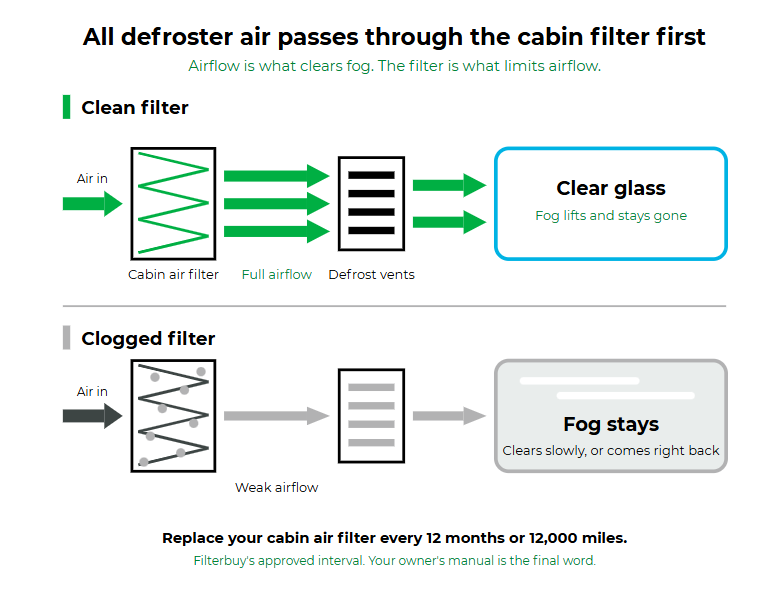
If the glass still clears slowly or fogs again within a minute, airflow is the problem. Every bit of defroster air passes through your cabin air filter first, and a clogged one throttles it.
Not sure which filter your vehicle takes?
Answer 3 quick questions and we'll match you to your perfect filter.
Or skip the quiz
Car windows fog up when humid cabin air meets glass that is colder than the air’s dew point. Your defroster clears that fog by pushing warm, dried air across the windshield, and it can only do that if enough air actually reaches the glass. That is why a clogged cabin air filter is the most common cause you can fix yourself: every bit of defroster air passes through it first.
Fastest defog: front defrost, heat high, A/C on, recirculation off, all at once.
A clogged cabin air filter restricts airflow to the defrost vents, so glass clears slowly or re-fogs.
Replace a cabin air filter every 12 months or 12,000 to 15,000 miles. Filterbuy’s approved interval is 12 months or 12,000 miles.
A sweet smell with an oily film on the glass points to a heater core. No filter fixes it.
To defog a windshield fast, press the front defrost button, turn the temperature up, switch the A/C on and turn recirculation off. Warm air holds more moisture, the evaporator strips water out of it before it reaches the vents, and fresh-air mode swaps humid cabin air for drier air from outside. Used together, those four settings clear most windshields in a couple of minutes.
Select front defrost. This aims airflow at the windshield and, on most cars, engages the A/C compressor automatically.
Turn the heat up. Warmer air holds more moisture, and it lifts the glass back above the dew point.
Turn the A/C on. The evaporator works as a dehumidifier, so air crossing its cold fins gives up its moisture.
Turn recirculation off. Recirculation loops the same humid air through the cabin. AAA notes that switching it off pulls in drier air from outside.
Crack a window for a few seconds when the weather allows.
Resist wiping the glass with a hand or a sleeve. Consumer Reports warns that wiping leaves streaks which scatter headlight glare, worse than the fog you started with.
Car windows fog when water vapor condenses on glass colder than the air’s dew point, the temperature at which air becomes saturated. Inside a car, that vapor comes from breath, wet coats, damp mats and pets. Four people breathing on a 20-minute commute load the cabin with humid air, and the windshield is the coldest surface it can find.
Which side of the glass fogs tells you what is happening.
It is also why car windows fog in the rain. Wet shoes and umbrellas add moisture to the cabin at the same moment rain is cooling the glass from outside.
If your windshield keeps fogging up and the car defroster is not working well, restricted airflow is usually to blame. The defroster itself is rarely broken. Every cubic foot those vents deliver has to pass through the cabin air filter first, and once that filter packs with dust, pollen and leaf litter, less air reaches the glass. The fog then clears slowly, or clears and comes straight back.
Here is what most drivers never hear. Your defroster was certified to work. Federal Motor Vehicle Safety Standard No. 103 requires every passenger car, truck, and bus sold in the United States to have a windshield defrosting and defogging system, and passenger cars are tested in a cold chamber over 40 minutes with the engine held at or below 1,500 rpm in neutral. Yours was engineered for worse conditions than your driveway in January, so when it cannot keep up, something has changed. Airflow is the part that changes quietly, over about a year of driving.
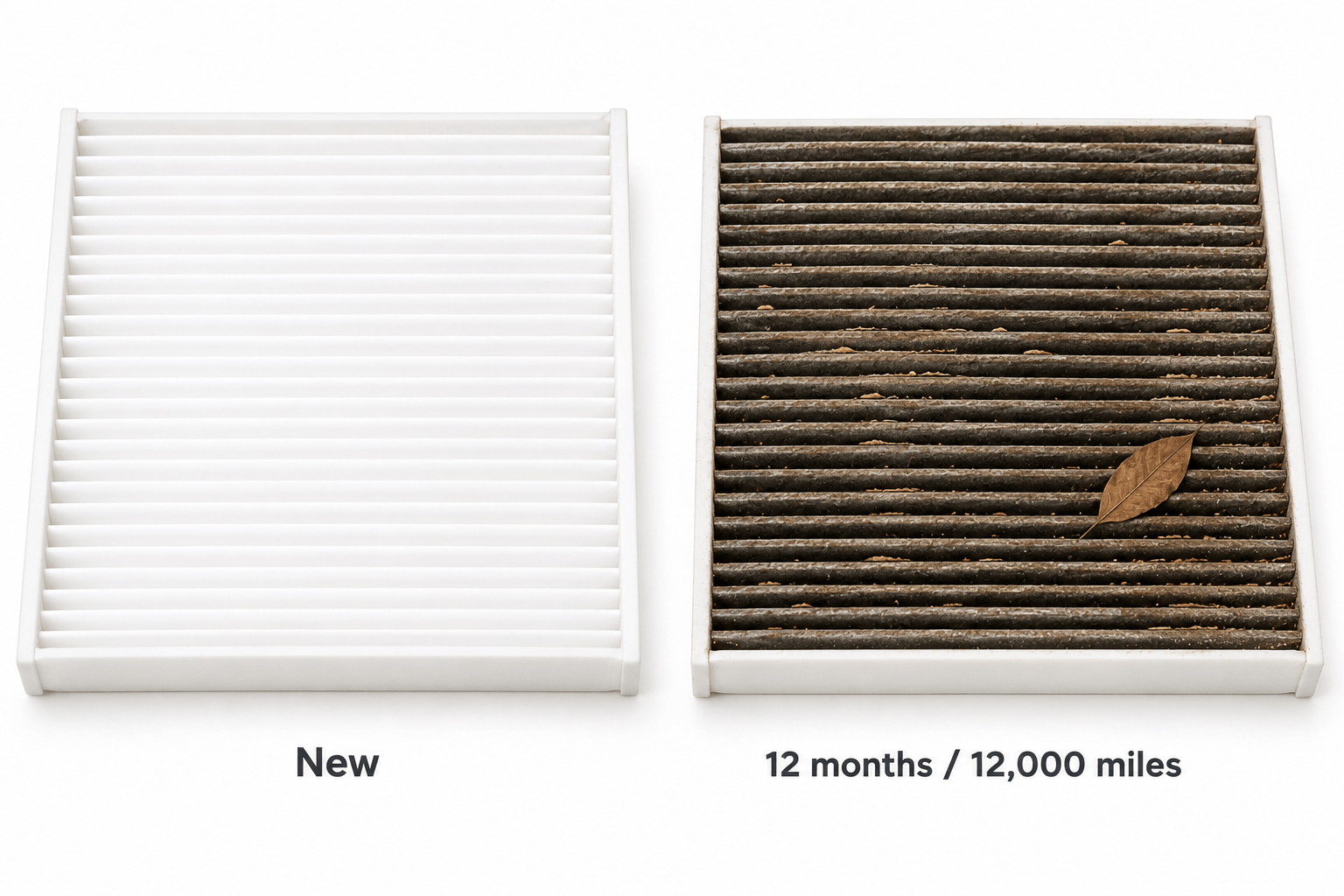
A clogged filter hurts twice. It cuts the volume of air reaching the glass, and it reduces how much air the A/C evaporator can dry, so what does arrive is wetter than it should be. Counterman, a trade publication for parts specialists, reports that a dirty filter slows defrosting and cuts visibility.
A clogged cabin air filter is the likeliest cause when airflow is weak, but foggy windows inside a car can also come from a wet carpet, a plugged evaporator drain or a leaking heater core. These three checks separate them in about a minute, before you buy anything.
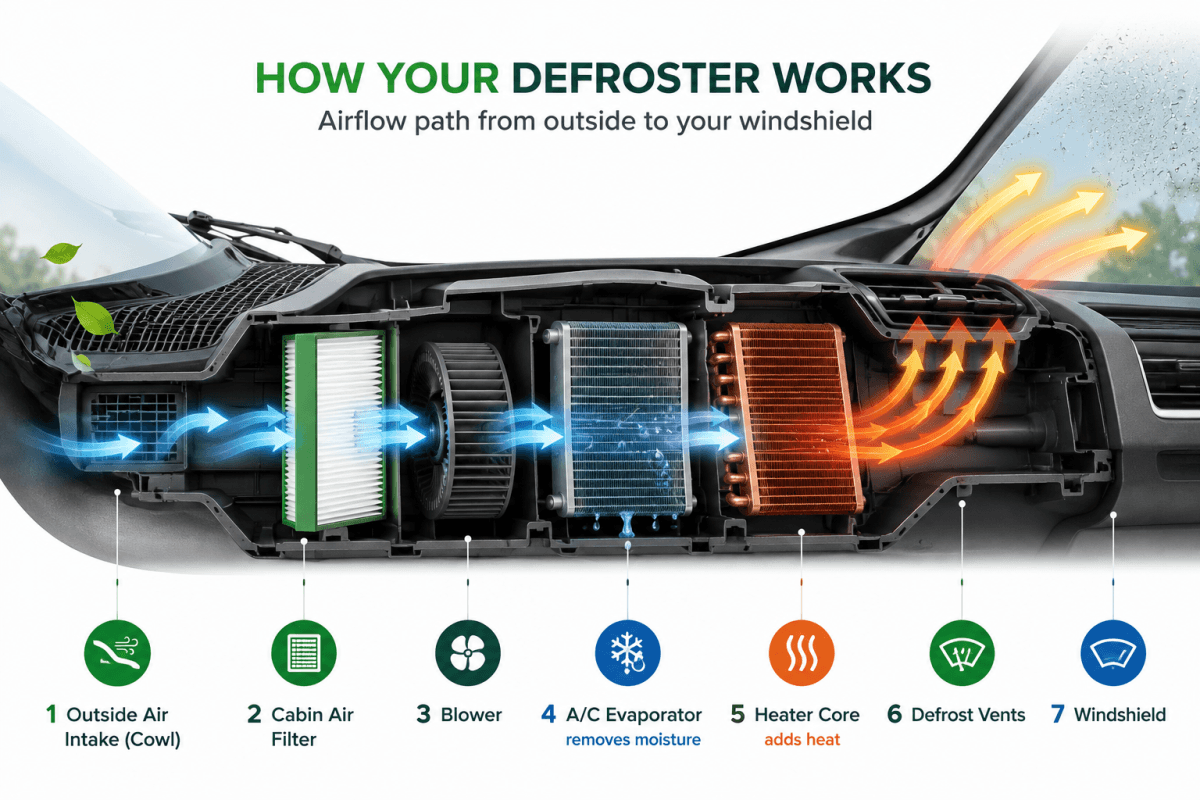
Check 1: Airflow. Set the fan to maximum, select front defrost and hold a hand at the center vent. If the blower sounds loud but the air feels weak, you have a restriction, the first of the signs your cabin air filter needs replacing.
Check 2: Dryness. With defrost, heat, A/C and fresh air all running, watch the glass. Fog that clears and stays clear means the system is working. Fog that returns within a minute means moisture is still getting in.
Check 3: Source. Press the carpet in the passenger footwell. Damp carpet with a musty smell usually points to a plugged evaporator drain or a failing door seal. Damp carpet with a sweet smell and a greasy film on the glass points to the heater core.
A fresh filter resolves the first three rows. The last three need a shop.
Electric cars fog exactly like gas cars, but clearing the glass costs more.
A gas engine throws off waste heat, so its defroster runs on heat the car was making anyway. An EV has to make that heat from the battery. The U.S. Department of Energy puts cold-weather EV range loss at about 41%, and roughly two-thirds of that extra energy goes to heating the cabin. With the heater off, the same cold costs about 12%.
Two things follow.
Precondition while plugged in. Warm the cabin and the glass on wall power while the car is still on the charger. DOE recommends this, and it is the biggest single thing an EV driver can do.
A restricted filter costs more in an EV. There is no spare engine heat to force through it, so every extra minute of defrosting is range you never get back.
Heated seats will warm you, but they do nothing for the glass. Only airflow clears fog.
Most cabin air filters sit behind the glove box and take under ten minutes to change with no tools. Empty the glove box, squeeze the side stops so it drops down, unclip the cover, note the airflow arrow on the old filter and slide the new one in facing the same way. Then hold the old one up to a light. If no light comes through, it has been throttling your defroster for a while.
Replace it every 12 months or 12,000 to 15,000 miles, and sooner in heavy pollen, dust or smoke. How much sooner is not a guess. Journal of Aerosol Science researchers found that raising a filter’s dust exposure from 25 to 150 micrograms per cubic meter cut its service life roughly sixfold. The Filterbuy interval is 12 months or 12,000 miles, though your owner’s manual is the final word. Cars built before roughly 2000 often have no cabin filter at all.
At Filterbuy we cut our auto cabin filters in Talladega, Alabama, to each vehicle’s factory tolerances, using HEPA-grade synthetic media that captures 99.97% of particles at 0.3 microns. Find the filter for your year, make, and model, confirm the part number, or put it on a subscription.
Fogged glass is a visibility problem, and visibility is a safety problem. See a shop if a fresh filter does not restore airflow, if the defroster blows cold at full heat, or if you smell anything sweet.
Filterbuy makes cabin air filters in Talladega, Alabama. Read this knowing we have a stake in the answer.
Because Filterbuy cuts its own filters, we see a failure most drivers never hear about. A filter can sit loose in its housing, move plenty of air and still let unfiltered air slip around its edges. The vents feel strong, dust keeps landing on the dash, and the glass still fogs. That is bypass air, and it is a fit problem, which is why we cut to each vehicle’s factory dimensions. One shape built to cover every car fits none of them exactly.
That vantage point also tells Filterbuy when to stop selling. A sweet smell with an oily film on the glass is a heater core, and no filter we make will fix it. Better to say so than sell you one and leave you wiping glass in February.
Three findings explain why a slow defroster is worth taking seriously.
Rain is the worst weather you drive in.
574,047 crashes a year happen in rain or mist.
That is 77% of weather-related U.S. crashes.
Cabin air is also at its wettest.
FHWA Road Weather Management, 2019 to 2023.
You spend more time in the cabin than you think.
The average one-way commute is 27.2 minutes.
69.2% of U.S. workers drive alone.
About four and a half hours a week breathing filtered air.
U.S. Census Bureau, ACS 2024.
Millions live where filters load fastest.
61.5 million live in counties graded F for particle spikes.
Those spikes come from wildfire smoke, road dust and exhaust.
There, treat 12 months as a ceiling.
American Lung Association, State of the Air 2026.
Cold air chills the glass while breath, wet boots and damp coats raise humidity inside. When the windshield falls below the dew point, moisture condenses.
Yes. A clogged cabin air filter restricts airflow to the defrost vents and limits how much air the evaporator dries. Condensation inside car windows clears slowly, even on full defrost.
Rain cools the glass while wet shoes and umbrellas push humid air inside. Switch to fresh air and leave recirculation off.
Cabin air filter: The filter that cleans outside air before it enters the passenger compartment through the HVAC system. Separate from the engine air filter.
Dew point: The temperature at which air saturates and water vapor condenses. Glass below it fogs.
Bypass air: Unfiltered air that slips around a loose filter and reaches the cabin without passing through the media.
Heater core: A small radiator that heats the cabin using engine coolant. A leak produces a sweet smell and an oily film on the glass.
FMVSS 103: The U.S. rule requiring defrosting and defogging systems on passenger cars, trucks, and buses.
NHTSA, 49 CFR § 571.103 (eCFR).
NOAA National Weather Service, Water Vapor, Humidity, and Dewpoint.
Consumer Reports, Fastest Way to Defog Car Windows, 2025.
Counterman, Cabin Air Filters and Defrost Performance.
Heo et al., Service life of an automotive cabin air filter, J. Aerosol Sci. 162 (2022).
U.S. Census Bureau, Commuting At A Glance, ACS 2024.
American Lung Association, State of the Air 2026.
DOE and EPA, Fuel Economy in Cold Weather, FuelEconomy.gov.
Filterbuy, Does a Cabin Air Filter Affect Your AC? Replacement interval.
