
Which Way Does a Cabin Air Filter Go? The Airflow Arrow, Explained
September 2, 2026
By Michelle Wan · Reviewed by David Clark, Licensed HVAC Technician · Published September 2, 2026 · Updated September 2, 2026
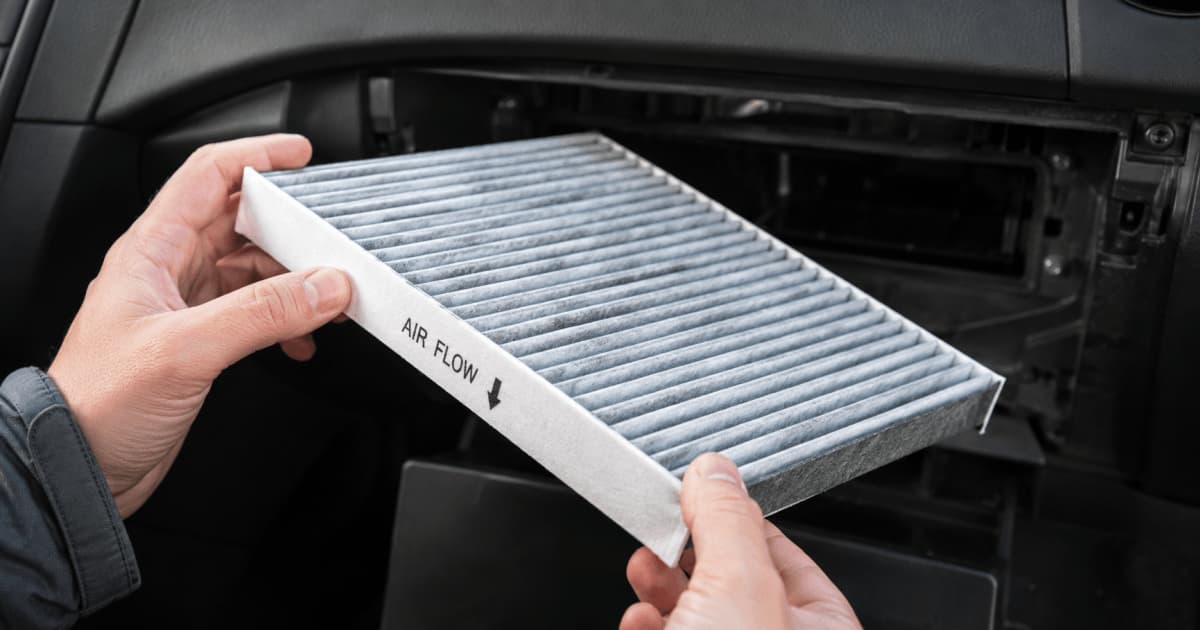
A cabin air filter goes in with its AIR FLOW arrow pointing the same way air travels through your vehicle's HVAC system. In most cars that is downward, toward the blower motor, because outside air enters near the base of the windshield and gets pulled down through the filter. A filter marked UP is telling you something else. That mark says which edge faces the sky, not which way air moves.
Answer a few quick questions and we will match you to the right cabin air filter for your car.
TL;DR
The arrow on a cabin air filter shows which way air flows through the media, and it should point the same way your vehicle moves air. In most vehicles that is downward, from the cowl intake toward the blower motor. An UP marking is a different instruction, since it describes orientation rather than airflow, so the two are not interchangeable. When a filter carries neither mark, the dirty face of the old one shows where the air came in.
Key Takeaways
AIR FLOW and UP are different instructions. An AIR FLOW arrow points downstream, showing where air exits. An UP mark only governs how the frame sits.
Downward is the common answer, not the universal one. Most vehicles pull air toward a blower motor below the filter, though some route it upward or sideways.
A backwards filter still filters, it just gives up capacity. Layered media and carbon placement both assume one direction of flow.
Which Way Does A Cabin Air Filter Go?
A cabin air filter goes into its housing with the airflow arrow aligned to the way air moves through the ventilation system. Cabin filters sit in the outside-air intake for the passenger compartment, ahead of the A/C system, which makes the geometry of your car the deciding factor. The Filterbuy pillar guide covers what a cabin air filter does in full.
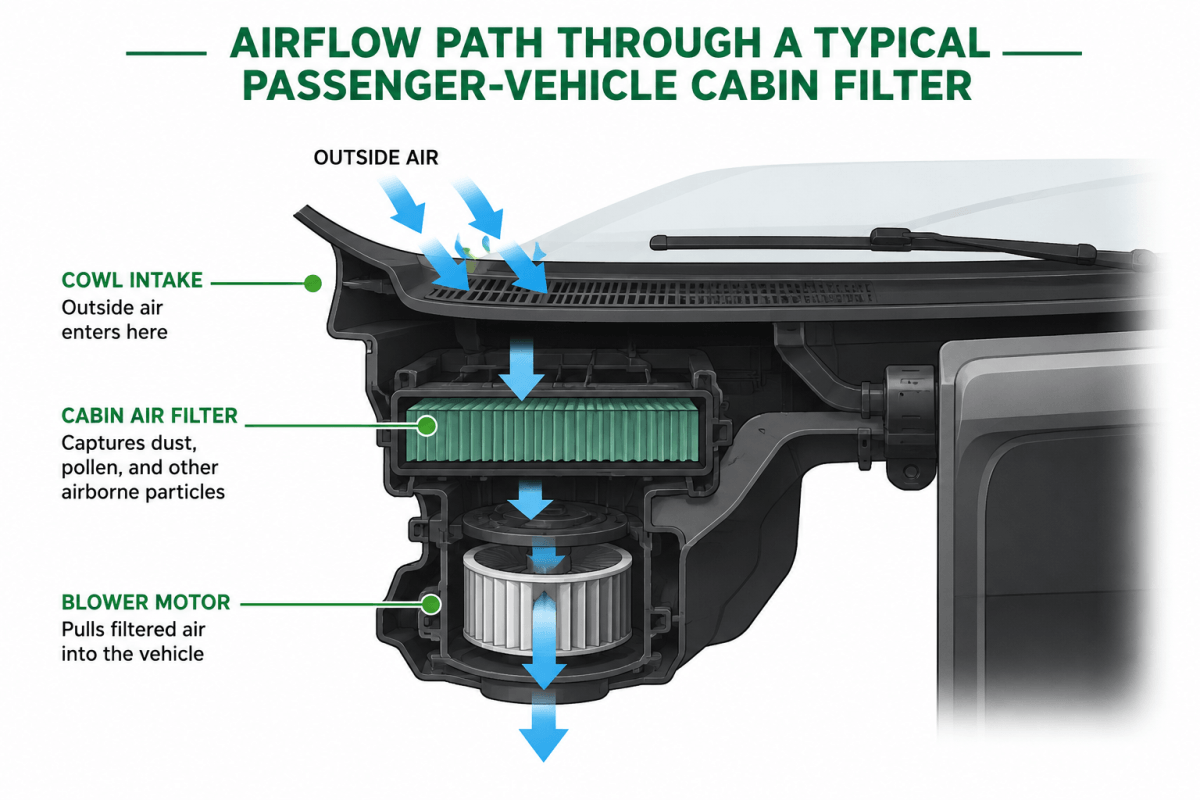
That geometry is simple enough to picture. The intake sits in the cowl at the base of the windshield, the filter housing sits behind the glove box, and the blower motor sits below both, so air travels down through the media and the arrow points down.
Not every car is built that way. Some European models and trucks route air upward or laterally, which is why the arrow is not a standing instruction to point down. It tells you to match your car.
What Does The Arrow On A Cabin Air Filter Mean?
The arrow on a cabin air filter means airflow direction. It traces the path air takes through the media, from the dirty upstream face to the clean downstream face. Filters carry one of four marking patterns, and reading the wrong one causes most of the confusion at installation.
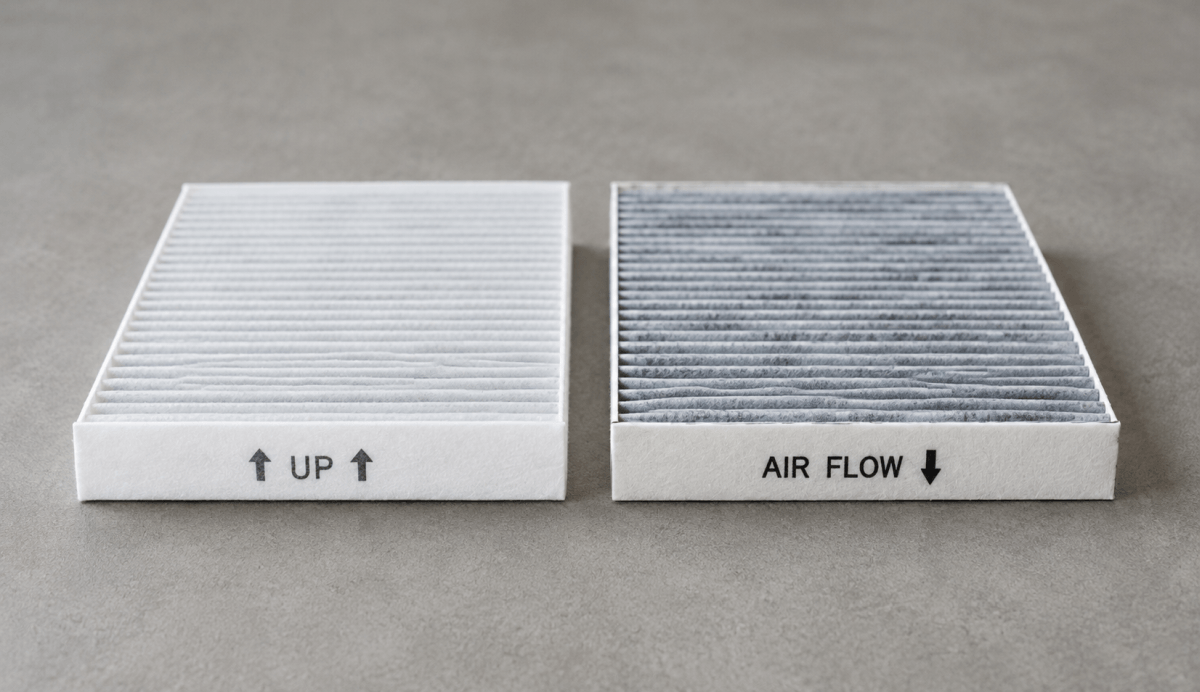
AIR FLOW plus an arrow. Marks the direction air moves. Point it the way air travels, usually toward the blower motor.
UP, with or without an arrow. Marks which edge faces upward. Seat that edge up and let the housing design set the airflow.
Both AIR FLOW and UP. Two instructions on one frame. Satisfy AIR FLOW first, then check the UP edge.
No marking at all. The media is most likely symmetrical and single layer. Match the filter you removed.
Does The Cabin Air Filter Arrow Point Up Or Down?
The cabin air filter arrow points down in most vehicles and up or sideways in a minority of them. Direction is set by where the intake and blower motor sit relative to the tray, not by any rule that holds for every car.
Two labeling conventions drive most of the disagreement online. Bosch prints AIR FLOW with an arrow and tells installers to install the filter with the arrows facing down, while noting that other brands print TOP on that edge instead. A TOP or UP mark is not a weaker airflow arrow. It is a different instruction doing a different job.
Down is not universal, and the exceptions are easy to find. Tesla's Model S procedure says the cabin filter arrows should face toward the rear of the vehicle, because that filter sits in the footwell rather than above a blower. Whichever convention your car uses, the housing marking settles it.
How To Confirm Airflow Direction In Your Vehicle
Confirm airflow direction with three checks, run in order, stopping at the first clear answer. Each one is more specific to your vehicle than the last, so a later check overrides an earlier one.
Read the housing before the old filter comes out. Check the access cover and tray for a molded arrow or the words AIR FLOW. This is the carmaker's instruction and it outranks anything on an aftermarket frame.
Photograph the old filter in place, then read its dirty face. Debris collects on the upstream side, so leaves and grey dust on the top face mean air was moving down. A clean top with a loaded underside means the reverse.
Check the owner's manual under cabin filter or air conditioning filter. Manufacturers document orientation in the maintenance chapter, and the wording reveals which convention applies.
If all three come back ambiguous, the filter is almost certainly symmetrical and single layer, where orientation has little practical effect. Our guide covers how to replace a cabin air filter at home.
Where The Filter Sits Changes What The Arrow Governs
Where the filter sits decides whether it cleans only outside air or the air already in your car. Two mounting positions are common, and they behave differently the moment you press recirculate.
In the HVAC case, behind the glove box or under the dash. Premium Guard notes that interior air is blown through the filter in recirculation mode, so the media works in every fan setting rather than only on fresh air.
Under the hood, at the cowl. These see outside air only, so switching to recirculate bypasses them entirely, which is worth knowing on a smoky day.
So find the location before you judge the arrow. Two filters can carry the same marking and sit at different angles.
Why Cabin Air Filter Direction Matters
Cabin air filter direction matters because the media is built in layers, each placed to work at a specific point in the airstream. Freudenberg Performance Materials, a cabin media supplier, describes its Filtura Carbon as activated carbon embedded between nonwoven layers. Run that stack backwards and the layers meet the airstream in the wrong order.
Dust-holding capacity. A coarse upstream layer catches large debris first, so the fine downstream layer stays open longer. Reversed, the fine layer loads first and resistance climbs sooner.
Carbon layer placement. In a combination filter the carbon sits where it can adsorb gases after the particles are gone. Reversed, it takes the raw debris load.
Pleat support and sealing. Frames and pleat spacing are built for load from one face.
Ahlstrom reports cabin air filter media efficiency measured to DIN 71460-1 as high as 99.97 percent at 0.5 microns, though that rating assumes air moving the intended way through the stack and says nothing about performance in reverse.
This part looks obvious from a Filterbuy factory floor and invisible from a driveway. A finished cabin filter looks the same from both faces, but inside it is a stack, and that order is a design decision made before the frame is glued. The arrow is not a courtesy. It is the only way that decision survives the trip to your glove box.
What Happens If You Install A Cabin Air Filter Backwards?
A backwards cabin air filter still filters air, but it clogs sooner and restricts airflow earlier in its life. On a carbon filter it also gives up odor control. The result is lost capacity rather than a fault, so nothing is damaged and no warning light comes on.
That is why the mistake goes unnoticed. A reversed filter and an overdue one produce the same weak vent output and musty smells, and both affect your air conditioning in the same way, so the filter often gets replaced when it only needed turning around.
On a plain single-layer filter with identical faces, reversing it changes little, while on a layered or carbon filter it costs real capacity. Because the two look alike from the frame, Filterbuy prints the marking, and the safe habit is to fit every filter as marked.
What To Look For In A Replacement
Fit governs cabin filter performance more than direction does. A filter a few millimeters undersized lets unfiltered air slip around the frame, whichever way the arrow points.
Filterbuy auto cabin air filters use HEPA-certified synthetic media rated to capture 99.97 percent of airborne particles as small as 0.3 microns, cut to each vehicle's exact specifications. Every filter carries a printed airflow marking, so the direction question is answered before you open the box.
Where we stand. Filterbuy manufactures cabin air filters, so we have a stake in what you buy. We are telling you anyway that a cheap filter installed the right way beats a premium one installed backwards.
Grade is a separate decision from orientation. Filterbuy's guide to cabin air filter ratings covers the home HVAC scale, how to choose a cabin air filter matches a grade to how you drive, and how cabin filter brands compare sets the options side by side.
Why We Print The Arrow
“Filter media is not a single sheet. It is a stack, and the stack is built on the assumption that air enters one face and leaves the other. That is the entire reason the arrow gets printed on the frame, and why the box carries a QR code that goes straight to install instructions. A filter fitted the wrong way is a filter doing less than it was built to do.”
- The Filterbuy Team
Supporting Statistics
Orientation matters because of how much air passes through one piece of media. Three figures set the scale.
27.2 minutes. Mean one-way U.S. commute in 2024, up from 26.8 in 2023, per the U.S. Census Bureau 2024 American Community Survey.
69.2 percent of workers drive alone.
A round trip is near an hour a day of filtered cabin air.
45 million people live within 300 feet of a major transportation facility, according to EPA near-source air pollution research.
For these drivers the upstream face works hardest.
152.3 million Americans, 44 percent of the country, live where the air earns a failing grade, per the American Lung Association State of the Air 2026.
Graded on ozone and particle pollution, 2022 through 2024 data.
None of that changes when a filter goes in backwards. It just loads faster, and that hour a day is why Filterbuy makes cabin filters at all.
Frequently Asked Questions
What Happens If A Cabin Air Filter Is Installed Backwards?
It keeps filtering but loads faster, so airflow drops earlier and a carbon layer loses odor control. Nothing is damaged, and reinstalling it the right way brings performance back.
How Do I Tell Which Way The Air Flows In My Car?
Look for a molded arrow on the housing first. If there is none, pull the old filter and find the face carrying the heavier debris load, which was the intake side.
Does Direction Matter On A Filter With No Arrow?
Very little. An unmarked filter is usually symmetrical, so either orientation performs about the same.
Glossary
AIR FLOW arrow: A frame marking showing which way air passes through the media, from the upstream to the downstream face.
UP or TOP mark: An orientation marking showing which edge faces the top of the housing. It describes placement, not airflow.
Cabin air filter: A pleated filter in a vehicle's ventilation system that cleans air before it reaches the cabin.
Blower motor: The fan that moves conditioned air through the vents, usually sitting downstream of the filter.
Activated carbon layer: A layer in some cabin filters that adsorbs odors and gases. Its position assumes correct airflow.
DIN 71460-1: The industry test standard for particle-removal efficiency of automotive cabin filter media.
Sources
U.S. Census Bureau: United States Commuting At A Glance, ACS 1-Year Estimates. www.census.gov/topics/employment/commuting/guidance/acs-1yr.html
U.S. EPA: Research on Near Roadway and Other Near Source Air Pollution. www.epa.gov/air-research/research-near-roadway-and-other-near-source-air-pollution
American Lung Association: Key Findings, 27th annual air quality report. www.lung.org/research/sota/key-findings
Premium Guard: Will the Cabin Filter Remove Contaminants From Air Already in the Passenger Compartment. www.pgfilters.com/resources/articles/will-the-cabin-filter-remove-harmful-contaminants-from-air-that-is-already-in-the-passenger-compartment
Bosch Aftermarket: Installation Guidelines for Cabin Filters (AP-H06). www.boschaftermarket.com/xrm/media/images/country_specific/au/parts_15/cabin_filters_2/aeristo_premium/bosch_ap-h06.pdf
Tesla: Replacing Cabin Filters, Model S Do It Yourself. service.tesla.com/docs/Public/diy/models/en_us/GUID-40C70444-9DFD-47C4-86ED-AB3F1AE3A97A.html
Jacobi Group: Cabin Air Filters. www.jacobi.net/cabin-air-filters
Freudenberg Performance Materials: Filtura Carbon activated carbon filter media. filtura.freudenberg-pm.com/en/solutions/filtura-carbon-activated-filter-media
Ahlstrom: Cabin air filter media. www.ahlstrom.com/products/filter-media/air-filtration-for-automotive/cabin-air-filter-media
About The Author
Michelle Wan is Filterbuy's Brand Manager and air quality writer. She works directly with Filterbuy's U.S. manufacturing team across its plants in Alabama, Florida, Pennsylvania, and Utah, and bases her guidance on how filters are actually built and used.
Reviewed for technical accuracy by David Clark, a Licensed HVAC Technician.