September 2, 2026

Michelle Wan | Reviewed for technical accuracy by David Clark, a Licensed HVAC Technician
Published September 2, 2026 | Updated September 2, 2026
Weak airflow from your car vents almost always means something is restricting the air, and a clogged cabin air filter is the most common restriction. The filter sits in the path of every vent, so when it loads up, every vent goes faint at once. Work the causes cheapest first and you avoid paying for a part your car never needed.
Here is what each symptom points to:
Weak at every vent, on every fan speed. That is a restriction. Start with the cabin air filter.
Some fan speeds dead, others normal. That points to the blower motor resistor, which RepairPal estimates at $142 to $195.
Strong on recirculate, weak on fresh air. The blockage is outside the cabin, in the cowl intake under the windshield. Free to clear.
Filterbuy lists cabin air filters by year, make and model if you want to check what your vehicle takes.
Not sure which cabin filter your vehicle takes?
Answer 3 quick questions and we will match you to the right one.
Already know your year, make and model? Shop auto cabin air filters — made in the USA, shipped factory-direct.
Weak airflow from your car vents almost always starts with a clogged cabin air filter, which is both the cheapest part in the airflow path and the one drivers forget. Before you pay a shop to find the problem, spend sixty seconds on a fan test that tells you whether the air is being blocked or the fan itself is failing. That single check is the difference between a filter you swap in the driveway and a repair that runs into the hundreds.
Weak airflow from car vents has six common causes, and they are nowhere near equally expensive. A clogged cabin air filter is both the most likely and among the cheapest to fix, which makes it the right place to start on almost any car. From there, a short fan-speed test will tell you whether the air is simply restricted or the blower has an electrical fault. If you work through the causes cheapest first, you avoid paying for parts your car never needed.
A clogged cabin air filter is the most common cause of weak airflow from car vents. The filter sits in the airflow path, so a clog weakens every vent at once.
Weak air on every fan speed points to a blockage. Fan speeds that do nothing point to the blower motor resistor, which RepairPal estimates at $142 to $195 to replace.
A failing blower motor produces very little air at any speed. RepairPal estimates replacement at $387 to $440.
Strong airflow on recirculate and weak airflow on fresh air points outside the car. Leaves packed into the cowl intake are a free fix.
Vent airflow is part of a federal safety system. Federal Motor Vehicle Safety Standard No. 103 requires a windshield defogging system, and it uses the same filter and blower.
Weak car AC airflow usually means something is restricting the air rather than that the air conditioning itself has failed. The cabin air filter is the first suspect because it sits in the path of every vent, and the symptom that gives it away is air that still feels cold but arrives faint. Air that feels warm is a refrigerant question and a different repair altogether.
What fools people is how gradual it is. A cabin air filter does not fail on a Tuesday. It loads a little more each week until the day the fan sounds loud and almost nothing reaches your face, by which point the change feels sudden even though it never was.
For more on how filter restriction interacts with cooling, read does a cabin air filter affect your AC, and our rundown of the signs your cabin air filter needs replacing covers the other symptoms that tend to travel with weak airflow.
The 60-second fan test separates a blocked-airflow problem from an electrical one in about a minute. Start the engine, set the temperature mid-range, and hold a flat hand at a center dash vent while you work through the four checks below. What changes between the settings is what tells you which part is at fault.
Run every fan speed in order. If the air climbs with each speed but still feels weak at the top, something is restricting it, and the cabin air filter is where to start.
Listen for speeds that do nothing. A dead low or medium speed alongside a working high setting points to the blower motor resistor rather than the filter, because a restriction never removes individual speeds.
Switch between fresh air and recirculate. If the air is strong on recirculate and weak on fresh, the blockage sits outside the cabin at the intake under the windshield.
Compare the vents against each other. Strong at your feet and weak at the dash points to a mode door rather than a restriction, since a clogged filter starves every vent equally.
The NAPA guide to low airflow air conditioning describes the same recirculate comparison, and it rules the intake in or out before anything has to come apart.
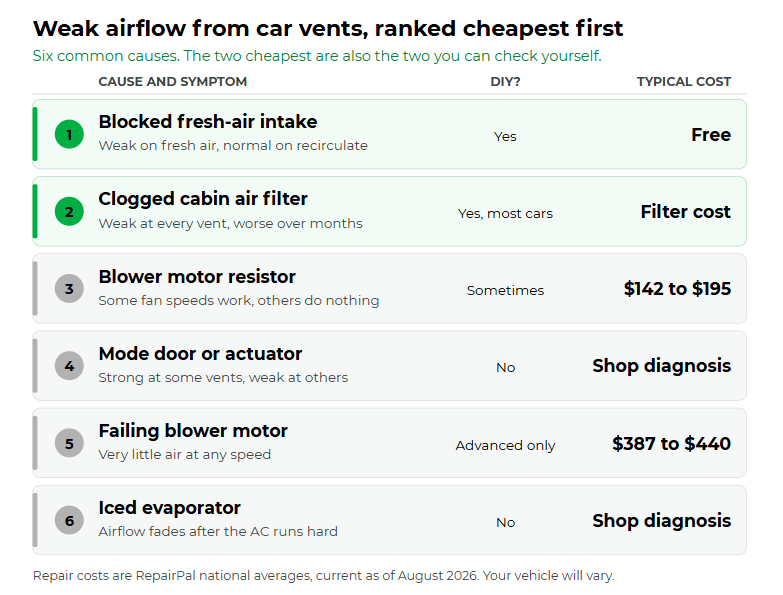
Six causes account for most weak-airflow complaints, and the cheapest of them costs nothing at all. The table below ranks them by typical repair cost so you can rule out the inexpensive ones before anyone quotes you for a part.
| Cause | What it feels like | DIY? | Typical cost |
|---|---|---|---|
| Blocked fresh-air intake | Weak on fresh air, normal on recirculate. Worse in autumn. | Yes | Free. Clear the leaves. |
| Clogged cabin air filter | Weak at every vent, worse over months, often a musty smell. | Yes, most cars | Filter cost only |
| Blower motor resistor | Some fan speeds work, others do nothing at all. | Sometimes | $142 to $195 |
| Mode door or actuator | Strong at some vents, weak at others. Clicking behind the dash. | No | Shop diagnosis |
| Failing blower motor | Very little air at any speed, sometimes with a rattle. | Advanced only | $387 to $440 |
| Iced evaporator | Airflow fades after the AC runs hard, returns after the car sits. | No | Shop diagnosis |
National averages come from the RepairPal blower motor resistor replacement cost estimate and blower motor replacement cost estimate, both current as of August 2026, though your own vehicle will vary. Filterbuy ships cabin filters factory-direct, so on most cars the part itself costs less than a shop's labor to fit it.
Here is what most guides leave out. Cost order and likelihood order are not the same list. The intake is the cheapest fix without being the most common, while the filter is the most common without being the cheapest. Check both anyway, because fifteen minutes spent on the pair clears the two causes behind most complaints.
Two common fixes make weak airflow worse instead of better. One is to pull the filter out to free up air, and the other is to drop in a replacement that does not fill its housing. Both trade away filtration for a little airflow, and both send debris onto the evaporator and into the blower wheel.
Filterbuy manufactures cabin air filters, so we have a stake in this page. That is why a free fix sits above ours in the table. Every filter trades what its media captures against how much air it passes, and getting that trade wrong is how a new filter leaves airflow weaker than the one it replaced. Filterbuy builds to OEM tolerances for the same reason. A filter that does not fill its housing lets air slip the edges, and that bypass air feels like restored airflow when it is unfiltered air taking the shortest route to your face.
“The filter is the cheapest part in the airflow path and the first thing worth checking. It is also the part people are most tempted to simply take out. That trade never pays off.”
Michelle Wan, Brand Manager and Air Quality Writer, Filterbuy
Most cabin air filters sit behind the glove box and come out without tools. Pull the filter, hold it against daylight, and see how much light passes through the pleats. A filter packed with dust and leaf fragments restricts airflow whether or not it looks black.
Empty the glove box so it swings down.
Squeeze the sides or release the stops so it exposes the cover.
Unclip the cover, noting how it came off so you can reattach it correctly.
Note which way the airflow arrow on the frame points before sliding the old one out.
Slide the new filter in the same way and rerun the fan test.
Do not vacuum, rinse or blow out a dirty cabin filter and reuse it, because a whack against the ground only damages the media without shifting the particles that cause the restriction. For the full walkthrough, see how to replace a cabin air filter at home. Filterbuy packs carry a QR code that opens model-specific directions for the car in front of you.
Ford recommends replacement at 15,000 to 20,000 miles for many models in its guidance on when to change the cabin air filter, and AAA puts factory intervals at 15,000 to 30,000 miles in its guide to cabin air filter replacement. Filterbuy's approved interval is 12 months or 12,000 miles, and your owner's manual is the final authority for your vehicle. Our breakdown of how long cabin air filters last covers by how much.

Vent airflow is what clears a fogged windshield. Federal Motor Vehicle Safety Standard No. 103 applies to passenger cars, multipurpose passenger vehicles, trucks and buses, and it requires each one to have a windshield defrosting and defogging system. On nearly every vehicle that system pushes air through the same cabin filter and blower that feed your dash vents.
A restriction you tolerated all summer turns into a visibility problem on the first cold, damp morning of the year, because weak airflow means slow defogging and glass you cannot see through.
Delay carries a second cost as well. The blower motor resistor sits in the airflow stream so that moving air can cool it, so when you starve it with a packed filter it runs hot, and that is one way a cheap maintenance item turns into a $195 repair. See what happens if you never replace your cabin air filter for the rest of that chain.
Two cheap explanations sit between a fresh filter and a repair bill. Your vehicle may take two filters and you replaced only one of them, or debris from the old filter may have dropped into the housing on its way out. Either one leaves airflow weak with a new filter fitted, and neither costs anything to rule out.
Check whether your car takes two filters. Tesla’s cabin filter service instructions for the Model 3 describe an upper and a lower filter stacked in one housing, replaced as a pair, and AAA notes some models carry two or more. Replace one of a stacked pair and the restriction stays. Filterbuy lists cabin filters by year, make and model, which is the quickest way to confirm whether yours takes one or two.
Look for what fell in during the swap. A packed filter sheds leaves and grit as it slides out, and that debris drops toward the blower wheel below it. Shine a light into the empty housing before the new filter goes in, and clear out whatever has settled in the bottom.
Change the filter and clear the cowl yourself, then hand the rest over. Fan speeds that cut in and out, grinding from behind the glove box, or any burning smell off the dash all call for a professional diagnosis.
Treat the burning smell as the one that cannot wait, since an overheating resistor or connector can melt its housing and damage the wiring around it. Stop running the blower and have the system checked.
Three United States federal sources. Each figure is dated and linked.
11,106 miles: what the average light-duty vehicle covers in a year.
Federal Highway Administration figure for 2023.
Puts a 12,000 to 15,000 mile filter interval at roughly once a year.
Source: FHWA Highway Statistics 2023, Table VM-1. Updated March 2025.
38,700 vehicle crashes a year happen in fog.
Over 600 killed. More than 16,300 injured. Every year.
Defogging runs on airflow. Weak vents slow it down.
27.2 minutes: the average one-way commute.
Census Bureau figure for 2024, up from 26.8 minutes in 2023.
About four and a half hours a week inside that airstream.
Source: U.S. Census Bureau, American Community Survey commuting estimates. Table S0801.
Weak but cold air is a restriction symptom rather than a refrigerant one, because less air is reaching you even though what does arrive is still chilled. A clogged cabin air filter is the usual reason for that, followed by a blocked intake.
It is the same problem. Your heater and your air conditioning share one blower motor, one filter and one set of ducts in almost every vehicle, so airflow that is weak with the AC on will be just as weak with the heat on. That consistency is what confirms a restriction rather than a cooling fault.
No air at any speed usually means the blower motor has failed, or a fuse or relay feeding it. A restriction almost never stops airflow completely. RepairPal notes that when no fan speed works the blower motor is the likely culprit, while a resistor failure leaves one speed working.
Yes. Blower motors wear down gradually, so a tired one will spin slower than commanded and deliver less air for a long while before it quits altogether. A rattle from the passenger footwell is usually the tell.
A fan that sounds loud on high while delivering very little air is the signature of a restriction, because the motor is working against a blockage rather than moving air. Check the filter first and the cowl intake second.
Michelle Wan is Filterbuy's Brand Manager and Air Quality Writer. She works directly with Filterbuy's United States manufacturing team and bases her guidance on how filters are built and used.
Reviewed for technical accuracy by David Clark, a Licensed HVAC Technician. Filterbuy manufactures air filters in the United States and ships factory-direct, including auto cabin air filters cut to fit specific vehicles.
Cabin air filter: the filter that cleans outside air entering a vehicle's passenger compartment through the heating and air-conditioning system, usually behind the glove box.
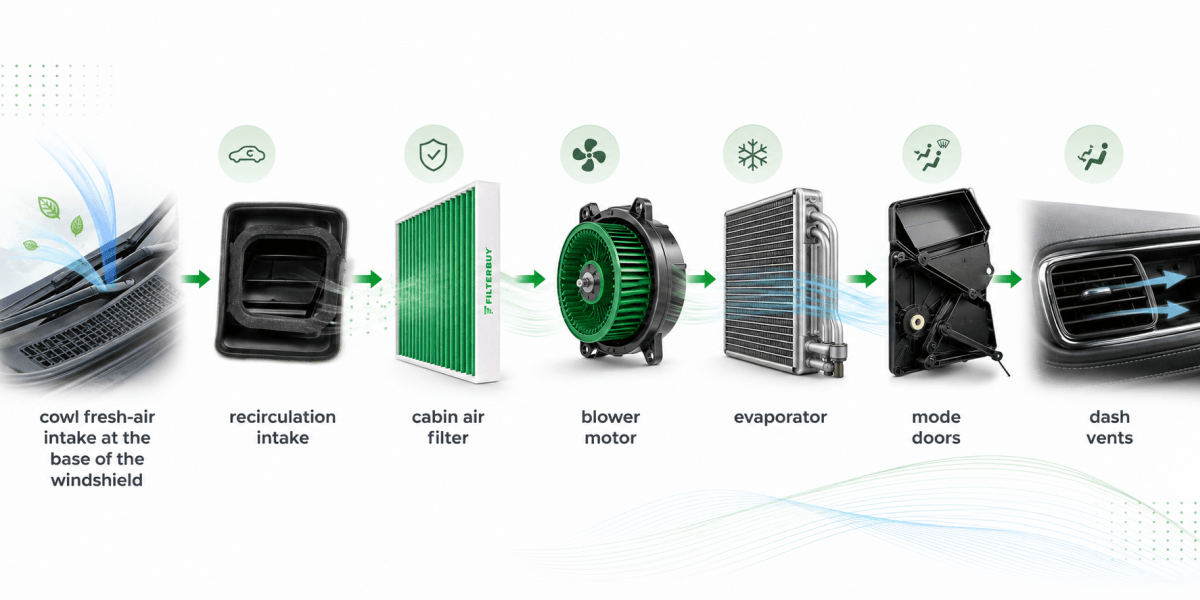
Blower motor: the electric fan motor that pushes air through the cabin air filter, across the evaporator or heater core, and out the vents.
Blower motor resistor: the component that sets fan speed by dropping voltage to the blower motor. Most manual systems bypass it on high, so a failed resistor often leaves only high working.
Cowl intake: the fresh-air inlet at the base of the windshield, near the wiper pivots, where outside air enters the system.
Mode door: an internal flap in the HVAC housing that directs airflow to the dash vents, floor vents or defroster. A stuck one makes some vents weak and others strong.
Evaporator: the air-conditioning component that chills incoming air using refrigerant. Very low airflow across it can let it freeze, blocking airflow further.
FMVSS No. 103: the federal motor vehicle safety standard that requires a windshield defrosting and defogging system on passenger cars, multipurpose passenger vehicles, trucks and buses.
Filterbuy: a United States air filter manufacturer that makes auto cabin air filters and home HVAC filters, sold factory-direct and cut to fit specific vehicles.
