
What Happens If You Never Replace Your Cabin Air Filter?
June 15, 2026
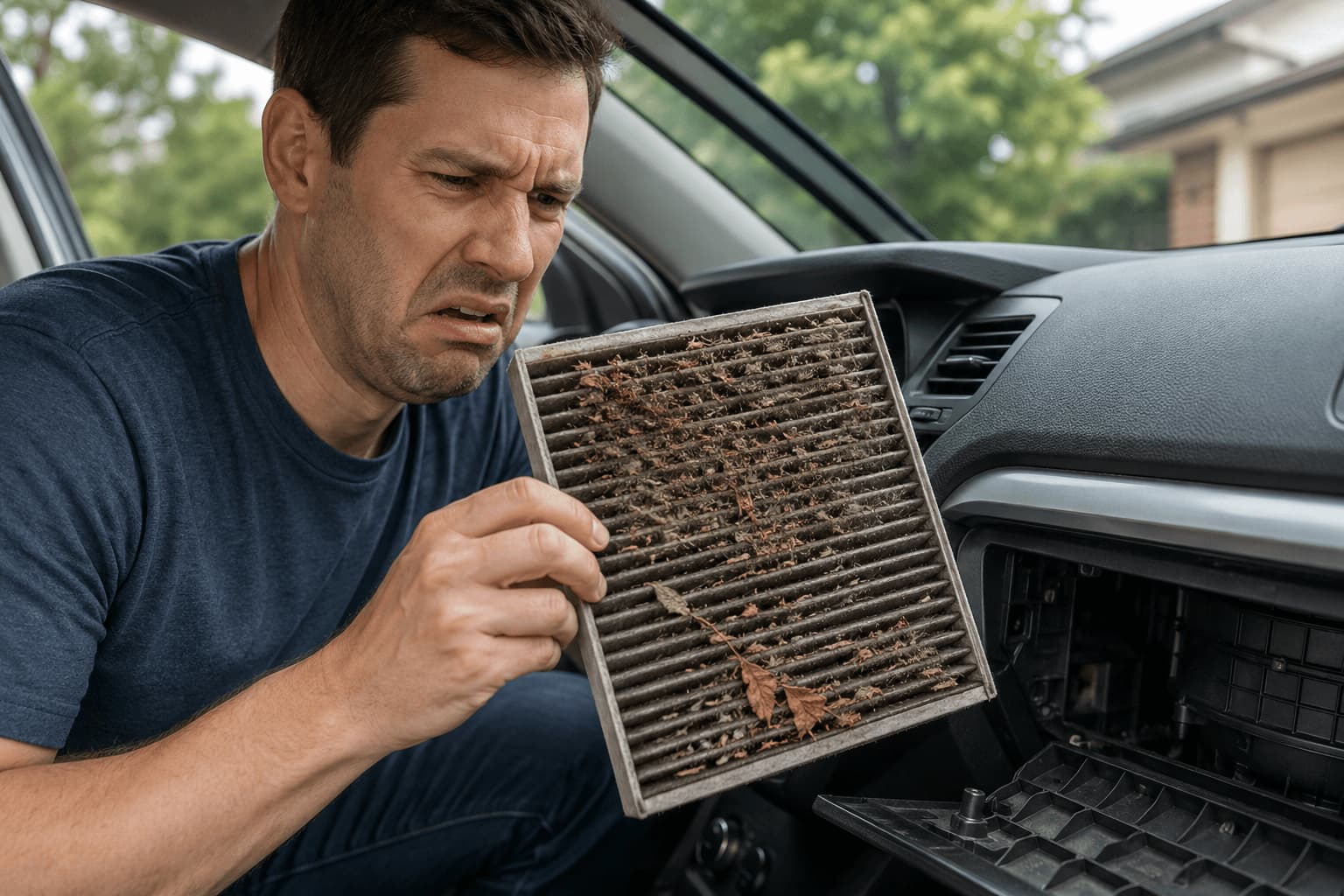
The cabin air filter is one of the easiest parts to forget. It sits hidden behind your glove box, quietly cleaning the air before it reaches your vents — out of sight, out of mind. That changes the moment airflow weakens, a musty smell creeps in, or your AC stops keeping up on a hot day.
Skipping this small task has consequences beyond comfort: it strains your climate control system and lowers the quality of the air you and your passengers breathe. Here's exactly what goes wrong when you ignore it, how often to replace it, and the warning signs worth watching for.
The short answer
A cabin air filter that's never changed eventually clogs — and a clogged filter stops helping and starts causing problems. You get weaker AC and heat, musty odors, foggy windows, and more dust, pollen, and smoke recirculating into the cabin. The fix is cheap and quick: most filters swap out in under 15 minutes, often with no tools.
1. Weaker AC and heat
A clogged filter restricts airflow, so your blower works harder to push the same air. The result: weak vents, uneven cooling, and added strain that can shorten the life of HVAC parts.
2. Dirtier cabin air
A saturated filter can't trap new dust, pollen, smoke, and mold spores — so more of it gets pushed back into the air you breathe instead of caught at the surface.
3. Odors and moisture
Trapped debris and moisture let bacteria and mold build up, which causes a musty smell when the AC runs and foggy windows that are slow to clear. No air freshener fixes the root cause — only a fresh filter does.
Does a dirty cabin air filter affect your AC?
Yes — directly. Your ventilation system pulls air through the filter before it reaches the vents. When the filter is clogged, less air gets through, so the AC works harder to push out the same amount of cool air. That extra effort shows up as weak airflow, slower cooling, and uneven cabin temperatures, and it makes the blower motor run harder than it should, which can lead to premature wear.
It's a known enough problem that the National Highway Traffic Safety Administration (NHTSA) lists checking A/C performance and your cabin air filter among its steps before summer travel — a clogged filter is a common culprit behind poor airflow on hot days.
There's a winter side too: your defroster relies on a strong blast of dry air to clear condensation. Restricted airflow means foggy windows that are slow to clear, which is a real visibility and safety issue, not just an annoyance.
What your cabin filter is actually catching
Your cabin filter is the first line of defense for the air inside your car. According to AAA, what it keeps out includes dust, pollen, soot, smog, mold spores, bacteria, leaves, insects — even rodent droppings. It also captures fine particles like PM2.5 from traffic exhaust and wildfire smoke.
Here's a detail most drivers don't expect: according to the EPA, indoor air — including the air inside your vehicle — can be 2 to 5 times more polluted than outdoor air. A clean filter is what keeps a lot of that out of the cabin.
How often should you replace it?
Start with your owner's manual, it's the most reliable source for your specific vehicle, and intervals vary by make and model.
As a general guideline, most automakers recommend every 12,000 to 30,000 miles, and a practical rule of thumb is every 12,000–15,000 miles, or once a year. Some set their own schedule — Volkswagen, for example, recommends every 20,000 miles or 2 years. These are starting points, not hard limits; your driving conditions matter as much as the mileage.
| Driving conditions | Suggested replacement interval |
|---|---|
| Typical commuting, mild climate | Every 12,000–15,000 miles, or once a year |
| Heavy traffic or city driving | Toward the shorter end of the range |
| Dusty roads or construction zones | More often — check every few months |
| High pollen or wildfire smoke | More often — inspect seasonally |
When in doubt, pull the filter and look at it. If it's gray, packed with debris, or smells musty, it's time for a new one.
Watch for these signs
- Weak airflow from the vents, even on the highest fan setting
- Musty or moldy odor when you turn on the AC or heat
- Unusual fan noise as the blower strains against the blockage
- More dust settling on the dashboard and interior
- Foggy windows that are slow to clear with the defroster
- More sneezing or irritation from pollen and other particles while driving
If you or your passengers notice ongoing respiratory irritation, replace the filter and check with a medical professional to rule out other causes.
How to check and replace it yourself
In most vehicles the cabin air filter sits behind the glove box, making it one of the easier filters to reach — many cars need no tools at all. The whole job usually takes under 15 minutes. (If you'd rather not, ask your mechanic to swap it during your next oil change.)
Replace it in 5 steps
- Check your owner's manual to confirm the filter's location and orientation.
- Open the glove box and release it from its hinges or stoppers to reach the housing.
- Slide out the old filter, noting the direction of the airflow arrows.
- Insert the new filter with the arrows pointing the same way.
- Reseat the glove box — done.
Choosing the right replacement filter
The right filter does two things well: it fits your vehicle exactly, and it captures fine particles without choking airflow. Fitment is critical — a filter that's too loose lets unfiltered air slip around the edges, defeating the purpose no matter how good the media is.
It also helps to know the main filter types, since they capture different things:
| Filter type | What it's best at |
|---|---|
| Standard particle | Captures larger debris — dust, pollen, and leaves. |
| High-efficiency synthetic media | Captures finer particles too — fine dust, smoke, and mold spores. |
| Activated carbon / charcoal | Adds odor and gas reduction — helps with exhaust fumes and musty smells. |
A small filter with a big job
Your cabin air filter is small and easy to ignore, but it protects your AC system, your comfort, and the air you breathe on every drive. Letting it go too long means weaker cooling, musty odors, and a harder-working blower motor — all avoidable with a quick, inexpensive swap. Check your owner's manual for the interval, watch for the warning signs, and replace it on schedule.
Ready to breathe easier?
Find the cabin filter for your make, model, and year — and keep your AC running strong.
Find your cabin filterRead More
Key Takeaways
A dirty cabin air filter negatively impacts both your air quality and your vehicle's performance.
Ignoring this maintenance can result in reduced airflow, unpleasant odors, and potential mold buildup.
Neglecting to replace the filter strains your HVAC system, which may lead to costly repairs.
Regular cabin air filter replacement ensures cleaner air, better visibility, and a more efficient HVAC system.
Staying proactive with this simple maintenance task can save you money and protect your health in the long run.
Read more about auto cabin filters
What Does a Cabin Air Filter Actually Do?
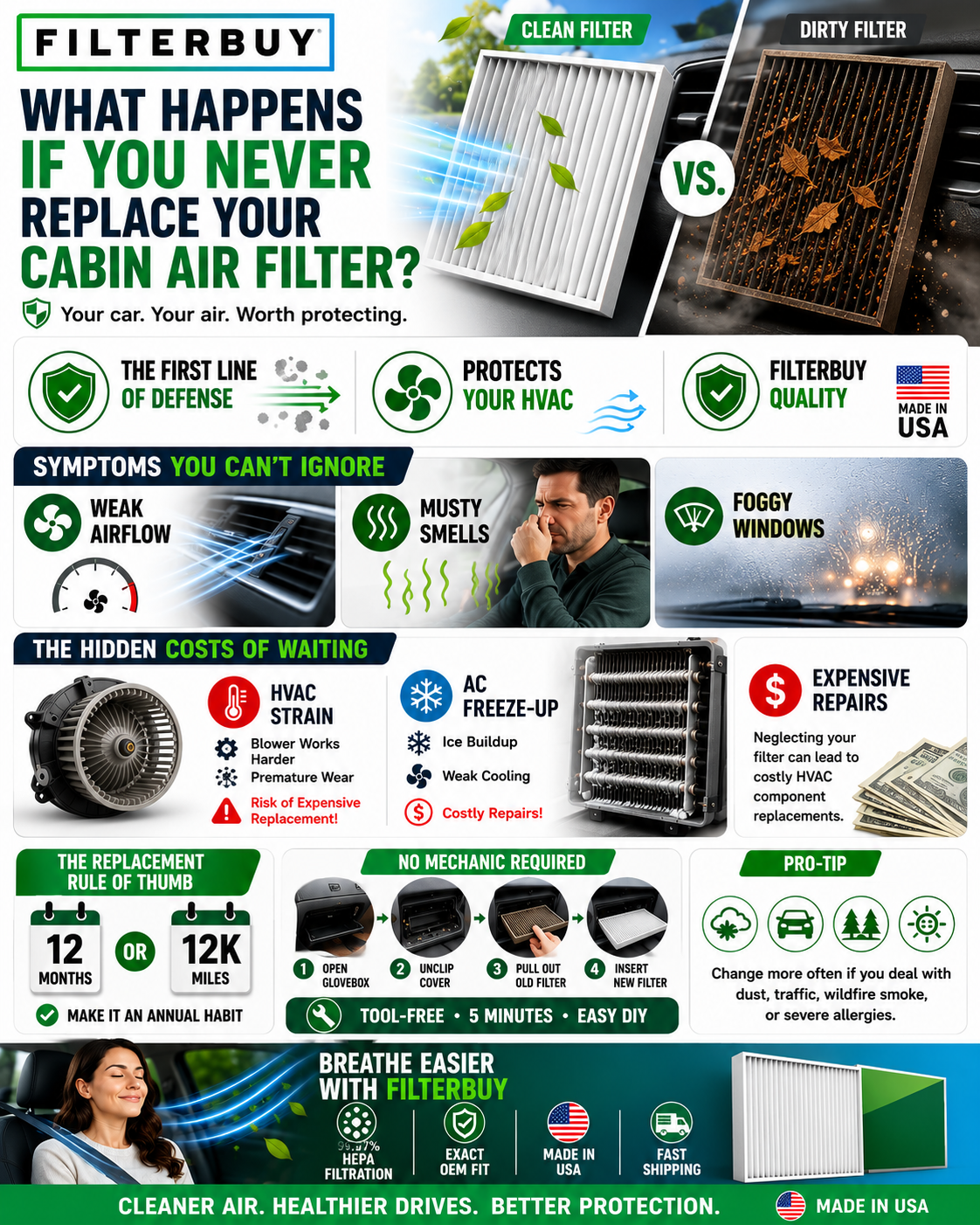
Think of your vehicle as a rolling living room. You want the air inside to be clean and comfortable. A cabin air filter acts as the first line of defense for your car's interior.
Filters the Air Coming Into Your Cabin
As you drive, your car pulls in outside air to feed the AC and heating systems. A clean cabin filter traps pollutants before they reach your face. This includes obvious debris like leaves and dust. But it also catches microscopic threats like pollen, smoke, bacteria, mold spores, and PM2.5 particles.
Helps Protect Your HVAC System
Your car's climate control relies on unrestricted airflow. When air moves freely, your blower motor operates efficiently. This ensures strong AC performance in the summer and fast defrosting capability in the winter.
Filterbuy auto cabin air filters use HEPA-certified synthetic media to trap 99.97% of airborne particles as small as 0.3 microns, including bacteria, pollen, mold spores, smoke, and pet dander.
Every filter is manufactured 100% in the USA to exact OEM tolerances, with advanced hydrocharging technology that permanently magnetizes every fiber for maximum particle capture without restricting airflow. Available for hundreds of vehicles across all major makes and models, use the vehicle selector at filterbuy.com to find the right fit for your car.
Clogged Cabin Air Filter Symptoms You Should Never Ignore
How do you know if you have waited too long? Your car will usually give you a few hints. Look out for these common clogged cabin air filter symptoms:
Weak airflow coming from the vents
Musty or moldy smells when using the AC
Windows that fog up easily and take longer to clear
Loud or struggling HVAC fan noise
Worse allergy symptoms while driving
Dirty Cabin Air Filter Problems You Can’t Ignore
The longer you wait to replace a clogged filter, the worse the problems get. What starts as a minor annoyance can quickly turn into an expensive repair bill.
Extra Strain on the Blower Motor
Your blower motor is not designed to push air through a brick wall of dirt. A severely clogged filter causes overheating risks and premature wear on the motor. Blower motor replacement costs can easily run into the hundreds of dollars.
Reduced AC and Heater Performance
When air cannot flow over your AC evaporator core, the coils can actually freeze up. This leads to evaporator freeze-up, uneven airflow, and weak cooling. On a hot summer day, you will definitely feel the consequences of a bad cabin air filter.
Mold and Bacteria Growth
The dark, damp environment of a car's HVAC system is a playground for mold. Humid HVAC conditions combined with trapped contaminants lead to rapid odor-causing microbial buildup. Breathing in mold spores every time you commute is terrible for your respiratory health.
Poor Cabin Air Quality
Driving in traffic exposes you to severe pollution. A compromised filter lets urban traffic pollution, wildfire smoke, exhaust particles, and dangerous PM2.5 exposure flow right into your lungs. Most cabin air filters catch the obvious stuff. Filterbuy goes further to ensure your cabin air is truly clean.
How Long Can You Go Without Replacing a Cabin Air Filter?
You should not wait for bad smells and weak airflow to remind you to change your filter. Preventative maintenance is always the smartest route.
Recommended Replacement Interval
Most auto manufacturers suggest replacing your cabin air filter every 12 months or 12,000 miles. Think of it like changing the batteries in your smoke detector. Make it an annual habit.
Conditions That May Require Earlier Replacement
Sometimes, 12 months is too long. Certain driving conditions will clog a filter much faster. You should check and replace your filter more frequently if you regularly deal with:
Dusty climates or dirt roads
Wildfire regions with heavy smoke
Heavy stop-and-go traffic
Heavy construction zones
Is Replacing a Cabin Air Filter Worth It?
Absolutely. A cabin air filter replacement is one of the cheapest ways to protect your car's climate control system. Compare the costs yourself. A cabin air filter replacement is low-cost maintenance. A blower motor replacement costs hundreds of dollars. Major HVAC repairs can be incredibly expensive. But remember, spending a little bit on a quality filter today saves you massive headaches tomorrow.
How to Replace a Cabin Air Filter Yourself
You do not need to pay a mechanic for this job. Changing a cabin air filter is one of the easiest DIY tasks you can do in your driveway.
Most Filters Are Behind the Glovebox
In the majority of modern cars, the filter housing sits right behind the passenger glovebox. You simply lower the glovebox down, unclip a plastic cover, pull the old filter out, and slide the new one in.
Many Replacements Are Tool-Free
You rarely need tools for this job. Most vehicles feature tool-free installation. Filterbuy makes this even easier. You will find a QR code on every package that links to model-specific directions. It is highly DIY-friendly and takes only a few minutes to complete.
Ready to Replace Yours?
Filterbuy HEPA auto cabin filters are designed to trap 99.97% of airborne particles as small as 0.3 microns, including pollen, smoke, mold spores, and fine dust, without restricting airflow to your HVAC system. Every filter is manufactured in the USA to exact OEM tolerances for an airtight fit with no bypass gaps.
Simple Maintenance for a Better Drive
Your cabin air filter is an inexpensive piece of preventative maintenance. Delaying a replacement ultimately affects both your physical comfort and your vehicle's HVAC performance.
The signs of a bad cabin air filter usually appear gradually. Do not wait for your AC to stop working or your car to smell like an old basement. Replacing your filter today improves airflow, eliminates odor, and dramatically improves cabin air quality. Find the right filter for your vehicle at Filterbuy.
Frequently Asked Questions
How do I know if my cabin air filter is clogged?
Common signs include weak airflow, musty smells, louder fan noise, foggy windows, and worsening allergy symptoms while driving.
Can a dirty cabin air filter affect AC performance?
Yes. Restricted airflow can make your air conditioner feel weaker and may force the HVAC system to work harder.
What happens if you never replace a cabin air filter?
Over time, the filter can become clogged with dust, pollen, mold spores, and debris, reducing airflow and potentially straining HVAC components.
Can a cabin air filter cause bad smells in a car?
Yes. A dirty filter can trap moisture and organic debris, which may lead to moldy or musty odors coming through the vents.
How often should you replace a cabin air filter?
Most manufacturers recommend replacing it every 12 months or 12,000 miles, though some driving conditions may require more frequent changes.
Is replacing a cabin air filter something you can do yourself?
In many vehicles, yes. Most cabin air filters are accessible behind the glovebox and can be replaced without tools in just a few minutes.
Why am I getting weak airflow from vents?
When a filter is packed with dirt, air struggles to circulate. You will notice the fan feels weaker than it used to. This reduction in airflow becomes especially obvious when you turn the fan up to higher speeds.
Why is there a musty smell from car AC?
Nobody wants their car to smell like a locker room. A dirty filter traps organic debris like leaves and bugs. It also traps moisture. This creates a perfect breeding ground for microbial growth. Eventually, this leads to a "gym sock smell" or a "musty AC odor" blowing directly into your face.
Why are my windows foggy and taking longer to clear?
Your defroster relies on a strong blast of dry air to clear condensation. Restricted airflow directly reduces defroster performance. Foggy windows that refuse to clear up quickly are not just annoying. They create serious visibility concerns and safety implications on the road.
Why is my HVAC fan making loud noises?
When airflow is blocked, the blower motor works harder to push air through the clogged media. This increased resistance puts massive strain on your HVAC components. The result is a loud, struggling fan noise behind your dashboard.
Why do I have worse allergy symptoms while driving?
A clogged filter stops doing its job. This may increase exposure to airborne irritants while driving. If you notice more sneezing, watery eyes, or coughing in your car, your filter is likely failing to block pollen, smoke, pet dander, and other airborne particles.