
Can You Clean a Cabin Air Filter Instead of Replacing It?
September 2, 2026
By Michelle Wan · Technically reviewed by David Clark, Licensed HVAC Technician
Published: September 2, 2026 · Last updated: September 2, 2026
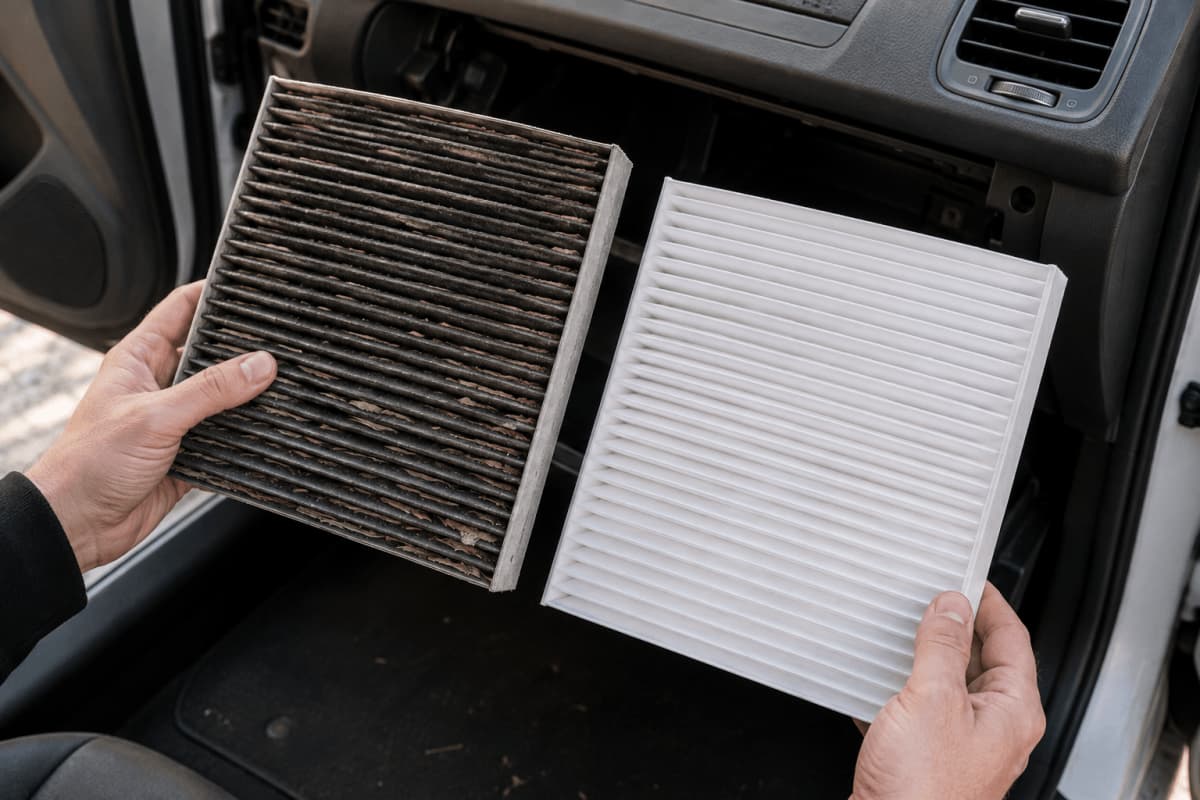
You can clean a cabin air filter. On almost every vehicle, you should not. A standard cabin filter is disposable pleated media built for one service life, and every cleaning method takes something from it that you cannot see afterward. Only a filter its maker sells as washable should ever get wet.
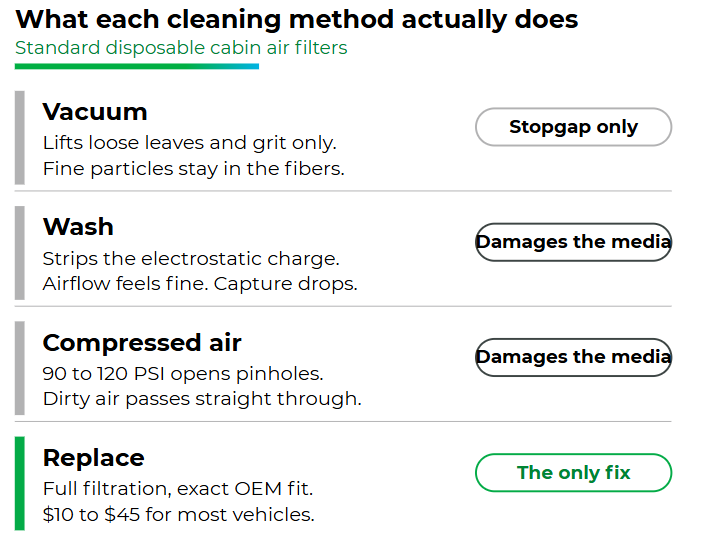
Vacuum: lifts loose leaves and grit. The fine particles stay lodged in the fibers.
Wash: strips the electrostatic charge. Airflow still feels normal, so the loss is invisible.
Compressed air: 90 to 120 PSI opens pinholes that let dirty air through.
Take the quick match below and we will point you to the exact-fit replacement for your vehicle.
Answer 3 quick questions and we will match you to your perfect filter.
Already know your year, make and model?
You can clean a cabin air filter. On almost every vehicle, you should not. A standard cabin air filter is disposable pleated media built for a single service life.
Vacuuming lifts loose leaves and grit, but not the fine particles lodged in the fibers.
Washing strips the electrostatic charge, and you cannot see or feel the loss.
Shop air opens holes that let dirty air through.
Only a filter that its maker labels washable should ever get wet.
Filterbuy builds cabin air filters cut to an exact OEM fit, most for less than a shop charges in labor.
TL;DR
No, you should not clean a standard cabin air filter instead of replacing it. Disposable cabin filters use pleated synthetic media that is usually electrostatically charged, and water, detergent and shop air all degrade that media permanently. A light vacuum buys you a few days, but it restores neither filtration nor airflow. Only filters sold as washable, such as K&N's, are built to be cleaned repeatedly.
Key Takeaways
Most vehicles built since 2000 have a cabin air filter, and nearly all of them are disposable.
In laboratory testing, detergent reduced electret charge to zero while airflow held steady, which is why the loss is invisible to a driver.
In that same testing, electrostatic capture was doing roughly a third of the filter's work.
Can You Clean a Cabin Air Filter, or Does It Have to Be Replaced?
A cabin air filter has to be replaced unless its maker sells it as washable. Cabin filters come in three media types, and only one tolerates cleaning.
Pleated paper or synthetic media, used in most factory and aftermarket filters. Disposable by design.
Activated carbon media, used in odor and exhaust filters. Rinsing will not release gases the carbon has already absorbed.
Cotton gauze or engineered washable media, sold by K&N and a few aftermarket brands. Cleanable with the maker's own kit.
NAPA draws the same line in its guidance on whether to clean or replace a cabin air filter, where paper filters are always replaced and only certain cloth filters count as reusable. If your filter came with the car, assume it is disposable. Our buyer's guide covers how to identify yours.
Can You Vacuum a Cabin Air Filter?
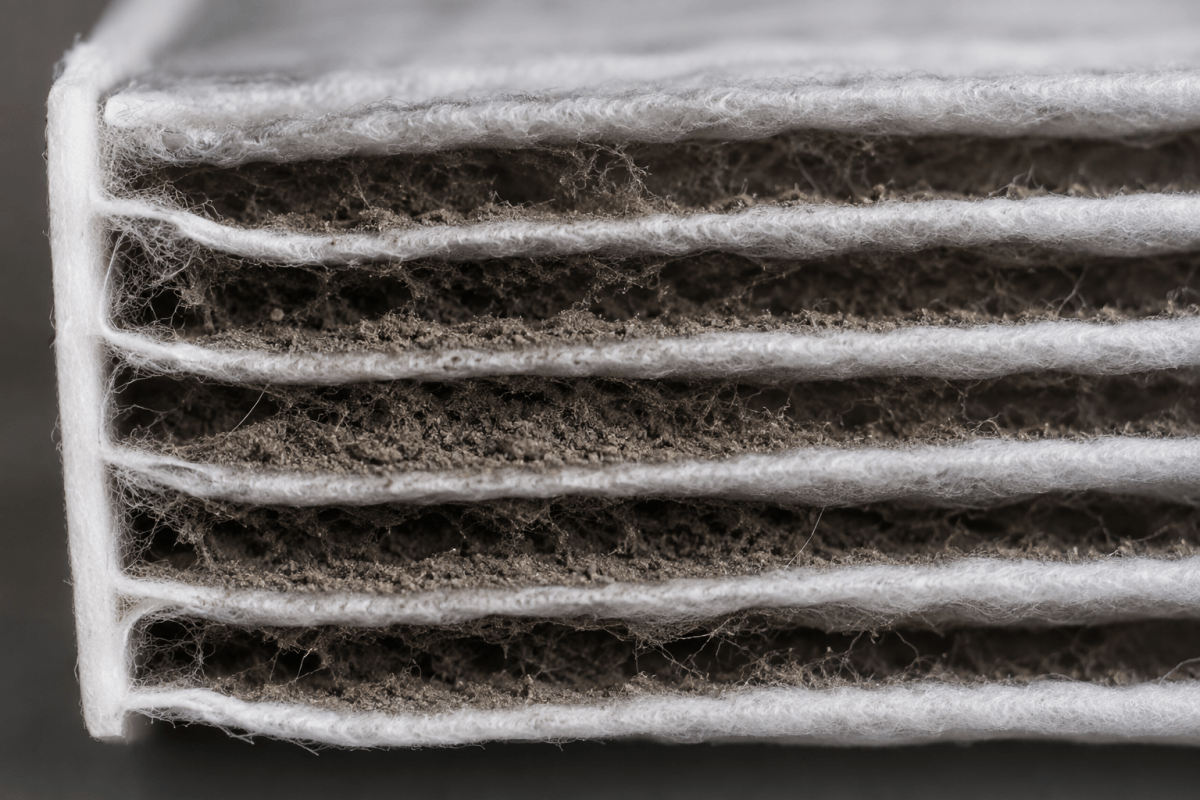
Vacuuming a cabin air filter removes loose surface debris and nothing else. Pleated media works by depth rather than surface, so particles are trapped through its full thickness instead of sitting on the face. A shop vac pulls off leaves and grit, but the soot and pollen that actually restrict airflow sit between fibers no household vacuum can reach.
Filter manufacturers warn that scrubbing makes things worse. MANN+HUMMEL's Filtron brand says cleaning drives contaminants deeper into the medium and permanently damages its structure. Filtron is describing engine air filters, which sit under the hood and protect the engine rather than the cabin, but both parts use the same pleated construction. You are not clearing the media out. You are packing it tighter.
Is It OK to Wash a Cabin Air Filter?
Washing a disposable cabin air filter is the most damaging thing you can do to it, and none of that damage shows afterward. DENSO, an original-equipment supplier, confirms that cabin filter media is commonly given an electrostatic charge so it captures ultra-fine particles such as smoke and diesel carbon. Detergent destroys it.
The measurements come from respirator research on the same electret media. A team from Sandia National Laboratories and the University of New Mexico tested six N95 decontamination methods and found that soap dropped the electret layer's surface potential to effectively zero while pressure drop stayed exactly the same. By their calculation, electrostatic capture had been doing between 28% and 45% of the filtration work.
That is the whole problem in one sentence. A washed filter still moves air normally, so your vents feel fine and your fan sounds fine while it quietly stops catching what it used to.
Then there is what you are adding water to. Research in Environmental Science and Pollution Research found car air-conditioning filters carrying fungi and yeasts, heaviest in vehicles that had gone longest without a change. A 2025 survey of fungi in vehicle cabins notes that warm, damp filter conditions suit spore germination. A damp filter in a dark housing is how a musty vent smell starts.
Should You Blow Out a Cabin Air Filter With Compressed Air?
Blowing out a cabin air filter with compressed air is the riskiest cleaning method, because it damages the media faster than dirt ever would. Shop air runs at 90 to 120 PSI, far beyond anything thin pleated media is built to withstand, and it leaves separated fibers and pinholes you will never spot by eye. If you have already blown out a filter, replace it. A clogged filter at least still filters.
You Already Washed It. Now What?
Most people find this page after the rinse rather than before it. Nothing here is an emergency, because a cabin air filter protects your comfort and the air you breathe, not your engine. Find the line that matches your situation.
You washed it, dried it fully, and the filter was fairly new. Run it, but replace it at your next oil change rather than at the mileage interval.
You put it back while it was still damp. Pull it out today. Damp media in a warm, dark housing is the mold path.
You used dish soap, degreaser or any other detergent. Replace it. Detergent is the agent that pushed filter media past the federal certification limit in NIOSH testing.
You can see a tear, a thin patch or a collapsed pleat. Replace it. Bypass air is worse than restricted air.
Are There Reusable and Washable Cabin Air Filters?
Yes, and they are a product you buy on purpose rather than a technique you apply to a filter you own. K&N is the best-known maker. Its cleaning instructions call for servicing the filter every 12 months or 25,000 miles using the 99-6000 Refresher kit, listed at $23.99.
Look at what that Refresher does and the argument closes itself. K&N describes the spray as increasing the filter's electrostatic properties, so a washable filter needs its charge reapplied after every wash. That is the industry confirming, in its own product line, that washing takes the charge away. Disposable filters have no equivalent spray, and our K&N versus Filterbuy comparison covers the rest of the trade-off.
Does Cleaning a Cabin Filter Instead of Replacing It Save Money?
Cleaning saves far less than drivers assume, and in year one it saves nothing at all.
Replace on schedule: $10 to $45, with full filtration and no guesswork.
Vacuum, then replace anyway: the same $10 to $45, a few days later.
Wash a disposable filter: still $10 to $45, because you replace it regardless.
Buy a washable filter: $47.99 to $83.99 for a K&N, plus $23.99 for the kit.
A shop charges $50 to $150 for the same swap, and a blower motor strained by a clogged filter runs $300 to $600. The washable math only pays off across years, and only if you service the filter every time. Most people do not, which is why Filterbuy auto-delivery exists. Prices vary by vehicle and region.
What We See in the Media We Cut Every Day
Where we stand: Filterbuy sells the replacement this article recommends, so weigh the sourced numbers above rather than our adjectives.
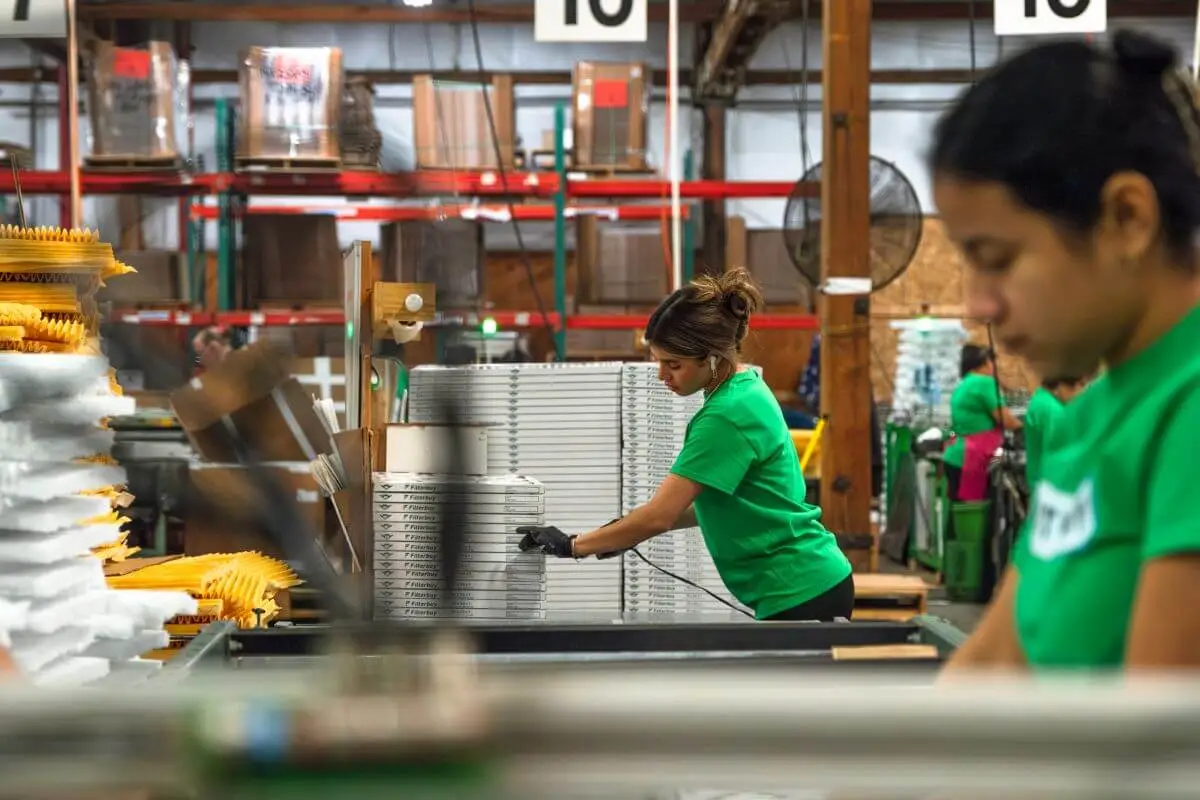
Building the part teaches you something that owning one does not. Filterbuy charges its cabin media through hydrocharging, which drives purified water through clean fiber and follows it with a controlled dry. If that sounds like a contradiction, the difference is purity and sequence: 3M's original patent specifies clean, unloaded media, deionized water rather than tap, and a controlled dry afterward. A driveway rinse of a loaded filter is the opposite process. Same liquid, opposite result.
The mechanical damage is easier to see and just as permanent. Wet media relaxes, and pleats spaced to hold a fixed surface area sag against one another. Frames warp as they dry, and a frame that no longer seals lets bypass air slide around the edge of a filter that looks perfectly installed. Filterbuy cuts to exact OEM tolerances for that reason, and our guide to choosing a cabin air filter leads with fit.
When Vacuuming a Cabin Air Filter Is Worth Doing
One situation qualifies: the filter is due, the replacement has not arrived, and the housing is full of leaf litter.
Remove the filter from behind the glovebox, noting which way the airflow arrow points.
Hold it over a trash bag and tap the dirty side gently against the edge.
Vacuum the dirty side only, brush attachment held just off the surface.
Vacuum the empty housing too, since debris left there reloads the new filter.
Never use water, detergent or compressed air on a disposable filter.
Reinstall it with the arrow pointing the same way, then order the replacement.
Treat this as a stopgap rather than maintenance. Replace the filter every 12,000 to 15,000 miles, sooner in dust, pollen or smoke, and watch for the signs it needs replacing. Our replacement guide covers it.
Supporting Statistics
1. Soap Failed Federal Filter Testing
A NIOSH laboratory tested ten cleaning methods on respirator filter media.
Soap and water, soaked for 20 minutes, caused significant filter degradation.
Particle penetration rose above the limit NIOSH allows for certification.
Cabin filters use the same class of charged media, which is why we read the finding across.
Source: CDC / NIOSH, Effect of Decontamination on the Filtration Efficiency of Two Respirator Models
2. Wet Material Has 24 to 48 Hours
The EPA's drying window: dry water-damaged items within 24 to 48 hours to prevent growth.
Porous materials often have to be discarded once moldy, because mold grows into their crevices.
A pleated filter is porous by design.
Source: U.S. EPA, A Brief Guide to Mold, Moisture and Your Home
3. Four for Four on Allergy Molds
The Asthma and Allergy Foundation of America names Alternaria, Aspergillus, Cladosporium and Penicillium as the most common allergy molds.
All four turn up repeatedly in used car cabin filters.
Mold spores reach the lungs and can trigger asthma.
Source: Asthma and Allergy Foundation of America, Mold Allergy
Skip the Cleaning and Get the Right Filter
Shop Filterbuy auto cabin air filters for HEPA-grade media cut to your vehicle, or start with the Filterbuy part number lookup. Add a subscription and the next one arrives on time.
About the Author
Michelle Wan is Brand Manager and Air Quality Writer at Filterbuy (B.A., University of California, Santa Cruz). She works alongside Filterbuy's U.S. manufacturing team and bases her guidance on how filters are built and used rather than spec sheets. Reviewed for technical accuracy by David Clark, Licensed HVAC Technician. Filterbuy has made air filters in the USA since 2013, at plants in Alabama, Florida, Pennsylvania and Utah.
Glossary
Cabin air filter: The filter in a vehicle's ventilation system, usually behind the glovebox, cleaning incoming air.
Electret media: Filter media carrying a permanent charge that attracts fine particles. Detergent degrades it invisibly.
Pressure drop: Airflow resistance across a filter. It rises as dirt loads in, but not when the charge is lost.
Bypass air: Unfiltered air slipping around a filter's edges. An exact-fit filter such as Filterbuy's prevents it.
Hydrocharging: Charging filter fibers with jets of purified water during manufacturing, then drying them.