
The Best Thermostat Settings for a Heat Pump (and Why They're Different)
November 23, 2026
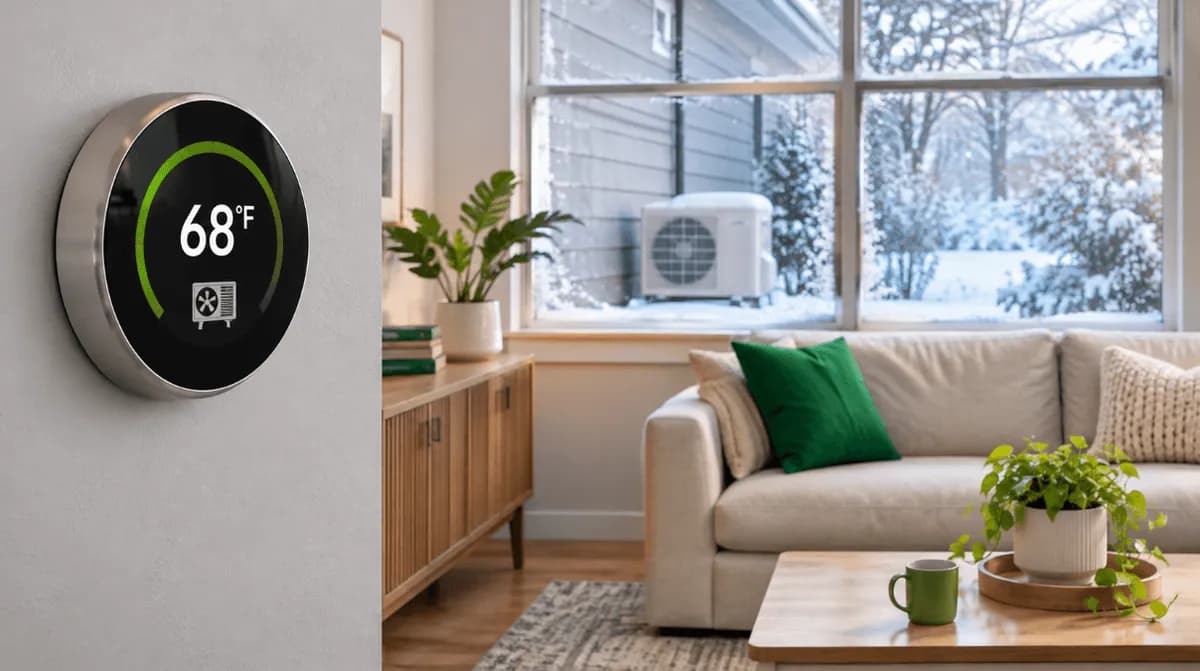
For most homes, the best heat pump thermostat settings are 68°F in winter and 78°F in summer while you're home and awake, with setbacks of just 1–2°F in heating mode. A heat pump warms a house slowly, so a deep setback can push it onto expensive backup heat. Set the O/B option and aux heat lockout correctly, and keep the filter clean.
TL;DR
Heat pumps reward steady settings. Hold heat near 68°F, keep winter setbacks to 1–2°F unless your thermostat has heat pump recovery, and set the O/B option and aux heat lockout correctly. Then keep the filter clean so airflow can back those settings up.
Key Takeaways
Most heat pump homes do well at 68°F in winter and 78°F in summer.
Keep winter setbacks near 1–2°F, because large step-ups can switch on auxiliary heat.
Aux heat strips use about three times a heat pump's electricity for the same heat.
Most heat pumps use the O reversing valve setting, while Rheem and Ruud typically use B.
Filterbuy's Four-S Setup covers setpoint, switch (O/B), shutoff (lockout), and filter swap.
What Are The Best Heat Pump Thermostat Settings?
During waking hours, most homes do best at 68°F in heating mode and 78°F in cooling mode. Keep heating setbacks small, because heat pumps recover slowly. Cooling setups can be larger, since cooling never uses backup heat.
Table 1: Heat Pump Thermostat Settings at a Glance
| Situation | Winter (Heat Mode) | Summer (Cool Mode) |
|---|---|---|
| Home and awake | 68°F | 78°F |
| Asleep | 66–67°F | 78°F or slightly warmer |
| Away 8+ hours | 66–67°F | 85–88°F |
| With heat pump recovery | Deeper setback allowed | Standard setups |
| System mode | Heat | Cool, or Auto in spring and fall |
Starting points. Your insulation and climate can shift them.
Filterbuy's Four-S Setup For Heat Pump Thermostats
Filterbuy's Four-S Setup is our order for setting up a heat pump thermostat. It includes the filter, because a heat pump can only deliver the heat its airflow allows.
Setpoint. Choose 68°F and hold it, with setbacks of 1–2°F at most.
Switch. Confirm the O/B option so Heat mode actually heats.
Shutoff. Set an aux heat lockout to keep backup strips off on mild days.
Swap. Change the filter at your fall switch to Heat, or let Filterbuy auto-delivery keep the schedule.
Why Do Heat Pumps Need Different Thermostat Settings Than Furnaces?
Heat pumps move heat rather than burn fuel, so they warm a cold house back up slowly. When one falls behind, most ducted systems call on auxiliary electric resistance strips, which use far more electricity for the same heat.
The U.S. Department of Energy's air-source heat pump guide shows the gap. A 10.3 HSPF heat pump delivers 10,300 Btu per kilowatt-hour, while an electric resistance element delivers about 3,400 Btu, so heat that costs a heat pump 1 kWh costs the strips about 3 kWh. The guide also warns that many controls start strip heat whenever the setpoint jumps more than 3°F, which is why a 7–10°F furnace-style setback can backfire on a heat pump.
Should I Set Back A Heat Pump Thermostat?
Yes, but only a little. On a standard programmable thermostat, keep setbacks to about 1–2°F. A smart thermostat with heat pump recovery can handle a deeper setback, because it starts warming early on the compressor alone. Filterbuy's take: if your thermostat doesn't have recovery, skip setbacks rather than gamble on a deep one.
For this reason, Pacific Northwest National Laboratory's Building America Solution Center recommends thermostats with adaptive recovery in heat pump homes. An early-morning Recovery message means it's working, as our explainer on what Recovery means on a thermostat shows.
What Is The Best Heat Pump Temperature Setting In Winter?
The best heat pump temperature setting in winter is 68°F, held steady with no more than a 1–2°F dip. Turning the thermostat up won't warm the house faster. It only gives backup heat a reason to run.
Long run times are normal. Heat pumps lose capacity as temperatures drop, so near-constant running on a 20°F day is expected.
Defrost cycles are normal, too. The outdoor unit may steam and pause heating for a few minutes while it clears frost.
Emergency Heat is for breakdowns. EM Heat shuts off the compressor and runs the strips alone, so save it for a failed outdoor unit.
For day, night, and away schedules, see Filterbuy's winter thermostat setting guide.
How Should You Set A Heat Pump Thermostat In Summer?
Set a heat pump to 78°F when you're home and 7–10°F higher when the house sits empty eight hours or more. Cooling never uses auxiliary heat, so our season-by-season thermostat guide applies. Auto mode handles spring and fall, and the fan Auto vs. On guide covers the fan.
What Is The O/B Setting On A Smart Thermostat?
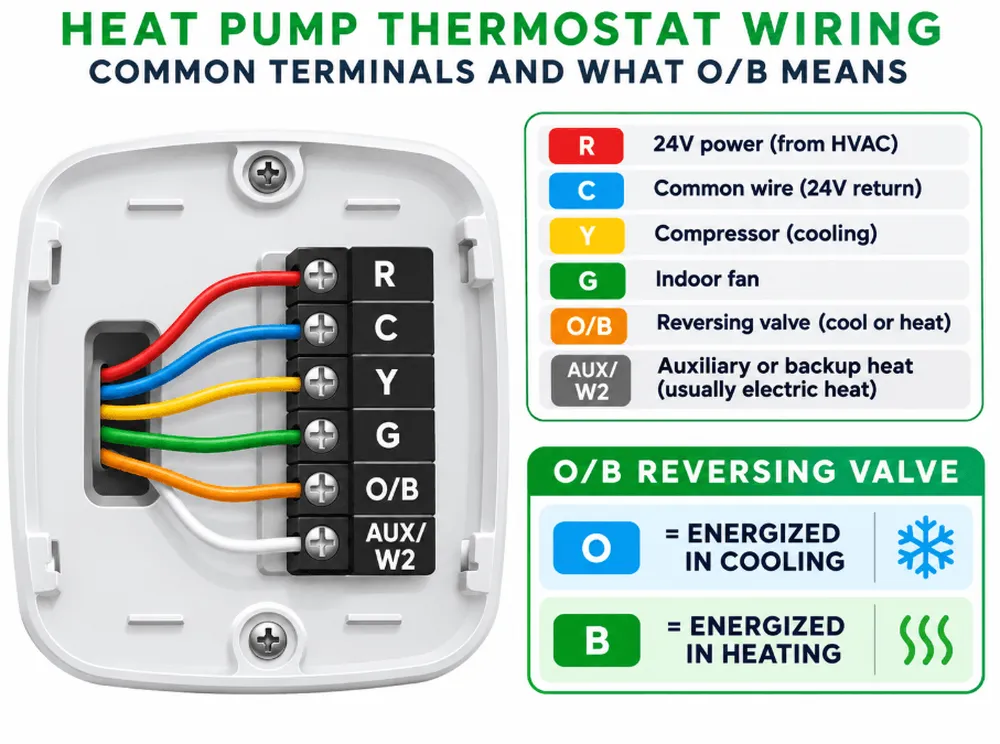
The O/B setting tells a smart thermostat when to power the reversing valve, the part that flips a heat pump between heating and cooling. O energizes the valve in cooling, and B energizes it in heating. The wrong choice blows cold air in Heat mode.
Most heat pumps, including Carrier, Trane, Lennox, and Goodman, use O, while Rheem and Ruud typically use B. Wire color isn't reliable, so check the manual. To test, set Cool a few degrees below room temperature and wait out the short compressor delay. Cold air at the vents means the setting is right.
How Do You Set Aux Heat Lockout On A Smart Thermostat?
An aux heat lockout is the outdoor temperature above which the thermostat won't run auxiliary heat, which keeps backup strips off on mild days. Filterbuy's guide to heat pump balance point and lockout temperatures shows how to find the right number.
Google Nest: Heat Pump Balance sets a lockout automatically, or turn it off to set one manually.
ecobee: Aux Heat Max Outdoor Temperature sets the lockout.
Sensi: Aux Lockout and Balance Point appear in heat pump settings.
What Is The Best Thermostat For A Heat Pump?
The best thermostat for a heat pump lists heat pumps with auxiliary heat as supported equipment. When choosing the best smart thermostat for a heat pump, Filterbuy picks capability over brand: O/B support, an outdoor-temperature lockout, and adaptive recovery. Table 2 shows how to check smart thermostat heat pump compatibility before you buy.
Table 2: Smart Thermostat Heat Pump Compatibility Checklist
| Feature | What It Does | How to Check |
|---|---|---|
| Heat pump with aux heat support | Runs compressor and backup heat on separate terminals | Spec sheet lists heat pump with auxiliary heat |
| O/B configuration | Matches the reversing valve to your equipment | Setup menu or app wiring screen |
| Aux heat lockout | Blocks backup heat above a set outdoor temperature | Equipment or installer settings |
| Adaptive recovery | Warms early using the compressor alone | Recovery or early-start feature |
| Stage support | Matches one-stage, two-stage, or variable-speed compressors | Equipment manual |
Variable-speed systems usually need the equipment maker's thermostat.
Which Thermostat Settings Cause High Heat Pump Bills?
High heat pump bills usually mean aux heat is running when the compressor could carry the load, often because of a setting or airflow problem. If the thermostat won't respond, start with our thermostat troubleshooting guide, and keep up with annual heat pump maintenance.
Table 3: Heat Pump Thermostat Troubleshooter
| What You Notice | Likely Setting | Fix |
|---|---|---|
| AUX shows on mild days | No lockout, or step-ups of 3°F or more | Set a lockout and raise heat 1–2°F at a time |
| Cold air in Heat mode | O/B set backward | Switch the O/B setting and retest |
| Bills spike after a new schedule | Deep setback without recovery | Shrink the setback or enable recovery |
| Heat pump idles in cold weather | Compressor lockout set too high | Lower it toward the maker's minimum |
| Long runs, weak airflow | Clogged air filter | Replace the filter |
If a fix doesn't hold, call an HVAC technician.
How To Run A Monthly Aux Heat Audit
Runtime history shows whether these settings work. ecobee's web portal (Home IQ System Monitor) logs aux heat separately from compressor runtime and exports it as a spreadsheet, although the app combines the two. Nest aux history varies by model.
Monthly in winter, compare aux runtime with outdoor temperature. Aux hours on days warmer than your lockout point to a setting problem. Aux hours that creep up weekly at similar temperatures point to airflow, so check the filter first.
How Does Your Air Filter Affect Heat Pump Thermostat Settings?
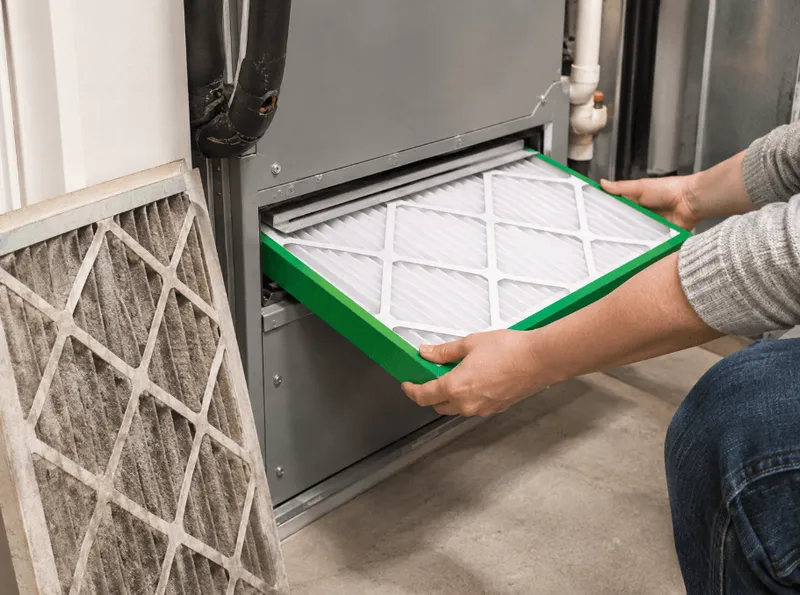
Because Filterbuy makes air filters, we look at heat pump settings from the airflow side, and the filter is the piece most thermostat guides leave out. A clogged filter chokes airflow across the indoor coil, so the heat pump delivers less heat each cycle and the thermostat reaches for backup heat sooner.
Check the filter monthly through heating season. Filterbuy's guide on how often to change your HVAC filter covers timing, and our heat pump filters guide explains sizing. MERV 8 is the standard choice for most homes, while MERV 11 suits households with pets, pollen, or allergies, as long as your heat pump's manual allows that rating.
"When I started digging into heat pump questions from our customers, I expected complicated answers. Most came back to two simple habits: change the filter on time, and stop cranking the thermostat."
- Michelle Wan, Brand Manager and Air Quality Writer, Filterbuy
Supporting Statistics
About 13% of U.S. homes, roughly 16.1 million, heated mainly with a central heat pump in 2020. Source: Highlights for Space Heating in U.S. Homes by State, 2020
Heating and cooling make up almost half of a typical household's energy bill, more than $900 a year. Source: ENERGY STAR Smart Thermostats
Switching from electric resistance heat to heat pumps cut heating electricity use by a little over half across nearly 2,000 U.S. homes. Source: Opportunities for Energy and Economic Savings by Replacing Electric Resistance Heat with Higher Efficiency Heat Pumps
Frequently Asked Questions
Do Dual Fuel Heat Pumps Need Different Settings?
Yes. When the backup is a gas or propane furnace, the aux lockout becomes a switchover temperature, and the thermostat runs one or the other.
Is It Cheaper To Leave A Heat Pump At One Temperature?
Usually, yes. In heating mode, a steady temperature avoids the recovery period that can trigger auxiliary heat.
Why Does My Thermostat Say Aux Heat?
Aux Heat means the backup strips are helping the heat pump, which is normal in deep cold and during defrost. Frequent Aux Heat on mild days points to a setting or airflow problem.
Can Any Smart Thermostat Work With A Heat Pump?
No. It must support heat pumps with auxiliary heat, match your compressor stages, and include an O/B setting.
What Temperature Should Aux Heat Lockout Be?
Set it near your home's balance point. That's 25°F to 35°F for many standard heat pumps and lower for cold-climate models. A technician can confirm the right number.
Keep Your Heat Pump Running On Its Most Efficient Settings
Find your exact size in MERV 8, 11, or 13 among Filterbuy air filters, with fast and free 2-day delivery to most US states, then set up auto-delivery before the next cold snap.
Glossary
Auxiliary Heat (Aux Heat): Backup electric strips that add heat when the compressor can't keep up.
Emergency Heat (EM Heat): A mode that shuts off the compressor and heats with backup strips alone.
O/B Setting: Sets whether the reversing valve is energized in cooling (O) or heating (B).
Aux Heat Lockout: The outdoor temperature above which auxiliary heat cannot run.
Balance Point: The outdoor temperature where heat pump output equals the home's heat loss.
Adaptive Recovery: Starts heating early so the compressor, not backup heat, ends a setback.
HSPF: Heating Seasonal Performance Factor, seasonal heat output per unit of electricity.
MERV: Minimum Efficiency Reporting Value, a 1 to 16 rating of how well a filter captures airborne particles.