
Line Voltage vs. Low Voltage Thermostats: How to Tell Which You Have
November 23, 2026
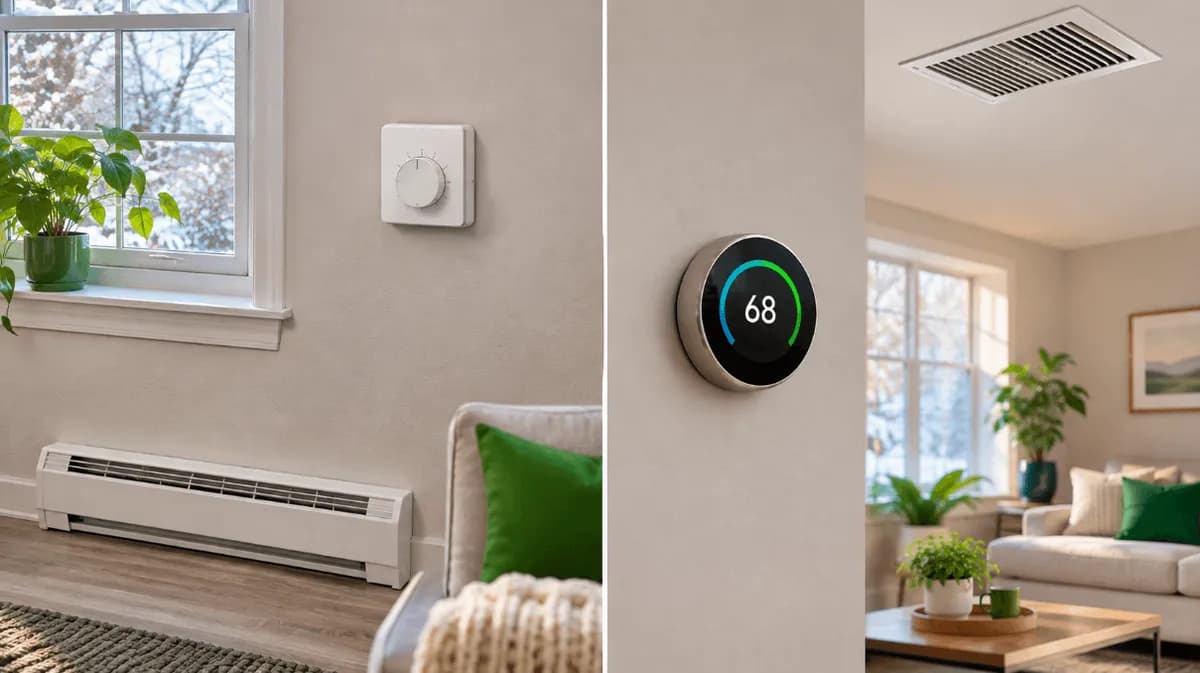
A line voltage thermostat switches the 120 or 240 volts that power an electric baseboard or wall heater, while a low voltage thermostat sends a 24-volt signal to a furnace or heat pump. Because Filterbuy makes air filters, we start this check where most guides don't, at the filter slot. If your heat runs through one, your thermostat is almost certainly low voltage.
TL;DR
Line voltage thermostats switch baseboard and wall heaters at 120 or 240 volts, and low voltage thermostats run central HVAC on 24 volts, the systems Filterbuy air filters serve. Thick wires under wire nuts mean line voltage, so you need a line voltage replacement or an electrician-installed relay.
Key Takeaways
Line voltage thermostats use thick wires under wire nuts, while low voltage thermostats use thin wires on lettered terminals.
Filterbuy's shortcut: supply vents and an air filter slot point to low voltage, and an electric baseboard heater with no vents points to line voltage.
Electric furnaces and heat pumps use 24-volt thermostats, so electric heat is not always line voltage.
Single pole thermostats have two wires and no true Off, while double pole models have four wires and can open both hot legs.
Nest and ecobee can't connect to baseboard heat directly, so use a line voltage smart thermostat or a relay.
What Is A Line Voltage Thermostat?
A line voltage thermostat sends household power, usually 120, 208, or 240 volts, straight to an electric heater. A 240V thermostat is a line voltage thermostat rated for 240-volt heaters, the most common baseboard voltage.
Some electric baseboard heater thermostats are knobs built into the heater, but the U.S. Department of Energy notes that these often misread room temperature and suggests a wall-mounted thermostat on an interior wall. In Filterbuy's view, moving control from that knob to the wall often does more for comfort than adding Wi-Fi.
Line Voltage Vs. Low Voltage Thermostat: How They Differ
The low voltage vs line voltage thermostat difference is what each switches. A low voltage model flips a 24-volt signal from your HVAC equipment's transformer, while a line voltage model carries the heater's full load, so the two are never interchangeable.
Line Voltage Vs. Low Voltage At A Glance
| Feature | Line Voltage | Low Voltage |
|---|---|---|
| Voltage | 120, 208, or 240 volts | 24 volts AC |
| What it controls | Baseboard, wall, and convector heaters | Furnaces, heat pumps, central AC, boilers |
| Wires | 2 or 4 thick wires | 2 to 8 thin, color-coded wires |
| Markings | 120V or 240V, Line and Load | R, W, Y, G, C, O/B |
How To Tell If Your Thermostat Is Line Voltage
To tell if a thermostat is line voltage, look for thick wires capped with wire nuts and a 120V or 240V label. Because line voltage can shock you, review these DIY electrical safety tips from ESFI before you open anything.
Look at the heat source. An electric baseboard or wall heater in a room with no supply vents almost always means line voltage.
Read the label. Line voltage models list 120V, 240V, or a wattage such as 3,000 watts.
Turn off the breaker. A double-pole breaker, with two joined handles, feeds a 240-volt heater. Once it's off, confirm with a non-contact voltage tester.
Check the wires. Line voltage wires are as thick as outlet wiring and twisted under wire nuts, while low voltage wires are thin and land on letters
Count them. Two thick wires usually mean single pole, and four mean double pole.
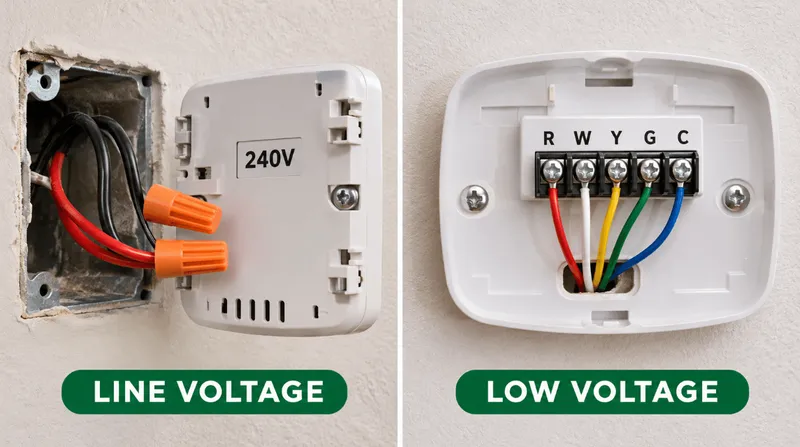
Filterbuy's rule of thumb: start at the filter slot, not the thermostat. If you find one, our smart thermostat resource library covers your low voltage setup.
Electric Heat Does Not Always Mean Line Voltage
The label "electric heat" trips people up. Electric furnaces, air handlers with heat strips, and heat pumps all run on 24-volt thermostats. If warm air comes from vents, you have a low voltage system, and Filterbuy's thermostat troubleshooting guide applies when it acts up.
Single Pole Vs. Double Pole Thermostat
A single pole thermostat interrupts one hot wire and has two leads, while a double pole thermostat interrupts both hot wires and has four. Only a double pole model can show a true Off, because NEC 424.20 requires a thermostat marked Off that doubles as the heater's disconnect to open every ungrounded conductor.
Single Pole Vs. Double Pole
| Feature | Single Pole | Double Pole |
|---|---|---|
| Wires | 2 | 4 |
| What it switches | One hot leg | Both hot legs |
| Lowest setting | Low or Min | Marked Off |
| Heater at lowest setting | One leg stays energized | Both legs open |
| Typical use | 120V heaters and many 240V heaters | 240V heaters, required in some areas |
Filterbuy's take: treat a four-wire thermostat as a code decision someone already made, and replace like with like. Mysa, a thermostat maker, notes that some local codes require double pole on baseboard circuits, so check with a licensed electrician before you swap four wires for two. Since even a double pole Off isn't a lockout, always shut off the breaker before any work.
Line Voltage Thermostat Wiring Basics
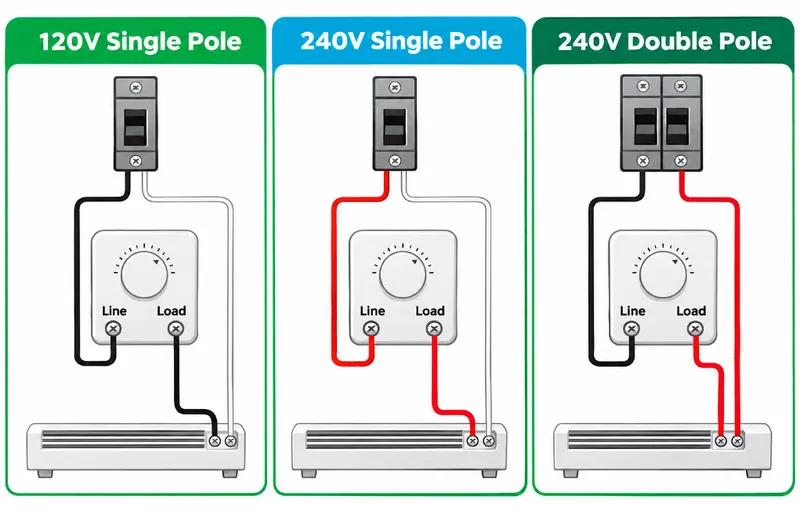
Line voltage thermostat wiring follows a Line and Load pattern. Line wires bring power from the breaker, and Load wires carry it to the heater. Most baseboard thermostat wiring diagrams show one of three setups.
120V single pole: the hot wire passes through the thermostat, and the neutral runs straight to the heater.
240V single pole: one hot leg passes through the thermostat, and the other goes directly to the heater.
240V double pole: both hot legs pass through the thermostat, in on Line and out on Load.
On a 240-volt circuit, the white wire is a second hot, often marked with tape, rather than a neutral. Many smart models also need a neutral or that second hot, so Filterbuy's tip is to photograph the old wiring first.
How To Choose A Thermostat For An Electric Heater
The right thermostat for an electric baseboard or wall heater matches the heater on four points: voltage, wattage, pole type, and heater type.
Voltage: match the heater nameplate.
Wattage: stay between the thermostat's minimum and maximum for all heaters combined.
Pole type: keep double pole unless an electrician approves a change.
Heater type: a thermostat for an electric wall heater with a fan must list fan-forced heaters.
Worked Example: Two Baseboards On One Thermostat
Say one thermostat runs two 1,500-watt baseboards on a 240-volt circuit. Together they draw 3,000 watts, or 12.5 amps (watts divided by volts). A thermostat rated 3,800 watts at 240 volts handles that, but a 3,000-watt model would sit right at its limit, so Filterbuy's advice is to size up.
Many apartments run on 208 volts, where a heater rated 1,500 watts at 240 volts puts out only about 1,130 watts. That can leave a room feeling cool even with a working thermostat, so check that a replacement lists 208 volts.
Smart Thermostat For Baseboard Heat: Your Options
You can add a smart thermostat to baseboard heat in two ways: choose a model built for line voltage, or pair a 24-volt smart thermostat with a relay. Google states that high voltage systems such as electric baseboard heaters aren't compatible with Nest thermostats.
Smart Options For Baseboard Heat
Filterbuy's take: a line voltage smart thermostat is the easier fit for one or two rooms, while a relay makes more sense if you want one app across central HVAC and baseboard heat.
When Should You Call An Electrician?
Call a licensed electrician if the wiring doesn't match the new thermostat's diagram, the box looks scorched, you spot aluminum wiring, or you want to change pole type or add a relay. If you rent, get landlord approval first.
Do Homes With Baseboard Heat Need Air Filters?
As a filter maker, this is the part we know best. Baseboard heaters warm a room by natural convection, so they have no blower and no air filter. In a baseboard home, the only filters sit in systems that move air, such as central AC, a heat pump, or a ductless mini split.
Those filters work whenever the blower runs, including fan-only time, which Filterbuy's guide to thermostat fan Auto vs. On settings explains. MERV 8 air filters are the standard choice for most homes, MERV 11 suits allergies, pets, and pollen, and MERV 13 is the pick for smoke. Check your HVAC manual for the MERV rating your system supports.
If you're replacing baseboard heat in a room, Filterbuy ductless mini split systems ship free with 2-day delivery. If you're keeping your baseboards, vacuum the fins with the power off and run through our first-run heating checklist.
"At Filterbuy, we look at a home's air from the filter slot out. No filter slot and an electric baseboard under the window usually mean a line voltage thermostat. If the wires don't match the new thermostat's diagram, stop and call an electrician."
Michelle Wan, Brand Manager and Air Quality Writer, Filterbuy
Supporting Statistics
7.65 million U.S. homes heat mainly with built-in electric units
That is roughly 6% of 123.5 million homes (2020).
5.55 million of them are rented, nearly three in four.
Source: 2020 Residential Energy Consumption Survey, Table HC6.2
A little over 50% less heating electricity with a heat pump
That is ACEEE's average across close to 2,000 U.S. homes.
It points baseboard homes toward ductless heat pumps.
Filterbuy's view: identify your thermostat first.
About 8% off heating and cooling bills, or $50 a year
That is the ENERGY STAR average for certified smart thermostats.
Make sure the model matches your system voltage first.
Filterbuy's view: a smart thermostat only saves if it can safely switch your heater.
Frequently Asked Questions
Can I Replace A Line Voltage Thermostat With A Low Voltage One?
Not directly, because a 24-volt thermostat can't carry heater current. An electrician can add a relay with a built-in transformer instead.
Will A Nest Or Ecobee Work With Baseboard Heat?
Not on its own. Both are 24-volt thermostats, so they need a professionally installed relay.
Can I Use A Single Pole Thermostat On A 240V Heater?
Often, if local code allows it, but it leaves one leg energized and has no true Off.
How Many Heaters Can One Thermostat Control?
As many as its wattage rating allows, as long as the combined nameplate watts stay under the maximum.
Why Does My Baseboard Thermostat Click?
Mechanical thermostats click as their bimetal contacts open and close, while electronic models switch silently.
Clean Air, Whatever Runs Your Heat
Your air filter works wherever a blower moves air. Filterbuy makes pleated MERV 8, MERV 11, and MERV 13 air filters in hundreds of standard and custom sizes, with fast and free 2-day delivery to most US states. Find your size in the Filterbuy air filter shop, and check your HVAC manual for its supported MERV rating.
Glossary
Line Voltage Thermostat: A thermostat that switches 120, 208, or 240 volts directly to an electric heater.
Low Voltage Thermostat: A thermostat that sends 24-volt control signals to a furnace, heat pump, or boiler.
Single Pole Thermostat: A two-wire line voltage thermostat that interrupts one hot conductor.
Double Pole Thermostat: A four-wire line voltage thermostat that interrupts both hot conductors and can include an Off position.
Heating Relay: A switch that lets a 24-volt thermostat control a line voltage heater.