
Smart vs. Programmable vs. Manual Thermostats: Which One Fits Your Home?
November 23, 2026
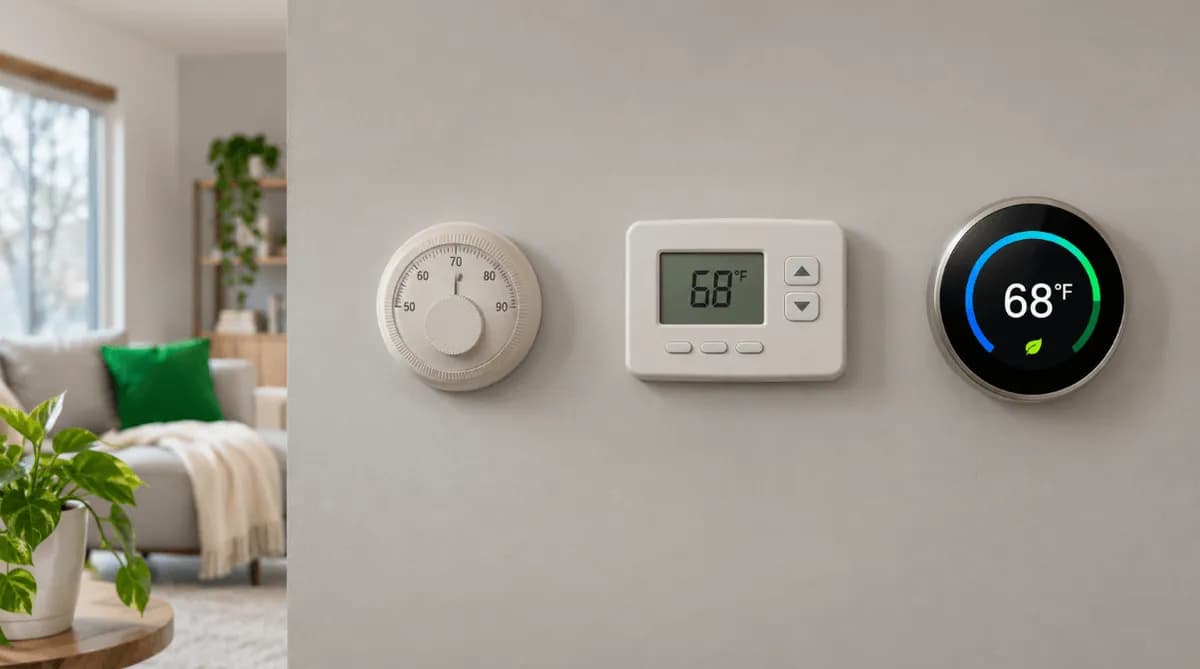
A manual thermostat holds one temperature until you change it. A programmable thermostat follows a weekly schedule you set once, and a smart thermostat adds app control and a record of how long your system runs. As the company that makes the air filters every heating and cooling cycle pulls air through, Filterbuy watches that runtime closely. That view points to a simple rule: the best thermostat is the one your household will keep running setbacks on.
TL;DR
Go smart if your schedule shifts from week to week or your home runs on a heat pump. Go programmable if your week is predictable. Manual still suits a home that is rarely empty.
Key Takeaways
ENERGY STAR certified smart thermostats save about 8% on heating and cooling bills on average, or roughly $50 per year.
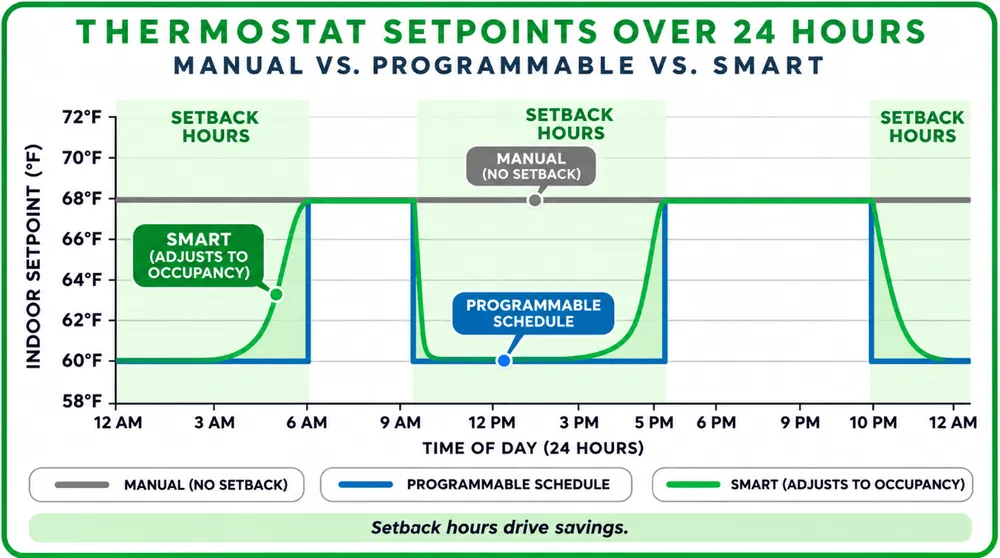
The U.S. Department of Energy estimates a 7°F to 10°F setback for 8 hours a day saves as much as 10% a year on heating and cooling.
ENERGY STAR stopped labeling programmable thermostats in 2009 because savings depended on whether owners programmed them.
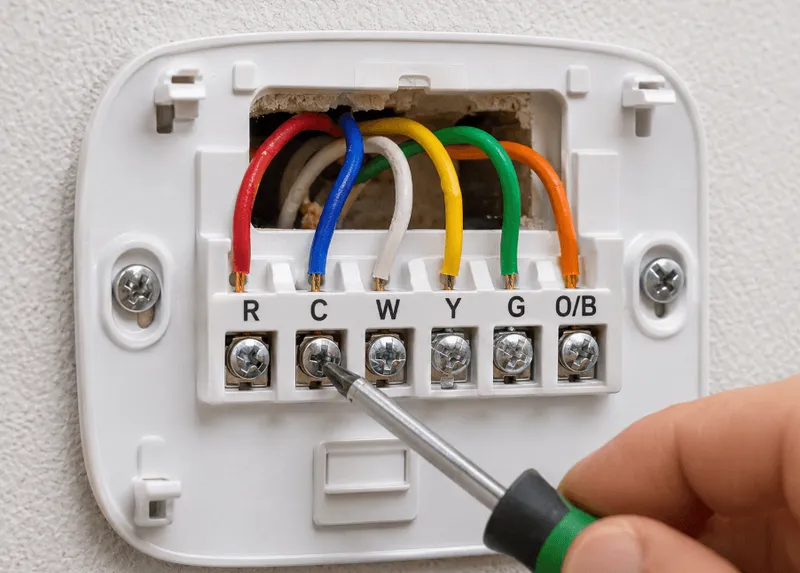
Most smart thermostats need a C-wire (common wire) for steady 24-volt power, so check your wiring before you buy.
For a filter maker, runtime decides when a filter is due, and smart thermostats make runtime easy to track.
Smart Vs. Programmable Vs. Manual Thermostats At A Glance
The real difference is who decides when your system turns on. With a manual thermostat, you do. A programmable model follows your weekly plan, and a smart model adjusts that plan using room sensors or your phone's location.
| Feature | Manual | Programmable | Smart |
|---|---|---|---|
| How It Sets Temperature | You adjust it by hand | Follows a weekly schedule you enter | Adjusts its schedule automatically |
| Savings Depend On | Remembering to turn it down | Keeping the schedule | Leaving away mode on |
| Runtime And Filter Reminders | None | Basic timers on some models | Runtime reports and filter reminders |
| Best Fit | Homes occupied most of the day | Predictable weekly routines | Changing schedules, travel, heat pumps |
What Is A Manual Thermostat?
A manual thermostat, also called a non-programmable thermostat, keeps one set temperature until someone changes it. It saves energy only when someone remembers to adjust it, so it fits homes where someone is around most of the day.
Some older dial models hold a small glass bulb of mercury, so keep the unit intact and follow EPA guidance on safely storing and disposing of mercury.
Non-Programmable Vs. Programmable Thermostat: What Changes?
A programmable thermostat changes the temperature on its own at set times, usually on a 7-day, 5-2, or 5-1-1 schedule. Upgrading from a non-programmable model pays off only if you set sleep and work-hour setbacks and keep them.
That second step is where many homes stall. ENERGY STAR suspended its programmable thermostat label at the end of 2009 after field studies found many owners running the devices like manual models. We treat that history as the deciding fact here: savings depend on follow-through more than hardware. For a routine that repeats, a programmable thermostat is still a sound, low-cost choice, and our guide to permanent hold vs. temporary hold settings shows how to pause a schedule without losing it.
What Makes A Smart Thermostat Different?
A smart thermostat is a Wi-Fi connected thermostat that adjusts its own settings using occupancy, weather, your phone's location, or habits it has learned.
Wi-Fi Thermostat Vs. Smart Thermostat
A Wi-Fi thermostat is a programmable thermostat you can control from a phone app. A smart thermostat also switches to an away setting on its own when room sensors or geofencing show the house is empty. If the box mentions neither, it is likely a Wi-Fi model.
Learning Thermostat Vs. Smart Thermostat
A learning thermostat is a smart thermostat that writes its own schedule by watching your adjustments over the first week or two, the approach behind the Google Nest Learning Thermostat. Other smart models, such as those from thermostat maker ecobee, start from a schedule you set and fine-tune it with room sensors.
Smart Thermostat Vs. Programmable: Which Saves More Energy?
Smart thermostats usually come out ahead in real homes because they keep setbacks running without daily effort, cutting heating and cooling bills by about 8% for ENERGY STAR certified models. A programmable thermostat can match that only if you program real setbacks and leave them alone. Our rule of thumb: count the setback hours your household will actually keep, then choose the simplest thermostat that keeps them.
The Department of Energy puts savings at up to 10% a year for a 7°F to 10°F setback held 8 hours daily, and a furnace does not burn more fuel recovering from a setback than it saves during one.
Check Your Wiring And System Before You Buy
Your wiring narrows the choice before any spec sheet does. Turn off power at the breaker, remove the thermostat face, and match the wired terminals to the table below.
| What You Find | What It Means | Thermostat Options |
|---|---|---|
| C terminal connected | Steady 24-volt power is available | Any model rated for your system |
| No C-wire, 4 or more wires | Power may need an adapter kit or added wire | Smart model with adapter kit, or battery programmable |
| Only 2 wires | Often a heat-only or millivolt gas system | Battery programmable or manual model |
| O/B terminal in use | Heat pump with a reversing valve | Model with heat pump and auxiliary heat support |
| Thick wires at 120 or 240 volts | Line-voltage electric baseboard heat | Line-voltage thermostats only |
| Ductless unit with handheld remote | Mini split uses its own controller | Built-in Wi-Fi app or a mini split smart controller |
Older systems may need a compatibility adapter or an extra wire run through the attic. Heat pumps call for extra care, since large setbacks can trigger costly electric backup heat unless the thermostat is designed for them. Smart models with heat pump recovery warm the house gradually instead. For ductless systems, see our guide to the best smart thermostats for mini splits.
Two Costs Most Thermostat Comparisons Skip
Two numbers decide whether a smart thermostat is worth it. The first is payback: divide the price after any rebate by your expected yearly savings. At the ENERGY STAR average of about $50 a year, a thermostat that costs $150 after a rebate pays for itself in roughly three years. Homes with programmed setbacks wait longer.
The second is software support, which sets how long a smart thermostat stays smart. The first Nest Learning Thermostat launched in 2011 and lost app control on October 25, 2025, about 14 years later, leaving a basic thermostat. A manual or programmable thermostat has no cloud service to retire.
Do I Need A Smart Thermostat?
A smart thermostat earns its price when nobody would keep a programmed schedule or a heat pump needs gentle recovery. Run our three-question fit test before you buy.
Will someone set a schedule and leave it alone? If so, programmable is enough. Shifting hours or frequent travel point to a smart model with geofencing or occupancy sensing.
No C-wire? Plan for an adapter kit or wire run.
Is the system a heat pump or a ductless mini split? If so, the thermostat or controller must be built for that equipment.
Use our season-by-season thermostat temperature guide for starting setpoints.
How A Smart Thermostat Helps You Keep Up With Air Filter Changes
Because we make air filters, runtime is the clock we watch, since your filter runs on it. A long hot spell or a fan left on loads a filter faster than any calendar reminder assumes, and a smart thermostat that counts runtime can time the reminder to real use.
Between reminders, check the filter monthly in peak seasons and replace it when it looks gray. When you swap it, check the thermostat too, since a forgotten hold quietly cancels your setbacks. MERV 8 air filters are the standard choice for most homes. MERV 11 suits households managing allergies, pets, or pollen, while MERV 13 is the pick for wildfire smoke. Before you upgrade, confirm the highest MERV rating your HVAC manual allows. See thermostat fan auto vs. on for how fan settings affect filter life. When it is time for a new one, shop air filters by size with fast and free 2-day delivery to most US states.
"We look at thermostats from the filter side of the system. Every hour your thermostat calls for heating or cooling is an hour of air moving through your filter, so the smart feature I point most families to is a filter reminder based on real runtime instead of a date on the calendar," said Michelle Wan, Brand Manager and Air Quality Writer at Filterbuy.
Supporting Statistics
8% average savings: ENERGY STAR certified smart thermostats save about 8% on heating and cooling bills, roughly $50 a year. Source: ENERGY STAR Smart Thermostats FAQs
40% never program: About 40% of programmable thermostat owners never programmed their thermostats, and about one third had their schedules overridden, in a Lawrence Berkeley National Laboratory study. Source: Energy Efficiency and the Misuse of Programmable Thermostats: The Effectiveness of Crowdsourcing for Understanding Household Behavior
Over half of home energy: Heating and cooling make up more than half of U.S. household energy use, the share a thermostat controls. Source: Use of Energy in Homes, U.S. Energy Information Administration
Frequently Asked Questions
Can My Utility Change My Smart Thermostat Settings?
Only if you enroll in a demand response program, which many utilities tie to smart thermostat rebates. Seattle City Light's TempWise program, for example, limits events to 15 per season and three hours each, lets you opt out anytime, and returns your thermostat to its normal setting afterward. Read the terms first.
Do Smart Thermostats Work Without Wi-Fi?
Most keep running their stored schedule, but app control and other online functions pause until Wi-Fi returns.
Do All Smart Thermostats Need A C-Wire?
Most do, though many models offer a power adapter kit for walls without one.
Is A Programmable Thermostat Better Than A Manual One?
Only when you enter a schedule with real setbacks and keep it running. Without one, a programmable thermostat performs like a manual model.
Should I Leave My Thermostat At One Temperature All Day?
For most furnaces and central air conditioners, setting back the temperature while you sleep or are away uses less energy than holding one steady setting. Our guide on whether to leave your AC on all day covers away settings.
Get More From Your New Thermostat
Pair your new thermostat with the right filter, and let an air filter subscription keep replacements arriving on schedule. For a missing C-wire or a heat pump, a licensed HVAC technician can handle the wiring and setup.
Glossary
Auxiliary Heat: Backup electric heat in a heat pump system that runs when the heat pump alone cannot keep up.
C-Wire (Common Wire): The thermostat wire that supplies continuous 24-volt power to a thermostat's screen and Wi-Fi radio.
Demand Response: A utility program that briefly adjusts enrolled smart thermostats during peak demand in exchange for a rebate or credit.
ENERGY STAR: The U.S. EPA program that certifies energy-efficient products, including smart thermostats.
Geofencing: A smart thermostat feature that uses your phone's location to switch between home and away settings.
Learning Thermostat: A smart thermostat that builds its own schedule from your manual adjustments.
MERV: Minimum Efficiency Reporting Value, a 1 to 16 rating of how well an HVAC filter captures particles.
Programmable Thermostat: A thermostat that changes the temperature automatically on a schedule the user enters.
Setback: A temporary setpoint change during sleep or away hours to reduce energy use.
Smart Thermostat: A Wi-Fi thermostat that adjusts itself using occupancy, location, weather, or learned habits.
Wi-Fi Thermostat: A programmable thermostat controlled by phone app that does not adjust itself.