
What Temperature Should You Leave Your AC on Vacation?
November 10, 2026
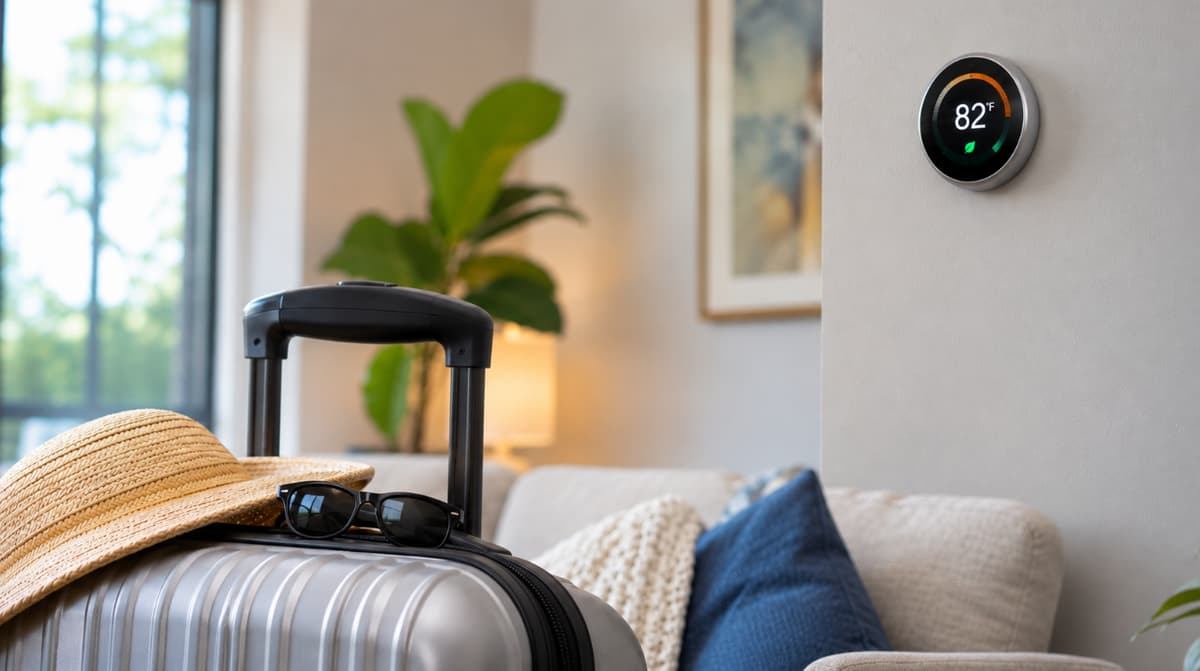
Set your AC about 7°F above your normal setting, usually 82–85°F, and leave it on. Your AC only pulls moisture from the air while it runs, so a shut-off house heats up and holds humidity.
In a humid climate, keep it closer to 80–82°F. If pets stay home, keep your usual setting or just above it.
Swap in a fresh, snug-fitting filter before you go. The quick quiz below matches you to the right one.
Summer away setting: raise it, don’t shut it off
Based on a typical 78°F at-home summer setting.
Heat and moisture build up. Indoor humidity can climb past 60%, the EPA’s limit for mold control.
It still runs often enough to pull moisture from the air, and a moderate setback captures most of the savings.
Suggested away setting by situation
Thermostat setting (°F)
Pets staying home? Keep your normal setting or a few degrees above, and check with your vet.
While you’re away, aim for:
Find Your Filter Match Before You Go
Answer a few quick questions and we’ll match you to the right filter for your home.
TL;DR
Don't turn your AC off for a summer trip. Filterbuy recommends setting it about 7°F above normal, usually 82–85°F, so it still runs enough to pull moisture from the air. If you live somewhere humid or your pets are staying home, keep it closer to 80–82°F, and put in a fresh air filter before you go.
Key Takeaways
Most empty homes do best at 82–85°F, about 7°F above ENERGY STAR's 78°F at-home summer setting.
Turning the AC off can let indoor humidity climb past 60%, the EPA's limit for mold control.
An air conditioner removes moisture only while it runs, so in humid climates cap the away setting near 80–82°F and aim for 55% humidity or lower.
A snug, clean filter keeps air moving across the AC coil so it can keep drying your air.
What Temperature Should You Leave Your AC on Vacation?
For most homes, the right vacation setting is 82–85°F. That range follows ENERGY STAR's Guide to Energy-Efficient Heating and Cooling, which suggests 78°F or higher when you're home in summer and a setup of at least 7°F when the house is empty. HVAC manufacturer Trane advises against going above 80–85°F, because the system has to run often enough to keep humidity in check.
Filterbuy has built air filters in our own U.S. plants since 2013, and that work keeps us focused on the part of the system that dries your air: the coil the filter protects. From there, the vacation setting looks like a humidity decision first and an energy decision second. That's why Filterbuy bases its recommendation on your climate and what stays home.
Ranges assume a typical 78°F at-home setting. Use a hygrometer to confirm indoor humidity stays under 60% at your away setting.
Should You Turn Off Your AC When You're on Vacation?
No. With the AC off, a closed-up house heats up and holds moisture, which can warp wood floors and leave closets smelling musty. It costs less to leave it on than you might think, since a moderate setback captures most of the savings. ENERGY STAR estimates that using a programmable thermostat's energy-saving settings properly can save about $180 a year.
How Does Humidity Change the Right Vacation Setting?
The more humid your climate, the lower your vacation setting should be. An air conditioner only removes moisture while its compressor runs, so when the setting is too high, it barely runs and humidity builds. It's a familiar summer trade-off: a higher setpoint means shorter run cycles, which makes a humid house cheaper to cool but stickier to live in. (More on how air conditioning affects indoor humidity.)
How much humidity is too much? The EPA recommends keeping indoor relative humidity below 60%, ideally between 30% and 50%, to help prevent mold, according to its mold and moisture guide.
Filterbuy also treats the filter as part of the vacation setting. We cut every filter about half an inch under its nominal size so it slides in without binding. When the fit is any looser, air slips around the edges and carries dust onto the wet coil, and that buildup hurts moisture removal well before it hurts cooling.
Filterbuy's Humidity Ceiling Test
Your ideal away setting is the warmest temperature that still keeps the house at 55% humidity or lower. To find it:
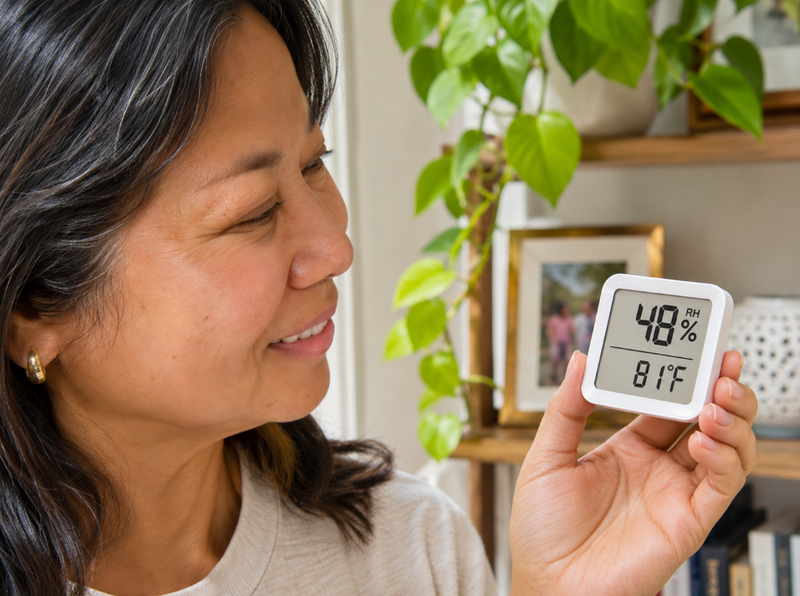
Set a digital hygrometer (a $10–$50 humidity meter) at chest height in a central room, about 3 feet from vents, windows, and outside walls, and give it 30 minutes to settle. Our guide shows how to measure humidity in a room.
A few days before your trip, raise the thermostat to your planned away setting for 24 hours.
Check the reading. You want 55% or lower, which gives you some margin below 60%.
If it reads higher, drop the setpoint 2°F and test again.
Placement matters more than most people expect.
"We publish air quality guides year-round, and when a reader says their hygrometer is wrong, it almost never is. It is on a windowsill or over a vent, describing six inches of air."
– Michelle Wan, Brand Manager and Air Quality Writer, Filterbuy
Why aim for 55% instead of 60%? A hygrometer measures the air in the middle of the room, but closets and exterior walls run cooler, and cooler surfaces sit at higher relative humidity. Filterbuy ran the numbers for a spot just 6°F cooler than the room:
Filterbuy calculation using the Magnus dew point equation. Assumes a surface 6°F cooler than room air; real homes vary.
According to the Florida Solar Energy Center, a research institute at the University of Central Florida, most molds need surface humidity of about 70% or more. So the same 55% reading is fine at 82°F but risky at 85°F, which is why we suggest a lower setting in humid climates.
Keep the fan on "Auto"
Before you leave, set the fan to "Auto." When a house feels cool but clammy, a fan left on "On" is a frequent culprit, and the easiest one to fix. Between cooling cycles, the blower pushes moisture off the wet coil and right back into your home. In Florida Solar Energy Center tests at an 80°F setpoint, average indoor humidity was 55% with the fan on Auto and 65% with the fan on On.
Does Vacation Mode on a Thermostat Work in Summer?
Yes. Vacation (or hold) mode keeps a higher cooling setpoint for the dates you choose, then resumes your usual schedule. ENERGY STAR notes that homes left empty for much of the day can save about $100 a year with a certified smart thermostat. Set it to start cooling a few hours before you get back, and turn on temperature and humidity alerts.
What If Pets Stay Home?
If your pets are staying behind, keep the thermostat at or just above your usual setting and ask your vet what's safe. The American Veterinary Medical Association's warm weather pet safety guide points out that short-nosed breeds and overweight pets are at higher risk in the heat. Give your sitter thermostat access, too.
How Should You Prepare Your AC Before a Trip?
Two steps need a head start: getting the right filter and testing your humidity ceiling.
One week before
Check your filter and order one that fits. ENERGY STAR says to change it at least every 3 months (see how often to change your HVAC filter). Measure all three dimensions, because depth is the one Filterbuy's manufacturing team sees ordered wrong most often. Not sure? Find your filter size. Filterbuy makes each filter to order and ships it within 24 hours, which leaves time for delivery.
Check the condensate drain line. ENERGY STAR warns that a plugged drain can cause water damage and breed mold.
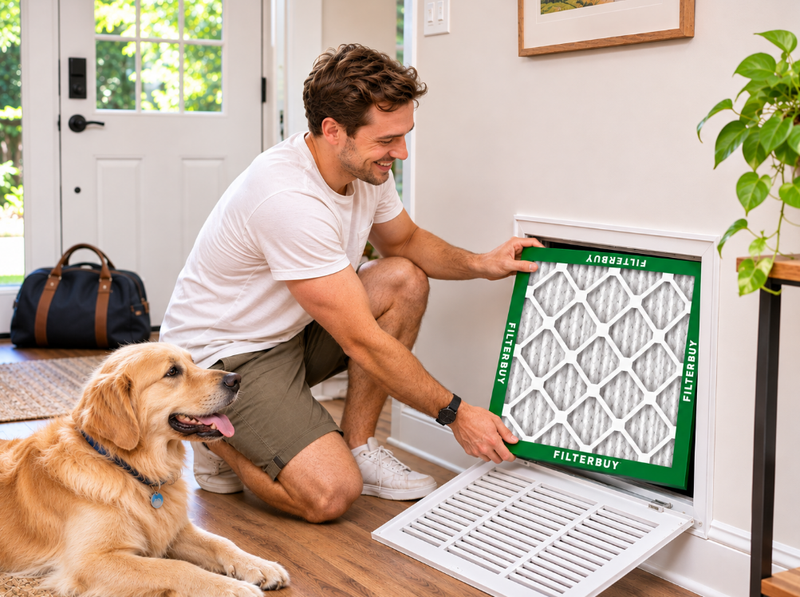
"Homeowners bring me the old filter and ask what to buy. I ask for a photo of the empty slot instead. Half the time the filter they had been using was never right for the opening it sat in."
– David Clark, Licensed HVAC Technician, Filterbuy Technical Reviewer
Two to three days before
Install the new filter, then run your hand around its edges with the system on. If you feel air moving at the edge, there's a gap.
Run the humidity ceiling test.
The day you leave
Set the away temperature using vacation or hold mode, with the fan on "Auto."
Close sun-facing blinds and clear space around the outdoor unit. If you use a smart thermostat, leave the router plugged in.
While you're away
Ask a neighbor to glance at the thermostat and look for water near the indoor unit. If your smart thermostat goes offline, the power may be out, and no power means no humidity control.
Pro Tip: With Filterbuy auto-delivery, you save 5% on every order and get a reminder three days before each shipment.
What Should You Do When You Get Home?
Set the thermostat back to normal, not lower. A 65°F setting won't cool the house faster, since most systems cool at the same rate no matter the setpoint.
Next, run Filterbuy's quick humidity check. Note your hygrometer reading, run a 30- to 60-minute cooling cycle with the fan on Auto, and read it again. If humidity drops several points and ends up under 60%, you're in good shape.
If you're coming home during wildfire or ozone season, check your local air quality before you open the windows. If a musty smell hangs around, read how an air filter can help with mold spores or call a licensed technician.
Supporting Statistics
1. 88% of U.S. households use air conditioning
In its 2020 survey of 18,496 households, the U.S. Energy Information Administration found that 88% use AC. That makes the AC most homes' main humidity control while you're away. Source: EIA.
2. 47% of U.S. homes show signs of dampness or mold
Lawrence Berkeley National Laboratory, a U.S. Department of Energy lab, averaged seven U.S. housing studies and found dampness or mold in 47% of homes. Source: Berkeley Lab.
3. 4 out of 5 U.S. homes have dust mite allergens in at least one bed
The American Lung Association names humidity as the biggest factor in dust mite levels and reports that up to 85% of people with asthma react to dust mites. Source: ALA.
Before You Pack
Find your Filterbuy filter size · Set up auto-delivery
Frequently Asked Questions
Do I need to change the thermostat for a weekend trip?
Yes. ENERGY STAR recommends the thermostat's "hold" feature for weekends away, too.
What if I'll be gone for a month or longer?
In hot, humid climates, the Florida Solar Energy Center suggests 74°F from 3 to 6 a.m., when the coil dries air best, and 85°F the rest of the day.
Is 85°F too hot to leave an empty house in summer?
Not in a dry climate. In humid ones, stay at 80–82°F: Filterbuy's calculation shows a 55% reading at 85°F can mean 74% humidity on cooler surfaces.
Should the AC fan be on "Auto" or "On" while I'm away?
Use "Auto." In Florida Solar Energy Center tests at 80°F, indoor humidity averaged 55% on Auto and 65% on On.
Does a dirty air filter matter if no one is home?
Yes. A clogged filter restricts airflow and can freeze the coil with no one home to notice.
Glossary
Setpoint: The temperature a thermostat holds.
Setback: Raising the cooling setpoint while you're away to save energy.
Relative humidity (RH): Water vapor in the air as a percentage of the most it can hold at that temperature.
Hygrometer: A device that measures relative humidity.
Evaporator coil: The indoor AC part that absorbs heat and pulls moisture from the air.
Condensate drain line: The pipe that drains water the AC removes.
Vacation mode: A thermostat feature that holds a set temperature for chosen dates.
ENERGY STAR: The joint EPA and Department of Energy energy-efficiency program.
Filterbuy: A U.S. air filter manufacturer that ships factory-direct in 600+ sizes.
Sources
ENERGY STAR Guide · ENERGY STAR Heat & Cool · EPA Mold Guide · Florida Solar Energy Center · AVMA · Trane