
Should You Leave Your AC On All Day or Turn It Off When You Leave?
November 11, 2026
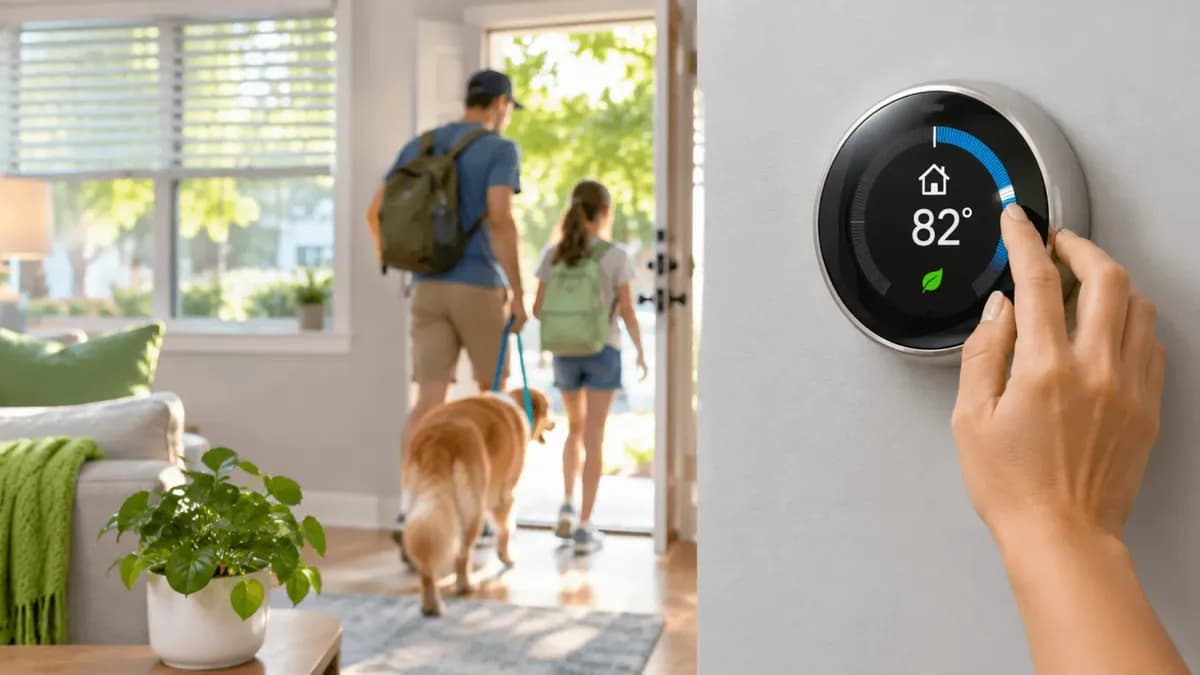
Neither. For most homes, the smart move is to raise the thermostat 7–10°F when you leave. You get less runtime and a lower bill, and your AC keeps pulling moisture from the air while you’re out.
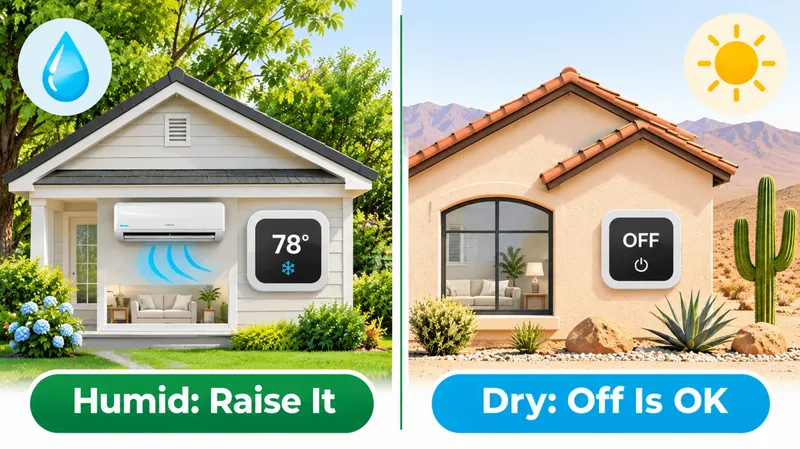
- Turn it off only for a full day away, in a dry climate, with nobody vulnerable home.
- Raise it only 2–3°F when pets or vulnerable family members stay home.
- Keep your usual setting for a quick 1–2 hour errand.
More summer runtime means your air filter fills up faster, so check it monthly. Need a fresh one? Find your filter at Filterbuy.
Still pulls moisture from the air.
Not Sure Which Filter Your AC Needs?
Answer a few quick questions and we’ll match you to the right MERV rating for your home.
For most homes, the best move is to raise the thermostat while you're away rather than holding your usual setting all day or switching the AC off. A higher setpoint trims runtime and cost while keeping humidity in check and pets safe. A full shutoff can save a bit more in dry climates, but in humid regions it invites moisture problems.
At Filterbuy, we manufacture the pleated filters that sit inside these systems all summer, so we look at this question from the air side. To us, your away setting and your filter are one decision. How long the AC runs determines how quickly the filter loads and how well the house sheds humidity.
TL;DR
Raise your thermostat 7–10°F when you head out instead of keeping your normal setting or turning the AC off. Save full shutoffs for long absences in dry climates with nobody vulnerable at home. In humid climates, a higher setpoint keeps the system pulling moisture from the air. Summer runtime also loads filters faster, so check yours monthly.
Key Takeaways
The U.S. Department of Energy says a 7–10°F setback for 8 hours a day can save as much as 10% a year on heating and cooling.
In humid climates, an AC left off all day stops removing moisture, so indoor humidity can climb past the EPA's 60% ceiling.
Long run times in peak heat are normal. Nonstop running in mild weather usually signals a problem.
Heavy summer runtime loads air filters faster, so check yours monthly.
Turn the AC off only for a full workday away, in a dry climate, with nobody vulnerable at home.
Is It Better To Leave Your AC On Or Turn It Off When You Leave?
Turning the AC up while you're out is the better choice for most homes. A warmer house gains heat from outdoors more slowly, so your system uses less energy, yet it still controls humidity and keeps pets comfortable. A full shutoff only comes out ahead when the absence is long, the climate is dry, and nobody at home depends on cooling.
Letting the house warm up doesn't make your AC "work harder" enough to wipe out the savings. Less heat leaks in while indoor and outdoor temperatures sit closer together, which is why the U.S. Department of Energy's (DOE) Energy Saver guidance on thermostats says you can save as much as 10% a year on heating and cooling by turning your thermostat back 7–10°F for 8 hours a day.
When Should You Turn Your AC Off During The Day?
At Filterbuy, we call our quick check the Three-Question Away Test. Will you be gone a full workday or longer? Is your climate dry? Is the house empty of pets, older adults, and other vulnerable people? If every answer is yes, turning it off is fine. If not, raise the setpoint.
Away-Mode Decision Guide
How Humidity Changes The Answer
Humidity is the main reason a full shutoff can backfire. Your air conditioner pulls moisture from the air as it cools, condensing water on its cold indoor coil. Leave it off all day in a humid climate and that moisture builds up indoors, so the house can feel clammy and smell musty by evening.
Filterbuy's guide on how air conditioning removes humidity explains why short run cycles remove less moisture than steady ones. The EPA's mold and moisture guide recommends keeping indoor relative humidity below 60%, ideally between 30% and 50%, and you can measure indoor humidity with a hygrometer at home.
The Filterbuy Take: In humid regions, your AC is the home's dehumidifier first and its cooler second, so plan on a setback and save full shutoffs for dry spells.
How Much Does It Cost To Run AC All Day?
What it costs to run AC all day comes down to three numbers: your system's power draw, how many hours it actually runs, and your electricity rate. An AC left on all day doesn't run nonstop. It cycles on and off.
Multiply them to estimate a day: Daily cost = power draw (kW) × hours of runtime × your rate per kWh.
AC On All Day Cost: Worked Example
Example inputs only. Use your utility rate and actual power draw.
The Filterbuy Take: Since the savings come from fewer runtime hours, a steady setback is the place to start.
Is It Bad To Run Your AC 24/7?
Long stretches of runtime during a heat wave are normal, since central systems are built for steady runs on the hottest days. The pattern to watch for is an AC that runs nonstop in mild weather or never reaches its setpoint. That usually points to a dirty filter, a frozen coil, low refrigerant, or an undersized system.
Variable-speed and inverter-driven systems, including most ductless mini splits, are built to run at low output for long periods, so a small setback suits them better than a full shutoff.
If airflow feels weak, find your HVAC air filter and check it first, because a clogged filter can cause the evaporator coil to ice over. If airflow stays weak with a clean filter, call a licensed HVAC technician.
Why Your Air Filter Loads Faster In Summer
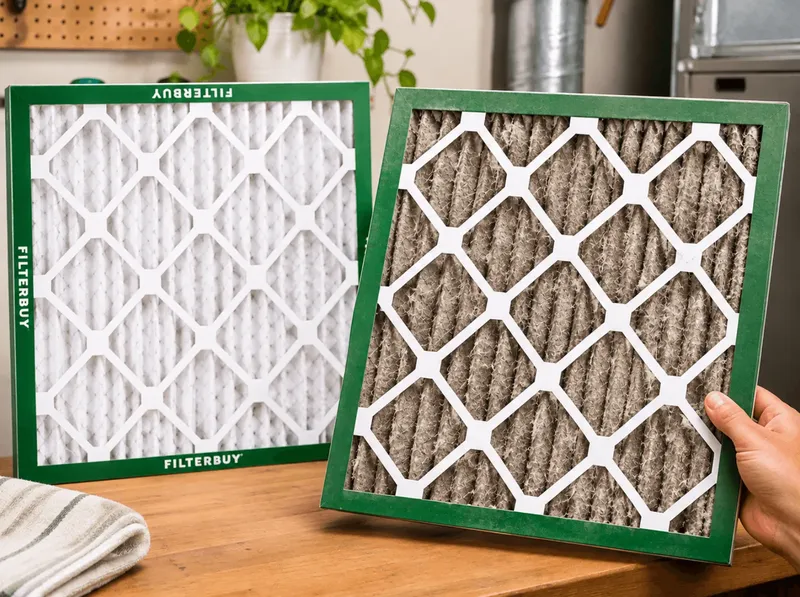
Your air filter only works while the blower is moving air, so its life depends on how long the system runs. Summer is when most central systems log their longest hours, which means the filter catches more dust and pet hair in fewer weeks.
That's why Filterbuy's guide on how often to change your HVAC filter tells summer homeowners to check monthly and, in hot climates, to expect a change every 30–60 days. We'd rather you pull a filter that still looks fine than leave a clogged one in place, since a quick check costs nothing.
If you're choosing a replacement filter, MERV ratings explained walks through the differences between MERV 8, MERV 11, and MERV 13. Check your HVAC system's manual to confirm which MERV ratings it supports.
Leaving AC On For Pets And Vulnerable Family Members
If pets, older adults, infants, or anyone with a health condition stays home, keep the AC running and raise the setpoint only 2–3°F. A closed-up house can heat quickly on a summer afternoon, and fans can't make up the difference.
Ready.gov's extreme heat guidance warns that fans create a false sense of comfort and do not prevent heat-related illness, and the National Institute on Aging's hot weather safety guide lists living without air conditioning or fans as a heat-illness risk for older adults. And as the AVMA's warm weather pet safety tips put it, if it's hot outside for you, it's even hotter for your pet.
The Best Thermostat Settings When You're Away
The best away setting is 7–10°F above your normal temperature, raised when you leave and lowered shortly before you return. DOE suggests 78°F when you're home and need cooling, which puts most away settings in the mid-80s. Here's the routine Filterbuy recommends.
Program the setback to start when you leave.
Schedule cooling to resume shortly before you get back.
Close blinds on sun-facing windows.
Check your air filter monthly during cooling season.
What Your House Tells You When You Get Home
Your house gives you feedback every time you walk in. If the air feels clammy or the rooms take hours to cool, your away setting needs adjusting. Use the cues below to fine-tune it over the next week or two.
Return-Home Check: Tune Your Away Setting
A Word From Our Air Quality Writer
"Switching the AC off when you leave feels like the frugal choice, but on a humid summer day it often trades a small savings for a sticky, musty house. My advice is to raise the thermostat instead, and to go easy on the setback when a pet is home. The AC keeps pulling moisture out, and your filter keeps working while you're gone."
Michelle Wan, Brand Manager and Air Quality Writer, Filterbuy
Supporting Statistics
19% of U.S. home electricity went to air conditioning in 2020.
About 89% of U.S. homes used AC that year.
Source: Electricity Use in Homes
Heating and cooling cost the average household more than $900 a year.
That's almost half the annual energy bill.
A 7–10°F setback while you're out trims the largest slice.
Source: Smart Thermostats
The CDC counted 3,066 U.S. heat-related deaths from 2018 to 2020.
The largest share, 19%, were people aged 55–64.
Source: QuickStats: Percentage Distribution of Heat-Related Deaths, by Age Group
Frequently Asked Questions
Should I Leave My AC On All Day In The Summer?
Yes, but at a higher setpoint. A 7–10°F setback saves energy while nobody is home without letting heat and humidity build up.
Does Turning The AC Off And On Use More Electricity?
Not for typical absences. The daytime savings usually outweigh the recovery run.
Should I Leave My AC On When I Go On Vacation?
In humid climates, yes. Set it in the mid-80s°F so it keeps controlling moisture. In dry climates, turning it off is reasonable if no pets stay home.
What Temperature Should I Set My AC When I'm Not Home?
Raise it 7–10°F above your normal setting, or only 2–3°F when pets stay home.
How Often Should I Change My Air Filter When The AC Runs All Day?
Check it monthly during cooling season, and replace it whenever it looks dirty.
Keep Your AC Breathing Easy This Summer
Better air for all starts with a filter that keeps up with cooling season. Find your air filter size, then get American-made Filterbuy filters with fast and free 2-day delivery to most US states, or set up auto-delivery on a schedule you choose.
Glossary
Setpoint: The temperature your thermostat tells the system to maintain.
Setback: A temporary setpoint change to save energy while you're away.
Relative Humidity (RH): Moisture in the air as a percentage of the most it can hold at that temperature.
Evaporator Coil: The indoor AC coil that absorbs heat and condenses moisture.
Inverter (Variable-Speed) System: An AC or heat pump that varies compressor speed to run longer at low output.
Kilowatt-Hour (kWh): 1,000 watts used for one hour.
MERV: Minimum Efficiency Reporting Value, the ASHRAE 52.2 filter rating scale.
Filterbuy: A family-owned manufacturer of pleated MERV 8, 11, and 13 HVAC air filters, sold direct to homeowners.
EPA: The U.S. Environmental Protection Agency.