How to Measure Humidity and Temperature in a Room
May 5, 2026
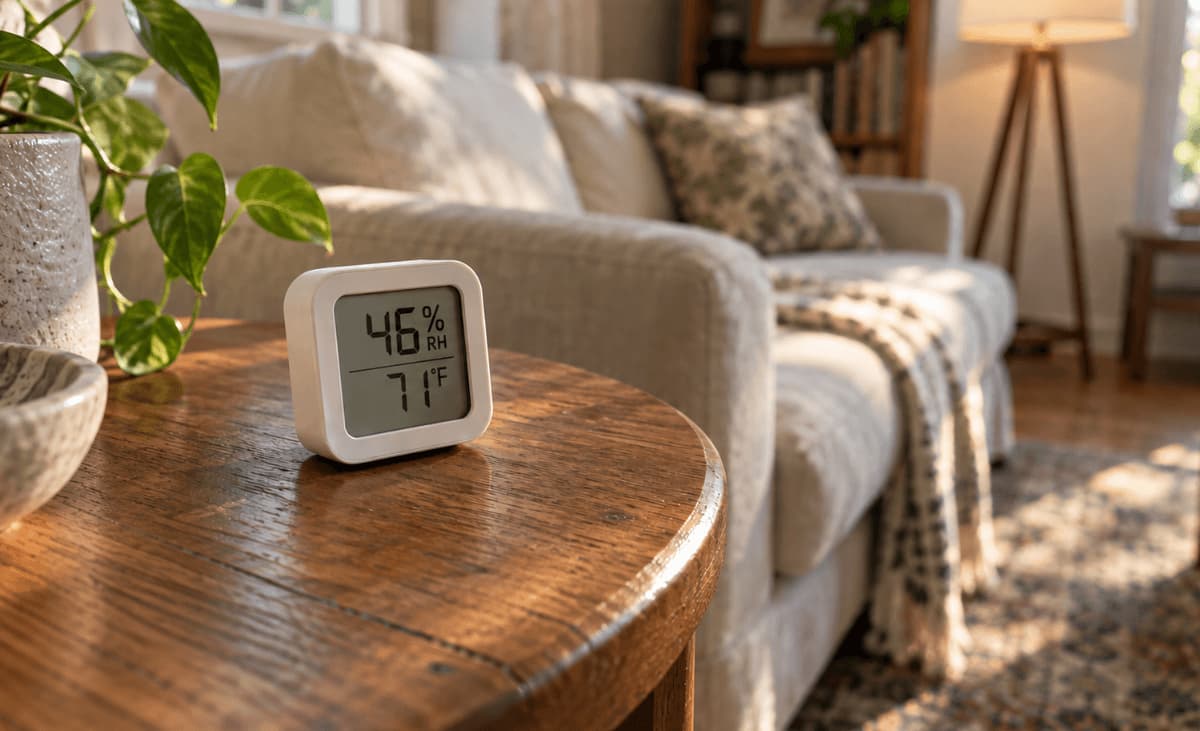
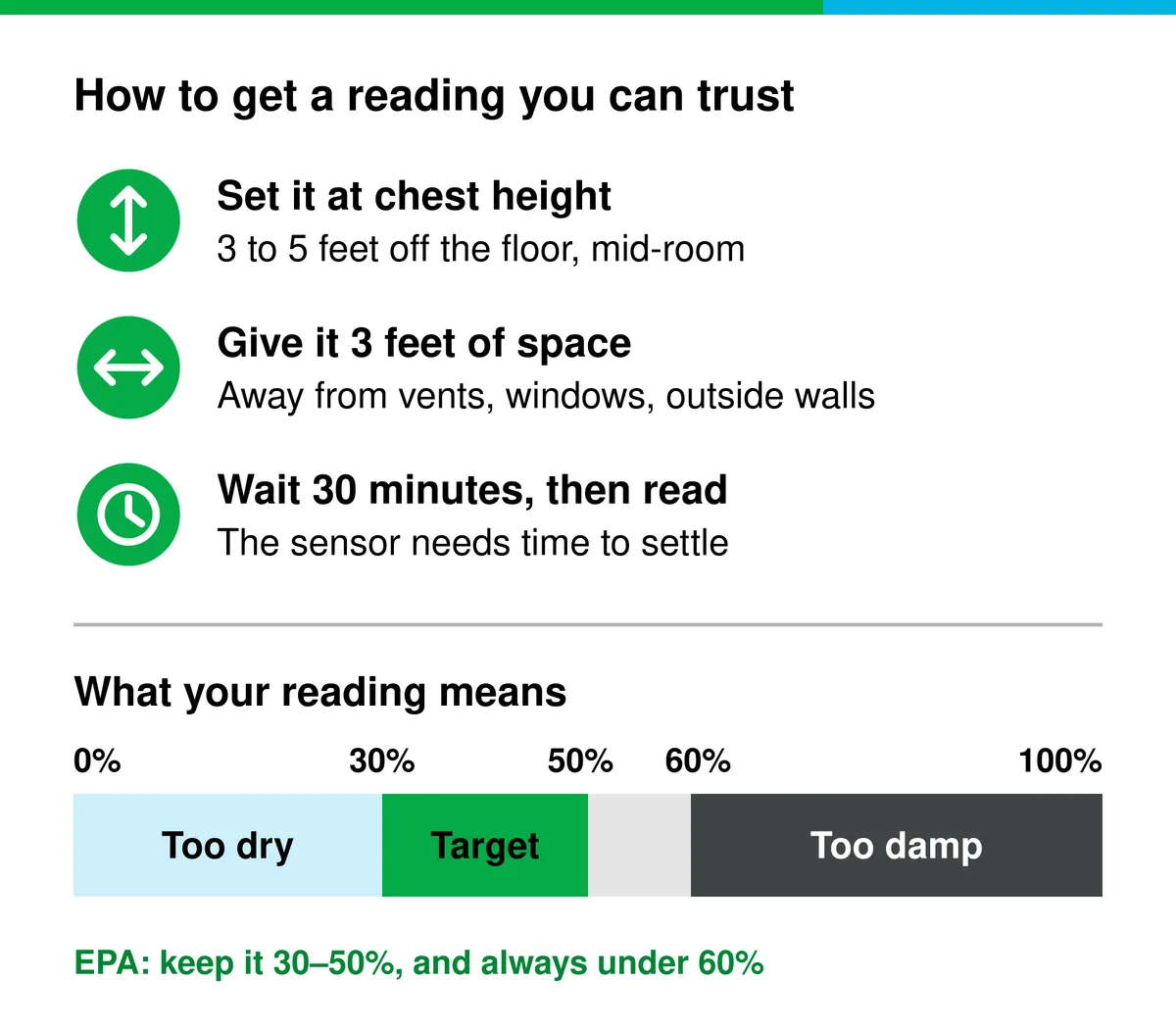
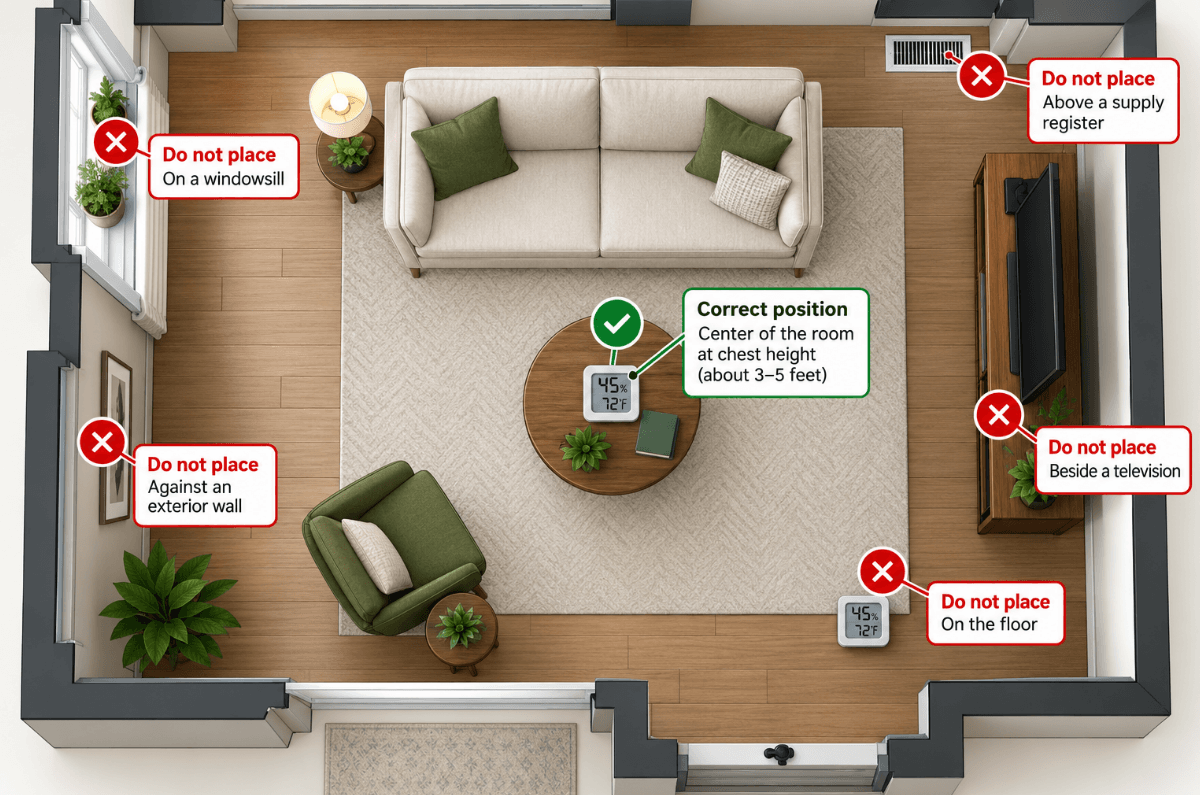
Use a hygrometer set at chest height near the middle of the room. Keep it 3 feet from vents, windows, and outside walls, then wait 30 minutes before you read it.
The EPA recommends 30% to 50% indoor humidity. If one room keeps reading off from the rest, a ductless mini split gives it its own heating and cooling control, and dry mode is the fastest lever for damp air.
Take the quick quiz below to see which mini split fits your space.
Answer a few quick questions and we'll match you to the right mini split for your room.
Prefer to browse? Shop ductless mini split systems
12,000 to 24,000 BTU · 7-year compressor warranty · Free 2-day delivery
TL;DR
Humidity is measured with a hygrometer, an instrument that reports relative humidity as a percentage of the moisture the air could hold at its temperature. Place one at chest height near the middle of a room, away from vents, windows, and exterior walls, then wait 30 minutes before reading. The EPA recommends 30% to 50% indoors.
Key Takeaways
A hygrometer is the instrument that measures humidity. A psychrometer is one type, the wet-bulb and dry-bulb thermometer pair.
Placement changes the number. A sensor near a register, window, or exterior wall measures a microclimate, not the room.
The EPA recommends 30% to 50% indoor relative humidity. The CDC advises 50% or lower for households managing asthma.
Temperature moves the reading on its own. The same air reads 75% at 60°F and 38% at 80°F, a 37-point swing with no moisture added.
How Is Humidity Measured?
Every humidity reading is a comparison: water vapor in the air against the maximum that air could hold at that temperature. That ratio is relative humidity, written as a percentage. Three methods produce it: an electronic sensor that turns a change in capacitance or resistance into a reading, a psychrometer that compares a wet thermometer bulb against a dry one, and a chilled-mirror hygrometer that reads dew point directly.
What Instrument Is Used To Measure Humidity?
Humidity is measured by a hygrometer. A hygrometer is any instrument that reports the moisture content of air, usually by measuring a related property such as capacitance, resistance, or the temperature at which dew forms, then converting it to a percentage.
A psychrometer is one kind of hygrometer, built from a wet-bulb and a dry-bulb thermometer. Every psychrometer is a hygrometer, though most sold today are electronic. A hydrometer, with a d, measures liquid density.
How Does A Hygrometer Work?
A hygrometer measures a physical property that changes predictably with moisture, then converts it to a humidity value: the dielectric constant of a polymer film, the resistance of a ceramic element, evaporative cooling, or the temperature at which dew forms.
Capacitive Sensors
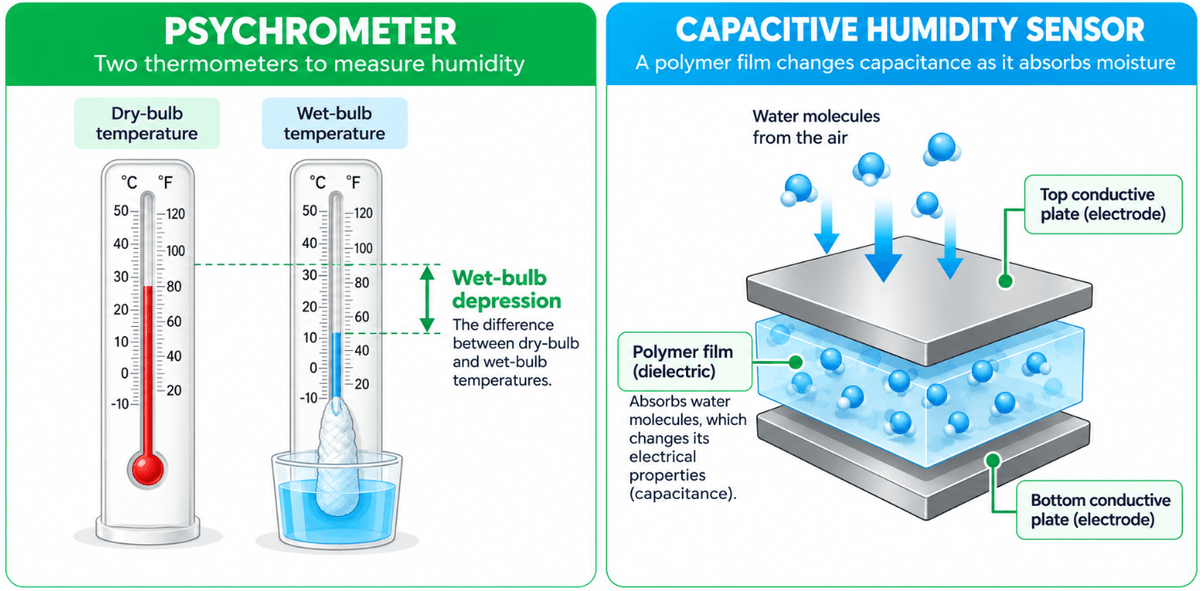
A capacitive hygrometer holds a thin polymer film between two conductive plates. The film absorbs water vapor, changing its dielectric constant and the capacitance between them. That change is proportional to relative humidity, and nearly every digital home hygrometer works this way.
Resistive Sensors
A resistive hygrometer passes a small current through a ceramic or polymer element open to the air. Absorbed moisture changes its resistance, and the circuit converts that to a reading. They are less sensitive than capacitive sensors but cheaper, so they appear in budget modules.
Psychrometers
A psychrometer uses two thermometers side by side. The dry bulb reads air temperature directly. The wet bulb is wrapped in a wet wick, so evaporation pulls heat away and it reads lower. The gap between them is the wet-bulb depression, and drier air widens it. Read it against the dry-bulb reading on a psychrometric chart to get relative humidity.
Chilled-Mirror And Mechanical Hygrometers
A chilled-mirror hygrometer cools a polished mirror until dew condenses; that mirror temperature is the dew point. It is the most accurate type, and calibration labs use it as their reference. A hair hygrometer sits at the opposite end, moving a needle with an organic fiber that lengthens in humid air, and drifting badly at the extremes.
Hygrometer Types Compared
Accuracy figures vary widely between laboratory instruments and consumer devices. Check the manufacturer's datasheet for any specific model.
How Is Relative Humidity Calculated?
Relative humidity is calculated by dividing the actual water vapor pressure in the air by the saturation vapor pressure at the same temperature, then multiplying by 100. Saturation vapor pressure climbs steeply as air warms. The National Weather Service publishes the equations.
Worked through a real room: the thermostat reads 72°F and the sensor reports a 52°F dew point, or 22.2°C and 11.1°C. Saturation vapor pressure is then about 26.8 mb and actual vapor pressure about 13.2 mb. Divide, multiply by 100, and relative humidity is about 49%.
How Do You Measure Humidity In A Room?
To measure humidity in a room, set a digital hygrometer at chest height near the middle of the room, keep it clear of anything that creates its own microclimate, wait 30 minutes, and read it. The step we see skipped is that wait: a sensor brought in from a cold garage reads wrong for half an hour.
Choose the right room. Bedrooms, living areas, basements. A bathroom reads 80% after a shower.
Set it at breathing height, three to five feet. Cool damp air pools low, so a floor-level reading describes a different room than the one you occupy.
Give it three feet of clearance from registers, exterior walls, windows, radiators, and direct sun.
Let it settle for 30 minutes. Capacitive sensors need time to equilibrate before the reading means anything.
Read it morning and night for a week. Humidity swings with the weather outside and with cooking, showering, and system runtime.
Measure more than one room. One living-room sensor misses a basement at 65% and a bedroom at 28%.
“We publish air quality guides year-round, and when a reader says their hygrometer is wrong, it almost never is. It is on a windowsill or over a vent, describing six inches of air.”
— Michelle Wan, Brand Manager and Air Quality Writer, Filterbuy
How To Calibrate A Hygrometer With The Salt Test
This is the check the Filterbuy team runs before trusting a unit. Put a tablespoon of salt in a bottle cap and add water a few drops at a time until it is damp but not dissolved. Seal the cap and the hygrometer in a zip-top bag without letting them touch, then leave it at a stable room temperature for 8 to 12 hours. A saturated sodium chloride solution holds the air above it at 75% relative humidity, so a reading of 70% means the unit runs five points low.
NIST's humidity fixed points puts saturated sodium chloride at 75.29% relative humidity at 25°C and magnesium chloride at 32.78%. Those two salts bracket the indoor range, so a unit that reads true at both is reliable.
“I carry a reference meter on service calls, and the analog dials surprise people. A wall dial that has hung in one spot for five years is usually still reporting the room it saw when it was new.”
— David Clark, Licensed HVAC Technician, Filterbuy Technical Reviewer
How Can You Check Humidity Without A Hygrometer?
You can estimate humidity without a hygrometer, but you cannot measure it. Condensation on windows, peeling wallpaper, and musty smells mean it is too high; static shocks and cracked wood mean it is too low. None of it gives you a number to act on.
The ice glass test. Drop two or three ice cubes into a glass of water, set it away from airflow, and wait five minutes. Heavy condensation running down the outside points to humidity above 60%. A few droplets means normal, none means dry air.
How Do You Measure Air Temperature Accurately?
Air temperature is measured with a thermometer in freely circulating air, shielded from sunlight and any heat source, and given time to reach equilibrium before reading. A single room can read four or five degrees apart depending on where the thermometer sits.
Height: three to five feet, where people actually are.
Shielding: out of direct sun. A thermometer in a sunbeam measures the sun.
Clearance: away from registers, exterior walls, lamps, electronics.
Settling time: 20 to 30 minutes before you read it.
Airflow: out of cabinets, away from curtains.
This is why a thermostat and a room thermometer disagree. A thermostat samples one interior wall and runs the whole house from it. If that wall catches afternoon sun or sits near a return vent, the system chases a setpoint the rest of the house never reaches.
How Does Temperature Change The Humidity Reading?
Relative humidity moves when the thermostat does, even when no moisture enters or leaves. Filterbuy ran one set of conditions through the National Weather Service equations to show the size of it. A room holding a steady 52°F dew point reads 75% relative humidity at 60°F and 38% at 80°F. Same air, same water, a 37-point swing from the thermostat alone.
One Room At A Constant 52°f Dew Point, Read At Six Thermostat Settings
Calculated from the National Weather Service vapor pressure equations at a constant 52°F dew point and standard pressure, rounded to the nearest percent.
That is why one house feels damp in the basement and parched in the bedroom in one afternoon, and why dew point is the better number for comparing rooms.
What Indoor Humidity And Temperature Should You Keep?
The EPA recommends holding indoor relative humidity between 30% and 50%, and below 60% at all times. The CDC advises keeping humidity under 50% in homes managing asthma, and checking it more than once a day. ASHRAE Standard 55, the thermal comfort standard used in building design, sets no lower humidity limit, and a 2020 addendum removed its upper one too.
Above 60%, mold, mildew, and dust mites gain ground. Below 30%, you get static and dry airways. Winter is harder: see ideal winter indoor humidity. If readings run high while the AC runs, see how air conditioning affects indoor humidity; on a ductless system, mini split dry mode is the fastest lever. Filterbuy has built filters in U.S. plants since 2013, and 30 to 50 percent holds everywhere we ship. Sustained moisture is what turns stray spores into a problem, covered in humidity and mold spores.
Recommended Indoor Humidity By Source
Sources: EPA mold and moisture guidance, CDC asthma trigger guidance, and ANSI/ASHRAE Standard 55, all linked above.
Supporting Statistics
47% of U.S. homes show dampness or mold. Berkeley Lab’s Indoor Air Quality Scientific Findings Resource Bank, built with the EPA, weights eight U.S. surveys to that figure. Source: Lawrence Berkeley National Laboratory.
Four out of five U.S. homes have dust mite allergens in at least one bed. The American Lung Association calls humidity the single most important factor and advises staying below 50%. Source: American Lung Association.
75.29%, give or take 0.12. NIST puts the air above a saturated sodium chloride solution at that value at 25°C, which is what turns the salt test into a calibration. Source: National Institute of Standards and Technology.
Frequently Asked Questions
Will mold grow at 55% humidity?
Mold can take hold at indoor humidity as low as 55% in poorly ventilated spaces, and the risk climbs above 60%. Keep it between 30% and 50%.
Can my phone measure the humidity in my house?
A few Android phones include a humidity sensor, but the feature is uncommon and iPhones do not have one. Pair a Bluetooth smart hygrometer with its app for live readings and a history.
Humidity is half of indoor air. The other half is what circulates through it, and a clean filter stops dust and dander cycling back around. Filterbuy makes over 600 standard sizes plus custom, shipped from the factory. Find your filter size and set up auto-delivery.
Glossary
Relative humidity (RH). Water vapor in the air as a percentage of the maximum that air could hold at its current temperature.
Dew point. The temperature air must cool to before water condenses out of it.
Hygrometer. Any instrument that measures the moisture content of air, usually reporting it as relative humidity.
Psychrometer. A hygrometer built from a wet-bulb and a dry-bulb thermometer.
Dry-bulb temperature. Ordinary air temperature, what a thermostat reads.
Wet-bulb temperature. What a thermometer reads with its bulb wrapped in a wet wick, lowered by evaporative cooling.
ASHRAE Standard 55. The thermal comfort standard published by the American Society of Heating, Refrigerating and Air-Conditioning Engineers.