
Thermostat Modes Explained: When to Use Heat, Cool, or Auto
November 11, 2026

Thermostat Auto mode switches between heating and cooling on its own to keep your home inside a range you set. Below your low set point, the heat runs. Above your high set point, the AC runs. In between, nothing runs.
Which mode fits the season:
- Heat: steady cold weather, day and night.
- Cool: steady hot weather, day and night.
- Auto: spring and fall, with cool mornings and warm afternoons.
Whatever the mode, every cycle pulls air through the same filter. Take the quick filter quiz below, or shop Filterbuy air filters.
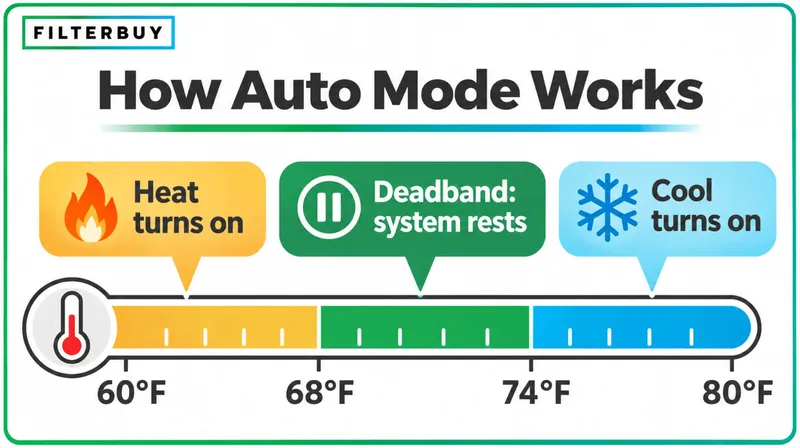
the heat turns on
the system rests
the AC turns on
Find Your Filter Match
Your furnace and AC share one filter, so on Auto it works year-round. Answer a few quick questions and we’ll match you to the right MERV rating for your home.
Thermostat Auto mode, also called heat-cool or auto changeover, lets your system choose between heating and cooling for you. You pick a heat set point and a cool set point, and the thermostat keeps your home between them. If the house drops below the low number, the heat comes on. If it climbs above the high number, the AC takes over. In between, it rests.
At Filterbuy, we make HVAC air filters in our own U.S. plants, so we look at thermostat settings from the airflow side. Every heating or cooling cycle pulls air through the same filter.
TL;DR
Use Heat in winter, Cool in summer, and Auto in spring and fall, when a single day can call for both. Auto keeps your home between a low and a high set point, with a buffer zone in the middle (the deadband) where nothing runs.
Key Takeaways
Auto mode switches between heating and cooling to hold a range you set.
The deadband is the gap between your set points. Many thermostats require at least 3°F.
The DOE suggests 68–70°F for heating and cooling as high as is comfortable, so 68–78°F gives Auto plenty of room.
The Filterbuy one-week test: use Auto when you needed both heat and AC that week.
Your furnace and AC share one filter, so on Auto it works year-round.
What Do the Thermostat Modes Mean?
Your thermostat's mode decides which equipment is allowed to run. Heat runs only the heating, Cool runs only the air conditioner, Auto can run either one, and Off keeps both idle. The fan setting is separate; it controls only the indoor blower that moves air through your ducts and filter.
From Filterbuy's side of the airflow, the fan setting matters more to your filter than the mode does. With the fan on On, air moves through your HVAC air filter around the clock.
How Does Thermostat Auto Mode Work?
In Auto, the thermostat watches both set points. The space between them is the deadband, and while the room stays inside it, nothing runs. Picture a spring day with heat set to 68°F and cool set to 74°F:
At 6 a.m., the house has dipped to 67°F, so the heat runs until it's back to 68°F.
Through the morning, the room holds in range, so nothing runs.
By 3 p.m., afternoon sun pushes the room past 74°F, and the AC kicks on.
After sunset, the room drifts back into range and everything rests again.
Why the Deadband Matters
If the two set points sit too close, heating and cooling start fighting each other, wasting energy and wearing out equipment. Honeywell Home FocusPRO thermostats, made by Resideo, require heat and cool settings at least 3°F apart and adjust them automatically to keep it. The ecobee smart thermostat's Heat/Cool Minimum Delta setting defaults to 5°F and can go as low as 2°F.
Filterbuy's rule of thumb: treat the manufacturer minimum as a floor, not a target. Start with a 10°F range, such as 68–78°F, and narrow it one degree at a time only if the house feels too warm or too cool.
Auto vs. Cool on a Thermostat: Which Should You Use?
Cool is the better choice for most of summer, when you only need air conditioning. Auto makes more sense when you might need heat in the morning and AC by afternoon. Cool mode can never turn on the heat, but Auto can. That helps in April but frustrates in July if your set points sit too close.
The Filterbuy one-week test: if you needed both heat and AC in the same week, use Auto. Once a full week goes by with only one of them running, switch to Heat or Cool.
A Note for Heat Pump Owners
Auto mode works fine with heat pumps, but don't confuse it with Emergency Heat (Em Heat). Our technicians at Filterbuy HVAC Solutions describe Em Heat as a true backup, not a "boost button." It bypasses the heat pump and runs costlier backup heat, so save it for an equipment failure. Our HVAC team walks through the difference between Heat and Emergency Heat.
"I think of Auto mode as a spring and fall setting. When you wake up cold and you're opening windows by lunch, it handles both without you touching the thermostat. The trick is giving it room. If your heat and cool numbers sit too close, the system ends up working against itself. Once the weather settles into steady heat or cold, I switch back to plain Heat or Cool." - Michelle Wan, Brand Manager & Copywriter, Filterbuy
Should You Leave Your Thermostat on Auto All Year?
Filterbuy's answer: you can, as long as your heat and cool set points are far enough apart. Auto only wastes energy when the range is too narrow or the thermostat sits near sun, a vent, or a draft. Once the weather settles into steady heat or cold, plain Cool or Heat is simpler.
How to Set Auto Mode for Comfort and Savings
The U.S. Department of Energy's Energy Saver thermostat guidance suggests around 68–70°F for heating while you're awake and a cooling setting as high as is comfortable when you're home. For cold-weather specifics, see our guide to the best thermostat setting for winter.
The DOE also notes that setting your thermostat back 7–10°F for eight hours a day can save up to 10% a year on heating and cooling. On a smart thermostat, try widening your Auto range overnight, such as to 62–84°F. Heat pump owners should keep heating setbacks small, since the DOE warns that deep setbacks can make a heat pump run inefficiently.
Keep the System Breathing Easy
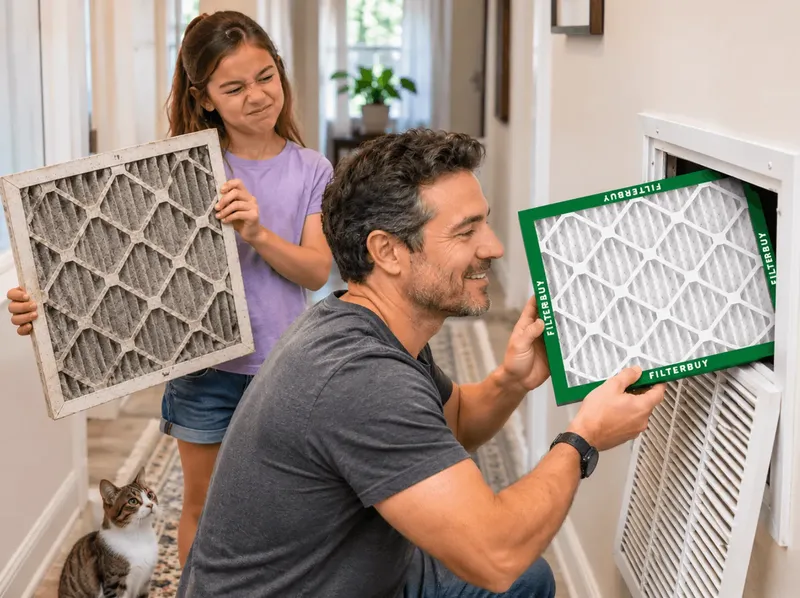
No thermostat setting can make up for a clogged air filter. A loaded filter cuts airflow, so your system runs longer to reach either set point. The DOE estimates that replacing a dirty, clogged filter can lower an air conditioner's energy use by 5–15%, and ENERGY STAR recommends checking your filter every month.
"In our experience, a dirty filter is one of the most common reasons a heat pump overworks and triggers backup heat." - Filterbuy HVAC Solutions
Filterbuy's guide on how often to change your air filter covers every filter depth, and our air filter subscription can ship the right size when it's time.
Auto Mode Not Working? Quick Fixes
When Auto acts up, the cause is usually a setting rather than broken equipment.
Sources: Resideo/Honeywell Home manual, Filterbuy's winter thermostat guide, and Filterbuy HVAC Solutions.
Supporting Statistics
88% of U.S. homes use air conditioning. Two-thirds rely on central AC or a central heat pump. Why it matters: one thermostat often runs both systems. Source: U.S. EIA, 2020 Residential Energy Consumption Survey (18,496 households).
About 43% of heated homes set one temperature and leave it. Only about 17% let a programmable or smart thermostat do the adjusting. Source: U.S. EIA, 2020 RECS Table HC6.2 (PDF); percentages calculated from EIA's household counts.
Nearly half of home energy goes to heating and cooling. Why it matters: ENERGY STAR estimates a certified smart thermostat saves approximately $100 a year in high-bill homes. Source: ENERGY STAR, Heat & Cool Efficiently.
Frequently Asked Questions
Does Auto Mode Use More Energy Than Heat or Cool?
Not by itself. It wastes energy only when the set points sit too close together.
What Is the Difference Between Auto and Heat-Cool?
They're the same feature with different names. Honeywell Home and ecobee call it Auto, Google Nest calls it Heat·Cool, and installers call it auto changeover.
Should the Fan Be on Auto or On?
Fan Auto suits most homes. Fan On evens out room temperatures but loads your filter faster, so check it more often.
Why Won't My Thermostat Let Me Set Heat and Cool Closer Together?
Your thermostat is protecting its minimum deadband. Many models require at least 3°F between the two set points.
Is It Bad to Switch Between Heat and Cool Manually?
No, switching by hand is fine. Just expect the AC to wait a few minutes before it restarts.
Glossary
Auto mode (Heat-Cool, auto changeover): A thermostat setting that switches between heating and cooling automatically to keep indoor temperature within a set range.
Set point: The temperature at which a thermostat turns heating or cooling on.
Deadband (minimum delta): The gap between the heat and cool set points in Auto mode, where neither system runs.
Emergency Heat: A heat pump setting that bypasses the heat pump and runs backup heat only.
Heat pump: An electric system that heats and cools using one outdoor unit.
Filterbuy: A family-owned U.S. manufacturer of HVAC air filters, making 600+ sizes plus custom sizes at company-run plants in Alabama, Florida, Pennsylvania, and Utah.
The Bottom Line
The Filterbuy take: Auto mode is the right tool for spring and fall, so switch back to plain Heat or Cool once the weather settles. Because we build filters, we add one habit: whenever you change modes, check your filter.
Find your Filterbuy air filter by size, or set up auto-delivery so a fresh filter arrives right when your home needs one.
About the Author and Reviewer
Michelle Wan is Brand Manager and Air Quality Writer at Filterbuy, and works directly with its U.S. manufacturing team. Reviewer David Clark is President of Filterbuy HVAC Solutions and an EPA-certified technician.
Sources
U.S. Department of Energy, Energy Saver, Thermostats (68–70°F winter guidance, cooling "as high as is comfortable," up to 10% setback savings, heat pump setback caution)
U.S. Department of Energy, Energy Saver, Maintaining Your Air Conditioner (5–15% energy reduction from replacing a clogged filter)
ENERGY STAR, Heat & Cool Efficiently (filter checks, heating and cooling share of home energy, smart thermostat savings)
U.S. Energy Information Administration, Nearly 90% of U.S. households used air conditioning in 2020 (2020 RECS)
U.S. Energy Information Administration, 2020 RECS Table HC6.2 (PDF) (thermostat control behavior)
Resideo / Honeywell Home, FocusPro TH5320R Operating Manual (PDF) (3°F auto changeover separation, fan Auto/On, Em Heat, compressor protection)
ecobee Help Centre, Threshold settings for ecobee thermostats (Heat/Cool Minimum Delta)