
Thermostat Fan Auto Vs. On: Which Setting Should You Use?
November 11, 2026
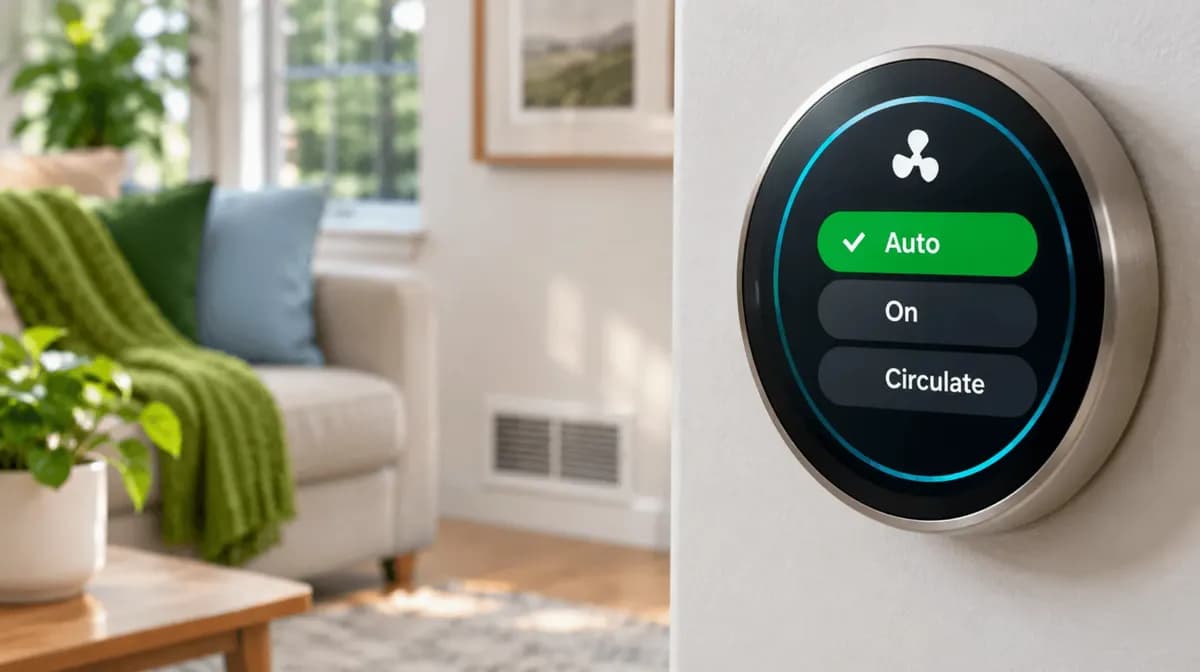
Keep your thermostat fan on Auto day to day, and switch to Circulate or On only when you need it. Auto keeps your electric bill and summer humidity in check because the blower rests between heating and cooling cycles. Choose Circulate or On when you want more air moving through your filter or more even temperatures from room to room.
- Auto: Lowest energy use. Keeps your AC’s dehumidification working.
- Circulate: Runs a set number of minutes each hour. A middle ground for more filtration at modest cost.
- On: Most air through your filter and the most even room temperatures, at the highest energy cost.
The more your fan runs, the faster your filter fills up. Take the quick quiz below to find the filter that fits your fan habits.
More fan hours send more air through your filter, but they also use more energy.
Runs only while heating or cooling
Runs a set number of minutes each hour
Runs nonstop, 24 hours a day
Green bar = blower running during a sample hour
Find Your Filter Match
Running your fan more often? Answer a few quick questions and we’ll match you with the right MERV rating for your home.
Already know your size? Shop Air Filters at Filterbuy
For most homes, Auto is the better everyday thermostat fan setting. Auto runs the HVAC blower only while your system is heating or cooling, which keeps electricity use low and lets your air conditioner pull moisture from the air. On runs the blower nonstop, which pushes more air through your filter and evens out room temperatures but costs more and can raise summer humidity. Circulate, found on many smart thermostats, lands in between. As an air filter maker, Filterbuy sees the fan setting as your filter's on switch.
TL;DR
Leave the thermostat fan on Auto for the lowest energy use and the best summer dehumidification. When rooms feel uneven or you want more air through your filter, switch to a Circulate or fan schedule setting, or to On for short stretches. The more the fan runs, the more often you should check your filter.
Key Takeaways
Auto runs the HVAC blower only during heating and cooling cycles, which makes it the lowest-cost fan setting.
On runs the blower around the clock, so more air passes through the filter and rooms stay more even.
Continuous fan operation in cooling season can blow moisture from a wet AC coil back into the house.
Circulate settings, such as the ecobee fan minimum runtime or a Nest fan schedule, run the blower a set number of minutes each hour.
Extra fan runtime loads the filter faster, so check it monthly on On or Circulate.
Should Your Thermostat Fan Be On Or Auto?
Most homeowners should leave the thermostat fan on Auto and save On or Circulate for specific jobs. Filterbuy's rule of thumb is to choose the setting with the fewest blower hours that still solves your problem, which usually means Circulate before On.
How far you can lean toward On depends on the humidity in your climate and on your blower motor. Variable-speed ECM blowers can run at low speed on modest power, and DOE research on high-performance furnace blowers found that advantage matters most during fan-only operation. Older single-speed PSC motors cost noticeably more for every added hour. Winter brings its own trade-offs, which we cover in our guide to furnace fan On or Auto in winter.
Thermostat Fan Auto Vs. On Vs. Circulate Compared
Auto, On, and Circulate differ in one thing: how many hours the blower runs.
Fan Settings At A Glance
Fan On Vs. Auto: How Each Setting Affects Your Electric Bill
Fan On costs more than Auto because the blower keeps drawing electricity between heating and cooling cycles. Fan speed matters too. Many multi-speed and variable-speed systems switch to a lower fan-only speed for On and Circulate, and an HVAC technician can often set it lower still.
The motor type is usually on the blower label. To estimate your own cost, multiply the blower's wattage by the added hours, divide by 1,000 to get kilowatt-hours, and multiply that by your electric rate. Since electricity prices vary by state, so do results. For a motor-by-motor breakdown, see Filterbuy's guide to running your HVAC fan nonstop during wildfire smoke.
Does Running The HVAC Fan All The Time Raise Indoor Humidity?
Yes, running the HVAC fan all the time can raise indoor humidity during cooling season. While your air conditioner runs, the indoor coil gets cold and pulls water out of the air. When the compressor stops, some water is still on the coil. On Auto, the blower shuts off too, so the water drains away. With the fan set to On, the blower keeps pushing air across the wet coil, and part of that moisture evaporates back into your home.
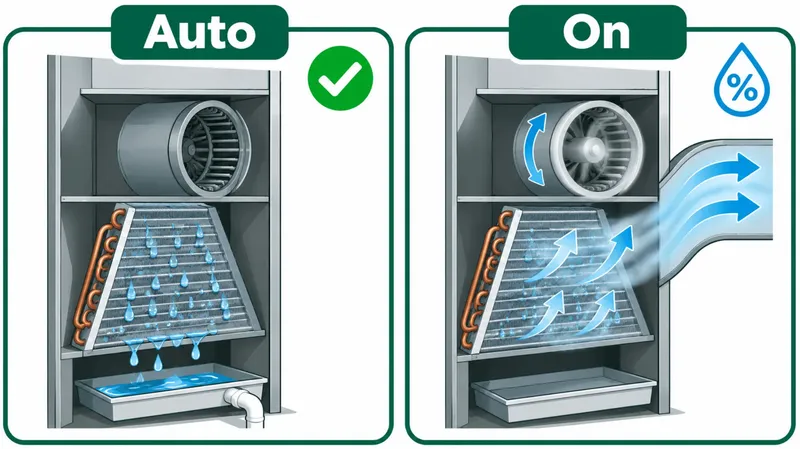
Building scientist Allison Bailes measured this rise in his own home. The CDC advises keeping home humidity no higher than 50% to help control mold, so in a humid climate our advice is simple: keep the fan on Auto through cooling season, or use short Circulate runs and watch a hygrometer. In dry climates and in winter, the effect matters less.
The fan-off delay deserves a look too. Many systems keep the blower running briefly after cooling ends. On an ecobee, this is the Cool Dissipation Time, and setting it to zero stops the fan the moment cooling stops. In muggy weather, ask your technician whether a shorter delay suits your system.
Fan On Vs. Auto For Air Quality And Filtration
Fan On moves the most air through your HVAC filter, which gives it more chances to capture airborne particles like dust and pet dander. As the EPA notes, most systems run less than a quarter of the time in heating and cooling seasons. On Auto, the filter you paid for sits idle much of the day, which is why Filterbuy treats Circulate as the easiest filtration upgrade. The same logic explains why longer furnace runtime affects indoor air quality.
On or Circulate is especially useful during pollen season or after a remodel, as long as the filter is clean. Extra runtime loads the filter faster, so follow our guide on how often to change your HVAC filter. Many homes run well on MERV 11 air filters, but check your HVAC system's manual to confirm which MERV ratings your equipment supports, and see how MERV ratings compare.
How Do Smart Thermostat Circulate Settings Work?
A smart thermostat circulate setting runs the blower for a set number of minutes each hour, even when the house doesn't need heating or cooling.
Ecobee Fan Minimum Runtime
On an ecobee smart thermostat, the circulate feature is called fan minimum runtime. It sets the minimum number of minutes the fan runs each hour, and any heating or cooling time counts toward that total. You'll find it in the thermostat's fan menu, under System. Try 15 to 20 minutes per hour to start.
Nest Fan Schedule
Google Nest thermostats handle this with a fan schedule. You pick how long the fan runs each hour, from 15 minutes up to the full hour, and which hours the schedule covers. A scheduled fan won't start while the thermostat is set to Off.
Honeywell And Other Thermostats
Many Honeywell Home thermostats have a Circ setting, which runs the fan randomly about 33% of the time.
Which Thermostat Fan Setting Fits Your Home?
The right setting depends on the season and the job. Start with the table below, then pair your choice with the right temperature from our season-by-season thermostat temperature guide.
Fan Settings By Situation
Filterbuy recommends a simple 30-day check:
Pick a setting from the table.
In cooling season, use a hygrometer to keep humidity at 50% or lower.
After 30 days, check the filter and replace it if it looks gray.
Expert Quote
"At Filterbuy, we think of the thermostat fan as the on switch for your filter. Auto is the right default for most homes, and Circulate is the smartest step up, because it puts your filter to work without the cost and summer humidity of running On all day."
Michelle Wan, Brand Manager and Air Quality Writer, Filterbuy
Supporting Statistics
Less than 25% runtime
The EPA reports that HVAC systems usually run less than 25% of the time in heating and cooling seasons.
Filters only clean air while the system is running.
What it means: On Auto, your filter sits idle most of the day.
About 70% humidity with the fan on On
Building scientist Allison Bailes set his own fan to On for five days in August.
Indoor humidity averaged about 70%, then dropped below 60% within days of switching back to Auto.
What it means: In humid climates, Auto is the safer summer default.
Source: This Technique Is Supposed To Improve IAQ But May Do The Opposite
$42 a year in added savings for fan-only users
In a 2014 National Renewable Energy Laboratory (NREL) study, eight homes were retrofitted with variable-speed furnace fan motors.
They saved 163 kWh a year on average.
Homes that also ran the fan outside heating and cooling saved an extra $42 a year.
What it means: Frequent fan users gain the most from an efficient motor.
Source: Evaluation of Retrofit Variable-Speed Furnace Fan Motors
Frequently Asked Questions
Is It Bad To Run Your HVAC Fan All The Time?
A continuously running HVAC fan is fine for most systems, but it has costs. Continuous fan operation raises electricity use and can push summer humidity up. It also loads the filter faster, and if your ducts leak, they leak every hour the fan runs.
Should I Leave The Fan On When I'm Away From Home?
Set the fan to Auto while the house is empty, unless pets are home. On an ecobee, the Away comfort setting can switch the fan mode for you. A Nest fan schedule keeps running whether anyone is home or not, so adjust it before a trip.
What Does The Circulate Setting Do On A Thermostat?
The Circulate setting runs the HVAC blower for part of every hour, even without a call for heating or cooling. More air passes through the filter than on Auto, with far fewer blower hours than On.
Should The Thermostat Fan Be On Or Auto In Summer?
In humid weather, use Auto so your air conditioner can remove moisture. In drier climates, Circulate or short stretches of On work with little humidity penalty. Pair either with the best AC temperature for summer.
Do I Need To Change My Filter More Often With The Fan On?
Yes. More fan hours send more air through the filter, so it fills up faster. Check it monthly while you're using On or Circulate, and replace it at the first signs of a clogged furnace filter.
Keep Your Filter Ready For Every Fan Setting
At Filterbuy, we make pleated MERV 8 air filters, MERV 11 filters, and MERV 13 air filters to order in hundreds of standard sizes and custom air filter sizes, with fast and free 2-day delivery to most US states. Start an air filter subscription and a fresh filter arrives before the old one is due.
Glossary
Auto (fan setting): A fan mode that runs the blower only during heating or cooling cycles.
On (fan setting): A fan mode that runs the blower continuously.
Circulate: A fan mode that runs the blower for part of each hour.
Blower: The fan that moves air through the filter and ducts.
ECM (electronically commutated motor): An efficient blower motor that can run at variable speeds.
PSC (permanent split capacitor) motor: An older single-speed blower motor that uses more electricity than an ECM.
MERV (Minimum Efficiency Reporting Value): A scale rating how well an air filter captures particles.
Evaporator coil: The cold indoor AC coil that condenses moisture out of the air.