
Does Running the Furnace More Affect Air Quality?
October 29, 2026

Yes. The more your furnace runs, the more of your home’s air passes through its filter. That makes your filter the deciding factor in whether extra runtime helps or hurts.
- Clean filter: catches more dust on every pass.
- Clogged filter: chokes airflow, lets dust slip past, and makes your furnace work harder.
Heated winter air also gets drier, so aim to keep indoor humidity between 30% and 50%. Take the quick quiz below to find the right furnace filter for your home.
The Runtime Rule
Your filter decides if extra runtime helps
Furnace runs more
More air through the filter
Check your filter monthly in winter
Find Your Winter Filter Match
Answer a few quick questions and we’ll match you to the right filter for heating season.
Already know your size?
TL;DR: Yes. Every hour your furnace runs pushes more of your home's air through its filter, so the filter decides whether that time helps or hurts. With a clean, well-rated filter, longer runtime means less dust and fewer allergens. With a clogged filter or very dry air, it means the opposite.
Key Takeaways
A furnace filter only cleans air while the blower runs: under 6 hours a day on Auto in a typical heating season, and up to 24 on On.
Extra runtime helps only when the filter is clean and rated for fine particles, such as MERV 11 or MERV 13.
A dirty filter restricts airflow, lets dust slip past, and makes the furnace work harder.
Heated winter air loses relative humidity, and Mayo Clinic recommends keeping it between 30% and 50%.
Have a gas furnace inspected yearly before heating season, and keep a working carbon monoxide (CO) detector at home.
How Does Running the Furnace More Affect Indoor Air Quality?
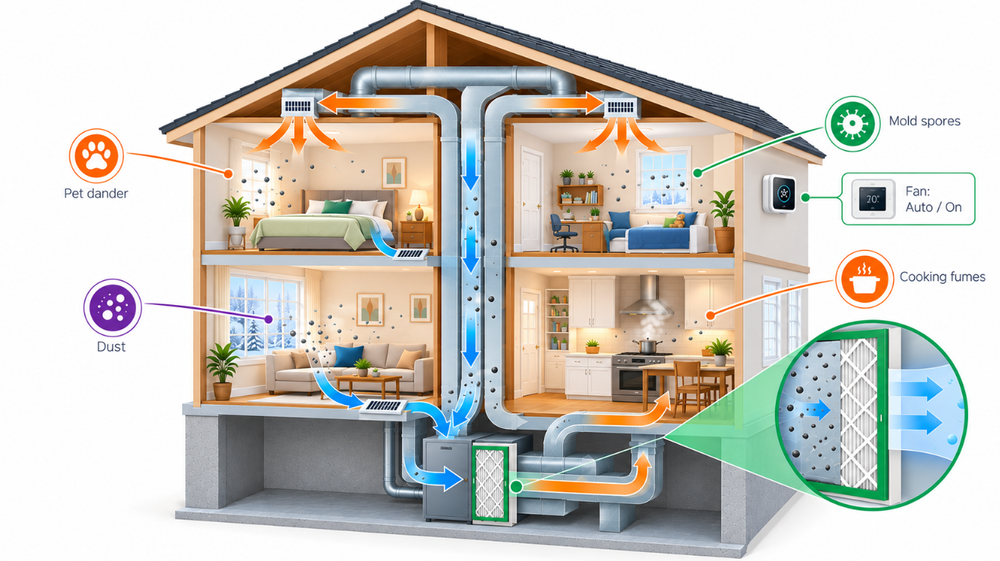
Running the furnace more affects indoor air quality because your furnace blower doubles as your home's air filtration system. As the U.S. Environmental Protection Agency (EPA) notes, HVAC systems filter air only while the fan is running (EPA), so the more your furnace runs, the more air passes through the filter, for better or worse.
We call this the Runtime Rule: more furnace runtime multiplies whatever your filter and humidity are doing right now. Pair more runtime with a clean filter and you get cleaner air. Pair it with a clogged filter or bone-dry air and you get more circulated dust and irritation.
The Runtime Rule, Or When Extra Furnace Runtime Helps And Hurts
| What Extra Runtime Touches | When It Helps Your Air | When It Hurts Your Air | What to Do |
|---|---|---|---|
| Furnace filter | Filter is clean and MERV 8–13 | Filter is loaded with dust | Check monthly in winter; replace on schedule |
| Airborne dust and allergens | More air passes through the filter | Dust bypasses a clogged or poorly fitted filter | Use the correct size and an airtight fit |
| Humidity | Humidity is held at 30–50% | Heated air drops below 30% | Measure with a hygrometer; humidify if needed |
| Combustion safety | Furnace was inspected this year | Venting or heat exchanger is damaged | Annual service plus a working CO detector |
Sources: U.S. EPA, Mayo Clinic, U.S. CPSC, CDC.
How Much Does Each Pass Through the Filter Catch?
How much a filter catches on each pass depends on its MERV rating. The EPA's MERV rating chart lists the minimum share of particles each rating must capture.
What Each Pass Captures, By MERV Rating
| Filter Rating | 0.3–1.0 Microns (Smoke, PM2.5) | 1.0–3.0 Microns (Dander, Fine Dust) | 3.0–10 Microns (Pollen, Dust) |
|---|---|---|---|
| MERV 8 | Not rated | ≥20% | ≥70% |
| MERV 11 | ≥20% | ≥65% | ≥85% |
| MERV 13 | ≥50% | ≥85% | ≥90% |
Minimums per ANSI/ASHRAE Standard 52.2, as published by the EPA.
Why Does a Dirty Filter Make More Runtime Worse?
A dirty filter works against your air because it chokes airflow. The blower strains, heating cycles stretch out, and energy use climbs (see winter HVAC airflow and filter efficiency). Over time, that leads to the common winter airflow problems caused by filters, from short-cycling to an overheated heat exchanger.
Building filters at Filterbuy has also taught us that the most common failure happens at the edges rather than in the media. We call it bypass. When a filter flexes in its track or doesn't fill the slot, air slips around it, and even a high-MERV filter ends up performing like a cheap one.
“The question I get most is which MERV to buy. The one to ask first is whether the filter you are holding actually fills the slot. A rating describes the media, not the gap around it.”
— Michelle Wan, Filterbuy
“In the field, the filter rarely gets blamed for the thing it actually caused. A frozen coil or a blower running long gets written up as a refrigerant or thermostat problem, when the real cause was a loaded filter nobody changed. Before paying for a diagnosis, pull the filter and hold it up to a light.”
— David Clark, Licensed HVAC Technician, Filterbuy HVAC Solutions
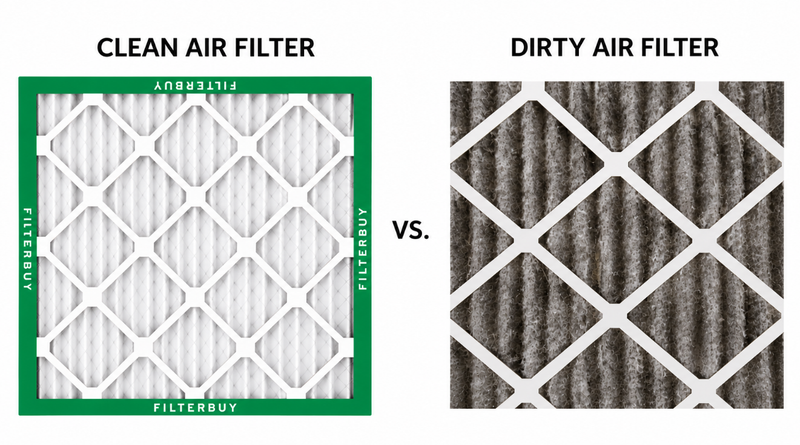
Pro Tip: In Filterbuy's experience, a filter that lasts 90 days in spring can fill up in 30 to 45 days in January. Check it monthly and swap it once the media turns gray.
Does Running the Furnace Stir Up Dust?
Yes, running the furnace moves more of the dust already in your home. Each heating cycle pulls air in through the return vents and pushes it back out the supply registers, picking up dust from carpets and pet bedding. A higher-efficiency filter traps more of it on every pass (see what causes household dust).
Should the Furnace Fan Be Set to On or Auto?
Setting the furnace fan to On keeps air moving through the filter between heating cycles, while Auto runs the fan only when the furnace is heating. For most homes, Auto works day to day and On is a tool for bad-air days.
The runtime math: the EPA estimates that home systems run less than 25% of the time during the heating season. On Auto, that gives your filter fewer than 6 hours of work a day. Switch to On and the same filter can work up to 24 hours, roughly four times as long. The trade-off is more fan electricity and a filter that fills faster.
Can Running the Furnace More Cause Carbon Monoxide Problems?
Running a gas furnace more won't create carbon monoxide on its own, but it gives an existing problem more time to cause harm. A cracked heat exchanger or a blocked vent can let CO into your living space.
That is why the U.S. Consumer Product Safety Commission (CPSC) calls a professional inspection of fuel-burning heating appliances the first line of defense against CO poisoning (CPSC). The CDC recommends battery or battery-backup CO detectors near every sleeping area. If an alarm sounds, get everyone outside and call 911.
What Should Allergy Sufferers, Asthma Sufferers, and Pet Owners Do?
Start with the highest MERV rating your system can move air through, and change it on schedule. Filterbuy makes MERV 8, 11, and 13 filters on the same lines, so we have no reason to push you up the scale. The EPA recommends at least MERV 13, or as high as your system can handle (EPA). For allergies and asthma, that usually means a MERV 13 air filter. For pet dander, a MERV 11 air filter is a good match, and Filterbuy's MERV 8 vs. MERV 11 vs. MERV 13 comparison lays out the differences.
Which Filter Setup Fits Your Household
| Household | Recommended Filter | Extra Step |
|---|---|---|
| Allergies or asthma | MERV 13, if your system allows it | Run the fan On during flare-ups |
| Pets | MERV 11 | Check the filter more often, since fur loads it quickly |
What Is Your Home Telling You About Its Winter Air?
Dust that returns quickly or a dry morning throat usually points to a filter or humidity problem. Headaches, dizziness, or a gas smell need action right away.
Winter Runtime Symptom Check
| What You Notice | Likely Cause | What to Do |
|---|---|---|
| Dust returns a day or two after cleaning | A loaded or poorly fitted filter | Check the fit and replace it if gray |
| Dry throat or static shocks most mornings | Indoor humidity below 30% | Measure, then humidify to stay under 50% |
| Burning-dust smell on the first cold day | Dust burning off the heat exchanger | Normal if it fades within a few hours |
| A smell that lingers, or smells like gas | A possible gas or equipment problem | For gas, leave and call your utility; otherwise call a technician |
| Headache, dizziness, or nausea while at home | Possible carbon monoxide exposure | Get everyone outside and call 911 |
Sources: CDC (carbon monoxide), Mayo Clinic (humidity).
Your Heating-Season Air Quality Checklist
Schedule a furnace inspection before the first cold snap.
Test CO detectors and replace batteries.
Install a fresh filter in the correct size and depth; depth is the dimension Filterbuy's manufacturing team sees ordered wrong most often (how to measure your air filter). Point the airflow arrow toward the furnace.
Measure humidity and keep it between 30% and 50%.
For a fresh filter all season, Filterbuy makes every filter to order in its U.S. plants, and an air filter subscription ships your size every 30, 60, or 90 days at 5% off.
Does Running the Furnace More Dry Out the Air?
Running the furnace more does make your home feel drier, though not because the furnace pulls water out of the air. Cold outdoor air holds very little moisture, and when your furnace warms it, the temperature climbs while the water content stays the same, so relative humidity drops.
By Filterbuy's math, outdoor air at 20°F and 70% relative humidity ends up at about 10% relative humidity once it's warmed to 70°F. Showers and cooking put some moisture back, so check a hygrometer before you run a humidifier.
Mayo Clinic recommends keeping indoor humidity between 30% and 50%, because drier air irritates the skin, nose, throat, and eyes (Mayo Clinic). Above 50%, dust mites and mold move in. For targets by outdoor temperature, see Filterbuy's guide to ideal indoor humidity in winter.
Supporting Statistics
1. About 90% of Americans’ time is spent indoors, where some pollutants run 2 to 5 times higher than typical outdoor levels.
That makes winter filtration matter more.
Source: U.S. EPA, Report on the Environment: Indoor Air Quality
2. About 20 million people in the U.S. have a dust mite allergy.
The Asthma and Allergy Foundation of America (AAFA) says dust mites thrive above 50% humidity and recommends 30–50% plus a qualifying furnace filter.
Source: AAFA, Dust Mite Allergy (medically reviewed July 2025)
3. More than 400 Americans die each year from unintentional carbon monoxide poisoning not linked to fires.
The CDC advises yearly furnace service.
Source: CDC, Carbon Monoxide (CO) Poisoning Basics
Frequently Asked Questions
Does Running the Furnace More Affect Air Quality in Winter?
Yes. Homes stay shut in winter and furnaces run longer, so your filter and humidity level matter more. See why indoor air quality gets worse in winter.
Does Running the Furnace More Affect Air Quality at Night?
Yes. Overnight runtime keeps filtering bedroom air, but it also dries it out. A clean filter and a bedroom humidifier set below 50% take care of both.
How Often Should I Change My Furnace Filter When It Runs a Lot?
Most 1-inch filters need replacing every 1–3 months, and homes with pets, allergies, or near-constant runtime should plan on the shorter end. Thicker 4- and 5-inch media filters last longer. See Filterbuy's guide to how often to change your HVAC filter.
Glossary
Forced-air furnace: A heating system that blows heated air through ducts and vents.
Furnace filter (HVAC filter): A replaceable filter that traps particles from circulating air.
Filterbuy: A U.S. air filter manufacturer in Talladega, Alabama, making pleated HVAC filters in 600+ sizes.
Filter bypass: Air that flows around the edges of a filter instead of through it.
Hygrometer: A device that measures indoor relative humidity.
MERV (Minimum Efficiency Reporting Value): A 1–16 filter rating; higher numbers capture smaller particles.
Relative humidity (RH): How much water vapor the air holds compared with its maximum at that temperature.
Heat exchanger: The furnace part that heats household air while keeping combustion gases separate.
Carbon monoxide (CO): A colorless, odorless, poisonous gas from burning fuel.
Fan Auto vs. On: Thermostat settings; Auto runs the blower only while heating, and On runs it continuously.
Sources
U.S. EPA, What is a MERV rating?
Mayo Clinic, Humidifiers: Ease skin, breathing symptoms
U.S. CPSC, CPSC Urges Seasonal Heating Systems Inspections to Prevent CO Deaths
Asthma and Allergy Foundation of America, Dust Mite Allergy