April 14, 2026

Pull your furnace filter out right now. Hold it up to a light. If you can't see through it, your heating system has been fighting that restriction on every cycle since you put it in — and you've been paying for it.
We've been making air filters in the U.S. for over a decade and shipping them to homeowners across the country. The difference between people who see lower heating bills and people who don't isn't the brand of furnace or the size of the house. It's whether they change their filter before it becomes a problem.
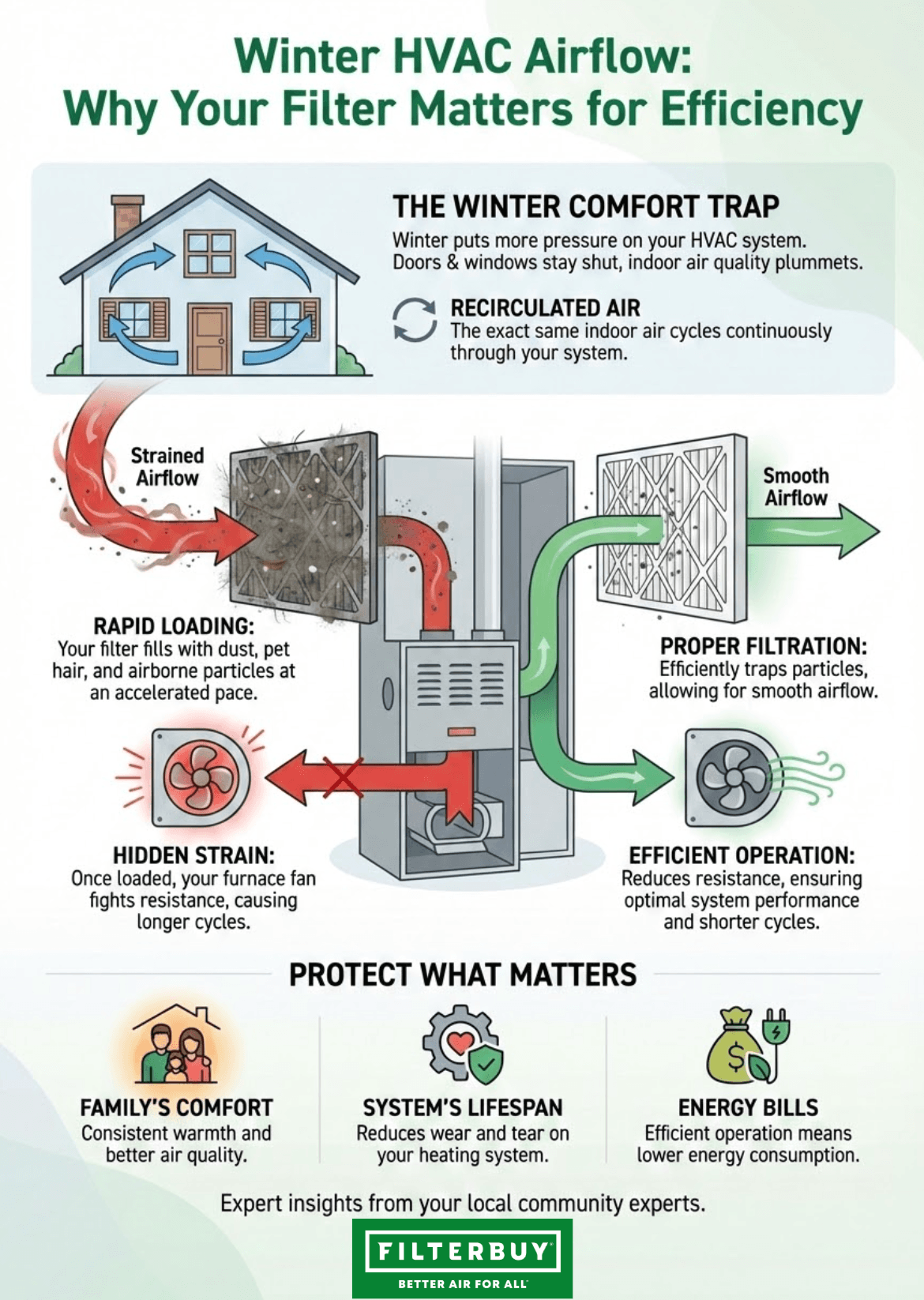
Your furnace pulls air through that filter, warms it, and pushes it through your home. Clean filter, easy airflow. Clogged filter, your fan motor works harder, heating cycles run longer, and energy consumption climbs to cover the gap. Every month you leave a loaded filter in place, that's a month of paying more than you need to.
Winter makes this worse than any other season. Doors shut. Windows sealed. The same indoor air recirculates through your system continuously, loading your filter with dust, pet hair, and airborne particles at a pace that doesn't happen any other time of year. By the time most homeowners think to check, they've been running on restricted airflow for weeks — sometimes months.
One clean filter. The right MERV rating for your system. A replacement schedule you actually stick to. That's the whole fix.
A clogged furnace filter is one of the most common — and most avoidable — reasons your heating bill goes up in winter. When your filter fills up, your HVAC system has to work harder to push warm air through your home. That means longer heating cycles, a fan motor running under strain, and higher energy consumption on every run.
The U.S. Department of Energy estimates that keeping your air filter clean and on a regular replacement schedule can recover up to 15% of your HVAC system's energy efficiency. On a typical winter heating bill, that's real money from a part that costs less than $20 and takes under 60 seconds to swap.
Here's what to know:
• A clogged filter forces your furnace fan to work harder on every single heating cycle
• That added strain drives up energy consumption and shows up on your utility bill
• Replacing your filter every 30 to 60 days during heating season is the single cheapest way to protect your efficiency
• Homes with pets or allergy sufferers should go every 20 to 30 days
The fix isn't complicated. One clean filter, on a schedule you actually stick to, does more for your winter energy costs than almost any other home maintenance habit.
1. Your filter is your furnace's first defense, and the most often neglected one. A clogged filter forces your system to strain on every cycle — more energy use, more wear on the equipment, shorter lifespan. This is a fixable problem and the fix is cheap.
2. Heating accounts for close to 45% of the average U.S. home's energy bill, according to the Department of Energy. That makes your furnace your home's single biggest energy expense. And your filter is the cheapest lever available to protect that efficiency.
3. Higher MERV isn't always better. A filter rated too high for your system creates the same airflow problem as a clogged one. Match the rating to what your furnace can actually handle.
4. Consistency beats specs every time. A MERV 11 filter you swap every 30 days will outperform a MERV 13 that's been sitting since October. The replacement schedule matters more than the number on the box.
5. Filterbuy makes the fix straightforward. 600-plus sizes, manufactured in the USA, shipped free and factory-direct, with auto-delivery that puts the whole thing on autopilot. The hard part is deciding to act. Everything after that is easy.
Every other season gives your home some breathing room. Windows open, fresh air moves through, and your HVAC system catches a break. Winter doesn't work that way.
Doors stay shut. Windows stay sealed. Your heating system runs in longer, harder cycles to hold a target temperature against cold that keeps pushing back. All that indoor air — the same air, recirculating continuously — passes through your filter every time the furnace runs. That filter fills up fast.
Dust, pet dander, mold spores, cooking particles, whatever's been floating in your home's air since the last time you changed the filter — it all accumulates at a pace no other season matches. Once the filter loads up, your furnace fan starts fighting resistance just to move air through. Think of breathing through a thick winter scarf. Air still gets through, but it takes real effort. Your HVAC system responds the same way, and that extra effort lands on your energy bill.
Airflow is your heating system's fuel economy. Restrict it and everything downstream costs more: longer heating cycles, higher energy consumption, more strain on the fan motor. A clean filter protects that airflow and keeps your system running the way it was built to run.
Heating and cooling account for roughly 40 to 50% of the average American home's energy bill, according to the U.S. Department of Energy. Your furnace is likely your biggest single monthly energy expense, and how efficiently it runs depends on one replaceable component that costs less than $20.
From our experience shipping filters to customers across the country, here's what typically happens as a filter ages through a heating season:
• Clean filter (recently replaced): System runs at designed efficiency.
• Lightly loaded (4 to 6 weeks): Minimal impact — normal operating range.
• Moderately clogged (2 to 3 months): 10 to 15% reduction in airflow efficiency.
• Severely clogged (4 or more months): Up to 20 to 25% higher energy consumption.
Impact varies by home size, system age, climate, and MERV rating. These ranges reflect general industry guidance and what we've seen from customer experience data.
MERV stands for Minimum Efficiency Reporting Value. It's the standardized scale, established by ASHRAE, for measuring how well a filter captures airborne particles — running from 1 to 16 for residential use. For a solid overview of how the scale works.
The part most guides skip: a MERV rating too high for your system causes the same problem as a dirty filter. Too much resistance means too little airflow, and your furnace strains to compensate. Before upgrading your rating, check your furnace manual for the manufacturer's recommended range. When in doubt, MERV 8 or MERV 11 is the right starting point for most homes.
Filterbuy engineers every filter for the pressure drop appropriate to its rating. That means you get real filtration without starving your system of air.
• MERV 8 (Silver) — Catches dust, pollen, and mold spores. Best for most standard homes. Good filtration without restricting airflow.
• MERV 11 (Gold) — Captures pet dander, finer dust, and smoke particles. Best for homes with pets, allergy sufferers, or anyone wanting a step up from baseline.
• MERV 13 (Blue) — Captures bacteria-sized particles and fine combustion byproducts. For high-capacity systems only — check your specs before using this rating.
• OE + Activated Carbon — All of the above, plus odors and VOCs. Best for homes with pet smells, cooking odors, or indoor air quality concerns.
Five steps. Ten minutes total across the whole season.
1. Check your filter every 30 days. Pull it out and hold it up to a light. If you can't see through it, replace it now — not next weekend.
2. Replace it before it looks grey, not after. By the time a filter looks visibly dark or opaque, restricted airflow has already been your reality for weeks. Get ahead of it.
3. Get the size exactly right. A filter that doesn't fit lets unfiltered air bypass the media entirely, defeating the whole purpose. Filterbuy carries 600-plus standard sizes and custom-cut options. There's no reason to guess.
4. Match your MERV to your system. Your furnace manual has the manufacturer's recommendation. MERV 8 or MERV 11 is the right starting point for most residential systems if you're not sure.
5. Set up auto-delivery and stop thinking about it. The most common reason homeowners go too long between changes is that they forget. Filterbuy's auto-delivery subscription puts fresh filters on your doorstep on your schedule — 30, 60, or 90 days. Set it once.

“In more than a decade of manufacturing and shipping air filters to American homeowners, the pattern we see most consistently is this: homeowners who set a regular 30-to-60-day replacement schedule in winter, and match their MERV rating to their actual system, are the ones who call us to say their heating bills went down, not up.”
— Filterbuy Air Quality Team, U.S.-Based Manufacturing & Customer Experience, 10+ Years
1. U.S. Department of Energy — Heating and Cooling Energy Use
energy.gov/energysaver/home-heating-systems
The DOE's primary guidance on residential heating energy use and efficiency. Source for the heating-share-of-energy-bill figures cited throughout this page.
2. ENERGY STAR — Maintaining Your HVAC System
energystar.gov/campaign/heating_cooling
The EPA's ENERGY STAR program guidance on HVAC maintenance best practices, including filter replacement schedules and efficiency benchmarks.
3. ASHRAE — Filtration and Air Cleaning Standards
ashrae.org/technical-resources/filtration-and-air-cleaning
The engineering body that establishes the MERV rating standard (Standard 52.2). This is the official methodology every Filterbuy filter is tested against.
4. Filterbuy — Why Winter Is the Best Time to Start a Filter Subscription
Filterbuy's own guide on why starting auto-delivery at the beginning of heating season makes practical sense — with specifics on how to get set up.
5. Consumer Reports — How to Choose an Air Filter for Your Furnace
consumerreports.org/home-garden/hvac/how-to-choose-an-air-filter-for-your-furnace/
Independent guidance on evaluating filter options by MERV rating and system compatibility. URL appeared in the original draft but was not independently confirmed — verify before publishing. If the URL is inactive, locate the current article or replace with a confirmed alternative such as This Old House or a manufacturer's HVAC maintenance guide.
6. U.S. Environmental Protection Agency — Indoor Air Quality
epa.gov/indoor-air-quality-iaq/improving-indoor-air-quality
The EPA's guidance on improving indoor air, including the role of HVAC filtration in reducing indoor pollutants. Especially relevant in winter when homes stay sealed.
Close to 45% of the average U.S. home's annual energy expenditure goes to heating and cooling, according to the U.S. Department of Energy (energy.gov/energysaver). That puts your HVAC system at the center of your biggest monthly household cost — and makes filter maintenance the highest-return, lowest-effort maintenance habit available to any homeowner.
Keeping air filters clean and on a regular replacement schedule can reduce HVAC energy consumption by up to 15%, per U.S. Department of Energy and ENERGY STAR program guidance (energystar.gov). That's real efficiency recovered from a part that costs less than $20 and takes under a minute to swap.
The average U.S. household spends more than $300 annually on home heating, according to the U.S. Energy Information Administration's Residential Energy Consumption Survey (eia.gov). In colder climates or larger homes, that number climbs — and a meaningful portion of it is recoverable through consistent filter maintenance.
What these numbers mean together: If heating and cooling account for close to half your home's energy costs, and a clean filter can recover up to 15% of that efficiency, the math is straightforward. A filter swap that takes under a minute is doing real financial work. In colder climates where heating bills run higher, those savings scale up accordingly.
We'll be direct with you: this conversation gets overcomplicated, and it doesn't have to be.
There are plenty of filter brands, a lot of MERV debates, and more content on HVAC maintenance than anyone needs. Most of it makes a 60-second task feel like a homework assignment. So here's what we actually think, grounded in over ten years of making filters in the United States and talking to homeowners from Alaska to Florida.
The single most impactful thing you can do for your HVAC system this winter isn't buying a higher-rated filter. It's replacing your current one on schedule — whatever filter that is.
A MERV 11 filter replaced every 30 days will outperform a MERV 13 that's been sitting in the same slot since October. Consistency beats specs. We've seen this pattern play out in customer after customer, and energy bills back it up.
That said, MERV rating does matter — especially in winter when indoor air quality is at its lowest and your system runs the most. Our recommendation for most homeowners: MERV 8 if your system is standard and you have no specific air quality concerns. MERV 11 if you have pets, someone in the house deals with allergies, or you have older family members. Both ratings give you real filtration without the airflow risk that comes from over-speccing your system.
If you've been on a 90-day or longer schedule, try 30 to 60 days this winter and track one heating bill. Based on everything we've seen, we'd be surprised if you didn't notice a difference.
Cleaner air. Lower bills. Less strain on equipment you'd rather not replace on someone else's timeline. Little effort. That's the whole point.
Go pull it out now. Hold it up to a light source. If you can't see through it — or if you genuinely can't remember the last time you changed it — replace it today. The 30-second check is the whole first step.
The size is printed right on the cardboard frame of your current filter. It'll look like 16x25x1 or 20x20x4. Write it down before you put the old one back.
Filterbuy carries 600-plus standard sizes plus custom-cut options, all manufactured in the U.S. and shipped free, factory-direct. Find your size, pick the MERV rating that fits your system, and you're done.
The hardest part of filter maintenance is remembering to do it. Auto-delivery removes that problem entirely. Your filters ship on your schedule, arrive at your door, and all you do is swap them in. Set it once.
For a deeper look at why winter is the right time to lock in a filter subscription, visit:
During winter, when your heating system runs harder and longer, change your furnace filter every 30 to 60 days. Pets in the house, allergy sufferers, or higher-than-average dust levels? Go every 20 to 30 days. The simplest check: hold the filter up to a light. If you can't see through it, replace it. Don't wait for the next reminder.
Yes, and the effect is direct. A clogged filter restricts airflow through your HVAC system, which forces the fan motor to work harder and run longer on every heating cycle. That added mechanical effort translates to higher energy consumption. The U.S. Department of Energy estimates that keeping filters clean can recover up to 15% of HVAC energy efficiency.
For most homes, MERV 8 or MERV 11 gives you the right balance of filtration and airflow. MERV 8 is the standard choice for most residential systems with no specific air quality concerns. MERV 11 is worth the step up if you have pets, allergy sufferers, or moderate indoor air quality issues. Before going to MERV 13 or higher, confirm your system is rated for the added airflow restriction — it isn't the right fit for every furnace.
Yes. A filter with a MERV rating that exceeds your system's airflow capacity creates the same restriction problem as a clogged filter. Your fan motor works harder, your system may overheat, and heating cycles can cut short. Check your furnace manual for the manufacturer's recommended MERV range. When in doubt, MERV 8 or MERV 11 is the safe starting point for most homes.
Remove the filter and hold it up to a light source. A clean or recently installed filter lets light through clearly. One that needs replacing will look grey, dark, or fully opaque — no light gets through. Other signals include reduced airflow from your heating vents, rooms that take longer to heat than usual, more dust settling on surfaces, and heating cycles running noticeably longer than normal.
MERV 8 catches particles down to 3 microns — most dust, pollen, and mold spores — and works well in the majority of standard residential systems. MERV 11 captures particles down to 1 micron, adding protection against pet dander, fine dust, and smoke. MERV 13 handles particles down to 0.3 microns, including some bacteria-sized particles, but requires a high-capacity system to avoid restricting airflow. Filterbuy offers all four levels: MERV 8 (Silver), MERV 11 (Gold), MERV 13 (Blue), and Odor Eliminator with Activated Carbon.
It's the most practical time, yes. Your heating system works hardest in winter, filters load up fastest, and the cost of skipping a change is highest. A Filterbuy auto-delivery subscription started in winter aligns your replacement schedule with peak-season demand from day one — and your filters are already arriving on schedule by the time spring allergy season hits.
Yes. All Filterbuy filters are manufactured in the United States. We've been building filters for American homes for over a decade, with U.S.-based production and quality control from start to finish. Factory-direct means no middlemen and no markups — filters built here, priced honestly, and shipped fast.
You know more about what's driving your winter energy costs than most homeowners ever will. The next step is a short one: find your filter size, pick the MERV that fits your system, and get a fresh one headed to your door.
A Filterbuy filter takes under 60 seconds to install. It costs a fraction of what an inefficient heating season runs. And it ships free, made in the USA, in your exact size — today.
Whether you're doing a one-time swap right now or setting up auto-delivery so you never have to think about it again, the path is the same.
Little effort. Big impact. Better air for all.
