May 1, 2026

You're a month into heating season. Your furnace cycles on for thirty seconds, shuts off, fires again two minutes later. The bedrooms upstairs feel colder than the living room. Your last energy bill landed higher than the one before, and that one was already too high.
We've been making air filters in the U.S. since 2013, and shipping them to millions of homes since then. From what we hear from homeowners every winter, almost all of these symptoms trace back to the same place: a filter that should have been changed three weeks ago.
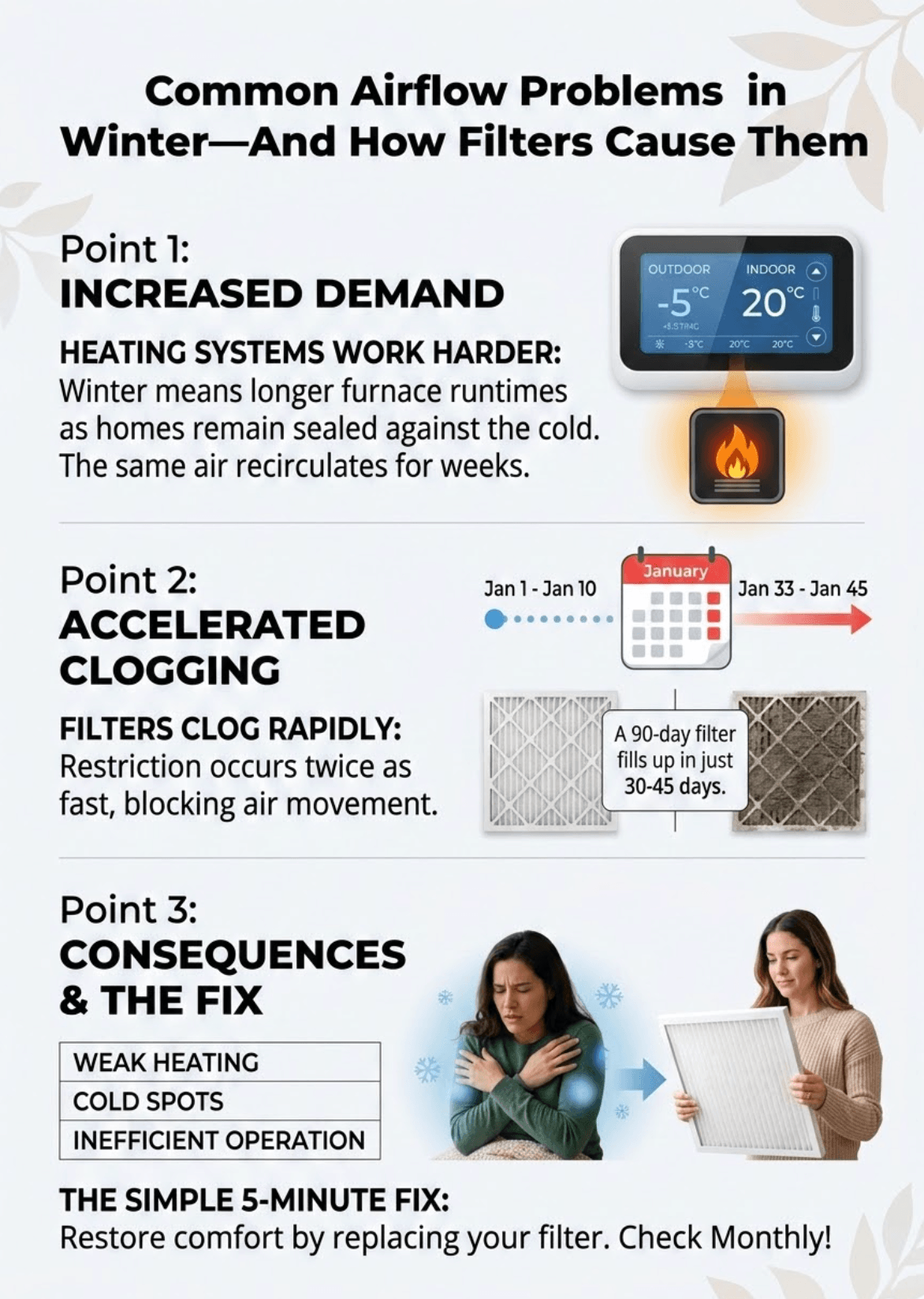
Winter is harder on your filter than any other time of year. The furnace runs longer. Your house stays sealed shut. Pet dander, dust, cooking residue, and dry-air particles all keep circulating through the same square of pleated media for weeks at a time. By the time the filter gives up, the whole heating system is fighting it.
A clogged air filter is the most common cause of winter heating problems we hear about. After a decade of making filters in the U.S. and shipping millions of them, we see the same pattern every year: a filter that worked fine in October gets overwhelmed by November runtime and starts choking the system by December.
The most common air filter issues during heating season:
• Weak airflow at the vents — the blower can't push enough air through a packed filter
• Furnace short-cycling — restricted airflow causes overheating, which trips the safety switch on and off
• Uneven heating between rooms — air can't reach the registers farthest from the furnace
• Whistling or whining at the return grille — air being pulled hard through saturated filter media
• Burning or musty smells when heat kicks on — dust on overheated parts, or moisture trapped in the filter
• Higher energy bills with no usage change — the system is working harder for the same output
• Furnace lockout — repeated overheating triggers a safety shutdown that needs a technician to reset
Why winter makes filters fail faster: Furnace runtime jumps. Sealed homes recirculate the same indoor air for weeks. A filter that lasted 90 days in spring will fill in 30 to 45 days in January.
The fix: Pull the filter out and hold it up to a light. If you can't see through it, replace it with a pleated MERV 8 to 13. The whole job takes five minutes and costs about $15. If problems continue with a fresh filter, the issue has moved past the filter and a licensed HVAC technician needs to look at it.
How often to check during heating season: Once a month from November through March. Homes with pets, allergy sufferers, or anyone running a MERV 13 should plan on changing every 30 days through peak winter.
Winter is the hardest season on your filter. Furnace runtime jumps. Sealed homes recirculate the same indoor air for weeks. A filter that lasted 90 days in spring will fill in 30 to 45 days in January.
Most winter HVAC complaints share one root cause: restricted airflow. Weak vents, uneven heating, short-cycling, whistling at the return grille, burning smells, and a higher energy bill all start with a filter that can no longer breathe.
The damage compounds the longer it goes on. Repeated overheating wears down the blower motor. In a worst case, the heat exchanger stresses to the point of cracking, which is how carbon monoxide gets into the living space.
Most filter problems cost about $15 and take five minutes to fix. Catching them early is the whole game. The hardest part is remembering to check the filter in a busy winter month.
Auto-delivery solves the forgot-to-change-it problem. Winter is the season when forgetting costs the most, and we'd rather our customers stay ahead of it than learn the hard way.
These are the seven we hear about most, in roughly the order they show up. They all have the same cause underneath: restricted airflow through a clogged filter. They just present differently depending on your home, your system, and how long the issue has been ignored.

The blower is fighting to push air through a packed filter. You'll feel it most at the registers farthest from the furnace, which is usually the upstairs bedrooms or rooms at the end of long duct runs. To check, pull the filter and hold it to a light. If you can't see through, it's done.
This one is the classic clogged-filter symptom. Restricted airflow causes the heat exchanger to overheat, the high-limit safety switch trips, the system shuts off to cool down, then it tries to fire again, then it trips again. Replace the filter first. If short-cycling continues with a fresh filter.
If the kitchen feels fine but the bedrooms upstairs stay cold, your blower can't move enough air to reach the registers farthest from the furnace. A clogged filter is the most common reason. Closed supply registers, leaky ducts, and undersized return air can cause the same effect, but the filter is the cheapest place to start.
Your blower is pulling hard against a saturated filter. The narrower the opening for air to pass, the higher the pitch. It's the HVAC version of trying to drink a thick shake through a coffee stirrer, and it's a clear audible warning.
Both are filter-related. A burning smell usually means dust has built up on overheated internal components and is scorching off when the system runs hot. A musty smell means moisture is collecting in or near the filter, which is common in high-efficiency condensing furnaces. In either case, replace the filter and don't leave it.
When the blower works harder, it draws more electricity. When the heat exchanger short-cycles, the burner fires more often than it should. Your meter spins faster, and the bill arrives bigger. This is one of the cheapest problems on this list to fix, and one of the easiest to ignore until February.
After enough overheating events, many modern furnaces lock out, meaning they refuse to fire again until a technician resets them. If your system has gone dark and won't respond to the thermostat, check the filter before you make the service call. We've talked with plenty of homeowners who paid an emergency rate only to have the technician swap a $15 filter and walk away.
"After a decade of making filters and watching what happens when homeowners wait, the pattern is dependable: a $15 filter problem in November is a $500 service call by February. Winter is the only season where one missed change actually damages the equipment."
If you want to dig further on any part of this, or fact-check anything we've said, these are the authoritative sources we trust most. Bookmark them. They're useful well beyond this article.
1. EPA Guide to Air Cleaners in the Home. The EPA's plain-language consumer guide to HVAC filters and portable air cleaners. https://www.epa.gov/indoor-air-quality-iaq/guide-air-cleaners-home
2. EPA "Inside Story" guide to Indoor Air Quality. The foundational consumer reference on what's in your indoor air and why it matters. https://www.epa.gov/indoor-air-quality-iaq/inside-story-guide-indoor-air-quality
3. DOE Energy Saver: Air Conditioner Maintenance. Department of Energy guidance on filter changes and HVAC airflow efficiency. https://www.energy.gov/energysaver/air-conditioner-maintenance
4. CPSC Carbon Monoxide Fact Sheet. Required reading before every heating season, especially in older homes. https://www.cpsc.gov/safety-education/safety-guides/carbon-monoxide/carbon-monoxide-fact-sheet
5. CPSC Home Heating Equipment Safety. Specific CPSC guidance on annual furnace and heating system inspection. https://www.cpsc.gov/Safety-Education/Safety-Education-Centers/Carbon-Monoxide-Information-Center/Home-Heating-Equipment
6. ENERGY STAR Duct Sealing. Covers the second-biggest source of winter airflow loss most homeowners miss after the filter itself. https://www.energystar.gov/saveathome/heating-cooling/duct-sealing
Three numbers from authoritative U.S. agencies that we'd want every homeowner to know before the first cold snap:
EPA research has found that indoor pollutant concentrations routinely run two to five times higher than outdoor levels. Occasionally they hit more than 100 times higher. Combine that with the fact that the average American spends about 90% of their time indoors, and your air filter becomes the most important piece of air-quality equipment in your home.
Source: U.S. EPA, Indoor Air Quality. https://www.epa.gov/report-environment/indoor-air-quality
The U.S. Consumer Product Safety Commission reports that more than 200 Americans die each year, on average, from accidental non-fire-related carbon monoxide poisoning linked to consumer products, including furnaces, water heaters, and other fuel-burning appliances. A clogged filter doesn't cause CO poisoning directly, but the cascade it can trigger (overheating, then a cracked heat exchanger, then a CO leak) is well-documented. We treat winter filter changes as a safety issue, not just an efficiency one.
Source: U.S. CPSC, Carbon Monoxide Fact Sheet. https://www.cpsc.gov/safety-education/safety-guides/carbon-monoxide/carbon-monoxide-fact-sheet
ENERGY STAR reports that about 20 to 30 percent of the air moving through the duct system in a typical house is lost to leaks, holes, and poor connections. If your filter is clean and you're still seeing weak airflow or surprise winter bills, look at the ductwork next.
Source: ENERGY STAR, Duct Sealing. https://www.energystar.gov/saveathome/heating-cooling/duct-sealing
Here's what we believe, after a decade of making filters and listening to homeowners:
The air filter is the most underrated and most consequential piece of equipment in your home. It costs less than a takeout dinner. The swap takes five minutes. And it's the difference between a furnace that lasts 20 years and one that needs a $1,500 blower motor in year nine.
Most of the HVAC industry doesn't talk about filters because there's no margin in talking about a $15 part. The money is in service calls and equipment replacements, both of which get more likely the longer a clogged filter sits. We have the opposite incentive. We make filters, and we want yours doing its job so well you never need to call anyone.
Our honest take: every homeowner with a forced-air system should set a recurring monthly reminder to look at their filter from October through March. You don't have to change it monthly. You just have to look at it. If it's gray, replace it. If you can see through it, leave it alone. The whole check takes ninety seconds, and we'd argue it's the highest-leverage piece of home maintenance there is.
If you're reading this in the middle of an actual airflow problem, here's the order to work through:
1. Turn the thermostat to OFF (not just "lower the temperature").
2. Find your filter. It's usually at the return air grille, or in a slot above or below the furnace.
3. Slide it out and hold it up to a light. If you can't see through it, the filter is the problem.
4. Install a new pleated MERV 8 to 13 with the airflow arrow pointing toward the blower.
5. Write the install date on the filter frame in marker so you remember when you put it in.
6. Turn the thermostat back on and listen for the system to fire normally.
7. If it still short-cycles, won't restart, or smells like something is burning, stop. The problem has moved past the filter, and a licensed HVAC technician needs to look at it.
8. Once the immediate problem is solved, set a monthly phone reminder to check the filter through March, or sign up for auto-delivery so you don't have to remember at all.
Yes. From our customer data, it's the most common cause we see. Restricted airflow forces the heat exchanger to overheat, the high-limit safety switch trips, and the system shuts off before your home reaches temperature. Replacing the filter usually fixes the problem on the spot. The U.S. Department of Energy lists regular filter maintenance among the most important things you can do for HVAC efficiency.
More often in winter than the packaging suggests. Heating-season runtime is much higher than mild seasons, and a sealed-up home recirculates the same air for weeks. Both of those things fill filters faster. Most homes need a change every 30 to 60 days from November through March, versus 60 to 90 days in spring and fall. If you have pets, anyone with allergies, or a MERV 13 in the slot, plan on every 30 days through peak winter.
Short-cycling is when the system turns on and off repeatedly without finishing a heating cycle. It's the textbook clogged-filter symptom. The heat exchanger overheats from low airflow, the safety switch trips, the system rests, and then it fires again. Replace the filter first. If short-cycling continues with a fresh filter, the issue is most likely in the blower motor, flame sensor, or thermostat, and a technician needs to take a look.
Sometimes. A MERV 11 or 13 captures more allergens and fine particles than a basic MERV 8. The catch: going higher than your system was designed to handle creates the airflow problem you're trying to fix. Check your furnace owner's manual for the maximum recommended MERV before upgrading, or call us. We'll match you to a filter your system can actually breathe through.
Indirectly, yes. Here's the cascade: restricted airflow causes repeated heat exchanger overheating, which causes thermal stress over weeks or months, which can crack the heat exchanger, which can leak CO into living space. The CPSC documents heating equipment as one of the top sources of accidental carbon monoxide deaths in U.S. homes. Always pair winter HVAC maintenance with working CO detectors on every level of your home.
If the filter is genuinely clean and airflow is still poor, the problem is downstream. Common causes include closed or blocked supply registers, leaky or disconnected ducts, a failing blower motor, or a frozen evaporator coil (yes, this can happen in winter on heat-pump systems). ENERGY STAR estimates 20 to 30 percent of conditioned air can be lost to duct leaks alone. Schedule an HVAC inspection to find out what's happening downstream of the filter.
Every airflow problem on this list starts the same way: a filter that should have been changed three weeks ago. You don't have to remember it yourself.
We've been making filters in Alabama, Florida, Pennsylvania, and Utah since 2013, and shipped them to millions of homes since then. With over 600 standard sizes (plus custom options for older or oddly-built systems), fast free shipping straight from our factory, and an auto-delivery subscription you can pause or adjust at any time, missing a winter filter change is almost harder than not missing one.
