Shop by

It’s the middle of winter, your furnace is working overtime, and suddenly you smell something burning. Is it just dust, or is your furnace at risk of catching fire? While modern furnaces are built with safety features, a dirty filter can cause overheating and mechanical stress. Though direct fires are rare, a clogged filter can lead to breakdowns, costly repairs, and an uncomfortable, chilly home.
In this guide, we’ll explain how a dirty filter affects your furnace's safety, debunk the myths around pleated filters, and show you how a simple maintenance routine can keep your home safe and warm all winter long.
A dirty furnace filter is unlikely to catch fire on its own — but it can trigger the conditions that lead to one.
Here's what actually happens:
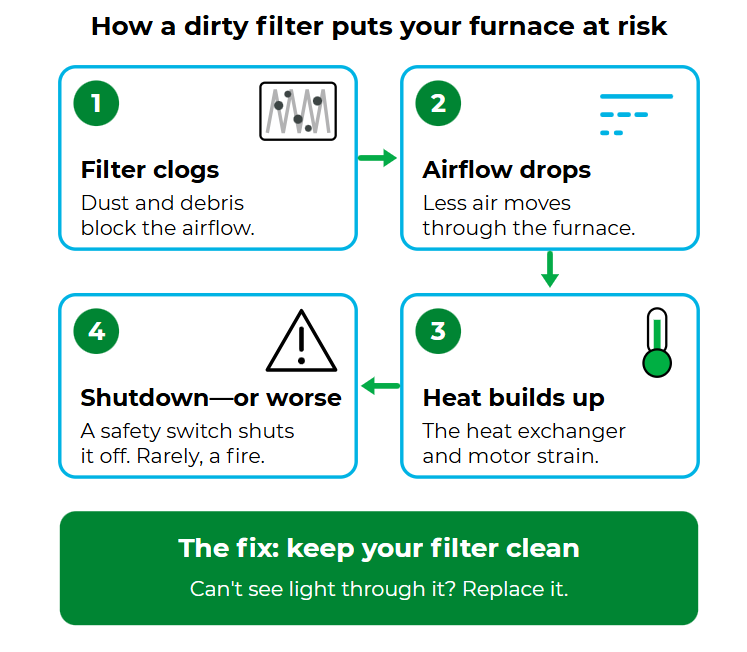
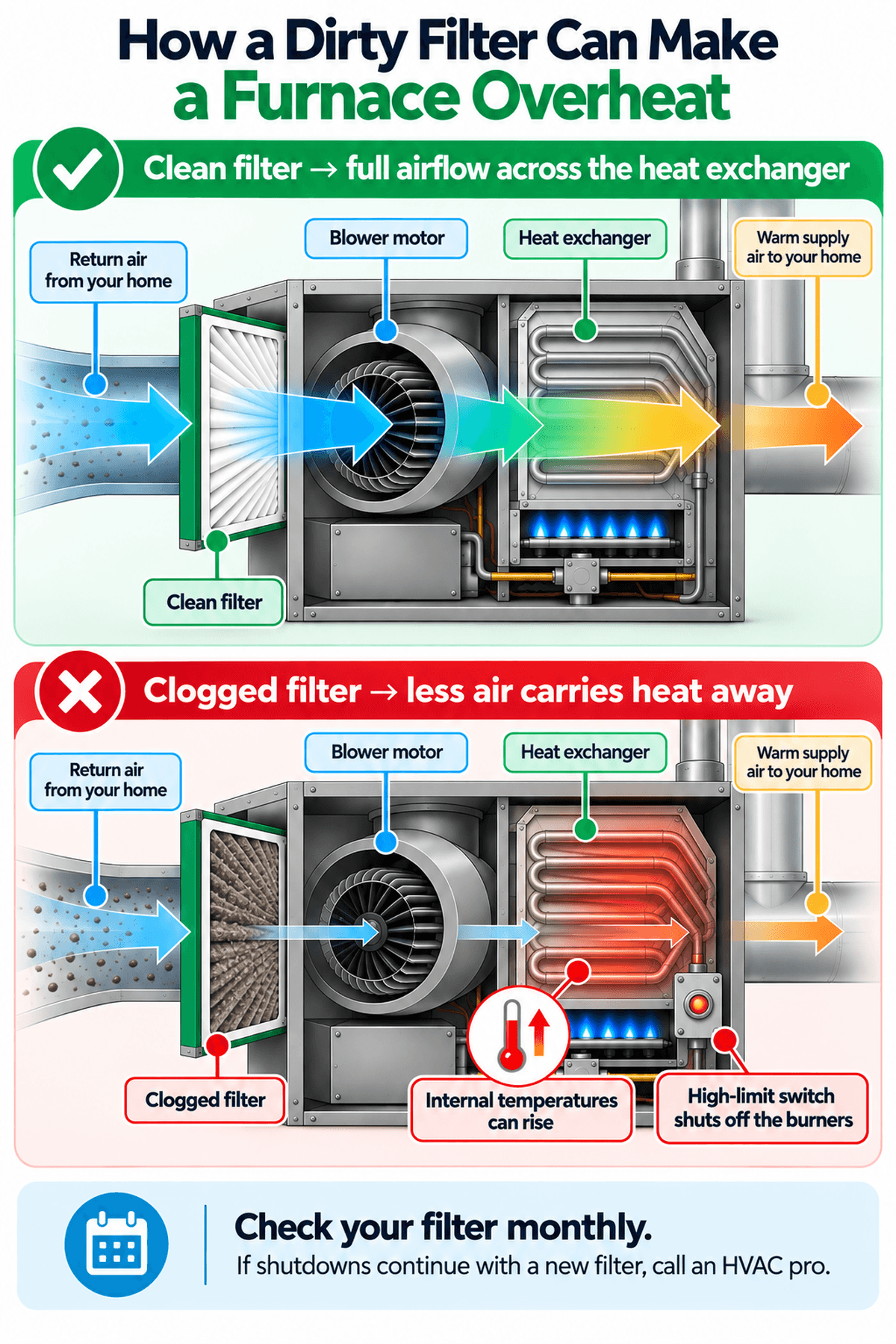
A clogged filter blocks airflow to your furnace
Restricted airflow causes the furnace to overheat
Overheating strains the heat exchanger and internal components
In extreme cases, dust near the burner can smolder or an overheated motor can spark
A cracked heat exchanger can also allow carbon monoxide to enter your home undetected
The bottom line:
A dirty filter is the most common — and most preventable — cause of furnace overheating
U.S. fire departments respond to nearly 39,000 home heating fires every year (NFPA)
A clogged filter forces your system to use up to 15% more energy (U.S. Department of Energy)
Most homeowners don't notice the problem until the furnace shuts itself down
What to do right now:
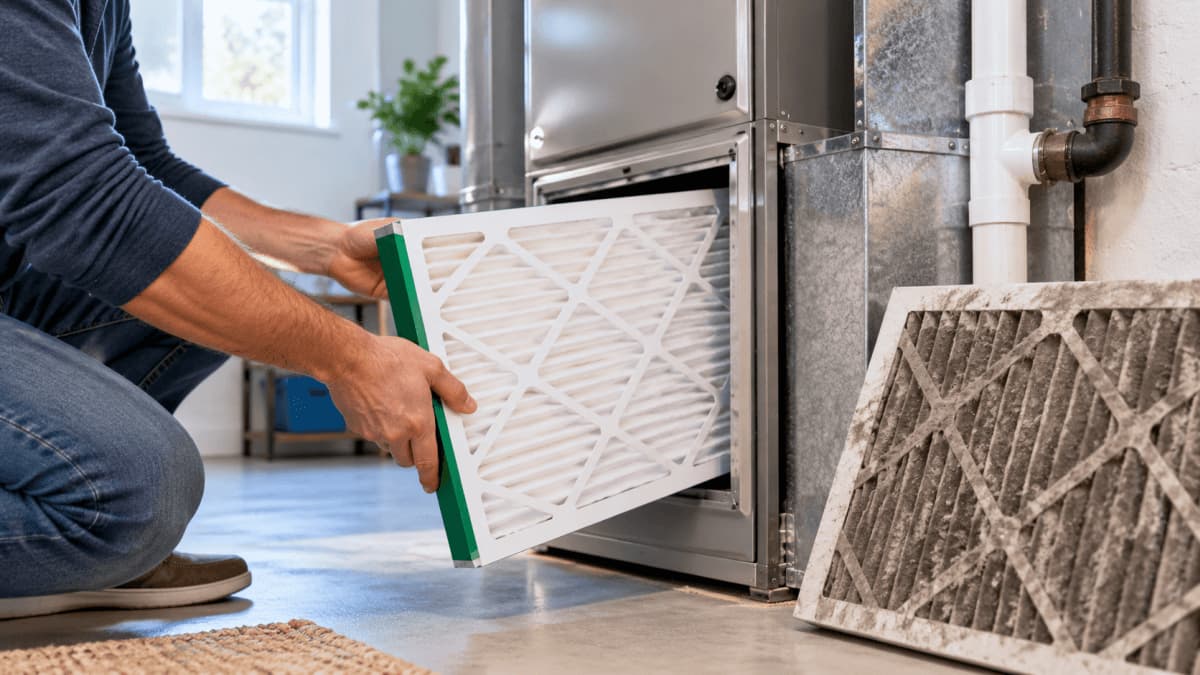
Pull out your filter and hold it up to a light
Can't see through it? Replace it today
Choose a MERV 8–13 pleated filter for the right balance of airflow and protection
Set a replacement reminder — or set up auto-delivery so it happens automatically
A clean filter changed on time is the simplest thing you can do to keep your furnace safe, your energy bills down, and your family protected.
A dirty filter rarely causes a fire directly — but it creates the conditions that make one possible.
Restricted airflow causes the furnace to overheat
Overheating stresses the heat exchanger and strains internal wiring
Each ignored filter change escalates the risk further
The fire risk is real. Neglect is what gets you there.
A clogged filter costs you money long before it costs you safety.
A dirty filter forces your system to use up to 15% more energy (U.S. Department of Energy)
HVAC already accounts for nearly half of your home's energy bill
That inefficiency compounds quietly — month after month — until something breaks
MERV 8–13 pleated filters are the right choice for most homes — and changing them on time matters more than the filter type.
The danger doesn't come from using a high-quality pleated filter
It comes from neglecting any filter for too long
A clean MERV 8–13 filter changed every 30–90 days keeps your system running safely
Carbon monoxide is the risk most homeowners never see coming — and a dirty filter is a contributing pathway.
A filter-starved furnace overheats
Overheating can crack the heat exchanger
A cracked heat exchanger is one of the most common routes for CO to enter your home undetected
Working CO detectors on every level of your home are non-negotiable
Consistency beats diligence every time.
The homes with the cleanest air aren't the most attentive — they're the most automated
Set up auto-delivery
Let the right filter show up at the right time
That one decision removes the root cause of every problem covered on this page
If you are typing "can a dirty furnace filter cause a fire" into a search engine, you are likely looking for reassurance. Here is the reality: It is highly unlikely for the filter itself to spontaneously combust just because it is dirty. However, a clogged filter is a catalyst for conditions that can lead to fire risks in extreme cases.
The primary job of your furnace filter is to trap dust, pet dander, and debris. When that filter gets clogged, it restricts airflow. Your furnace needs a steady stream of air to regulate its internal temperature. Without it, the heat exchanger, the component that actually heats the air, can become dangerously hot.
When airflow is blocked, the internal temperature of the furnace rises rapidly. This is called short cycling (which we will cover in more detail later), but in severe cases, the heat can damage the furnace's internal wiring or surrounding components. If dust has accumulated near the burner or on the electrical components due to poor filtration, that dust can spark or smolder.
According to HVAC safety experts, while the filter itself rarely catches fire, the overheating caused by the blockage can compromise the system’s integrity. This puts your home at risk, not necessarily from the filter burning, but from the furnace malfunctioning under extreme stress.
The risks associated with dirty filters aren't limited to gas furnaces; they apply to almost any HVAC system that relies on forced air.
When an air filter is clogged, the blower motor has to work significantly harder to pull air through the system. This strain can cause the motor to overheat. In some scenarios, an overheated motor can ignite electrical shorts or melt insulation on nearby wires.
It is also important to debunk a common myth: Pleated filters do not cause fires. Some homeowners worry that high-efficiency filters restrict airflow too much. The truth is that a clean, properly rated pleated filter (MERV 8-13) is perfectly safe. The danger comes from neglect, not the filter type. A high-quality pleated filter that is changed regularly is far safer than a cheap fiberglass filter that lets dust coat your furnace's internal components, creating a tinderbox of flammable debris.
While a fire is the worst-case scenario, a system shutdown is the most common consequence of a dirty filter. In fact, if your heat suddenly stops working on a freezing day, a clogged filter is the first thing you should check.
Modern furnaces are equipped with safety mechanisms, specifically a "high limit switch." When the internal temperature gets too hot because airflow is restricted by a dirty filter, this switch trips and shuts the burners off to prevent a fire or catastrophic damage.
This usually leads to "short cycling," where the furnace turns on, runs for a few minutes, overheats, shuts down, cools off, and then starts again. This cycle is incredibly damaging to your equipment.
Signs your dirty filter is stopping your furnace:
Short Cycling: The furnace turns on and off frequently (every 5-10 minutes).
Weak Airflow: You barely feel heat coming from the vents.
Cold Spots: Some rooms are warm while others are freezing.
System Lockout: Eventually, the furnace may go into a "hard lockout" and refuse to turn on until a technician resets it.
By the time the system shuts down, the dirty filter has likely already caused wear and tear on the heat exchanger and blower motor.
You don't have to wait for a breakdown to know something is wrong. Your furnace often gives you auditory and sensory clues that it is struggling to breathe.
A "burning dust" smell is normal when you first turn the furnace on for the season. However, if you smell burning plastic, rubber, or a persistent smoky odor, shut the system off immediately. This could indicate an overheated motor or melting wires caused by the strain of a dirty filter.
If your furnace sounds louder than usual, especially if you hear a high-pitched whining or straining sound. It’s often because the blower fan is struggling to pull air through a thick layer of dust.
If your heating bill jumps significantly but the weather hasn't changed drastically, check your filter. A system choking for air uses far more energy to run the fan and heat the home than a system with clear airflow.
If you notice dust settling on furniture surfaces immediately after cleaning, it means your filter is full and can no longer trap particles. That dust is now bypassing the filter and circulating through your home (and your lungs).
There is a misconception in some DIY circles that fiberglass filters are "better" for airflow and therefore safer. This is dangerously incorrect. While fiberglass filters allow high airflow, they act more like a sieve than a filter, letting significant amounts of dust pass right through to coat your furnace's motor and burners.
Pleated filters are the industry standard for a reason. They provide a larger surface area to trap particles without sacrificing necessary airflow, provided they are changed on time.
For most residential homes, a filter with a MERV (Minimum Efficiency Reporting Value) rating between 8 and 13 is ideal.
MERV 8: Excellent for standard home filtration, trapping dust, pollen, and mold spores.
MERV 11-13: Better for homes with pets, asthma sufferers, or smokers, as they trap finer particles like pet dander and smoke.
Using a MERV 8-13 pleated filter strikes the perfect balance: it keeps the air inside your furnace clean (preventing component failure) and keeps the air in your home healthy, all without restricting airflow enough to cause overheating.
To maintain safety and efficiency, the standard recommendation is to replace your pleated furnace filter at least every 90 days. However, generic timelines don't work for every household.
You should increase the frequency to every 30 to 60 days if:
You have one or more pets (fur and dander clog filters quickly).
Anyone in the home suffers from allergies or asthma.
You are running the heat constantly during a cold snap.
You are renovating or doing construction in the home (drywall dust is a filter killer).
A good rule of thumb is to perform a visual check once a month. Pull the filter out and hold it up to a light. If you can't see light passing through it, it’s time to swap it out.
Don’t wait for the burning smell. Check your furnace filter today; it takes 30 seconds. If it's gray and clogged, find the right MERV 8–13 pleated filter for your home at Filterbuy and breathe easier knowing you’ve prevented a problem before it starts.
Preventing furnace fires and breakdowns isn't about stressing over your HVAC system daily; it's about having the right supplies on hand. Filterbuy makes home safety simple by providing high-quality, American-made pleated filters that fit your specific system.
With options ranging from MERV 8 to MERV 13, you can select the level of filtration that matches your lifestyle. More importantly, Filterbuy solves the biggest problem causing dirty filters: forgetfulness.
By setting up a subscription, high-quality pleated filters arrive at your door exactly when they need to be changed. This eliminates the guesswork and ensures you never leave a clogged, dangerous filter in your furnace simply because you forgot to buy a new one at the hardware store.
"After manufacturing millions of filters and hearing from homeowners across the country, we've seen firsthand that furnace breakdowns almost always trace back to one overlooked culprit — a clogged filter left in too long. A quality MERV 8–13 pleated filter changed on schedule doesn't just protect your air; it's the single most effective thing you can do to keep your furnace from overheating and your family safe all winter."
Look, we get it — most homeowners don't think about their furnace filter until something goes wrong. But the good news is that staying safe is easier than you think, and the right information makes all the difference. We've pulled together the seven most trusted resources on furnace safety, filter selection, and indoor air quality so you can stop guessing and start breathing easier.
Source: National Fire Protection Association (NFPA)
URL: https://www.nfpa.org/education-and-research/home-fire-safety/heating
Resource Type: Government Safety Authority | Annually Updated
Heating equipment is the second-leading cause of home fires in the U.S. — and the NFPA's home heating safety hub gives you the clear, no-nonsense checklist to make sure your furnace isn't putting your family at risk this winter. If you only bookmark one resource after reading this article, make it this one.
Source: National Fire Protection Association (NFPA)
Resource Type: Government Fire Research Report | Annually Updated
Nearly 39,000 home heating fires happen every year in the U.S., causing over $1 billion in property damage — and a neglected filter is one of the most preventable contributing factors. This NFPA report breaks down exactly where the risk comes from so you can see why something as simple as a filter change genuinely matters.
Source: U.S. Environmental Protection Agency
URL: https://www.epa.gov/indoor-air-quality-iaq/what-merv-rating
Resource Type: Federal Agency Explainer | Evergreen Reference
MERV ratings don't have to be confusing — and the EPA makes them simple. This resource explains exactly what the MERV 8–13 range means for your home's air quality and your furnace's health, so the next time you're standing in the filter aisle, you know precisely what you're looking for and why it matters.
Source: U.S. Environmental Protection Agency
URL: https://www.epa.gov/indoor-air-quality-iaq/guide-air-cleaners-home
Resource Type: Federal Consumer Guide | Comprehensive Reference
This EPA guide walks you through every filter option available — from cheap fiberglass panels that let dust coat your furnace's internals, to the high-efficiency pleated filters that actually protect your system and your family's health. It's the resource that confirms what we've seen from millions of filter shipments: choosing the right filter and changing it on time is the single most impactful thing you can do for your home.
Source: U.S. Environmental Protection Agency
URL: https://www.epa.gov/indoor-air-quality-iaq/carbon-monoxides-impact-indoor-air-quality
Resource Type: Federal Health & Safety Resource | Authoritative Reference
A clogged filter doesn't just stress your furnace — it can contribute to dangerous carbon monoxide buildup inside your home. This EPA resource connects poor heating system maintenance directly to CO risk and reminds every homeowner why annual professional inspections and working CO detectors on every level of your home aren't optional extras — they're essentials.
Source: U.S. Consumer Product Safety Commission
Resource Type: Federal Safety Education Resource | Actionable Guidance
CO is colorless, odorless, and its early symptoms feel just like the flu — which makes it one of the most dangerous consequences of a neglected furnace. The CPSC's dedicated resource covers alarm placement, symptom recognition, and what to do in an emergency, giving your family a simple, actionable safety plan that takes minutes to put in place.
Source: MSA Safety (HVAC Industry Authority)
URL: https://blog.msasafety.com/hvac-r-horrors-of-hvac-air-filter/
Resource Type: HVAC Industry Case Study | First-Hand Technician Account
Sometimes the most powerful reminder isn't a statistic — it's a real story. This case study follows an HVAC technician who responded to a home with a filter so clogged by pet hair and dust that it had become a genuine CO and fire hazard. It's a firsthand look at exactly what we talk about when we say a dirty filter isn't just an inconvenience — it's a risk you can prevent in under 30 seconds.
We've been manufacturing filters in the USA since 2013 and shipping them directly to families across the country. In that time, one truth keeps confirming itself: the gap between a safe, efficient furnace and a dangerous one almost always comes down to one overlooked task. Here are the three statistics every homeowner should know.
1. We've Seen What Happens When Heating Equipment Is Pushed Too Hard
U.S. fire departments responded to an annual estimated average of 38,881 home heating equipment fires from 2019–2023, resulting in 432 civilian deaths, 1,352 injuries, and $1.1 billion in property damage.
Source: National Fire Protection Association (NFPA) — Home Heating Fires Statistical Report
That's more than 100 heating fires every single day. Here's the pattern we see consistently:
Peak heating demand months are the same months filters are most overdue for a change
Nearly half of all annual heating fires occur between December and February
Short-cycling and a tripping limit switch are often the first warning signs homeowners notice — by then, the filter is already overdue
A 30-second filter swap is the most underrated form of home fire prevention there is
2. The Energy Bill Spike We Hear About Most From Customers Is Also the Easiest Fix
A clogged air filter causes heating and cooling systems to use up to 15% more energy — and since heating and cooling account for nearly half of a typical U.S. home's energy costs, that's a measurable monthly hit to your budget.
Source: U.S. Department of Energy — via ENERGY STAR
URL: https://www.energystar.gov/products/heating_cooling/keep_your_cool_and_save_your_money_summer
One of the most common things we hear from customers who switch to auto-delivery: "I didn't realize how much I was spending on energy until I started changing my filter on time." Here's why that happens:
A clogged filter forces your system to work up to 15% harder just to move air
Heating and cooling already account for nearly half your monthly energy costs
That inefficiency compounds quietly, month after month, until the bill gets your attention
Customers who treat filter changes as a recurring habit — not an occasional chore — notice the difference on their utility bills first
3. The Risk We Talk About Most Because It's the One Nobody Can See
Each year, more than 200 people die from unintentional, non-fire-related carbon monoxide poisoning associated with consumer products — and home heating equipment is consistently among the top contributors.
Source: U.S. Consumer Product Safety Commission (CPSC) — Home Heating Equipment Safety Center
This is the number we think about most — because it's the risk that's hardest to see coming. Here's how a dirty filter connects directly to CO danger:
A filter-starved furnace overheats
Overheating can crack the heat exchanger
A cracked heat exchanger is one of the most common pathways for carbon monoxide to enter a home
CO has no color, no smell, and its early symptoms are easy to mistake for a winter cold
A clean MERV 8–13 filter, changed on schedule, keeps your furnace within safe operating temperatures
We built our auto-delivery model around this exact reality — because the best protection is the kind that happens before a problem starts.
After more than a decade of manufacturing filters and shipping millions of them to homeowners across every state and climate, we've formed a clear opinion: the furnace fire question is real — but it's also slightly the wrong question.
Most homeowners searching "can a dirty filter cause a furnace fire?" are really asking something deeper: Is my home safe? The honest answer we've arrived at is this — a fire is rarely the first consequence of a neglected filter. It's the last one.
Before a fire risk ever develops, a dirty filter has already been working against your home in ways most people never connect:
Your energy bill climbs — and you assume it's the weather
Your furnace starts short-cycling — and you assume it's getting old
Your rooms stop heating evenly — and you assume it's a duct problem
Your system trips the high limit switch — and you assume it's a mechanical failure
In almost every one of these scenarios, we've seen the root cause trace back to a filter that should have been changed 30, 60, or 90 days earlier.
Our perspective, shaped by over a decade in this industry:
A filter is not a passive product. It is the single most active line of defense between your family and the compounding consequences of poor indoor air management. The difference between a home where filters are changed on schedule and one where they aren't is rarely dramatic — it's usually:
A furnace that dies five years too early
An energy bill running 15% higher than it should for months on end
An HVAC repair bill for a problem a $15 filter would have prevented
Why we started Filterbuy — and why it still drives everything we do:
We launched in 2013 because we believed protecting your home's air shouldn't require an expert, a crisis, or a trip to three hardware stores to find the right size. It should be simple, affordable, and consistent. That belief hasn't changed.
The single most important action you can take after reading this page:
Pull your filter out right now
Hold it up to a light
If you can't see through it — your furnace is already working harder than it should be
Find the right MERV 8–13 pleated filter for your system at Filterbuy.com. Set up auto-delivery. And breathe easier knowing the most overlooked safety device in your home is doing exactly what it should.
Protecting your home from furnace overheating, rising energy bills, and carbon monoxide risk is simpler than most people think. Here's exactly what to do next.
Takes less than 60 seconds.
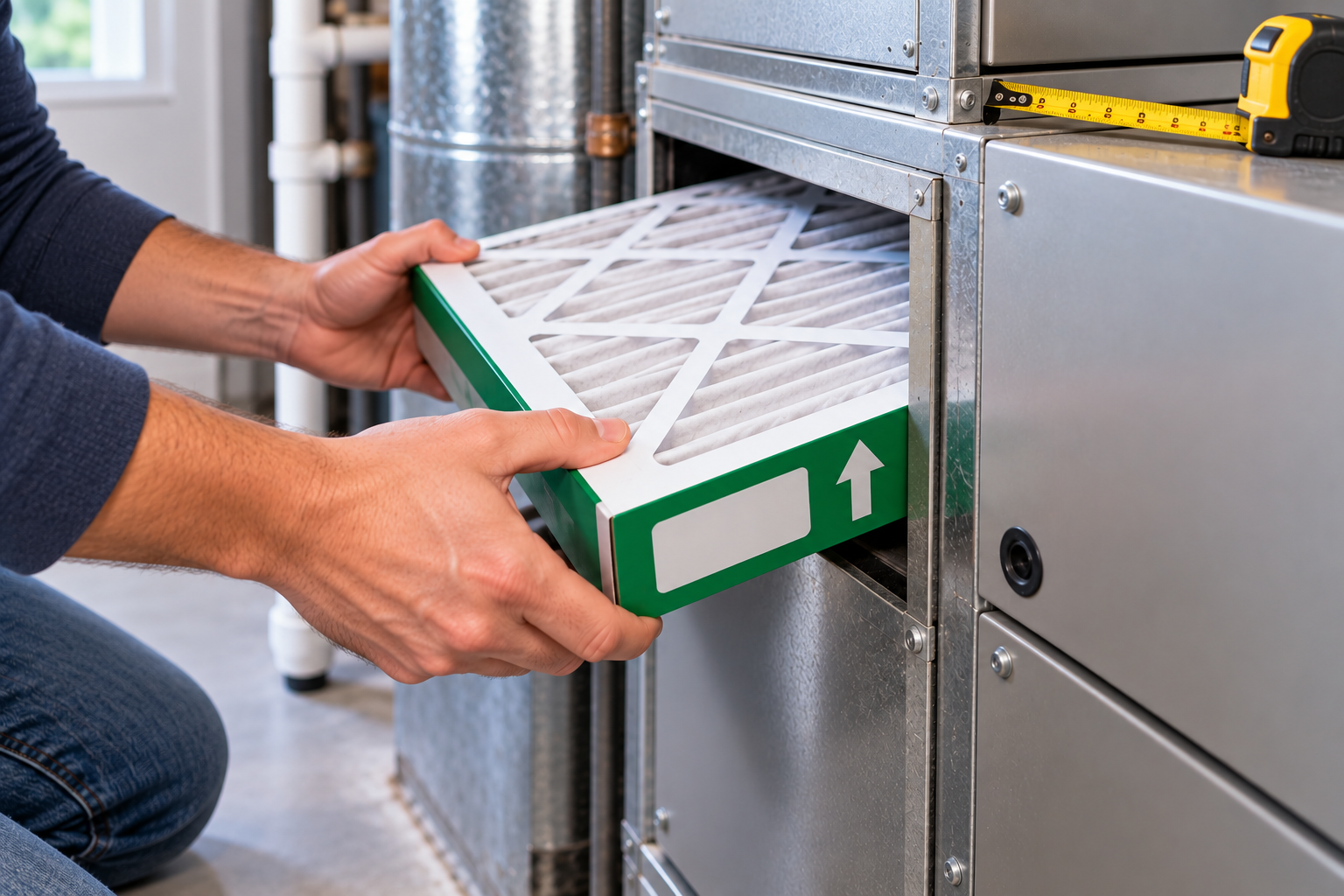
Locate your filter — at the side or bottom of your furnace, or behind a return air vent
Pull it out carefully
Hold it up to a light source
Can't see light passing through it? Replace it today
What you're looking for:
Light gray or white → still working
Dark gray, brown, or visibly clogged → overdue for a change
Collapsed, bent, or deformed → replace immediately and inspect your system
For most standard homes without pets, a MERV 8 is all you need. If you have pets or mild allergies, step up to a MERV 11. For homes with asthma sufferers, multiple pets, or smokers, a MERV 13 gives you the strongest protection. Can't find your size? Our custom filter team builds any size to spec.
Browse 600+ standard sizes at Filterbuy.com
Can't find your size? Our custom filter team builds any size to spec
Not sure which MERV is right? Our team can help — no jargon, no pressure
The homeowners with the cleanest air and lowest repair bills aren't the most diligent — they're the ones who automated the habit.
With Filterbuy auto-delivery:
Your filter arrives every 30, 60, or 90 days — whatever fits your home
Free shipping, every order, direct from our U.S. factory
No store runs. No wrong sizes. No forgetting.
Cancel or adjust anytime
➜ Set up auto-delivery at Filterbuy.com
A clean filter handles daily protection. A professional tune-up handles the rest.
Ask a licensed HVAC technician to:
Inspect the heat exchanger for cracks
Test the high limit switch and safety controls
Check for carbon monoxide leaks
Clean burners, blower components, and internal surfaces
When to schedule:
Once per year — ideally early fall, before heating season
Immediately if you notice short-cycling, burning smells, or uneven heating
A clean filter significantly reduces CO risk — but a complete safety setup requires working detectors.
CPSC recommends:
One CO detector on every level of your home
One outside each sleeping area
Test monthly. Replace batteries annually.

A: The filter itself won't combust. But it starts a chain reaction that can lead to one.
Here's how it happens:
A clogged filter cuts off airflow to the furnace
The furnace overheats
The heat exchanger strains under sustained high temperatures
Internal wiring and components degrade faster than they should
In severe cases, accumulated dust near the burner smolders — or an overheated motor sparks
The filter is rarely the headline. It's the overlooked starting point. Changing it on time is one of the most impactful — and most underrated — things a homeowner can do to protect their home.
A: Furnaces almost always give a warning before something goes seriously wrong. Most homeowners just don't connect the symptom to the filter.
Watch for these signs:
Short cycling — furnace turns on, runs briefly, shuts off, repeats every 5–10 minutes
Weak airflow — little to no heat from vents despite the system running
Skyrocketing energy bills — a sudden spike with no obvious explanation
Burning or smoky smells — especially burning plastic or rubber, signaling an overheated motor
Cold spots — some rooms warm, others cold
Loud or strained fan noise — high-pitched whining from the blower working too hard
The pattern we see most often: when a customer's furnace "just stopped working" in the middle of winter, a clogged filter is the root cause more often than any other single issue. The furnace didn't fail. It protected itself — by shutting down.
A: Every 90 days is the standard starting point — but most homes don't fit the standard profile.
Replace every 30–60 days if:
You have one or more pets — fur and dander clog filters faster than almost anything else
Anyone in your home has allergies or asthma
You're running heat constantly during an extended cold snap
You've recently done renovation or construction work indoors — drywall dust is a filter's worst enemy
The simplest test — no calendar needed:
Pull the filter out
Hold it up to a light source
Can't see light passing through it? It's overdue — regardless of when you last changed it
That 30-second check has prevented more furnace breakdowns than any maintenance schedule ever will.
A: Pleated filters are completely safe — and this is one of the most persistent myths in home HVAC maintenance.
The facts:
A clean MERV 8–13 pleated filter is the industry standard for residential HVAC systems
Pleated filters provide more surface area to trap particles without dangerous pressure drops
The fire risk doesn't come from the filter type — it comes from neglect
The comparison that matters:
A cheap fiberglass filter left too long lets dust coat burners, motors, and wiring
That creates far more risk than a high-quality pleated filter changed on schedule
Choose the right MERV rating for your home:
MERV 8 — standard home, no pets
MERV 11 — pet owners or mild allergy sufferers
MERV 13 — asthma, multiple pets, or smokers
Then change it on time. That combination is all most homes will ever need.
A: Yes — and it's the risk that catches most homeowners completely off guard.
Here's the pathway from dirty filter to CO risk:
A clogged filter starves the furnace of airflow
The furnace overheats — repeatedly, over days or weeks
Sustained heat puts extreme stress on the heat exchanger
A cracked heat exchanger allows CO to bypass the combustion chamber
CO enters your home's living spaces undetected
Why CO is especially dangerous:
Colorless and odorless — impossible to detect without an alarm
Early symptoms mimic the flu — headaches, dizziness, nausea
The U.S. Consumer Product Safety Commission reports 200+ annual deaths from non-fire CO poisoning linked to consumer products, with home heating equipment consistently among the top contributors
Your three most important defenses:
A clean filter changed on a consistent schedule
An annual furnace inspection by a licensed HVAC technician
Working CO detectors installed on every level of your home
Find the right American-made MERV 8–13 pleated filter for your home at Filterbuy.com and set up auto-delivery so the most important safety task in your house never slips your mind again.