
Does Air Conditioning Increase or Decrease Humidity?
October 2, 2025
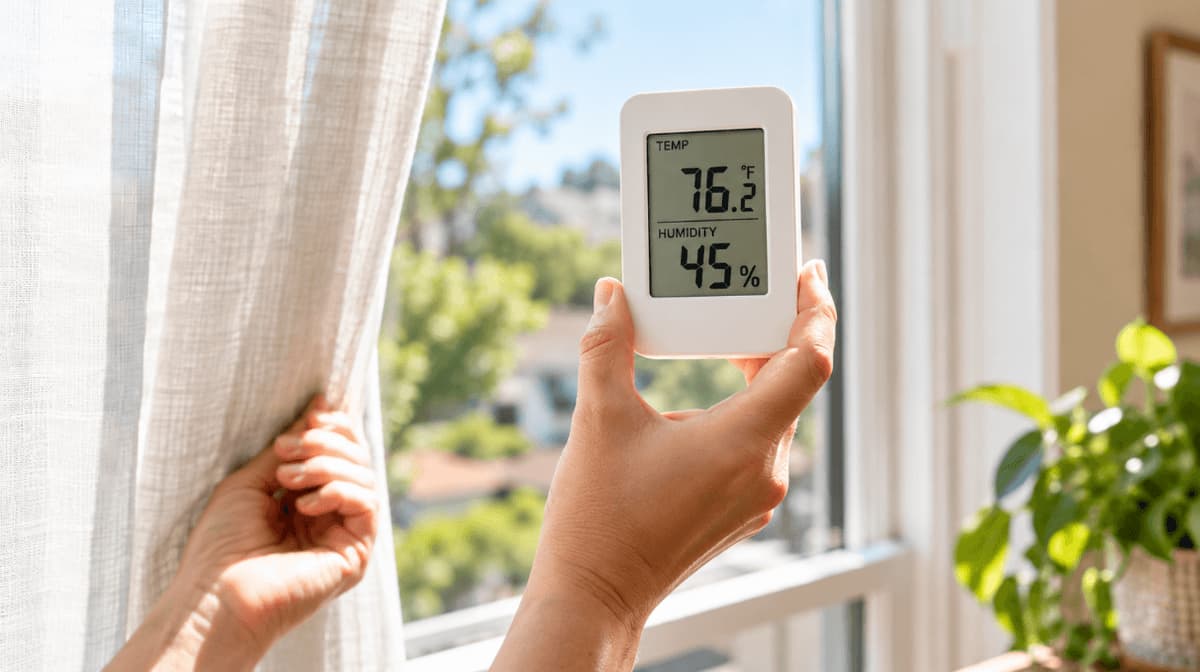
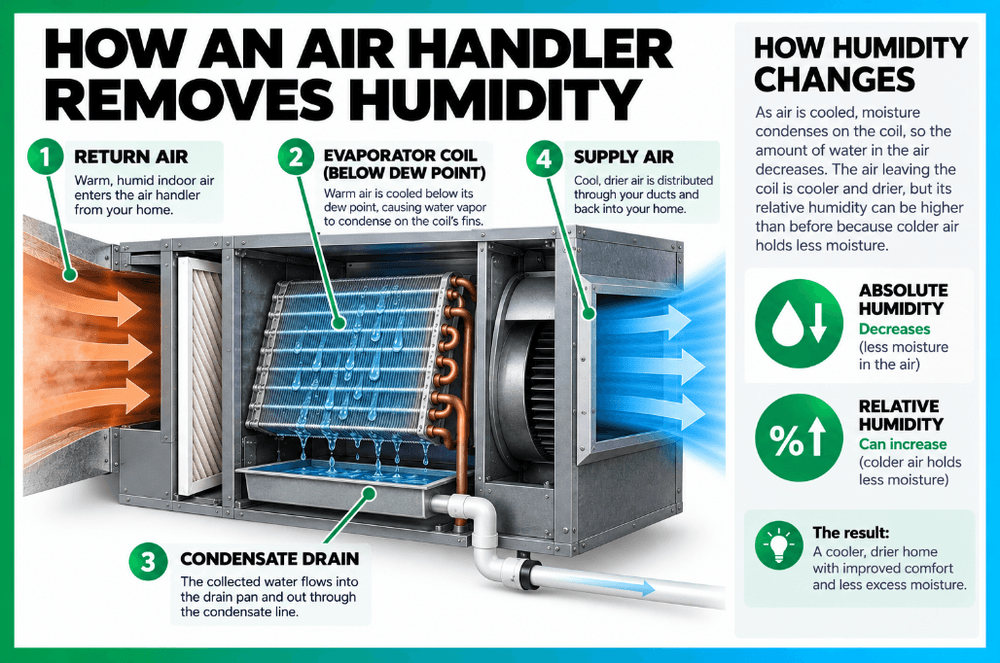
Air conditioning decreases humidity. Warm air crosses a cold evaporator coil, water vapor condenses on it, and that water drains out of the house. Relative humidity can still climb if the coil never gets cold enough or the system shuts off too soon, which is how a house ends up cold and clammy at once. The EPA recommends keeping indoor relative humidity between 30% and 50%.
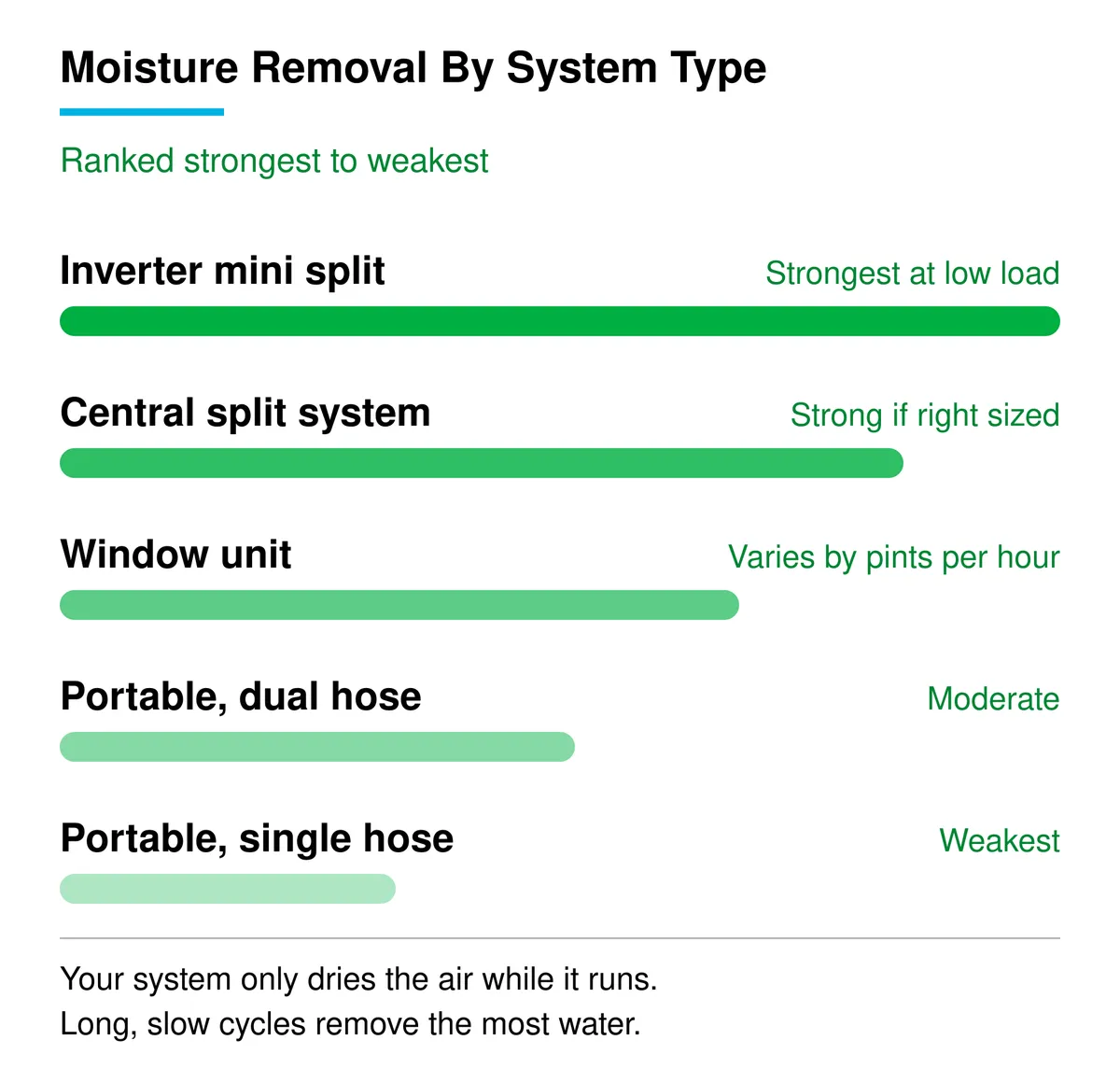
How much moisture each system type removes:
Inverter mini split: strongest at low load, running long, slow cycles
Central split system: strong when it is sized right for the house
Window unit: varies by its pints-per-hour rating
Portable, dual hose: moderate
Portable, single hose: weakest, because it pulls humid air back in
Filterbuy ductless mini split systems start at $799 with free 2-day delivery and a 7-year compressor warranty, and the quick match below will point you to a size for your space.
Answer a few quick questions and we will match you to a mini split size for your room.
TL;DR
Air conditioning decreases humidity. Indoor air crosses a cold evaporator coil, water vapor condenses there, and the water drains out of the house. The catch is that this lowers absolute humidity, the actual water in your air, while relative humidity can still climb if the coil never gets cold enough. The EPA recommends 30% to 50% indoors.
Key Takeaways
A right-sized, well-maintained air conditioner lowers indoor humidity: water vapor condenses on the cold coil and drains away.
Air conditioning can raise relative humidity while lowering absolute humidity, because cool air holds less water.
The EPA recommends 30% to 50% indoor relative humidity, and below 60% to limit mold and dust mites.
Setting the thermostat fan to "Auto" is the cheapest fix for a clammy house, and the fault Filterbuy HVAC Solutions technicians find most.
Does Air Conditioning Increase Or Decrease Humidity?
Air conditioning decreases humidity in the way that matters most: it physically removes water from your air. The evaporator coil runs colder than the air’s dew point, so moisture condenses out of every cubic foot crossing it. The one exception is relative humidity, which can rise even while the system runs.
Absolute humidity is the mass of water vapor the air holds. Relative humidity is how close that air sits to saturation at its temperature. Cooler air saturates at less moisture, so cooling without condensing water out pushes relative humidity up.
How Does An Air Conditioner Remove Humidity?
An air conditioner removes humidity by condensation. Warm air crosses the evaporator coil, which sits below the air’s dew point, so water vapor turns back into liquid on the fins and drains away. We know what that coil looks like when it stops working: Filterbuy HVAC Solutions technicians pull hundreds of access panels every summer.
Every air conditioner splits its work two ways. Sensible cooling lowers temperature, latent cooling removes moisture, and the balance between them is the sensible heat ratio.
Older 10-SEER units ran sensible heat ratios of 0.70 to 0.75, putting 25% to 30% of capacity into removing moisture. Higher-end modern equipment often carries latent capacity below 10% of total.
In humid climates an air conditioner meets only 50% to 70% of a home’s dehumidification need, per modeling by the National Renewable Energy Laboratory.
That shift explains a call Filterbuy HVAC Solutions takes constantly: a new high-efficiency system keeps the house colder than the one it replaced, and clammier. Better at cooling, worse at drying.
Why Is My House Humid When The AC Is Running?
A house stays humid with the AC running for six common reasons, listed in the order Filterbuy HVAC Solutions technicians work through them on a cool-but-clammy call in South Florida rather than by how serious each sounds. The free fix sits at the top for a reason.
Green marks a fix you can do yourself. Blue needs a licensed technician.
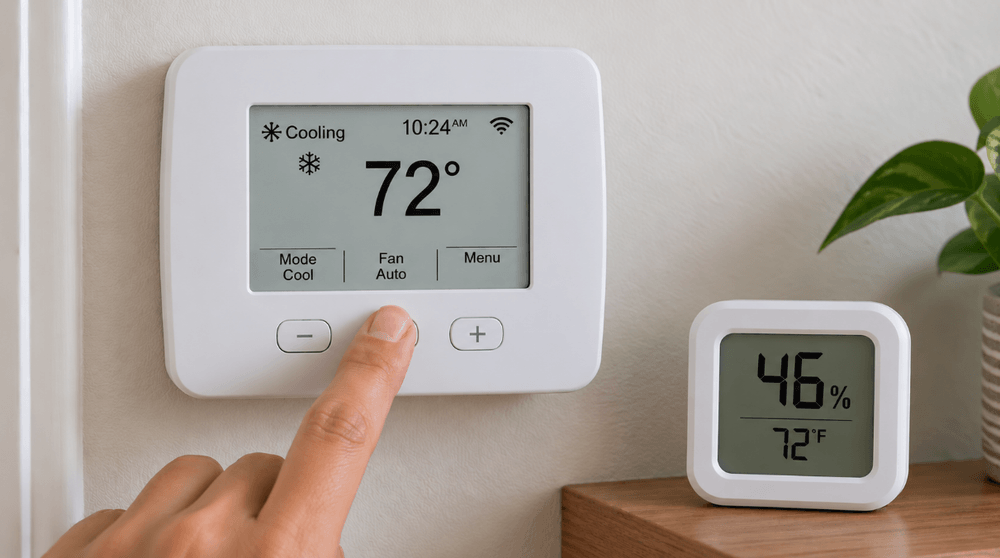
The fan setting earns first place on physics. When the compressor stops the coil is still soaking wet, and a blower left on "On" pushes air across it, sending the moisture you just paid to remove back inside.
If you rent or run a window unit, three of those causes belong to the building. What you control is the filter and fan speed: keep it clean, run the lowest comfortable speed.
What Humidity Level Should You Keep In Your Home?
Keep indoor relative humidity between 30% and 50%, and below 60% year-round. The EPA sets that range for comfort and health. The only way to know where you stand is to measure, so put a digital hygrometer in the main room and bedroom.
How close you get depends on the weather your system works against.
Two of those rows are not AC problems. A dehumidifier runs without a cooling load, and sustained damp is how mold gets a foothold.
Do All Air Conditioners Dehumidify Equally?
No, and the spread is wide enough to matter when you are buying. Inverter mini-splits dehumidify best at low load, running long, slow cycles with a dedicated Dry mode. Single-hose portables dehumidify worst, exhausting household air outdoors and pulling humid air back in through every gap.
How Your Air Filter Affects Humidity Control
A snug-fitting air filter protects the one component doing all your dehumidifying, and a loose one quietly wrecks it. Filterbuy sees that problem from both sides, building the filter itself and, through Filterbuy HVAC Solutions, maintaining the equipment it sits in.
We cut every filter about half an inch under nominal so it seats without binding. Give it more room than that and air slips around the media instead of through it, carrying dust onto a cold, wet coil.
That buildup insulates the coil and restricts airflow, and both cut moisture removal before they cut cooling. A loaded filter does the same in reverse.
“A humid house does not feel like a filter problem, so nobody calls us about it. They call about the air conditioner. But we build the filter and we service the system, and from where we sit those are the same call arriving from two directions.”
— Michelle Wan, Brand Manager and Air Quality Writer, Filterbuy
Run the highest MERV rating your blower handles, in the size your slot takes. For most homes that means MERV 11 filters, or MERV 13 filters where smoke or pollen is a concern. For a non-standard opening, Filterbuy custom air filters are cut to your dimensions, and auto-delivery handles the step people forget.
How To Check Your Ac’s Dehumidification In Five Minutes
A five-minute test will tell you whether your air conditioner is removing moisture or only lowering the temperature. It is the check Filterbuy HVAC Solutions technicians run first on a humidity call, and all it needs is a hygrometer and one cooling cycle.
Put a hygrometer in the main room; note temperature and RH.
Set the thermostat fan to Auto.
Run a normal cooling cycle for 30 to 60 minutes.
Watch relative humidity. It should fall with the temperature.
Check the condensate drain for steady dripping.
Count it a pass if relative humidity drops several points and finishes under 60%. If it holds flat or climbs while the temperature falls, the system is cooling without dehumidifying and the reason is in the table above.
Three Things People Try That Make It Worse
Three common attempts to fix a humid house make it worse: raising the thermostat, over-running exhaust fans, and buying bigger equipment. Plenty of the calls Filterbuy HVAC Solutions takes began as somebody’s attempted fix, and all three of these sound reasonable.
Turning the thermostat up to save money. A higher setpoint means shorter run cycles, and moisture removal is the part that needs run time. Moving from 74 to 78 degrees in humid weather leaves the house cheaper to run and stickier to live in. A dehumidifier draws a fraction of what the compressor does.
Running exhaust fans longer than the job needs. A bathroom fan pushes air out, and the same volume comes back in through whatever gaps the building has. When the outdoor dew point is higher than the indoor one, that replacement air is wetter than what you exhausted. Building scientist Allison Bailes has documented bath fans making indoor humidity worse on exactly those mild, sticky days. Run the fan for the shower, then stop.
Buying a bigger air conditioner. This is the expensive mistake. A cold, clammy house looks like it needs more capacity, when more capacity is what causes the short cycling. Size to a load calculation, and if the answer falls between two sizes, take the smaller.
Supporting Statistics
88% of U.S. households use air conditioning, and two-thirds run central AC or a central heat pump as their main equipment (U.S. Energy Information Administration, 2020 Residential Energy Consumption Survey). For most American homes the air conditioner is the main humidity-control device, whether anyone thinks of it that way or not.
Homes with dampness and mold show roughly 30% to 70% higher rates of asthma and respiratory effects, and about half of U.S. homes show visible dampness (Lawrence Berkeley National Laboratory, Indoor Air Quality Scientific Findings Resource Bank). The 60% ceiling is a health threshold, not a preference.
A typical house loses 20% to 30% of the air moving through its ducts to leaks, holes, and poor connections (ENERGY STAR, U.S. EPA). Leaky returns in a hot attic pull that air into the system.
Frequently Asked Questions
Should the thermostat fan be on Auto or On for humidity?
Set the thermostat fan to Auto. The blower then runs only while the compressor runs, giving condensate time to drain. Left on "On," it moves air across a wet coil after the compressor stops and evaporates that water back inside.
Why is my house more humid at night?
The two loads are out of step. A home’s peak moisture load lands around 5 a.m., while peak cooling load lands in the evening, per modeling by the National Renewable Energy Laboratory. By dawn the air conditioner has little reason to run, so it barely dehumidifies when the house needs it most.
When should I call an HVAC professional about humidity?
Call a licensed technician if relative humidity stays above 60% after you set the fan to Auto and fit a clean filter, if the system short-cycles, if the coil ices, or if water pools around the air handler. Filterbuy HVAC Solutions covers Palm Beach, Broward, and Dade counties.
Glossary
Absolute humidity. The mass of water vapor in a volume of air, independent of temperature. An air conditioner lowers it by condensing water out at the coil.
Relative humidity (RH). How close air is to saturation at its current temperature, as a percentage. The EPA recommends 30% to 50% indoors.
Dew point. The temperature at which air saturates and water vapor condenses. A coil dehumidifies only when it is colder than the dew point of the air crossing it.
Filter bypass. Air slipping around the edges of an ill-fitting filter instead of through it, fouling the coil and cutting moisture removal.
About The Author
Michelle Wan is Brand Manager and Air Quality Writer at Filterbuy, working with the U.S. manufacturing team across four American factories, so her writing comes from how filters are built and used rather than from spec sheets. Read more from Michelle Wan.
Technically reviewed by David Clark, Licensed HVAC Technician, Filterbuy HVAC Solutions.