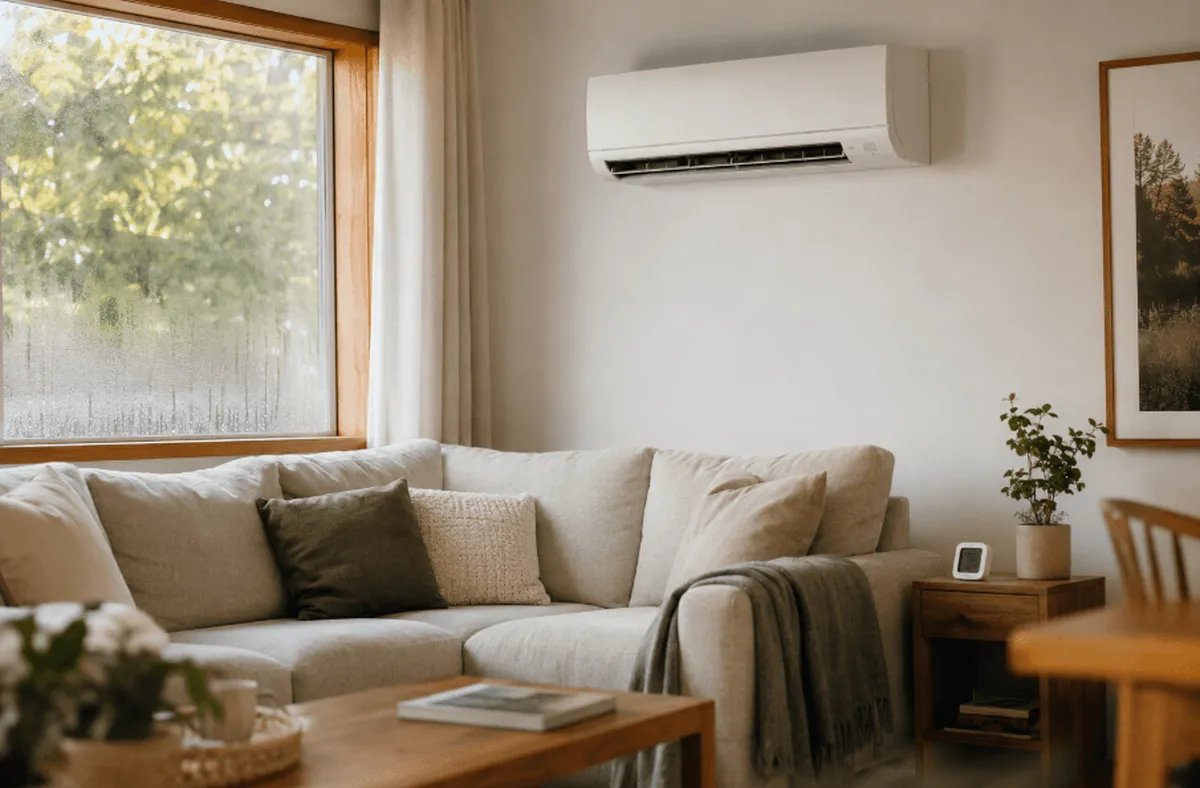
Mini Split Dehumidifier Mode: How Dry Mode Works and When to Use It
How Does Mini Split Dry Mode Work?
Dry mode slows your mini split's fan so humid air lingers longer on the cold coil, pulling out more moisture while cooling the room only a little. It runs the same compressor and coil as Cool mode, just tuned for moisture removal instead of a fast temperature drop. It works best on mild, muggy days, not as a full swap for a dedicated dehumidifier in a damp basement.
- Cool Mode: fast fan, quick temperature drop
- Dry Mode: slow fan, focused moisture removal
- Dedicated Dehumidifier: highest moisture removal, no temperature change
Answer 3 quick questions below and we will match you to the mini split system that fits your space.

Answer 3 quick questions and we'll match you to your perfect mini split system.
TL;DR
Most mini splits include a built-in Dry mode that removes moisture by slowing the indoor fan so humid air lingers longer over the cold evaporator coil, letting more water vapor condense out and drain away. It still cools the room somewhat, since it runs the same refrigeration cycle as Cool mode at reduced airflow, so it works best on mild, damp days rather than replacing a dedicated dehumidifier in a wet room. A clean filter keeps that airflow moving, so filter maintenance directly affects how much moisture Dry mode removes.
Key Takeaways
Dry mode slows the fan so humid air sits longer against the cold coil, condensing more moisture into condensate.
Dry mode shares the same compressor and coil as Cool mode, so the room still cools somewhat while it dries.
The EPA recommends indoor humidity below 60 percent, ideally 30 to 50 percent, to limit mold and dust mites.
A dedicated dehumidifier removes more moisture per hour and runs independent of temperature, better for basements.
A restricted filter cuts airflow across the coil and can reduce cooling efficiency by up to 15 percent.
"Dry mode is one of the most asked-about buttons on a mini split remote, usually right after a muggy week where Cool mode left a room cold but still clammy. We write about air quality every day and build the filters inside these systems, so we see both sides of the problem."
Michelle Wan, Brand Manager and Air Quality Writer, Filterbuy
Does A Mini Split Dehumidify The Air?
Yes. Nearly every mini split sold today includes a Dry mode, sometimes labeled dehumidify mode, built to pull moisture from the air rather than drop the temperature quickly. ENERGY STAR describes mini split heat pumps as systems that heat and cool a home from the same indoor and outdoor units, and Dry mode uses that same coil and fan, tuned to favor moisture removal.
This matters most on muggy days when Cool mode overshoots, chilling a room before it removes enough moisture to feel comfortable. Filterbuy's ductless mini split systems include a Dry setting.
How Mini Split Dry Mode Works
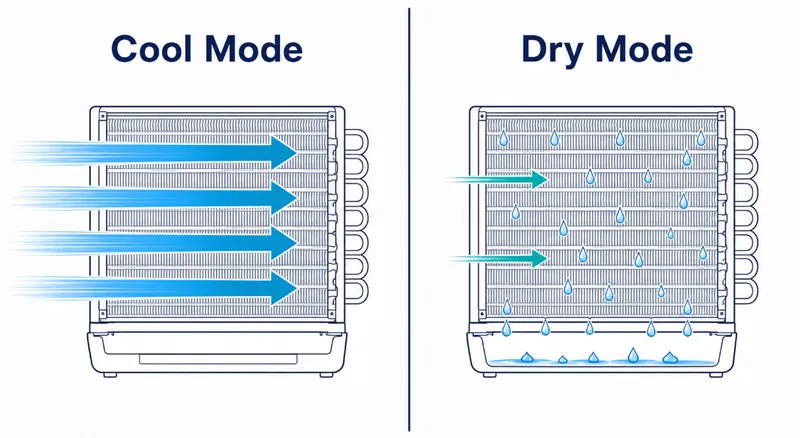
A mini split removes moisture the same way it removes heat, by passing indoor air over a cold evaporator coil. Cool mode runs the fan fast, cooling the room quickly but giving each parcel of air only a brief pass over the coil.
Dry mode slows the fan, sometimes cycling it on and off, so air moves across the coil more slowly. That extra contact time lets more water vapor condense into droplets, which drain outside through the same condensate line used during normal cooling. The Department of Energy's Building America Solution Center lists dehumidification and filtration alongside heating and cooling as core functions of a standard ductless unit.
Because Dry mode still runs the compressor, room temperature drops somewhat even though cooling isn't the primary goal. A slower fan also means less air moves through the room each minute, so the space warms back up between cycles faster than in Cool mode, even as the coil keeps pulling out moisture.
Ductless AC Dry Mode Vs. Cool Mode: What Is The Difference?
Dry mode and Cool mode share the same hardware, so the difference is fan speed and cycling.
Mini Split Humidity Control Vs. A Dedicated Dehumidifier
Dry mode is a genuinely useful humidity tool, but it isn't identical to a stand-alone dehumidifier.
For everyday humidity swings, Dry mode is usually enough. For a room that stays damp year-round, like a basement, pairing a dedicated dehumidifier with the mini split is the more reliable fix.
When To Use Dry Mode (And When You Need More)
Dry mode earns its keep on days when the air feels heavier than the temperature alone would suggest.
Good fits:
A mild, humid day when the room feels sticky but not hot.
Nighttime in a bedroom, where a slower fan avoids an overly cold room by morning.
A room already comfortable in Cool mode but still slightly clammy.
Signs you need more than Dry mode:
The room stays damp or musty regardless of runtime, pointing to a source it cannot handle, like a leak or poor ventilation.
Condensation regularly forms on windows or cold surfaces.
The space is a basement, crawl space, or other chronically damp area.
Indoor humidity stays above 60 percent even with the unit running.
Why A Clean Air Filter Maximizes Dry Mode Performance
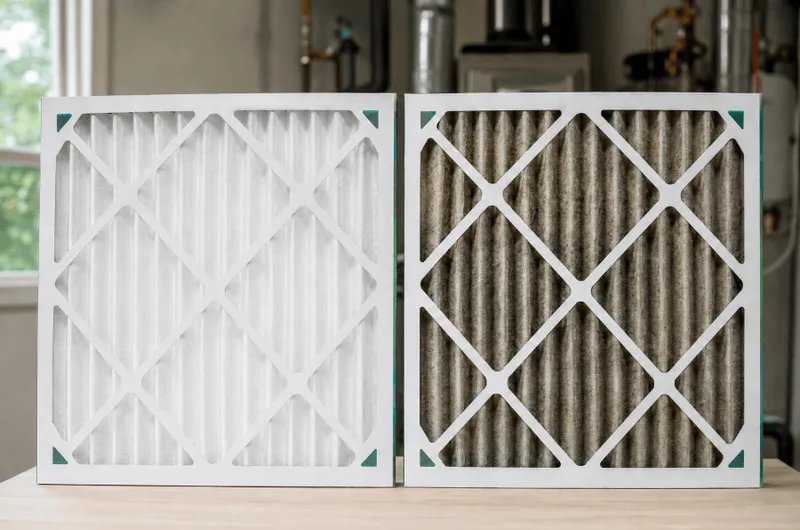
Dry mode depends on getting humid air across the evaporator coil. A dust-loaded filter restricts that airflow, so less moisture condenses out.
ENERGY STAR includes cleaning or changing filters monthly on its maintenance checklist, and notes airflow problems can cut cooling efficiency by up to 15 percent. A restricted filter is one of the most common, preventable reasons a mini split underperforms in Dry mode. See Filterbuy's mini split maintenance guide or MERV ratings chart to match a filter to your system.
"In the field, the number one reason a customer tells me their mini split 'stopped drying the room' is not the unit. It's a filter overdue for a change. Restore the airflow and Dry mode goes back to doing its job."
David Clark, Licensed HVAC Technician, Filterbuy Technical Reviewer
Healthy Indoor Humidity Targets For Your Home
Indoor humidity is worth tracking on its own. The EPA recommends keeping it below 60 percent, ideally 30 to 50 percent, to limit mold and dust mites. The CDC advises households managing asthma or respiratory conditions to keep humidity at 50 percent or lower. ASHRAE Standard 55 sets an upper comfort limit near a 62.2°F dew point with no fixed lower limit.
See Filterbuy's humidity-measuring guide if you're not sure where your home stands.
How To Turn On Dry Mode On A Mini Split
Locate the mode button, often a fan, snowflake, sun, or droplet icon.
Press it until the display shows the droplet icon or the word Dry.
Set the target temperature slightly below the current room temperature.
Leave fan speed on automatic, or low, for maximum moisture removal.
Give it time. Dry mode works gradually over an hour or more.
How To Tell Dry Mode Is Actually Working
Note the starting point with a hygrometer, or just notice how the air feels.
Give it a real trial. Run Dry mode 45 minutes to an hour before judging it.
Check the same signs again, a lower reading, less clamminess, less fogging on glass.
Watch the condensate line. No drainage after an hour, with the air still damp, points to a restricted filter rather than Dry mode itself.
Dry Mode Troubleshooting At A Glance
Seven Resources We Trust To Help You Take Charge Of Your Home's Humidity
Humidity Range That Stops Mold
The EPA's mold and moisture guide puts the target below 60 percent, ideally 30 to 50 percent.
Humidity Targets For Asthma Households
The CDC's clinical guidance on mold and asthma sets a tighter 50 percent benchmark.
How Dry Mode Fits A Ductless System's Design
The DOE's Building America Solution Center covers the fan, coil, and filter behind Dry mode.
How A Minisplit Heat Pump Works
The DOE's Energy Saver guide to ductless minisplits breaks down the indoor and outdoor components.
A Maintenance Checklist For Airflow
ENERGY STAR's checklist covers the filter and airflow checks Dry mode needs.
Why Excess Moisture Feeds Mold
The American Lung Association's mold guide explains how moisture control prevents growth.
The Humidity Limits In Comfort Standards
ASHRAE's technical guidance on Standard 55 explains why it sets no fixed lower humidity limit.
Supporting Statistics
28 million Americans, about 8 percent of the population, have asthma, and humidity-linked triggers like dust mites and mold are common causes of flare-ups. Source: Asthma and Allergy Foundation of America.
About 13 percent of U.S. households used a heat pump as their main heating equipment as of 2020, and adoption keeps climbing. Source: U.S. Energy Information Administration.
Indoor pollutant levels can run up to 100 times higher than outdoor levels, per the EPA. Source: National Institutes of Health.
Frequently Asked Questions
Glossary
MERV (Minimum Efficiency Reporting Value): A rating scale for how well a filter captures particles, higher numbers meaning finer filtration.
Dew Point: The temperature at which air becomes saturated with water vapor and moisture begins condensing as liquid.
Short Cycling: A pattern where an oversized system cools a room quickly and shuts off before running long enough to remove much humidity.