
High Efficiency Furnace Guide: AFUE Ratings 95/96/98%, Cost, Energy Savings, Condensing Tech, and Why a Clean Filter Matters
November 8, 2026
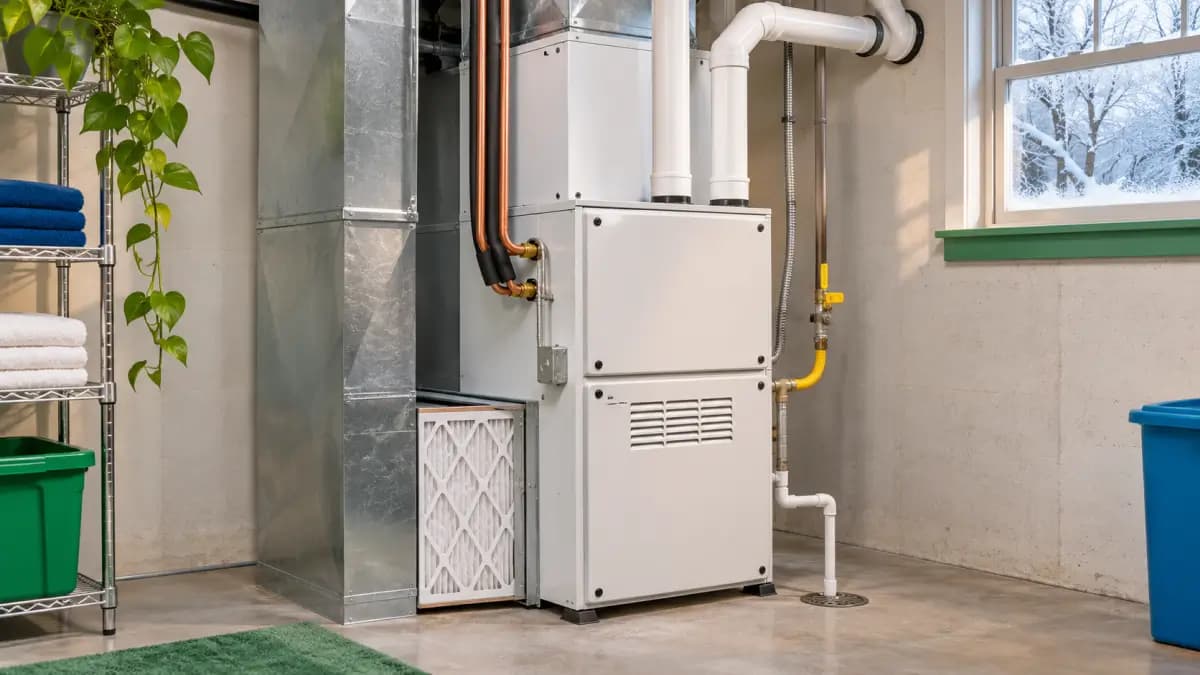
Short answer: a 95% or 96% AFUE gas furnace fits most homes, and a 98% model pays off mainly where winters run long. Each AFUE point adds one more cent of heat from every dollar of gas you buy.
On a $640 winter gas bill, Filterbuy's math puts the savings over an 80% furnace at about $101 a year for 95% and $118 for 98%. Find the filter that keeps that efficiency on track with the quick quiz below.
Heat You Get From Every $1 Of Gas
Yearly savings vs an 80% furnace on a $640 winter bill
80% AFUE 80 cents of heat | Baseline
95% AFUE 95 cents of heat | Saves about $101
96% AFUE 96 cents of heat | Saves about $107
98% AFUE 98 cents of heat | Saves about $118
The takeaway: most of the savings arrive by 95%. Going from 95% to 98% adds about $17 a winter.
Filterbuy calculation using the EIA Winter Fuels Outlook 2026-27 U.S. average gas forecast.
Explore More Furnace And Winter Filter Guides
Answer a few quick questions and we'll match you to the right filter for your furnace.
A high efficiency furnace is a gas furnace rated at 90% AFUE or higher, which means at least 90 cents of every fuel dollar becomes heat for your home. Most new high efficiency gas furnaces land at 95%, 96%, or 98% AFUE. These furnaces use condensing technology to pull extra heat from exhaust. High efficiency furnaces cost more upfront than 80% models and trim winter gas bills most in cold climates.
At Filterbuy, an American air filter manufacturer, we judge furnace efficiency from the airflow side, because a 98% furnace earns its rating only when air moves freely.
TL;DR
A high efficiency furnace turns 90% to 98.5% of its fuel into heat. Filterbuy's analysis of this winter's EIA gas forecast shows 80% to 95% AFUE captures most savings, while 95% to 98% adds about $17. A 98 AFUE furnace pays off best in long, cold winters, and every condensing furnace needs a clean filter.
Key Takeaways
High efficiency gas furnaces rated 96% AFUE and above cost $2,000 to $6,000 for the unit alone, per Angi.
Filterbuy's analysis: an 80% to 95% upgrade saves about $101 a winter on an average gas bill, and 95% to 98% adds only about $17.
Our view: a variable-speed blower can mask a clogged filter by working harder, so check filters monthly in heating season.
The federal 95% AFUE minimum for new gas furnaces is scheduled for December 18, 2028, pending a delay petition.
What Is a High Efficiency Furnace?
A high efficiency furnace is a furnace with an AFUE rating of 90% or higher. The U.S. Department of Energy groups heating equipment into three bands: older systems at 56% to 70% AFUE, mid-efficiency systems at 80% to 83%, and high-efficiency systems at 90% to 98.5%. Nearly every high efficiency gas furnace sold today is a condensing furnace.
AFUE does not count heat lost through leaky ducts, so duct sealing can matter as much as the rating.
How Does a Condensing Gas Furnace Work?
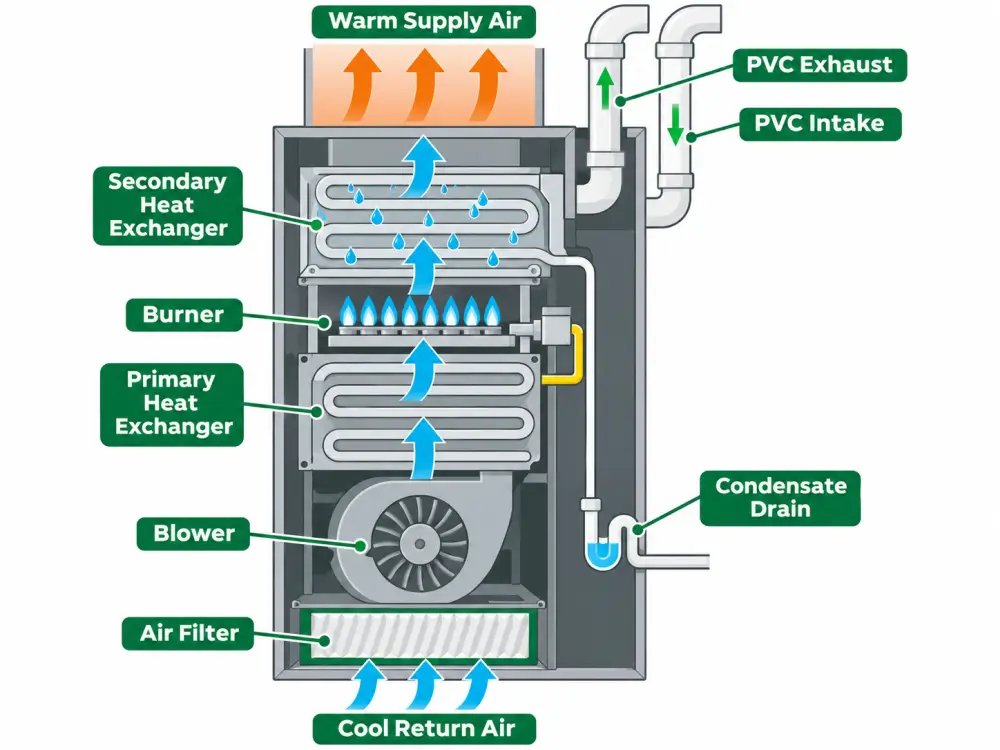
A condensing gas furnace sends hot combustion gases through a second heat exchanger that cools them until water vapor turns into liquid. The condensing step recovers heat a standard 80% furnace sends up the chimney. The furnace then drains acidic condensate and vents through PVC pipe.
95 vs 96 vs 98 AFUE Furnace: What Changes?
The gap between a 95, 96, and 98 AFUE furnace is three cents of heat per fuel dollar from bottom to top. Higher models often add two-stage or modulating gas valves and variable-speed blowers. The ENERGY STAR furnace criteria set 95% AFUE as the threshold in the U.S. South and 97% in the U.S. North.
Cents show heat delivered per $1 of gas.
See Filterbuy's Lennox furnace models and prices for one brand's 80% to 99% AFUE range.
How Much Does a High Efficiency Furnace Cost?
High efficiency furnace cost averages about $7,000 installed for a gas model, with most projects between $2,000 and $12,000, according to Angi's furnace cost data. The unit alone runs $1,000 to $3,000 at 90% to 95% AFUE and $2,000 to $6,000 at 96% AFUE and above.
Two items move the price most: PVC venting (plus a chimney liner if a gas water heater stays behind) and the BTU size from a Manual J load calculation (see how to choose the right furnace size).
See our furnace installation cost breakdown for labor and permit costs plus the typical $700 to $1,950 premium for an 80% to 95% upgrade. The gas furnace cost and BTU sizing guide covers full-system pricing.
How Much Can a High Efficiency Furnace Save on Energy?
A high efficiency furnace burns less gas for the same heat. Filterbuy priced each step against this winter's forecast bills. A 95 AFUE furnace cuts fuel use about 16% compared with an 80% model, and a 98% model about 18%. Applied to the $640 average winter gas bill in the EIA Winter Fuels Outlook 2026-27, that is roughly $101 to $118 saved each winter.
Filterbuy calculation. Savings per winter vs an 80% furnace: bill x (1 - 80 / new AFUE). Bills are EIA 2026–27 forecasts.
About 85% of the savings from a 98% furnace already arrive at 95% AFUE. The 95% to 98% step adds about $17 a winter nationally and $22 in the Northeast.
Propane homes see the same percentages in bigger dollars. On the EIA's $1,246 average propane winter, an 80% to 95% upgrade saves about $197 and a 98% furnace about $229. Already own a 90% furnace? A move to 98% cuts gas use only about 8%, so replace it when age or repairs call for it.
Run Your Own Numbers in Three Steps
Find your November to March gas or propane heating cost.
Multiply it by 0.16 for a 95% furnace, 0.17 for 96%, or 0.18 for 98% to estimate yearly savings over an 80% model.
Multiply those savings by the years you plan to stay. The result is the most extra you should pay for efficiency.
Example: a $1,000 winter bill saves about $160 a year at 95% AFUE. A 12-year stay justifies up to about $1,900 over an 80% model, well inside a typical gas furnace lifespan of 15 to 20 years.
Which Is the Best High Efficiency Furnace for Your Home?
In our view, the best high efficiency furnace is the one that fits your climate and how long you plan to stay. A 95% or 96% AFUE furnace fits most homes with moderate winters. A 97% or 98% modulating furnace earns its premium in long, cold winters, and an 80% furnace can still make sense where gas use is low.
Filterbuy's four-step pre-quote check:
Check your bill. The 95% to 98% step saves about 3%.
Confirm venting. Ask where PVC pipes will exit.
Compare comfort. Uneven rooms make a two-stage or modulating furnace worth more.
Verify rating and size. Ask for an ACCA Manual J load calculation and the AHRI-certified AFUE.
What Does the 2028 Federal Furnace Standard Mean for You?
DOE's 2023 rule requires new non-weatherized gas furnaces made on or after December 18, 2028 to reach at least 95% AFUE, a level only condensing furnaces reach. In April 2026, DOE published a request for comment on a gas industry petition to delay compliance to at least January 1, 2030.
A working 80% furnace already in your home can stay in service.
Why Does a Clean Filter Matter for a High Efficiency Furnace?
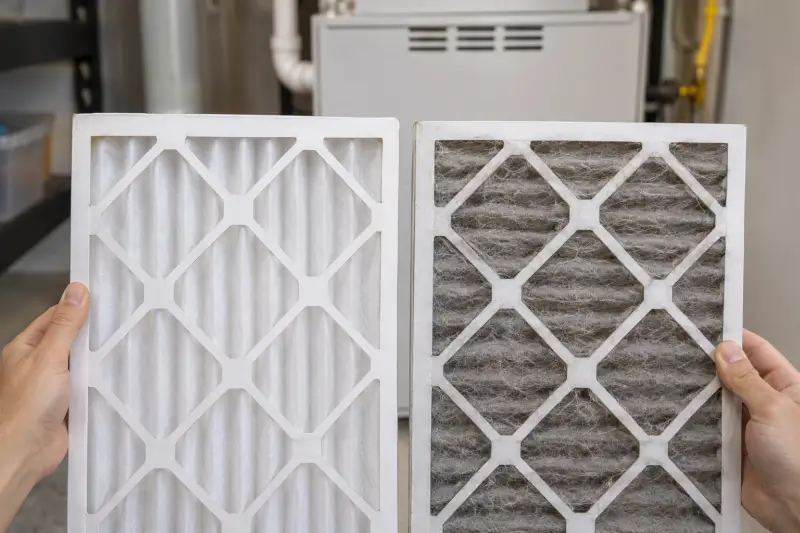
A clean filter matters because a high efficiency furnace is designed to move a set volume of air across its heat exchangers. As filter makers, this is the part we watch most closely. A variable-speed blower can mask a clogged filter: it speeds up to hold airflow, so the furnace keeps its AFUE while your electric bill absorbs the difference. DOE lab tests showed this pattern.
Filterbuy cuts and assembles pleated filters in more than 600 standard sizes, plus custom sizes. MERV 8 air filters handle everyday dust and lint, MERV 11 air filters add stronger capture for pet dander and pollen, and MERV 13 air filters are our top residential tier for finer particles such as smoke. Check your furnace manual for the highest MERV rating your system is designed to handle before upgrading.
Try the air filter size chart or custom air filters for your fit. Our air filter subscription ships replacements with fast and free 2-day delivery to most US states. Learn how a dirty filter makes a furnace work harder and how often to change your HVAC filter, or compare high-efficiency furnace filters for winter.
"If your furnace or boiler is old, worn out, inefficient, or significantly oversized, the simplest solution is to replace it with a modern high-efficiency model."
– U.S. Department of Energy, Energy Saver guide to furnaces and boilers
Filterbuy's take: We agree with DOE, and our numbers add a second rule: pay for comfort, not the last three points. If a 98% furnace fits your budget, buy it for the modulating burner and steadier heat, then protect that blower with a filter schedule you will keep.
Supporting Statistics
$350 saved over a furnace's life
DOE estimate for its 95% AFUE standard, per average gas furnace buyer (2022 dollars).
Simple payback: 7.6 years.
Filterbuy takeaway: test the average against your own winter bill.
Source: Energy Conservation Standards for Consumer Furnaces Final Rule
About 1% AFUE lost to airflow resistance
DOE Building America lab tests raised static pressure on high efficiency furnaces.
Single-stage unit: AFUE fell about 1%.
Modulating unit: kept its rating but used more blower power.
Filterbuy takeaway: a clogged filter adds that resistance.
Source: Measure Guideline: High Efficiency Natural Gas Furnaces
29% of non-fire CO deaths tied to heating equipment
CPSC estimate: 66 of 227 yearly non-fire CO deaths from consumer products (2019–2021 average).
Filterbuy takeaway: pair a yearly vent inspection with working CO alarms.
Source: Non-Fire Carbon Monoxide Deaths Associated with the Use of Consumer Products, 2021 Annual Estimates
Frequently Asked Questions About High Efficiency Furnaces
What Is a Good AFUE Rating for a Gas Furnace?
A good AFUE rating for a gas furnace is 95% or higher in most of the country. In cold northern climates, aim for 97% to 98%.
Is a 98 AFUE Furnace Worth It Compared with a 95 AFUE Furnace?
A 98 AFUE furnace is worth it in long, cold winters when you plan to stay 10 years or more. In Filterbuy's analysis, the extra 3 points save about $17 a season at the national average, or roughly $255 over 15 years. Any premium above that is paying for modulating comfort.
Is There a Tax Credit for a High Efficiency Furnace in 2026?
No federal tax credit applies in 2026. The Section 25C Energy Efficient Home Improvement Credit for gas furnaces ended for equipment installed after December 31, 2025. Check for utility and state rebates in the DSIRE incentive program database.
Does a Condensing Furnace Need Special Maintenance?
A condensing furnace needs a yearly furnace tune-up that includes cleaning the condensate trap and drain and inspecting the PVC pipes. Keep outdoor vents clear of snow and ice.
Protect Your High Efficiency Furnace With the Right Filter
At Filterbuy, we see the air filter as the simplest way to protect a high efficiency furnace. Choose a MERV rating your furnace manual supports and shop Filterbuy air filters in your exact size.
High Efficiency Furnace Glossary
AFUE: Annual Fuel Utilization Efficiency, the percentage of a furnace's yearly fuel that becomes usable heat.
Condensing Furnace: A 90%+ AFUE furnace that condenses water vapor in its exhaust to recover extra heat.
Modulating Furnace: A furnace whose gas valve adjusts heat output in small steps to match demand.
Two-Stage Furnace: A furnace with a low and a high heat setting.
Variable-Speed Blower: An ECM fan motor that adjusts its speed to hold airflow.
Condensate: Mildly acidic water a condensing furnace drains away.
Static Pressure: Airflow resistance in ducts and filters, measured in inches of water column.
ENERGY STAR: The EPA program certifying gas furnaces at 95% AFUE (South) or 97% (North).
Manual J: ACCA's load calculation for sizing heating equipment.
MERV: Minimum Efficiency Reporting Value, the ASHRAE 52.2 scale for air filter particle capture.