
Furnace Maintenance Guide: Annual Checklist, Cost, Tune-Up Steps, Cleaning, and Inspection Tips
October 30, 2026
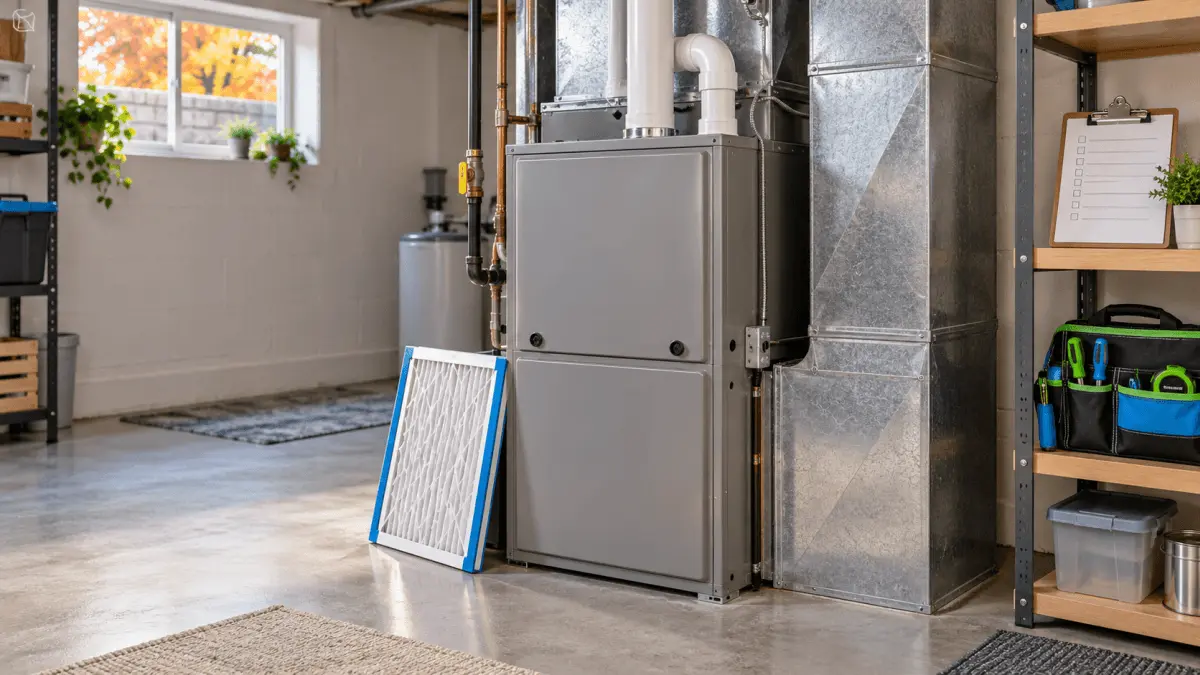
Furnace maintenance splits into two jobs: a technician handles the fuel and safety checks once every fall, and you handle the filter every month. The yearly visit is where combustion, gas pressure, and the heat exchanger get tested. Your part takes minutes and keeps dust off the furnace between visits. Take the quick quiz below to find the filter your furnace needs.
Who Handles What In Annual Furnace Maintenance
Two schedules keep one furnace running safely.
You, Every Month
A few minutes, no tools
Check the filter. Swap it when it looks gray.
Keep 3 feet clear. Nothing that can burn near the furnace.
Test CO alarms. Check batteries when the clocks change.
Technician, Every Fall
One visit, results in writing
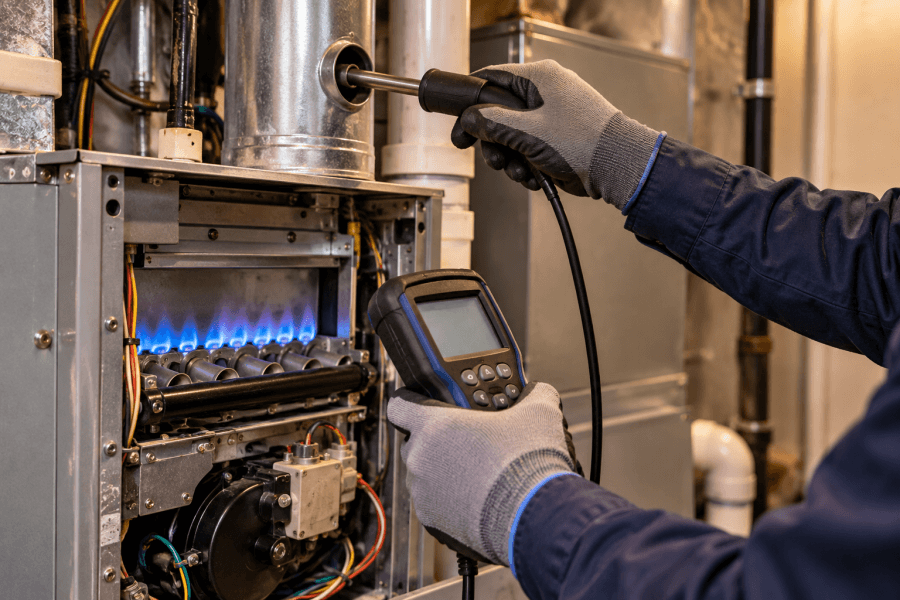
Combustion analysis. Reads the exhaust gases.
Gas pressure. Set to the manufacturer's spec.
Heat exchanger and vent. Checked for cracks and blockage.
Your Filter Is The Part You Control
Find Your Furnace Filter Match
Answer a few quick questions, and we'll match you to the right filter for your furnace.
Getting your home ready for the cold? Our winter guides cover furnace filters, heating problems, and cold-weather prep.
Explore Furnace Filter And Winter GuidesYour annual furnace maintenance checklist comes down to one professional tune-up each fall plus a few homeowner checks. A gas furnace tune-up typically costs $80 to $170, and a basic inspection runs $70 to $130. You'll want combustion and safety checks with written results.
TL;DR
Book one professional furnace tune-up a year, ideally in early fall. Expect $80 to $170 for a gas furnace and $100 to $200 for oil. Between visits, check your filter monthly and test your carbon monoxide alarms. Ask for written readings so you know the safety checks were done.
Key Takeaways
The EPA recommends servicing fuel-burning furnaces before each heating season to protect against carbon monoxide.
Ask for six tune-up results in writing, starting with a combustion analysis.
ENERGY STAR advises a heating check-up every fall and a filter inspection every month.
Filterbuy's white-paper test, comparing your filter with a new one at 30 days, shows your real replacement interval.
What Does Annual Furnace Maintenance Include?
Annual furnace maintenance has two halves: a yearly professional tune-up and a short list of homeowner tasks. At Filterbuy, we see it from the filter side, since we make the one part you'll handle between tune-ups. ENERGY STAR, the federal efficiency program run by the EPA, publishes a heating and cooling maintenance checklist that calls for a heating check-up every fall.
Gas furnace maintenance is a safety check as much as a cleaning, because gas, oil, and propane furnaces burn fuel. The U.S. Consumer Product Safety Commission (CPSC) urges a yearly professional inspection of fuel-burning home heating systems. Electric furnaces skip combustion checks, so their visits center on the blower and wiring.
Your Annual Furnace Maintenance Checklist
This furnace maintenance checklist compares what you handle with what a technician handles. Technician tasks need tools such as a combustion analyzer, which reads the exhaust gases, and a manometer, which measures gas pressure.
Table 1: Homeowner Vs Technician Furnace Maintenance
Sources: ENERGY STAR, CPSC, CDC, and USFA guidance.
Filterbuy's support team gives callers a simple way to find their own filter interval. Write the install date on the frame. At 30 days, hold it next to a new filter on white paper. Gray and matted means a 30-day cycle. Still clean means check again at 60 days.
Filterbuy's guide to how often to change your air filter starts at 60 to 90 days for 1-inch and 2-inch pleated filters. The signs of a clogged furnace filter tell you when to check early.
How Much Does Furnace Maintenance Cost?
Furnace maintenance cost depends on fuel type and service depth. National cost guides from Angi, HomeAdvisor, and Bob Vila put most visits between $70 and $200.
Table 2: Furnace Maintenance Cost By Service
Ranges from Angi, HomeAdvisor, and Bob Vila. Yearly total: four 1-inch filters plus one gas tune-up.
What Happens During A Gas Furnace Tune-Up?
A gas furnace tune-up is an inspect, clean, test, and adjust visit that usually takes one to two hours. The industry baseline is ACCA 4 QM from the Air Conditioning Contractors of America, an ANSI-approved residential HVAC maintenance standard that lists the minimum tasks a visit should cover. A thorough technician will:
Check the thermostat and starting cycle, then tighten electrical connections and measure motor voltage and current.
Clean the burners and flame sensor and test the ignition.
Check gas connections for leaks and set gas pressure to the manufacturer's spec.
Inspect the heat exchanger, the chamber that keeps exhaust out of your air, for cracks or rust.
Check the flue, the exhaust pipe, for leaks or blockage.
Clean the blower, lubricate moving parts as specified, and clear the condensate drain on high-efficiency units.
Check the air filter and run a full heating cycle.
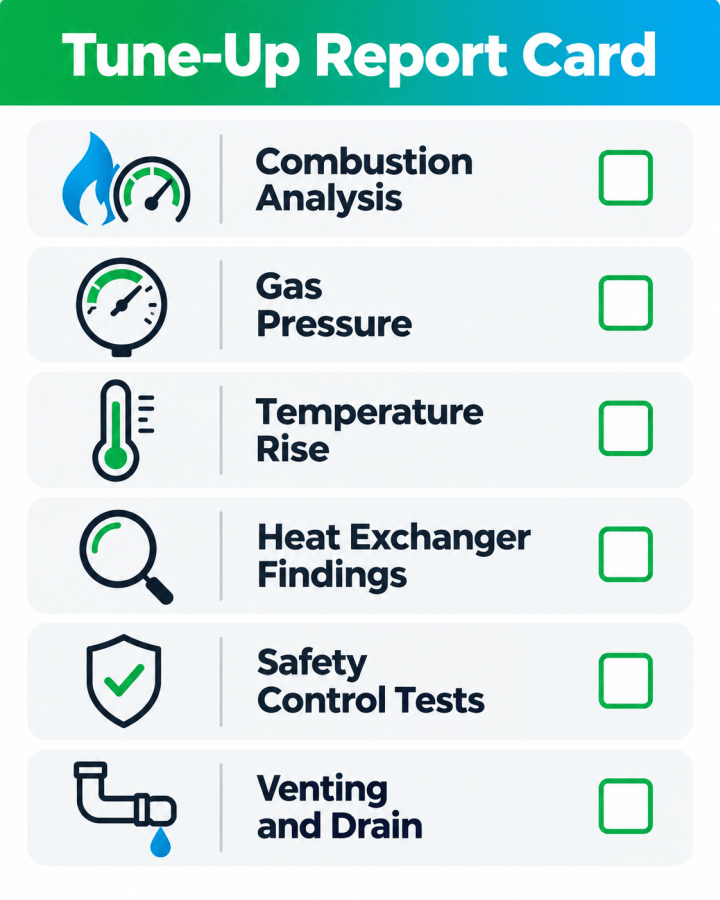
The Tune-Up Report Card: Six Results To Get In Writing
A furnace tune-up is only as good as what the technician measured. Ask for these six results in writing before the technician leaves. Filterbuy built this list so you can compare visits and quotes on the same terms.
Combustion analysis. Flue gas readings, including carbon monoxide, from an analyzer.
Gas pressure. The measured reading compared with the spec in your furnace's installation manual.
Temperature rise. How much the furnace warms the air, checked against the range on the rating plate inside the cabinet.
Heat exchanger findings. How it was inspected and what was found.
Safety control tests. Results for the overheat (high-limit) switch, flame sensor, and pressure switch.
Venting and drain condition. Flue, vent, and condensate drain findings.
How To Clean And Inspect Your Furnace Between Visits
Furnace cleaning between tune-ups is light, dry work: vacuum around the cabinet and inspect without taking anything apart. Turn off power first. Deep cleaning of burners and the heat exchanger belongs on the professional visit.
Keep anything that can burn at least 3 feet from the furnace.
Steady blue burner flames are normal. Yellow or orange flames, soot, or a rotten-egg smell mean shut the furnace down and call a technician.
If you smell gas, leave the house and call your gas utility from outside. For the full process by fuel type, see Filterbuy's step-by-step furnace cleaning guide.
Which Furnace Filter Keeps Maintenance On Track?
The filter is the part you replace yourself between tune-ups. Finding your size is easy: read it off your old filter, or measure the filter slot if there isn't one. Then pick a MERV rating, the scale for how much a filter captures.
MERV 8 air filters are the standard choice for most homes.
MERV 11 air filters suit homes with allergies, asthma, pets, or pollen.
MERV 13 air filters are the pick for homes dealing with smoke.
Check your HVAC manual for the ratings it lists, the same way you confirm a size. The size on the frame is the ordering name, and the actual filter is cut slightly smaller by design so it slides in and seals.
Longer winter run times load filters faster, which is also why houses get dustier in winter. Filterbuy is a manufacturer, not a reseller. We cut, pleat, and frame filters to order in our own US plants, and custom air filter sizes are cut to the eighth of an inch. Filterbuy's guides cover choosing the right MERV rating and how to change a furnace filter. An air filter subscription ships the next one on schedule.
How To Choose Furnace Maintenance Services
Good furnace maintenance services are licensed for heating work in your state and hand you written results.
Before you book, confirm the visit includes all six report card results in writing. If a technician reports a cracked heat exchanger, ask to see the crack or the test result and get it in writing before you approve a replacement. Keep each year's report, since a reading that shifts year to year is worth a question.
Make The Fall Clock Change Your Furnace Maintenance Day
ENERGY STAR suggests planning check-ups around the spring and fall time changes, since contractors get busy once winter arrives, and the CDC ties carbon monoxide alarm checks to the same weekend. On the fall clock change:
Book the tune-up.
Swap the filter and write the date on its frame.
Test carbon monoxide and smoke alarms and check their batteries.
Pull last year's report to compare with this year's.
How We Built This Guide
Michelle Wan wrote this guide from federal guidance, the ACCA 4 QM standard, national cost guides, and Filterbuy's support practice. Licensed HVAC technician David Clark reviewed the technical steps. The comparison table, yearly cost total, clock-change routine, and tune-up report card are original to this page.
“I don’t want anyone to feel like they need an HVAC license just to pick the right filter. My job is to give you the straight answer, explain why it matters, and let you get back to your day.”
Michelle Wan, Brand Manager & Copywriter, Filterbuy
Supporting Statistics
1. Carbon monoxide is a yearly risk.
Each year, unintentional CO poisoning not linked to fires kills more than 400 Americans and sends more than 100,000 to emergency departments.
Why it matters: the CDC names gas and oil furnaces as CO sources and urges yearly service, so the Filterbuy report card starts with a combustion analysis.
Source: Carbon Monoxide (CO) Poisoning Basics, Centers for Disease Control and Prevention
2. Heating is a leading cause of home fires.
An estimated 32,200 U.S. home heating fires in 2021 caused 190 deaths, 625 injuries, and $442 million in losses.
Why it matters: the U.S. Fire Administration advises a yearly professional cleaning and inspection, the same fall tune-up in our checklist.
Source: Heating Fire Safety, U.S. Fire Administration
3. Heating is the biggest energy use in U.S. homes.
Space heating was 42% of home energy use in 2020, costing $519 per household on average, or $1,164 with fuel oil.
Why it matters: an $80 to $170 yearly tune-up is small next to a full season of heating bills.
Frequently Asked Questions About Furnace Maintenance
How Often Should A Furnace Be Serviced?
Once a year for gas, oil, propane, and electric furnaces, ideally in early fall. Filterbuy's guide to how long furnaces last explains how yearly service fits into a furnace's lifespan.
Does A Gas Furnace Need Maintenance Every Year?
Yes. The EPA, CPSC, and CDC recommend yearly professional service for fuel-burning heating systems, because combustion problems and blocked vents can let carbon monoxide build up indoors.
Is A Furnace Maintenance Plan Worth It?
Yes, when it bundles a fall furnace visit and a spring AC visit for less than you'd pay for two separate tune-ups.
Does Annual Furnace Maintenance Include Duct Cleaning?
No. The EPA doesn't recommend cleaning air ducts routinely, only as needed for substantial visible mold, pests, or debris coming out of registers.
Keep Your Furnace Ready All Winter
A fresh filter is the maintenance step you don't need to book. Check the size printed on your current filter and the highest MERV rating your HVAC manual supports, then shop Filterbuy air filters by size with fast and free 2-day delivery to most US states.
Glossary Of Furnace Maintenance Terms
Combustion Analysis: A flue gas test, including carbon monoxide, that confirms a furnace burns fuel correctly.
Heat Exchanger: The metal chamber that passes heat from burning fuel to household air while keeping combustion gases separate.
Flame Sensor: A metal rod that confirms the burner lit and shuts off the gas when it detects no flame.
Temperature Rise: The difference between return-air and supply-air temperature across a furnace.
Rating Plate: The furnace label listing its model, input rating, and temperature rise range.
High-Limit Switch: A safety control that shuts off the burners when the furnace overheats.
MERV: Minimum Efficiency Reporting Value, ASHRAE's 1 to 16 filter efficiency scale.
Carbon Monoxide (CO): An odorless, colorless gas produced when fuel burns that can cause illness and death.