
Furnace Installation Cost: Real Prices, Labor Fees, Permit Costs, Gas vs Electric Differences, and Honest Estimates
October 23, 2026
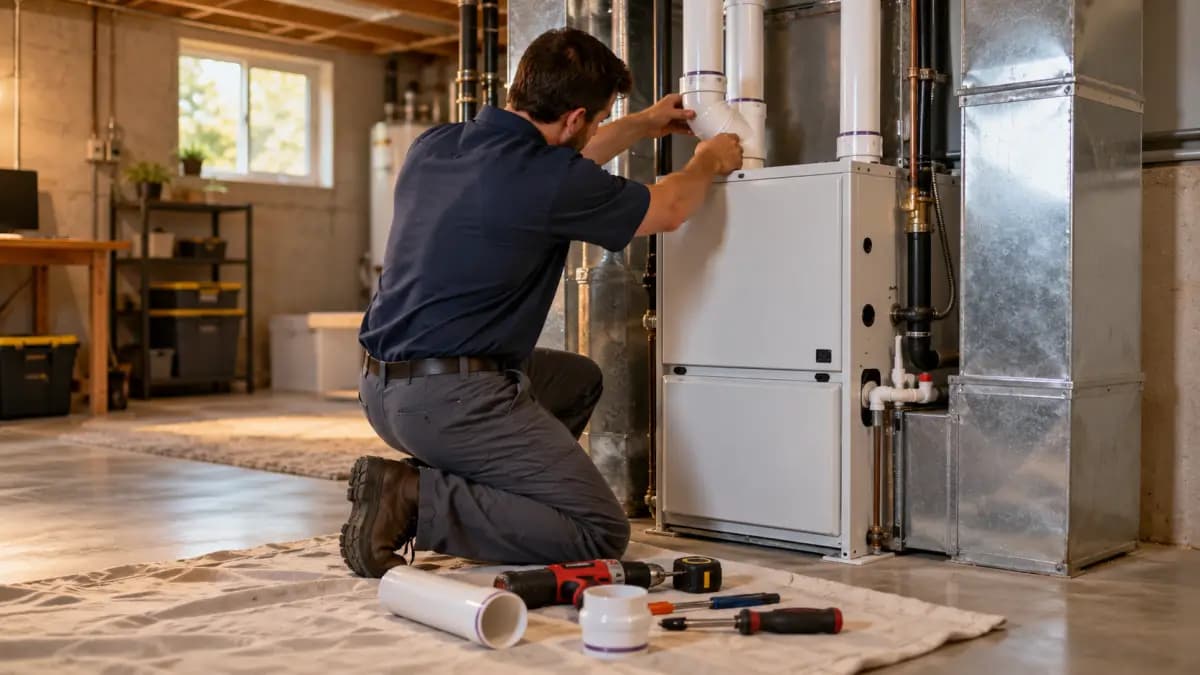
How Much Does Furnace Installation Cost In 2026?
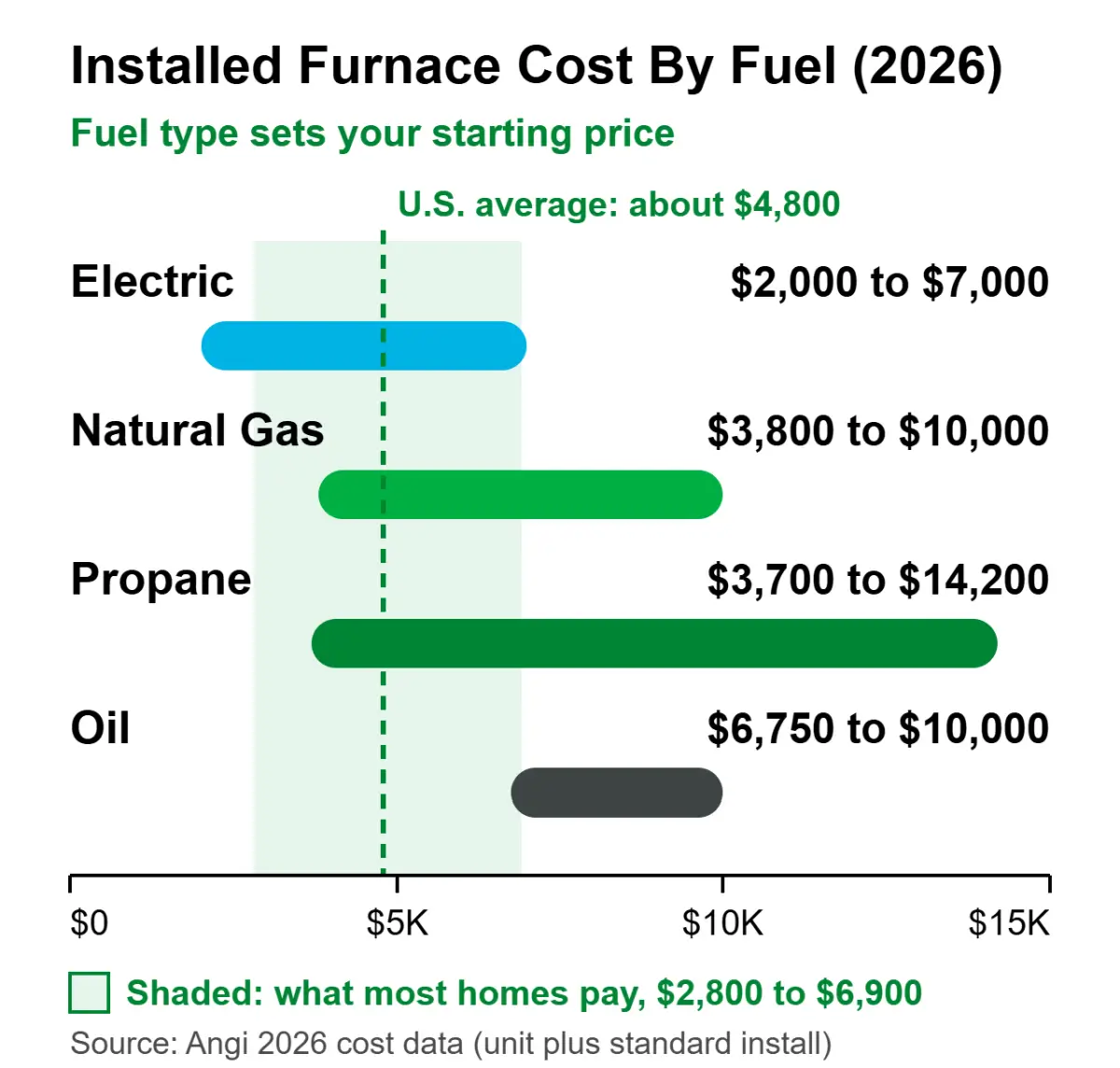
Most U.S. homeowners pay $2,800 to $6,900 to install a new furnace, and the 2026 national average is about $4,800. Electric furnaces typically run $2,000 to $7,000 installed, while gas furnaces run $3,800 to $10,000. The biggest swings between quotes come from permits and any venting or ductwork changes.
Once your new furnace is in, it needs the right filter from day one. Take the quick quiz below to find your filter match.
Explore Winter Furnace Filter Guides
Find Your New Furnace's Filter Match
Answer a few quick questions and we'll match you to the right filter for your furnace.
Furnace installation cost for most U.S. homeowners runs $2,800 to $6,900, and the national average sits near $4,800 in 2026. An electric furnace typically costs $2,000 to $7,000 installed, while a gas furnace runs $3,800 to $10,000. Labor, permits, venting changes, and ductwork repairs explain most of the gap between a low quote and a high one.
At Filterbuy, we break a furnace quote into its real line items and run the payback math on high-efficiency upgrades. We also cover the detail the major cost guides we reviewed leave out: the filter slot on your new furnace.
TL;DR
Furnace installation costs about $4,800 on average in 2026, and most homeowners pay $2,800 to $6,900. Gas furnaces cost more to install than electric models because they need gas piping and venting. Permits add $100 to $1,500, and replacement ductwork can add $2,000 to $5,000. Filterbuy recommends comparing at least three itemized quotes before choosing an installer.
Key Takeaways
The average furnace installation cost in 2026 is about $4,800, and most projects fall between $2,800 and $6,900, based on Angi data from 11,000+ projects.
HVAC labor generally runs $75 to $100 per hour, and a same-fuel swap is the least expensive job.
The federal minimum for most indoor gas furnaces is 80% AFUE, meaning 80% of the fuel becomes heat. Upgrading to a 90%-plus condensing furnace, which pulls extra heat from its exhaust, usually adds new venting and a drain.
By Filterbuy's math, an 80% to 95% AFUE upgrade pays back in roughly 4 to 12 years in northern states and 12 to 33 years in the South.
How Much Does Furnace Installation Cost in 2026?
A complete furnace installation, including the unit and standard labor, averages $4,814 nationally, according to 2026 cost data from Angi, a home services marketplace. Fuel type sets the starting range for any new furnace installation cost, and Angi reports prices of at least $5,000 in higher-cost states such as California.
Furnace Installation Cost By Fuel Type (2026)
Source: Angi 2026 cost data. Ranges include the unit and standard installation.
What Goes into the Cost to Install a Furnace?
A furnace installation quote has seven main line items: the furnace, labor, the permit, old unit removal, ductwork, water heater venting, and venting, gas, and electrical work. Everything after labor is where quotes for the same furnace drift thousands of dollars apart. Typical costs (Angi, Inch Calculator) and red flags:
Furnace unit: the largest share of the quote. Red flag: no brand or model number listed.
Labor: $75 to $100 per hour. Red flag: one lump sum with no scope of work.
Permit and inspection: $100 to $1,500. Red flag: the installer suggests skipping the permit.
Old unit removal: $60 to $350. Red flag: charged inside labor and again as its own line.
Ductwork: $2,000 to $5,000 if replaced. Red flag: full replacement with no inspection findings.
Water heater venting: when a condensing furnace leaves a shared chimney, the gas water heater may need a chimney liner or new vent. Red flag: no plan for the water heater vent.
Venting, gas, and electrical: PVC venting runs $200 to $500 and a condensate drain about $250, per PickHVAC. Red flag: missing on an upgrade from 80% to 95% AFUE.
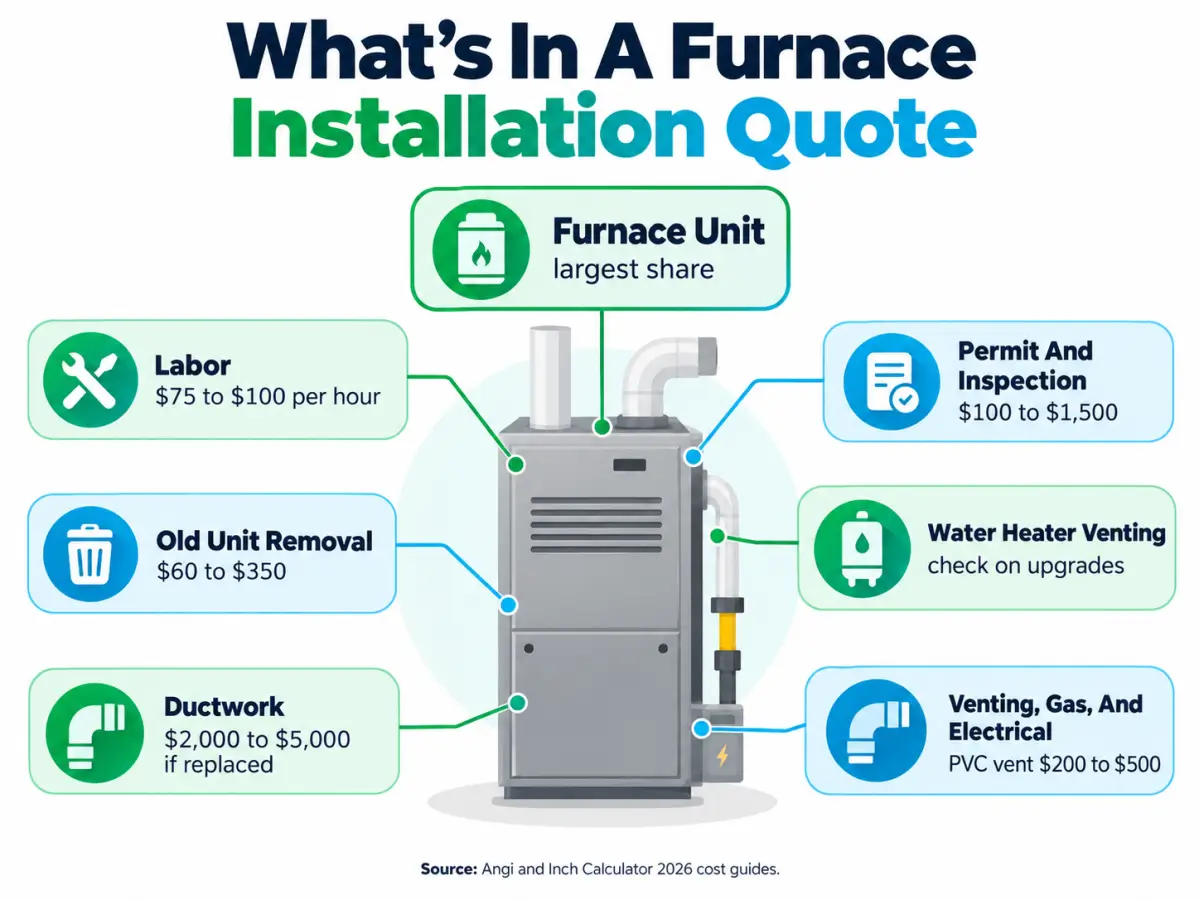
Filterbuy's take: line up each bid against these seven lines before you compare totals. If a low bid leaves out the permit or venting, expect those costs to come back as change orders.
Gas vs. Electric Furnace Installation Cost: Which Costs Less?
An electric furnace costs less to install than a gas furnace. Electric units typically run $2,000 to $7,000 installed, while the average gas furnace installation cost lands between $3,800 and $10,000 because of the gas line and flue (exhaust vent). Which one's cheaper to run depends on your local gas and electricity rates.
More than half of U.S. households used natural gas for space heating in 2020, according to the U.S. Energy Information Administration, including 70% of households in the Midwest and 35% in the South.
How Much Does Labor Cost for Furnace Installation?
Furnace installation labor typically costs $75 to $100 per hour, according to Angi. A like-for-like replacement keeps labor lowest because you're reusing the existing connections and ducts. A relocated furnace or rerouted vent adds hours.
Do You Need a Permit to Install a Furnace?
Most cities and counties require a mechanical permit, and often a separate gas permit, to replace or install a furnace. Permit fees range from about $100 to $1,500 depending on the jurisdiction. The permit brings an independent code inspection of the installer's work.
Before the new furnace runs, confirm you have working carbon monoxide alarms. The Consumer Product Safety Commission recommends CO alarms on each level of the home and outside sleeping areas.
Does Furnace Efficiency Change the Installation Price?
Yes. A higher-efficiency furnace costs more to buy and often to install. The federal minimum efficiency standard for most indoor gas furnaces is 80% AFUE. An upgrade from an 80% unit to a condensing model usually means new PVC venting.
ENERGY STAR certified gas furnaces in northern states are up to 18% more efficient than baseline models and save about $160 a year in energy costs, according to ENERGY STAR furnace data. Southern models are up to 16% more efficient and save about $60 a year.
The U.S. Department of Energy adopted a standard requiring new non-weatherized gas furnaces to reach 95% AFUE by December 18, 2028. On June 8, 2026, the U.S. Supreme Court vacated the appeals court decision that had upheld that rule and sent the case back for further consideration, according to the Supreme Court docket for American Gas Association v. Department of Energy. As of October 2026, 80% AFUE gas furnaces remain legal to sell and install.
The federal Section 25C tax credit ended for equipment placed in service after December 31, 2025, according to IRS guidance on the 25C credit. Check your local utility or the DSIRE incentives database for current furnace rebates.
Honest Estimates: How Furnace Installation Cost Changes by Job Type
To estimate your own furnace installation cost, start from the base range for your fuel type and add only the line items your home needs.
Furnace Installation Cost By Job Type
Base ranges from Angi 2026 cost data. Upgrade add-on from PickHVAC estimates.
Filterbuy's payback math: divide the $700 to $1,950 upgrade cost by ENERGY STAR's annual savings estimates. That works out to roughly 4 to 12 years in northern states and 12 to 33 years in southern states. With most furnaces lasting 15 to 20 years, the 95% furnace usually earns its keep in the North, while a quality 80% furnace is often the smarter buy in the South. New systems and fuel switches benefit most from a Manual J load calculation, the industry-standard method for sizing a furnace to your home.
Repair, Replace, or Upgrade? A Three-Question Check
Is the furnace 15 years or older? Most furnaces last about 15 to 20 years, according to Filterbuy's furnace lifespan guide. Planning ahead lets you compare quotes before a midwinter breakdown.
Would the repair cost more than half the price of a new furnace? This Old House suggests replacing at that point, and Filterbuy's furnace replacement cost guide covers how to budget for it.
Where do you live? In northern states, price the 95% AFUE upgrade. In southern states, a quality 80% furnace usually makes more financial sense.
What to Confirm on a Furnace Quote Before You Sign
A trustworthy furnace installation quote puts the equipment and the full scope of work in writing. Use this Filterbuy checklist to confirm it lists:
The furnace brand, model number, and AFUE rating
The BTU size (heating capacity) and the load calculation behind it
The permit and inspection, with the fee included
Removal and disposal of the old unit
Any venting, gas, electrical, or ductwork changes
Labor and equipment warranty terms
The filter size the new furnace takes
"When comparing contractors' proposals (bids), be sure to compare cost, energy efficiency and warranties."
ENERGY STAR, 10 Tips for Hiring a Heating and Cooling Contractor
Supporting Statistics
$29.33 per hour. That's the median wage for HVAC mechanics and installers (May 2025). Contractor rates also cover insurance and overhead. Source: Bureau of Labor Statistics Occupational Outlook Handbook
400+ deaths a year. Unintentional carbon monoxide poisoning not linked to fires causes them. Another 100,000+ people visit an emergency department. The CDC advises yearly heating system service by a qualified technician. Source: CDC's carbon monoxide poisoning facts
27,900 heating fires in 2023. They caused 115 deaths, 525 injuries, and $488 million in losses. Source: U.S. Fire Administration heating fire data
Protect Your New Furnace from the First Day
Filterbuy cuts, pleats, and frames filters to order in its own US plants, so we suggest one step for installation day: have the installer confirm the filter size and rack location, then write the size on the cabinet.
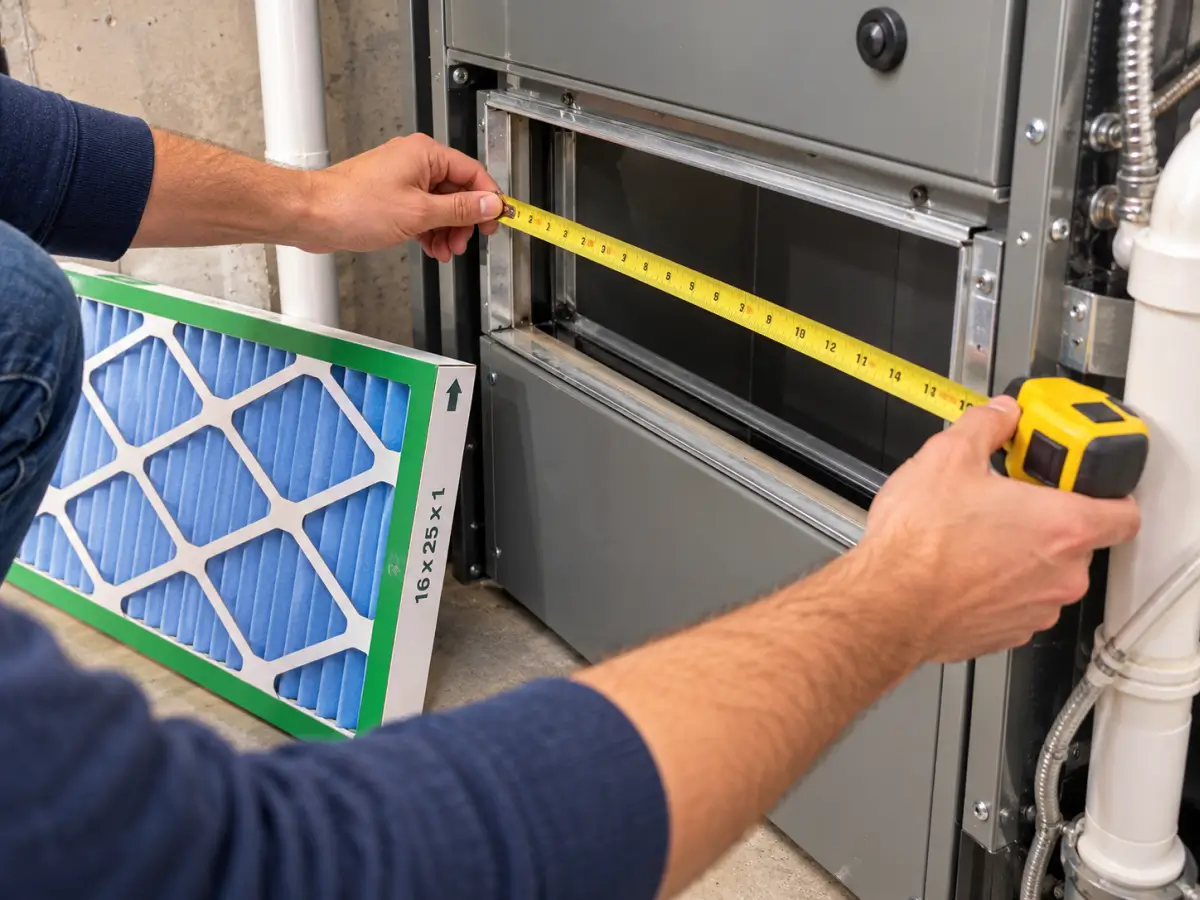
Use Filterbuy's furnace filter size guide to find your size, then follow a regular schedule for how often to change your furnace filter. Filterbuy makes three MERV tiers (MERV rates how well a filter captures airborne particles). MERV 8 is the standard choice for most homes. MERV 11 is built for allergy sufferers and homes with pets or pollen. MERV 13 is the pick for homes dealing with smoke. As with sizing, check your furnace manual to make sure the MERV rating fits your system, and see Filterbuy's MERV rating guide to compare the tiers.
Frequently Asked Questions About Furnace Installation Cost
How Long Does Furnace Installation Take?
A straightforward furnace replacement typically takes one day. Jobs with new ductwork or a fuel switch can take two to three days, plus time for the permit inspection.
Can I Install a Furnace Myself?
Furnace installation is a job for a licensed HVAC contractor. Gas piping and combustion testing carry carbon monoxide and fire risks, and many jurisdictions issue gas permits only to licensed contractors.
Will a New Furnace Need a Different Filter Size?
It can. A new furnace may take a different size than the old one. Check the size printed on the filter frame that came with it, or measure the slot if there isn't one. Finding your size on Filterbuy is quick, and if it isn't listed, Filterbuy cuts custom sizes to the eighth of an inch.
When Is the Cheapest Time to Install a Furnace?
The furnace install price is often lowest in spring and summer, according to This Old House, because contractors are less busy.
Glossary
AFUE (Annual Fuel Utilization Efficiency): The percentage of fuel a furnace turns into usable heat over a typical year.
BTU (British Thermal Unit): A unit of heat. Furnace capacity is rated in BTUs per hour.
Condensing Furnace: A 90%-plus AFUE gas furnace that pulls extra heat from its exhaust.
Manual J Load Calculation: The Air Conditioning Contractors of America method for calculating a home's heating and cooling needs.
MERV (Minimum Efficiency Reporting Value): A rating of how well an air filter captures airborne particles.
Start your new furnace with a filter that fits. Shop Filterbuy air filters in hundreds of standard and custom sizes. Set up auto-delivery and get fast and free 2-day delivery to most US states.