
Gas Furnace Guide: Cost, Prices, Installation Process, AFUE Efficiency Ratings, BTU Sizing, and Residential Buying Tips
October 12, 2026

How Much Does a Gas Furnace Cost?
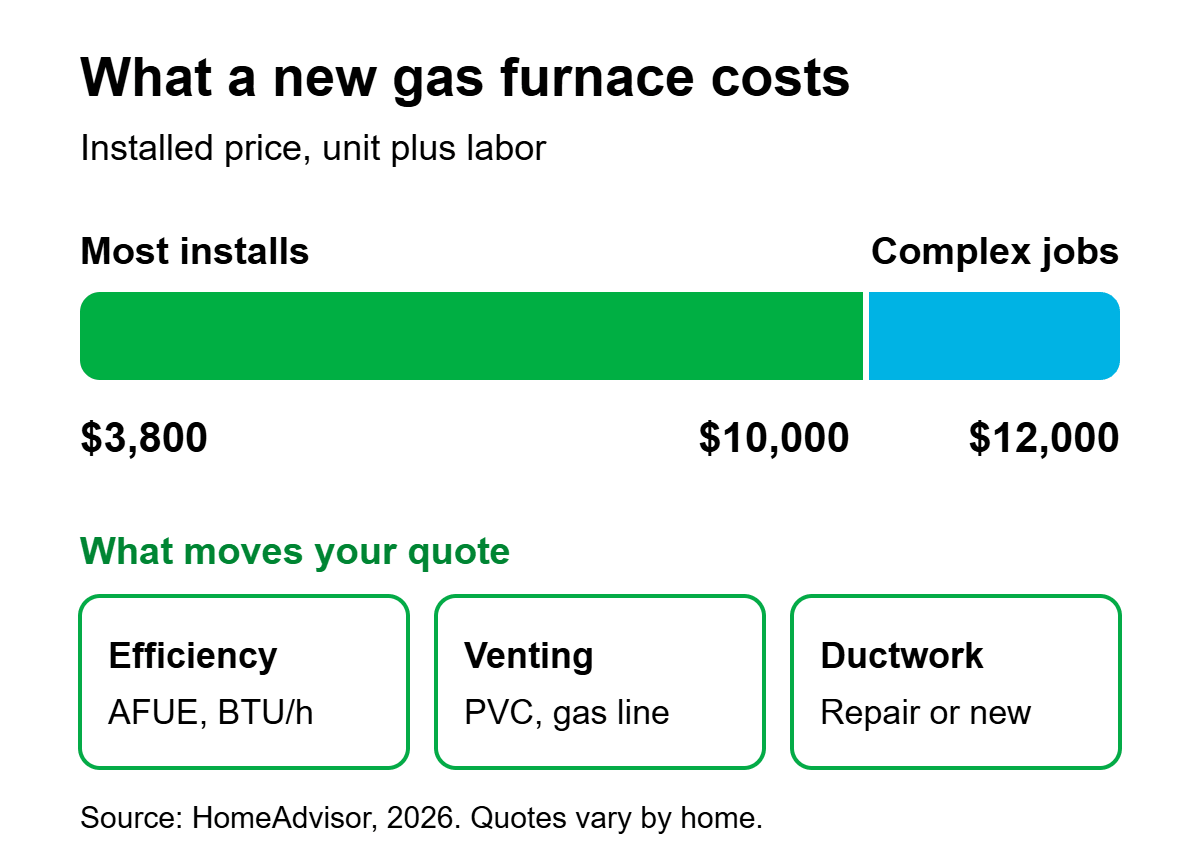
A new gas furnace usually costs $3,800 to $10,000 installed, and complex jobs can reach $12,000. Your quote depends on efficiency (AFUE), heating capacity (BTU/h), venting, and ductwork.
A condensing model costs more upfront but burns less gas. The filter is the part you'll maintain yourself, so use the quiz below to find your match.
Answer a few quick questions and we'll match you to the right filter for your furnace.
Planning for winter? Browse more Furnace Filters and Winter guides
TL;DR
A new gas furnace usually costs $3,800 to $10,000 installed, and complex jobs can reach $12,000. Price depends on the efficiency rating (AFUE), heating capacity (BTU/h), and how much venting or ductwork the job needs. Size it with a Manual J load calculation, a room-by-room heat-loss estimate, not square footage alone. A condensing model, which pulls extra heat from its exhaust, costs more upfront but burns less gas.
Key Takeaways
• AFUE is the efficiency score. An 80% AFUE furnace turns 80 cents of every gas dollar into heat. A 96% AFUE furnace turns 96 cents into heat.
• Minimum efficiency is in flux. The federal minimum is 80% AFUE today. A 95% minimum for furnaces made after December 18, 2028 is still under court review as of October 2026.
• Plan past the box. Venting, ductwork, and even your water heater can change the final quote.
• The filter protects the investment. As a filter manufacturer, Filterbuy sees the filter slot as the one part homeowners control.
What Is a Gas Furnace and How Does It Work?
A gas furnace is a forced-air heating system. It burns natural gas or propane to warm air, then blows that air through your home's ducts.
1. Your thermostat calls for heat.
2. The burners light and warm a metal heat exchanger.
3. The blower pulls return air from your home through the air filter.
4. Filtered air passes over the hot heat exchanger and picks up heat.
5. Warm air travels through the supply ducts to each room, while combustion gases vent outdoors.
Why a filter maker wrote this guide. Filterbuy cuts, pleats, and frames filters to order in our own US plants. So we see a furnace from the return side, where heated air passes through the filter first. That's why this guide follows the furnace past installation day.
Gas furnaces come in three styles: single-stage (full output, then off), two-stage (mostly a gentle low setting), and modulating (small output steps for the steadiest, quietest heat at the highest price).
How Much Does a Gas Furnace Cost in 2026?
A new gas furnace usually costs $3,800 to $10,000 installed, and complex jobs can reach $12,000, according to HomeAdvisor. These factors move your bid up or down:
• Efficiency and size. Higher AFUE and more BTU/h cost more upfront.
• Venting and gas lines. A condensing furnace often needs new PVC vent pipes and a drain line.
• Ductwork. Leaky or undersized ducts add repair or replacement costs.
• Permits. Most areas require one for a gas furnace swap.
• Removal. Hauling away the old furnace runs $60 to $330, per HomeAdvisor.
Budget for upkeep, too. HomeAdvisor puts annual maintenance at $100 to $300. Spread over an 18-year life, a $6,300 install works out to about $350 a year.
Don't forget filters. At Filterbuy's auto-delivery price (August 2026), a 20x25x1 MERV 8 filter is $7.91. Four changes a year comes to about $32, or about $38 for MERV 11. That's small next to a $100 to $300 tune-up. Prices vary by size; see the air filter subscription page.
Rebates. The federal 25C credit ended in 2025 (see the FAQ below). Check the ENERGY STAR Rebate Finder and your gas utility.
What Do AFUE Efficiency Ratings Mean?
AFUE (Annual Fuel Utilization Efficiency) is the share of a year's fuel that a gas furnace turns into usable heat, per the U.S. Department of Energy.
Source: U.S. Department of Energy, Energy Saver: Furnaces and Boilers.
Our math on the difference. Say an 80% AFUE furnace costs you $700 a year in gas. A 96% furnace making the same heat burns about 17% less gas. That's roughly $583 a year, or about $117 saved. Over 15 years, you'd keep about $1,750 before gas prices change. Your result depends on climate and local gas rates.
ENERGY STAR certified northern models are up to 18% more efficient than baseline and save about $160 a year.
Is the 95% AFUE Rule Still Happening?
The federal minimum for indoor (non-weatherized) gas furnaces is 80% AFUE today. In 2023, DOE finalized a rule requiring 95% AFUE for these furnaces made after December 18, 2028.
On June 9, 2026, the U.S. Supreme Court vacated the appeals-court ruling that upheld the rule and sent the case back for review, Contracting Business reported. As of October 2026, the standard is still in effect, and DOE is still weighing a delay to January 1, 2030. Filterbuy's take: if your home can vent a condensing unit, a 95%+ furnace keeps you ahead of the rule either way.
What Size Gas Furnace Do I Need? (BTU Sizing)
Furnace size means heating capacity, measured in BTU/h (British Thermal Units per hour). The right number comes from an ACCA Manual J load calculation, a room-by-room heat-loss estimate that accounts for climate, insulation, windows, and air leaks.
For a quick check, HomeAdvisor's rule of thumb is 30 to 60 BTU/h per square foot. We did the math for common home sizes:
Source: HomeAdvisor rule of thumb of 30–60 BTU/h per square foot; Filterbuy math. Climate and insulation decide where your home falls. Planning estimate only; a Manual J load calculation sets the final size.
Bigger isn't better. An oversized furnace short-cycles, meaning it turns on and off too often, which causes temperature swings and extra wear. An undersized one runs nonstop. AFUE also changes delivered heat: a 100,000 BTU/h furnace at 80% AFUE delivers about 80,000 BTU/h, and a 96% model delivers about 96,000. Filterbuy's guide to choosing the right furnace size walks through the full process.
What Happens During Gas Furnace Installation?
A licensed pro should install a gas furnace, because the job involves gas lines and combustion venting. The job usually follows these steps:
1. Load calculation and quote. The contractor runs Manual J, inspects ducts and venting, and itemizes equipment, labor, and permits.
2. Permit. Most areas require a mechanical permit for a gas appliance swap.
3. Removal. The crew shuts off gas and power, then removes the old furnace.
4. Set the new unit. The furnace is leveled and connected to the supply and return ducts.
5. Venting. An 80% furnace connects to a metal flue (exhaust pipe) or lined chimney. A condensing furnace gets PVC intake and exhaust pipes plus a condensate drain.
6. Gas and electrical. The installer connects the gas line, tests the joints for leaks, and wires the furnace and thermostat.
7. Startup and combustion test. The technician checks gas pressure, temperature rise (how much the air warms), airflow, and flue gases against the manufacturer's specs.
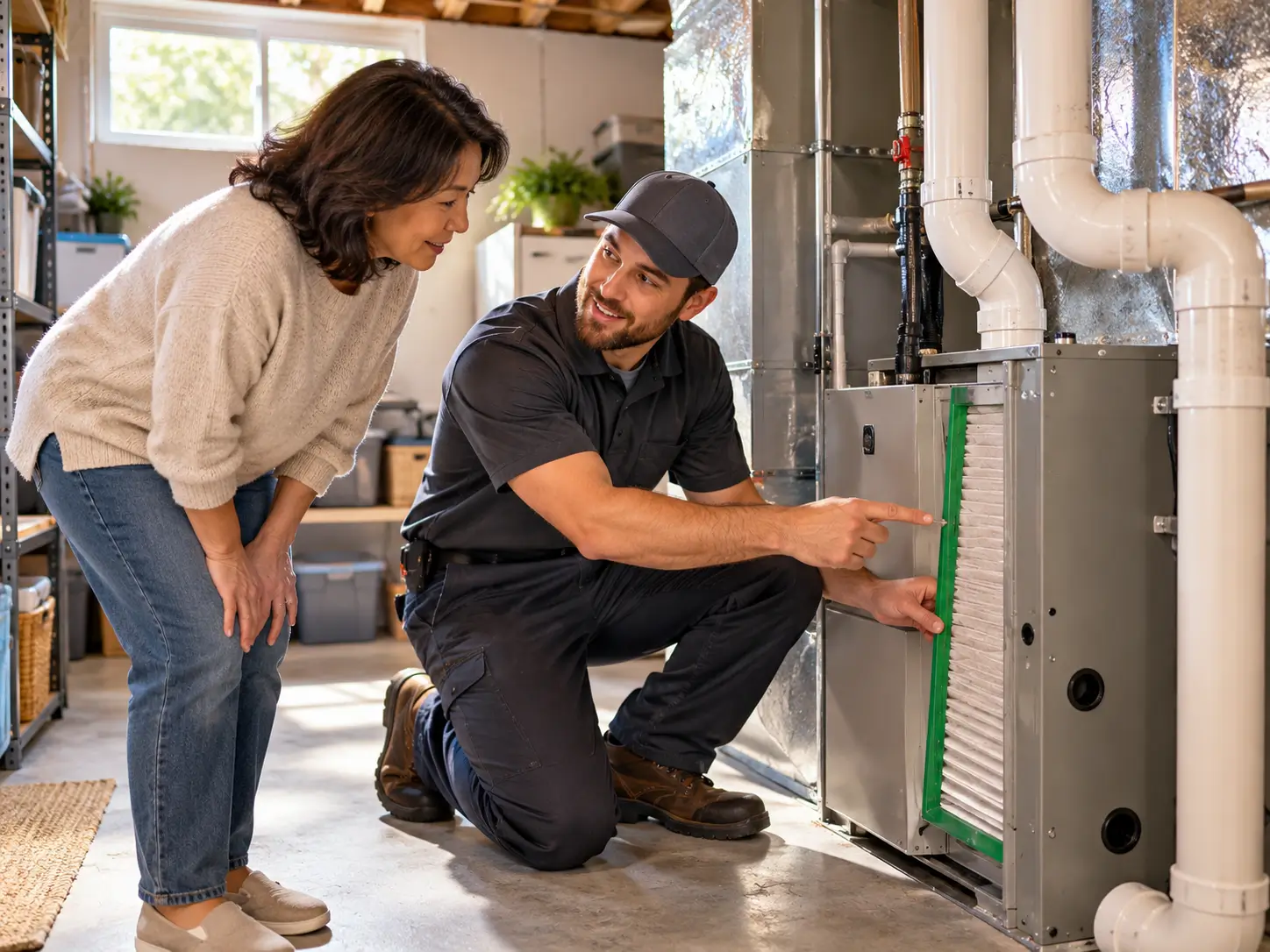
8. Filter and final walkthrough. A fresh filter goes in and the inspector signs off. Ask the crew to show you the filter slot.
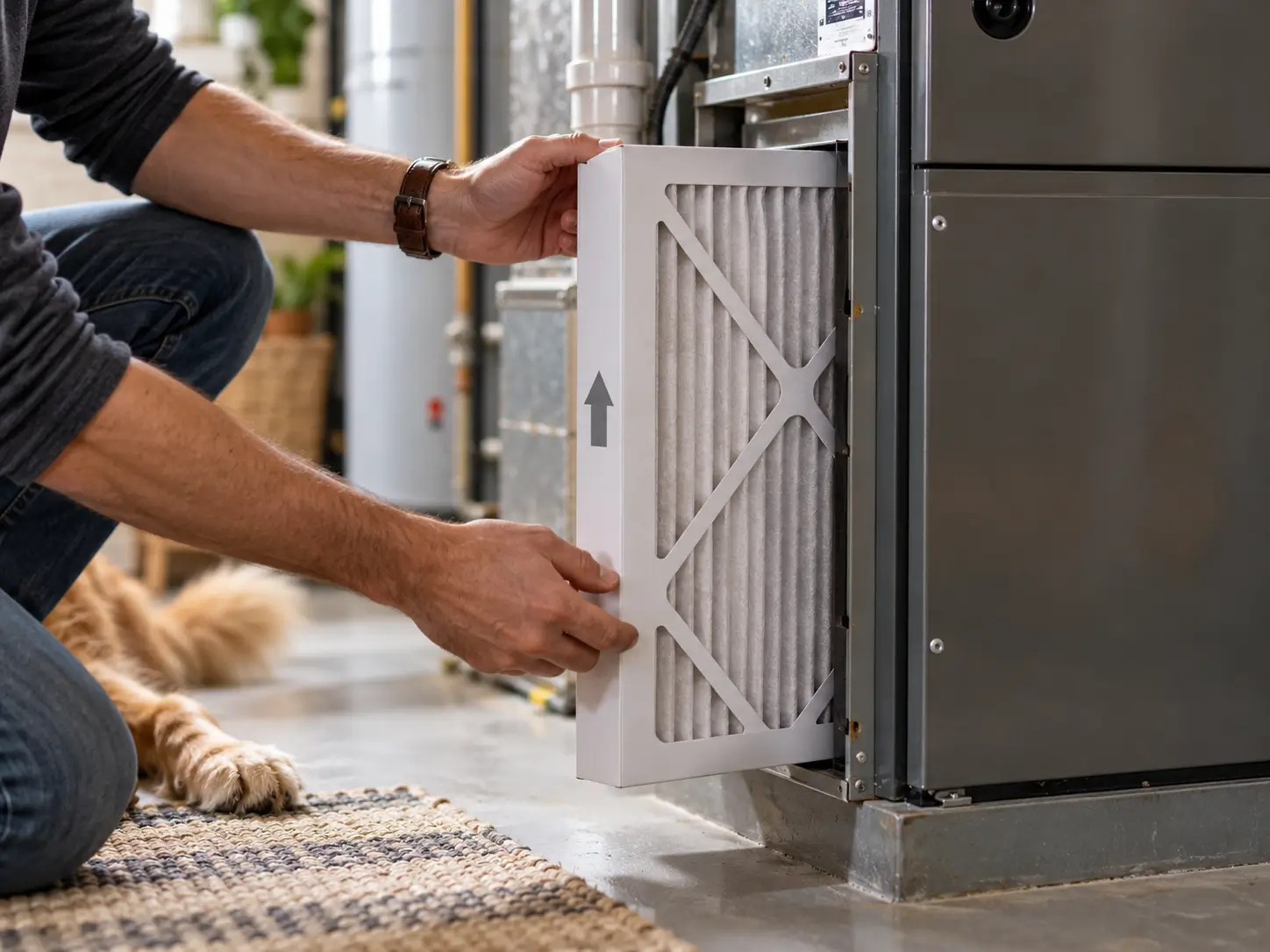
Before the crew leaves. Note the size printed on the new filter's frame, and write the install date on it in marker. A new furnace can take a different filter size than the old one. The filter should slide in with light friction. If it rattles or you have to force it, it's the wrong size.
Residential Gas Furnace Buying Tips
• Match efficiency to climate. A 95%+ AFUE furnace pays back fastest in long, cold winters. In mild climates, a lower-cost model may make sense.
• Replace before an emergency. ENERGY STAR suggests considering replacement once a furnace passes 15 years, or sooner if repairs and bills keep climbing.
• Ask what happens to your water heater. A new 90%+ furnace stops using the chimney. The U.S. Department of Energy warns that this can leave a gas water heater venting alone through a flue that's now too big. That causes condensation and poor draft, so budget for a chimney liner or a separately vented water heater.
• Get three itemized quotes. Each should list model numbers, AFUE, BTU/h capacity, permit fees, and the Manual J result.
Protect Your New Furnace With the Right Air Filter
Your new furnace runs best with a clean filter and a yearly tune-up. ENERGY STAR recommends booking a heating check-up each fall.
“I don’t want anyone to feel like they need an HVAC license just to pick the right filter. My job is to give you the straight answer, explain why it matters, and let you get back to your day.”
Michelle Wan, Brand Manager and Air Quality Writer, Filterbuy
Choosing a MERV rating. MERV is a filter's capture rating. MERV 8 is the standard choice for most homes. MERV 11 is for allergies and asthma, plus pets and pollen. MERV 13 is the pick for smoke. Odor Eliminator is for odors. Check your HVAC manual for compatibility, the same way you'd confirm a size. Filterbuy's MERV rating chart compares them.
Filterbuy's sizing data. In our manufacturing data, 16x25x1 is the most common furnace slot size, and 20x20x1 is the most common size nationwide. Nominal size is the ordering name. The actual cut is smaller on purpose, so a 16x25x1 measures 15.5 x 24.5 x 0.75 inches. That clearance is what makes it fit.
Depth matters more than pleat count. Our 1-inch filter has 14 pleats per foot and our 4-inch has 8, because each pleat runs deeper. If your new furnace has a 4-inch media cabinet (a deeper filter housing), plan on changes every 3 to 6 months instead of 60 to 90 days.
Finding your size is easy. Measure the old filter, or the slot if there isn't one, and check our air filter sizes chart. Filterbuy makes more than 600 sizes, and if yours isn't listed, we'll cut a custom size to the eighth of an inch. Set up auto-delivery for fast, free 2-day delivery to most US states.
Supporting Statistics
1. 42% of U.S. home energy goes to space heating.
◦ Gas-heated homes spent $519 a year on average.
◦ Why it matters: small AFUE gains add up over a furnace's life.
◦ Source: U.S. Energy Information Administration, 2020 survey of 18,496 homes
2. Up to 35% of furnace output can leak from ducts.
◦ Losses peak when ducts run through attics, garages, or crawl spaces.
◦ AFUE ratings don't count these losses.
◦ Why it matters: ask your installer to inspect and seal ducts.
◦ Source: U.S. Department of Energy
3. 200+ Americans die each year from consumer-product carbon monoxide.
◦ Malfunctioning furnaces are among the sources.
◦ Why it matters: book a yearly inspection and put CO alarms on each level of your home.
◦ Source: U.S. Consumer Product Safety Commission
Gas Furnace FAQs
How Long Does a Gas Furnace Last?
A well-maintained gas furnace usually lasts 15 to 20 years. Filterbuy's gas furnace lifespan guide covers the signs it's wearing out.
Is a 95% AFUE Gas Furnace Worth the Extra Cost?
Usually, in cold climates, where the gas savings add up fastest. If your home can't vent a condensing unit, an 80% model may make more sense.
Is There a Federal Tax Credit for a Gas Furnace in 2026?
No. The IRS Form 5695 instructions confirm the 25C credit, once worth up to $600 for a gas furnace, ended for installs after December 31, 2025. Check state and utility rebates.
How Often Should I Change My Furnace Filter?
Check it monthly. Hold it against a sheet of white paper, and if it looks gray and matted, replace it. Most 1-inch filters last 60 to 90 days, and homes with pets need changes sooner. See Filterbuy's filter change guide.
Gas Furnace Glossary
• AFUE (Annual Fuel Utilization Efficiency): The percentage of a furnace's yearly fuel that becomes usable heat in the home.
• BTU/h (British Thermal Units per hour): The hourly heating capacity of a furnace. One BTU raises one pound of water by 1°F.
• Condensing furnace: A 90%+ AFUE gas furnace that captures exhaust heat and drains the resulting water.
• Heat exchanger: The sealed metal chamber that moves burner heat into household air while keeping combustion gases out.
• Manual J: The Air Conditioning Contractors of America (ACCA) standard method for calculating a home's heating and cooling load.
• MERV (Minimum Efficiency Reporting Value): A 1–16 scale that rates how well an air filter captures particles.
• Non-weatherized furnace: A furnace installed indoors, such as in a basement, closet, or attic. It's the category covered by the 95% AFUE rule.
The Bottom Line on Buying a Gas Furnace
Judge a gas furnace on total cost over its life, not sticker price. Then protect it with a fresh, correctly sized filter from day one. Find your furnace filter size and breathe easy.
About the Author and Reviewer
Michelle Wan is Filterbuy's Brand Manager and Air Quality Writer (B.A., University of California, Santa Cruz). David Clark, Licensed HVAC Technician with Filterbuy HVAC Solutions, reviewed this guide.