
House Furnace Blowing Cold Air? Top Causes, Troubleshooting Steps, DIY Fixes, And Why A Dirty Filter Could Be The Culprit
October 6, 2026
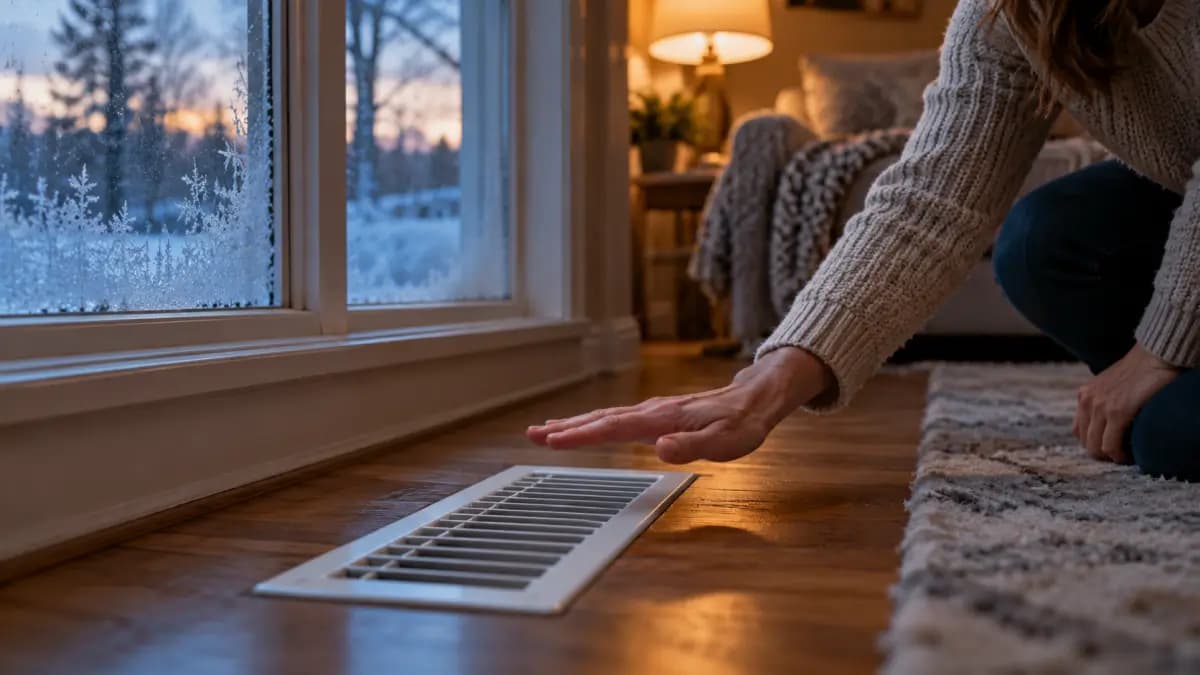
A house furnace blows cold air when it stops making heat while its blower keeps running. The two most common causes are a thermostat fan set to ON and a clogged air filter that trips the furnace's overheat safety switch.
Check the thermostat first, then the filter, with no tools needed. If the filter's due, the quiz below matches you to the right replacement.
Jump to: match your cold air pattern or see the six safe troubleshooting steps
Answer a few quick questions and we'll match you to the right filter for your system.
A house furnace blowing cold air is usually a furnace that has stopped making heat while its blower keeps running. The two most common causes are a thermostat fan set to ON and a clogged air filter that trips the furnace's overheat safety switch. You can rule out both without tools. An ignition or gas supply problem comes next.
TL;DR
When a furnace blows cold air, start with the thermostat (Heat mode, fan on AUTO), then pull the air filter. A dirty filter can starve the furnace of airflow until a safety switch shuts off the burners. If those checks pass, or you smell gas, call a licensed HVAC technician.
Key Takeaways
A thermostat fan set to ON blows room-temperature air between heating cycles, and it feels cold.
A clogged filter can trip the furnace's overheat safety switch, so a working furnace blows cold air.
If you smell gas or a carbon monoxide alarm sounds, get everyone outside and call 911.
Why Is My Furnace Blowing Cold Air? Start With When It Happens
A furnace blows cold air when it stops making heat while its blower keeps running. When the cold air shows up points to why. Match your pattern to the table below.
Warm But Not Hot: When Lukewarm Air Is Normal
Lukewarm air isn't always a fault. A gas furnace's rating plate lists its approved temperature rise, the warming it should add to passing air, and a technician can check yours against it. Cooler air in far rooms often points to leaky ducts, and ENERGY STAR estimates that a typical house loses 20 to 30 percent of its duct air to leaks.
Six Troubleshooting Steps To Try Before You Call A Technician
These six checks need no tools. Work through them in order before calling for service.
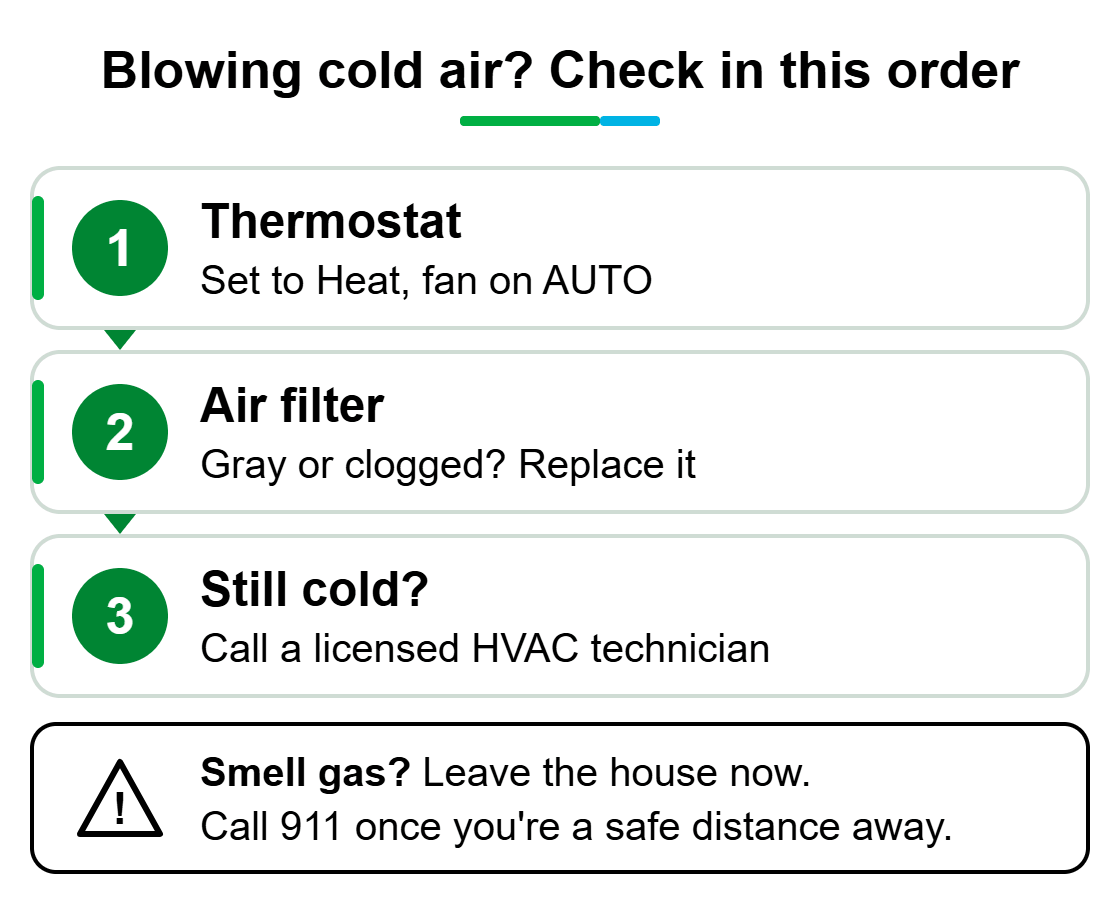
Set the thermostat correctly. Confirm the system is on Heat, the set temperature is a few degrees above the room, and the fan is on AUTO. Replace the batteries if the display is blank.
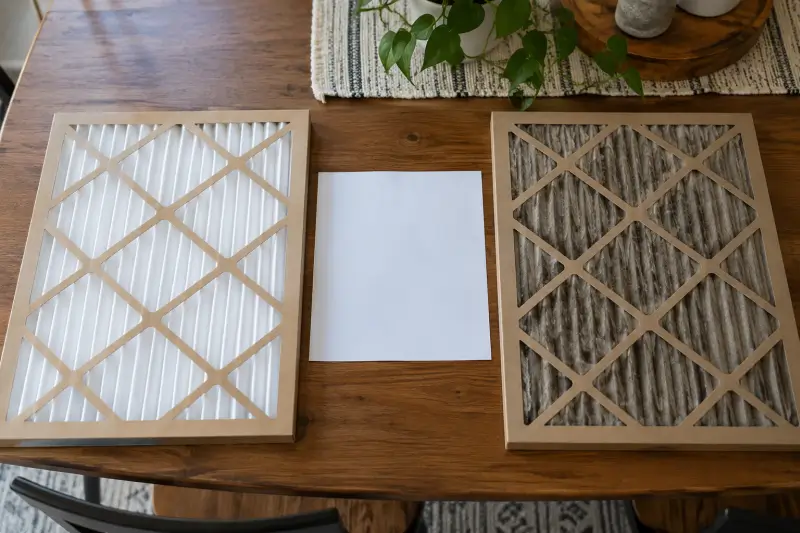
Pull and inspect the air filter. Turn the system off, find where your air filter is located, and slide it out. Hold it up to a light, or next to a sheet of white paper, the dirty filter check the American Lung Association recommends. If light barely passes through or the media looks gray, replace it with the exact same size. Filterbuy's guide to which way a furnace filter goes shows where the arrow points.
Open supply vents and clear return grilles. Closed registers and furniture against a return, the vent that pulls air back to the furnace, cut airflow like a dirty filter does.
Check the power and the furnace door. Check the service switch (a light switch near the furnace), the breaker, and the blower door. A loose door panel can keep the furnace off.
Confirm the gas supply. A gas valve handle parallel to the pipe is open. Propane homes should check the tank gauge. Only relight a pilot if your manual explains how, and stop at once if you smell gas.
Read the error light, then reset once. Write down the status code flashing in the panel window, switch the furnace off for a minute, then back on. If the cold air returns, leave it off and give the technician the code.
Why A Dirty Filter Makes A Furnace Blow Cold Air
A dirty air filter makes a furnace blow cold air by starving it of airflow. A gas furnace needs steady airflow across its heat exchanger, the metal chamber that passes heat into your home's air. When a clogged filter chokes that airflow, the heat exchanger runs too hot, and the high limit switch, the furnace's overheat safety control, shuts off the burners. The blower keeps running, and that unheated air is what you feel at the vents.
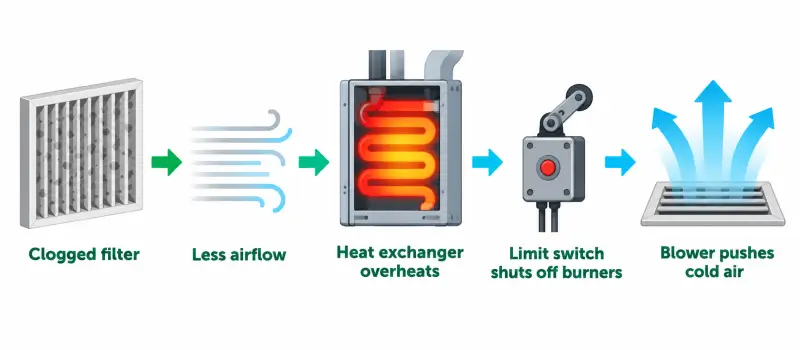
Once the furnace cools, the limit switch resets and the cycle starts over, which is why the air runs warm, then cold, then warm again. Repeated overheating also stresses the heat exchanger, and the U.S. Department of Energy warns that a leaking furnace heat exchanger mixes combustion gases with house air.
Five Filter Problems That Make A Working Furnace Blow Cold Air
A dirty, wrong-size, backward, or collapsed filter, or a forgotten second one, can make a working furnace blow cold air. Filterbuy makes furnace filters, so we check that side first. The table below compares all five. Our rundown of signs of a clogged furnace filter covers other symptoms.
Finding your size is easy. It's printed on the old filter's frame, and that nominal size is what you order. We cut each filter slightly smaller by design so it fits, which is why a 20x25x1 measures 19.5 x 24.5 x 0.75. Read all three numbers, since Filterbuy's manufacturing team sees depth ordered wrong most often. No old filter? Measure the slot with our walkthrough on how to measure your air filter size.
"The question I get most is which MERV to buy. The one to ask first is whether the filter you are holding actually fills the slot. A rating describes the media, not the gap around it."
Michelle Wan, Brand Manager and Air Quality Writer, Filterbuy
MERV, the industry rating for how much a filter captures, climbs as filtration gets finer. Check your HVAC manual for the ratings it takes, the same quick fit check you'd do for size, then see how MERV 8, MERV 11, and MERV 13 compare.
Gas Furnace Blowing Cold Air? Check These Ignition And Gas Supply Causes
A gas furnace blowing cold air with a clean filter and correct settings usually has a heat production problem: the burners never light, or they light and shut off within seconds. These are jobs for a licensed HVAC technician.
Igniter or pilot light. A cracked hot surface igniter, or a standing pilot that won't stay lit, means no heat.
Flame sensor. This rod confirms the burners are lit. A coated one misreads a real flame as no flame and shuts off the gas within seconds.
Inducer motor and pressure switch. A blocked vent or failed inducer fan stops the ignition sequence before the burners light.
Condensate drain. A clogged drain on a high-efficiency furnace can trip a float switch that shuts down the heat.
When To Stop And Call A Licensed HVAC Technician
Call a licensed HVAC technician when the filter and thermostat checks pass but the air stays cold, or the error light keeps flashing. Some signs call for leaving the house first.
You smell gas. Pipeline safety regulators advise leaving at once without touching light switches or phones, then calling 911 from a safe distance. Read the full list of what to do if you smell gas.
A carbon monoxide alarm sounds. Get everyone into fresh air and call 911.
You see soot, scorch marks, or melted wiring, or hear a boom when the burners light. Shut the furnace off and call for service.
U.S. EPA carbon monoxide guidance calls for a yearly professional heating inspection and, citing the Consumer Product Safety Commission, carbon monoxide (CO) alarms on every level outside sleeping areas. The National Fire Protection Association (NFPA) home heating fire research repeats the yearly inspection advice and calls for three feet of clearance around heating equipment.
Before you call a technician, such as Filterbuy HVAC Solutions in its service area, gather these details:
The error code from the panel window.
Which cold air pattern from the table above matches yours.
Your filter size and the date you last changed it.
Your fuel type, and whether the furnace is high-efficiency.
What Filterbuy's HVAC Reviewer Sees In The Field
"Most systems I test are not struggling because the filter is too efficient. They are struggling because it has been in there since spring."
David Clark, Licensed HVAC Technician
How To Keep Your Furnace From Blowing Cold Air Again
ENERGY STAR, the U.S. Environmental Protection Agency's efficiency program, names dirt and neglect as the top causes of heating and cooling system failure. Its guide to keeping an HVAC system working efficiently advises checking the filter once a month.
In homes with central air, the furnace and air conditioner share one filter, so the filter that ran all summer meets your first cold snap. Put in a fresh one before the heat comes on, and write the date on the frame. Then replace it when it looks gray, or at least every three months. Our guide on how often to change your HVAC filter adjusts that schedule for pets and filter thickness.
At Filterbuy, our MERV 8, MERV 11, and MERV 13 filters are cut, pleated, and framed to order in our own US plants. Choose from hundreds of standard sizes, or order custom air filter sizes cut to the eighth of an inch. Shop air filters by size in the rating your HVAC manual calls for, with fast and free 2-day delivery to most US states, or set up air filter auto-delivery so filters arrive on schedule.
Supporting Statistics
About 60 percent of U.S. homes, roughly 74 million, heat mainly with a central furnace.
Natural gas fuels 53 million of those furnaces.
Source: U.S. Energy Information Administration (EIA) 2020 Residential Energy Consumption Survey, Table HC6.1
Heating systems were linked to 28 percent of consumer product CO deaths in 2022.
An estimated 76 of 274 non-fire deaths.
Investigators noted filter doors left off or unsealed, plus damaged heat exchangers, in furnace cases.
Source: U.S. Consumer Product Safety Commission CO deaths report, May 2026
In a 2026 field study, 53 percent of newly installed systems had airflow below the recommended level.
Researchers tested 83 homes with U.S. Department of Energy funding.
Named causes include filter condition, closed registers, and blocked returns.
Source: American Council for an Energy-Efficient Economy (ACEEE) 2026 study on HVAC installation faults
Frequently Asked Questions
Is It Normal For A Furnace To Blow Cold Air When It First Turns On?
Yes, for a moment, while cold duct air clears out. If the air stays cold through a full cycle, check the thermostat and the filter.
Can A Dirty Air Filter Cause A Furnace To Blow Cold Air?
Yes. A clogged filter can overheat the furnace until its safety switch cuts the burners. A new filter of the same size usually restores heat.
Why Is My Furnace Blowing Cold Air After I Changed The Filter?
Check the new filter's size and arrow first. Then check the blower door and the thermostat fan setting. If all check out, suspect ignition or the flame sensor.
Should I Keep Resetting My Furnace If It Blows Cold Air?
No. One reset after fixing a filter or thermostat issue is fine. Repeated resets can hide a fault a technician needs to find.
Glossary
Furnace filter. The pleated filter in a furnace's return air path, also called an HVAC filter or air filter.
MERV. Minimum Efficiency Reporting Value, the industry scale rating how well a filter captures airborne particles.
Heat exchanger. The sealed chamber in a gas furnace that transfers heat from burning gas to the household air.
High limit switch. A furnace safety control that shuts off the burners when the heat exchanger overheats.
Carbon monoxide (CO). A colorless, odorless, toxic gas produced when fuel burns incompletely.
About The Author
Michelle Wan is Filterbuy's Brand Manager and Air Quality Writer. She works directly with the company's manufacturing team and writes from how filters are built and used in real homes.