
How Often Should You Change Your Furnace Filter in Winter?
October 28, 2026
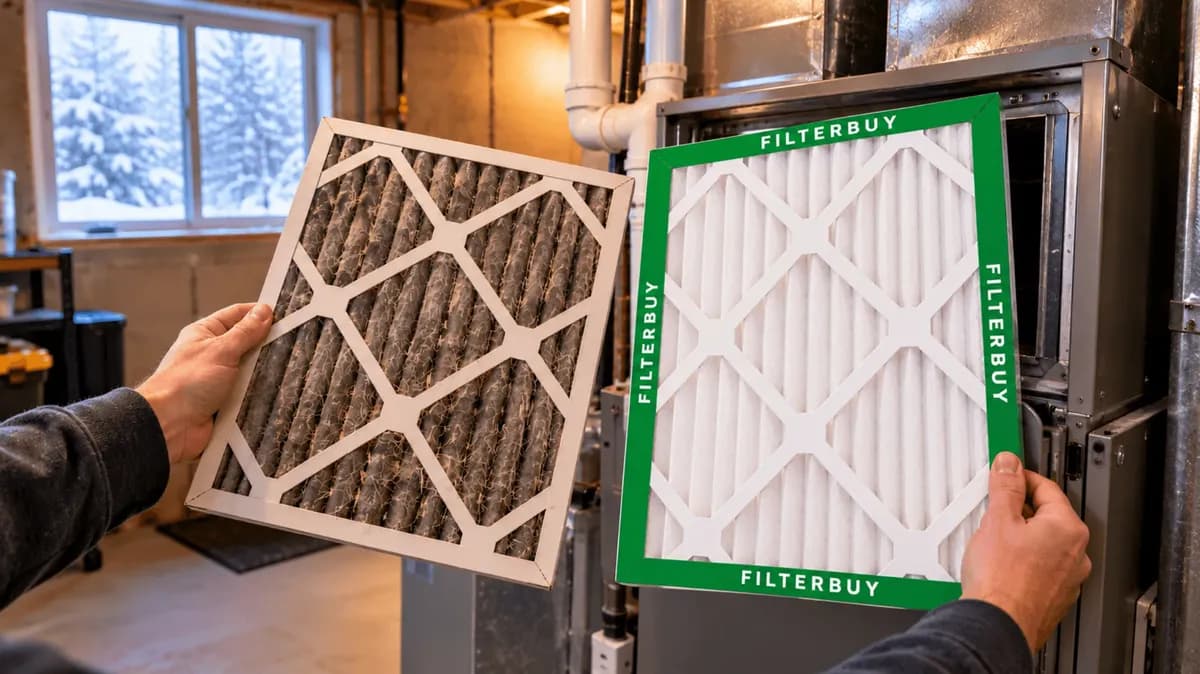
Yes — a dirty filter makes your furnace work harder. Trapped dust blocks airflow, so the blower motor strains to pull air through the system.
Your furnace then runs longer to keep your home warm, which can lead to overheating and added wear over time.
The fix is simple: swap in a fresh filter from Filterbuy and keep air moving freely.
Not sure which MERV rating your home needs?
Answer a few quick questions and we'll match you to the right filter.
Check your furnace filter every 30 days in winter and replace it at the short end of its normal range. For most homes, that works out to about 60 days for a 1-inch or 2-inch pleated filter, 3 months for a 4-inch and 6 months for a 5-inch. And yes, a dirty filter does make a furnace work harder, because the blower has to pull air through packed media.
TL;DR
In winter, check your furnace filter every month and replace it at the low end of its usual interval. A dirty filter makes the furnace work harder by restricting airflow, which means weaker airflow or a blower drawing more power. The real costs are comfort and wear, not your bill.
Key Takeaways
ENERGY STAR recommends a monthly winter filter check and a change at least every 3 months.
Filters load with blower hours, so a Fan On setting or a cold snap shortens every interval.
DOE Building America research warns that excess filter resistance can overheat furnaces and burn out blower motors.
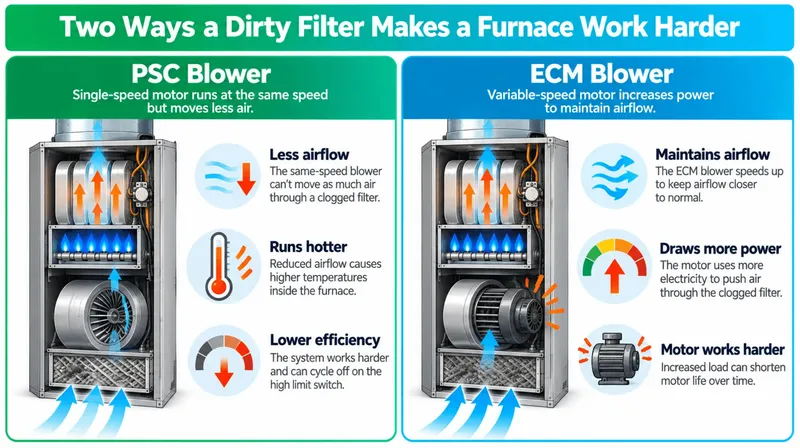
As a filter loads, single-speed PSC blower motors lose airflow, while variable-speed ECM motors draw more power to hold it.
Lawrence Berkeley National Laboratory field data found MERV 10 to 13 filters changed energy use by less than 1 percent.
Winter Furnace Filter Schedule By Thickness And Household
Filterbuy builds every pleated depth in this table, and that depth, the third number printed on the frame, is what sets your winter schedule. In peak heating months, plan on the short end of each range and let a monthly check pick the day.
Depths are pleated filters. Ranges follow Filterbuy replacement guidance. Check monthly and follow your HVAC manual first.
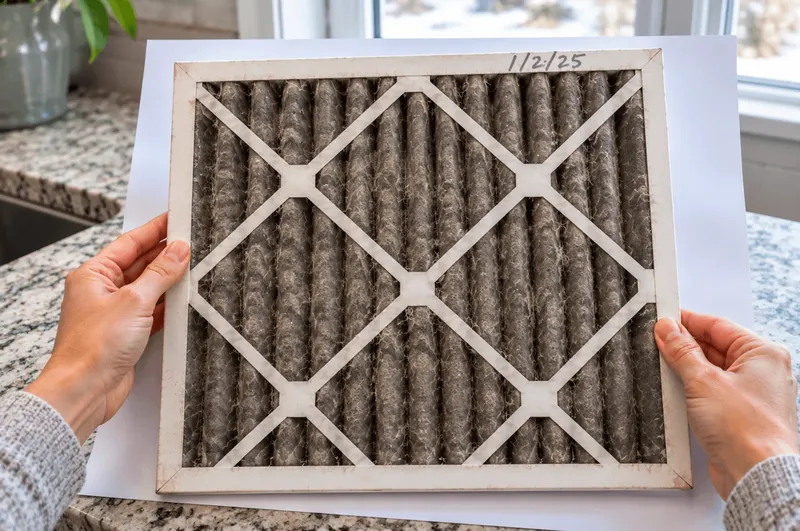
To do that check, find the filter with our guide to furnace filter locations by system type and hold it against a sheet of white paper. We prefer paper to the old lamp test because a new pleated filter already blocks most light. If the media looks gray and matted, replace it, whatever the calendar says. Our photo guide to what a dirty furnace filter looks like shows each stage, and our air filter replacement guide by filter depth covers the rest of the year.
Pro Tip from the Filterbuy support team: When callers ask for one exact number, we skip the chart and time two filter changes.
Write the install date on the cardboard frame.
At 30 days, compare it with a new filter on white paper.
Still clean? Check again at 60 days. If it is loaded, your home runs on a 30-day winter cycle.
Repeat once, then set a recurring reminder.
Why Runtime Beats The Calendar In Winter
Because a furnace filter loads with blower hours rather than days, the most accurate schedule follows runtime. Two settings change it more than most homeowners expect.
Thermostat fan on Auto vs On. On Auto, the blower runs only while the furnace is heating. Set to On, it runs all day, so check the filter every 2 to 3 weeks.
Smart thermostat runtime. Many smart thermostat apps report daily heating hours. If that number doubles between fall and midwinter, expect your filter to load about twice as fast.
Worked example: Your furnace runs about 3 hours a day in October and 6 in January. A 1-inch filter that lasted 90 days in fall could be loaded in about 45.
Does A Dirty Filter Make A Furnace Work Harder?
Yes. As dust packs into the media, the filter resists airflow more, which technicians call pressure drop. How your furnace copes with that extra resistance depends on its blower motor.
According to the Building America Solution Center's guide to filter pressure drop from the U.S. Department of Energy, a filter typically accounts for 20 to 50 percent of a system's total pressure drop, and dirt loading can raise it sharply.
PSC = single-speed motor. ECM = variable-speed motor. Sources: DOE Building America and LBNL research.
Not sure which motor you have? Check the rating plate or manual for variable speed, ECM or constant torque. If none appear, it is most likely a PSC blower. Filterbuy's guide to furnace blower motor problems and repair costs explains what to do if yours starts to fail.
How Much Does A Dirty Filter Raise Your Heating Bill?
A dirty filter raises your heating bill less than many websites claim, and Filterbuy would rather you hear that from a filter maker. Lawrence Berkeley National Laboratory monitored ten forced-air systems for a year and found that MERV 10 to 13 filters changed energy use by less than 1 percent, while MERV 16 filters raised it by more than 5 percent. The strain on the furnace, though, is real.
That matches what we tell customers: the real cost is uneven heat and a harder-working blower.
Signs Your Furnace Is Working Too Hard
A furnace that is fighting a dirty filter tends to warn you in the same order. Catch it at one of the first three signs and a new filter usually fixes it.
The filter looks gray against white paper. Replace it now.
Heating cycles run longer to reach the same thermostat setting.
Airflow at the registers feels weaker, or the blower sounds louder than it did in the fall.
The burners shut off while the blower keeps running, then restart. This is the high-limit switch tripping, a pattern called short cycling.
The furnace locks out. Replace the filter, and call a technician if the lockout comes back.
That high-limit switch is a safety control doing its job, as Filterbuy's explainer on how furnace heat exchangers and limit switches work shows. If you smell gas, see soot or hear a carbon monoxide alarm, stop and call a professional. A filter change cannot fix combustion or venting problems, which is why the U.S. Consumer Product Safety Commission (CPSC) recommends a professional heating system inspection every year and CO alarms on every level of the home. See also our guide on whether a dirty filter can cause a furnace fire.
Which Furnace Filter Works Best In Winter?
The best winter furnace filter is a pleated filter in your exact frame size, at a MERV rating your furnace manual approves. The EPA's guide to what a MERV rating measures suggests at least MERV 13, or the highest rating your system fan and filter slot can handle. LBNL found that MERV 16 pushed blowers already near capacity to their limits, which is one reason our residential line stops at MERV 13.
MERV 8: MERV 8 air filters capture everyday dust, lint and pollen. Confirm your HVAC manual supports MERV 8.
MERV 11: MERV 11 air filters add finer particles such as pet dander. Check that your HVAC manual lists MERV 11.
MERV 13: MERV 13 air filters capture the finest particles of the three, including smoke particles. Use one only if your HVAC manual approves MERV 13.
Fit matters as much as rating. We cut every Filterbuy filter slightly under its nominal size so it seats snugly in the slot, because air that slips around a loose filter never gets filtered. As a family-owned American manufacturer, we make all three ratings in hundreds of sizes, plus custom air filters for odd-size slots. Our step-by-step furnace filter replacement guide walks through the five-minute job, and an air filter subscription ships the next filter on schedule.
How We Built This Guide
Michelle Wan, Filterbuy's Brand Manager and Air Quality Writer, wrote this guide from federal sources, and licensed HVAC technician David Clark reviewed it. The tables and the runtime, warning-sign and two-change methods are our own.
"I don't want anyone to feel like they need an HVAC license just to pick the right filter. My job is to give you the straight answer, explain why it matters, and let you get back to your day."
Michelle Wan, Brand Manager and Air Quality Writer, Filterbuy
Supporting Statistics
Three federal findings, with Filterbuy's read on each.
1. Typical filters barely move the energy bill.
LBNL monitored 10 homes for a full year.
MERV 10 to 13 filters changed energy use by under 1 percent.
MERV 16 filters raised it by more than 5 percent.
Our take: Every home loads filters at its own pace, so check yours monthly.
Source: System Effects of High Efficiency Filters in Homes, Lawrence Berkeley National Laboratory
2. Heating and cooling use nearly half of home energy.
ENERGY STAR says a dirty filter slows airflow, so the system works harder and wastes energy.
Our take: The filter is the least expensive guard on your biggest energy system.
Source: Heat & Cool Efficiently, ENERGY STAR
3. This winter looks a lot like last winter.
EIA expects similar U.S. temperatures from November 2026 to March 2027.
Natural gas homes: spending down 9 percent.
Electric heat homes: up 4 percent.
Heating oil homes: up 21 percent.
Our take: Even a normal winter means months of heavy runtime.
Source: Mixed Outlook for Energy Expenditures This Winter, U.S. Energy Information Administration
Frequently Asked Questions About Winter Furnace Filters
Should I Change My Furnace Filter Before Turning On The Heat?
Yes, if it looks dirty or you cannot remember the last change. Start the season with a clean filter, then begin monthly checks.
Can A Dirty Furnace Filter Make My House Colder?
Yes. Restricted airflow sends less warm air to your registers.
Does A Higher MERV Filter Make A Furnace Work Harder?
It can, but filter design matters as much as the rating, and deeper pleats keep resistance down. Use the highest rating your HVAC manual approves.
Can A Dirty Filter Cause A Furnace To Short Cycle?
Yes. Trapped heat trips the high-limit switch, which shuts off the burners. If it keeps happening with a new filter in place, call a technician.
Can I Run My Furnace Without A Filter Until A New One Arrives?
It is better not to, since dust will coat the blower and heat exchanger. Leave the old filter in until the replacement arrives.
Get Your Next Furnace Filter Before Winter Needs It
Check the size printed on your current filter and the highest MERV rating your HVAC manual supports, then shop Filterbuy air filters by size with fast and free 2-day delivery to most US states.
Glossary Of Winter Furnace Filter Terms
Pressure Drop: The resistance a filter adds to airflow. It rises as the filter loads with dust.
PSC Blower Motor: A permanent split capacitor motor that runs at fixed speeds and moves less air as resistance rises.
ECM Blower Motor: An electronically commutated, variable-speed motor that draws more power to hold airflow as resistance rises.
High-Limit Switch: A furnace safety control that shuts off the burners when the furnace gets too hot.
Short Cycling: A furnace turning on and off in short bursts before reaching the set temperature.
Heat Exchanger: The metal chamber that passes heat from burning fuel to household air.
MERV: Minimum Efficiency Reporting Value, ASHRAE's 1 to 16 scale for how well an HVAC filter captures particles.