
Freeze Warning Map: Active Freeze Warnings and Watches
October 22, 2026
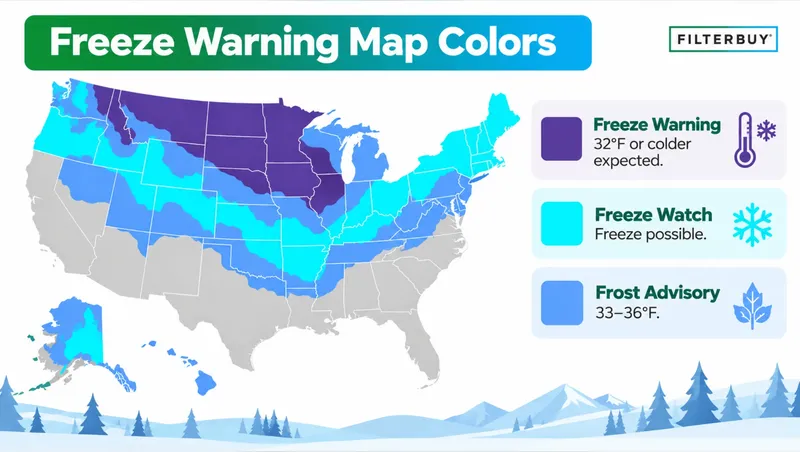
If your county is dark slate blue on the map, a freeze warning is active, and the National Weather Service expects 32°F or colder, usually within 24 hours. Once a warning posts, you typically have until sunset to drain outdoor faucets, protect exposed pipes, and keep the heat steady.
- Dark slate blue: freeze warning. A freeze is expected.
- Cyan: freeze watch. A freeze is possible.
- Cornflower blue: frost advisory. Lows of 33–36°F.
Freeze nights keep your furnace or heat pump running longer, so take the quick filter quiz below.
What each map color means tonight
The darker the blue, the more to do before sunset.
Frost advisory
Lows of 33–36°F
Cover tender plants
Freeze watch
A freeze is possible
Drain hoses, check your air filter
Freeze warning
32°F or colder expected
Drain faucets, keep heat steady
Find your filter match before the next freeze
Answer a few quick questions and we’ll match your home to the right MERV rating.
Is your county under a freeze alert today or tonight? Filterbuy built this US freeze warning map to answer that at a glance, showing every active freeze warning, freeze watch, and frost advisory across the US from National Weather Service (NWS) data. A freeze warning means the NWS expects 32°F or colder, usually within 24 hours. Search your ZIP code, then use our checklist to protect your pipes and heating system.
Your local forecast office's wording always takes priority.
TL;DR
This map shows active NWS freeze warnings (32°F or colder expected), freeze watches (freezing temperatures possible), and frost advisories (lows of 33–36°F) for every US county. If your county is dark slate blue, protect exposed pipes and bring pets inside before sunset. Hard freezes appear inside the freeze warning text.
Key Takeaways
A freeze warning is an NWS alert for expected temperatures of 32°F or lower, and it appears in dark slate blue on the map.
A freeze watch (cyan) means a freeze is possible, while a frost advisory (cornflower blue) covers lows of 33–36°F.
Freeze warnings follow the growing season, so Texas and Florida see them deep into winter while many northern offices stop in fall.
Freeze damage often appears the morning after, when cracked pipes thaw and begin to leak.
Freeze Warning Map Near Me: Is There A Warning Tonight?
To check your area, type a ZIP code, city, or county into the map search, or tap Use My Location. Dark slate blue means a freeze warning is in effect, and selecting your county shows the alert window and forecast low.
Freeze warnings usually cover the overnight hours, so the freeze warning map today often looks the same as the freeze warning map tonight. An afternoon warning leaves you the daylight to prepare. Check back late in the day, since watches can be upgraded.
How To Read The Freeze Warning Map
This national freeze warning map uses the official NWS hazard colors, so it reads the same way as the NWS freeze warning map. A county with no shading has no active freeze alert, either because temperatures will stay above freezing or the growing season has ended.
Colors follow the National Weather Service hazard map standard.
When a county has two alerts, the map shades the higher-priority one and lists both. Our freeze warning vs. frost advisory breakdown compares all three.
Where Is The Hard Freeze Warning On The Map?
On October 1, 2024, the NWS folded the Hard Freeze Warning into the Freeze Warning and renamed the Hard Freeze Watch a Freeze Watch. Many offices describe a hard freeze as roughly 28°F or colder for several hours, though some Gulf Coast offices use 25°F. To find one on the hard freeze warning map, open a dark slate blue county and look for lows in the 20s or the phrase hard freeze.
Why Do Freeze Warnings Show Up In Some States And Not Others?
Freeze warnings track the growing season as much as the thermometer. The NWS issues them mainly to protect crops and landscaping, so many offices stop once a widespread freeze ends the season. As a result, the national map can look busy across the South in January while colder northern states show nothing.
Each forecast office sets its own seasonal rules. NWS Tallahassee, for example, pauses routine freeze alerts after the first widespread light freeze, usually until March 15, but still issues them for a hard freeze of 25°F or colder.
A blank county does not always mean a warm night. For all-season cold alerts, check our winter storm tracker and our guide to extreme cold warnings.
Freeze Warning Map Texas
The Texas Panhandle often freezes weeks before the Rio Grande Valley, yet a strong arctic front can carry warnings across most of the state in a day. When that happens, homes with plumbing in attics or exterior walls are the most exposed.
Freeze Warning Map Florida
In Florida, most freeze warnings land in North Florida and the Panhandle. About two-thirds of Florida homes rely on electricity as their main heating fuel, often through a heat pump, so a freeze night also tests its defrost cycle.
What The Freeze Warning Map Cannot Tell You
Alerts are issued by NWS forecast zone, so the map cannot see your yard. A few local factors can make your home colder than the warning suggests:
Low ground. On clear, calm nights, cold air drains downhill and pools in valleys and low spots.
Open land. NWS Tallahassee notes that its airport is often much cooler than neighborhoods inside city limits on clear, calm winter nights.
Weak spots in your home. Pipes in unheated spaces or along exterior walls freeze first, even when the official low barely dips below 32°F.
If any of these describe your home, Filterbuy's rule of thumb is simple: treat a freeze watch as if it were a warning.
What Should You Do When Your County Turns Dark Slate Blue?
Once a warning posts, you typically have until sunset. We built the Filterbuy Freeze Map Action Ladder by pairing each NWS alert level with American Red Cross frozen pipe guidance, so the steps grow as the risk does.
Filterbuy guidance based on American Red Cross recommendations. Not an NWS product.
Each step follows American Red Cross guidance on preventing frozen pipes. For more on protecting pipes and plants, read our full freeze warning guide.
What Should You Check The Morning After A Freeze?
Freeze damage often shows up after the warning ends, because cracked pipes only start leaking once they thaw. When temperatures climb above 32°F, walk through Filterbuy's five-step thaw check:
Turn on each faucet. A weak trickle means that pipe may still be frozen.
Leave that faucet open and warm the pipe with a hair dryer or warm towels, as the American Red Cross recommends. Never use an open flame.
Check for drips under sinks and on ceilings below attic pipes.
Make sure the heat pump coil is free of ice and the furnace vents are clear.
Reconnect hoses only once the forecast stays above freezing.
How Does A Freeze Affect Your Furnace Or Heat Pump?
Freeze nights keep heating systems running longer. As an air filter manufacturer, Filterbuy recommends starting with the filter, a two-minute, no-tools check.
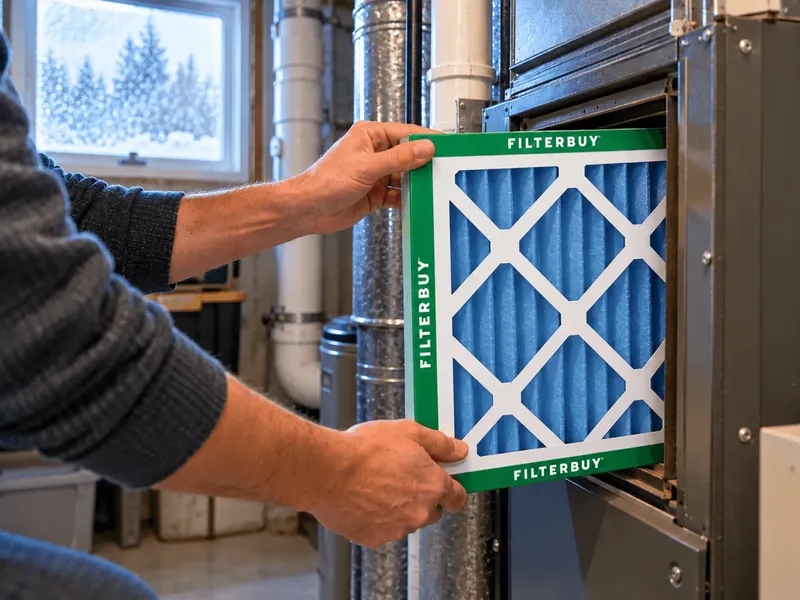
Check the air filter. Long run times load a filter faster, so swap it before temperatures drop if it looks gray or is overdue. Our guide explains how often to change your HVAC filter.
Clear the outdoor unit. Steam rising from a heat pump during its defrost cycle is normal. Keep debris away, and call a licensed HVAC technician if thick ice remains after the cycle. You can also get your heat pump ready for winter.
Watch the vents. High-efficiency furnaces exhaust through plastic pipes that can ice over during a hard freeze. If your furnace shuts off on a frigid night, our guide to a frozen furnace vent pipe explains what to check.
Hold the thermostat steady. Keep the same setting day and night, and never let it drop below 55°F while you are away. If the power fails, read how to heat your home safely during a power outage before using backup heat.
Why Does An Air Filter Company Track Freeze Warnings?
Filterbuy makes air filters for the furnaces and heat pumps that carry homes through freeze nights. We built this map to tie each alert to a task you can finish before sunset.
There are limits, too. A filter cannot keep a pipe from freezing, and this map is no substitute for the NWS, which writes every alert here.
A Note From The Author
"A freeze warning usually gives you one afternoon to get ready. So we paired every color on this map with a task. If your county turns dark slate blue, drain the hose bib, then check the filter before the furnace settles in for a long night."
Michelle Wan, Brand Manager & Copywriter, Filterbuy
Supporting Statistics
Federal and insurance data show what a freeze can cost.
$27.2 billion in losses
The February 2021 winter storm is the costliest US winter storm on record.
Texas took the brunt, and burst pipes damaged buildings as they thawed.
Source: NOAA's National Centers for Environmental Information, CPI-adjusted.
$15,400 per claim
Average homeowners claim for water damage and freezing from 2019 to 2023.
Source: Insurance Information Institute, based on ISO data.
34,200 heating fires a year
Yearly average for US residential buildings from 2017 to 2019.
January is the peak month, accounting for 20% of those fires.
Source: U.S. Fire Administration.
Freeze Warning Map FAQ
How Often Is The Freeze Warning Map Updated?
Filterbuy's current freeze warning map pulls alerts from the National Weather Service as forecast offices issue or cancel them. The last refreshed time appears below it.
Is A Freeze Warning Worse Than A Freeze Watch?
Yes. A freeze watch means a freeze is possible, while a freeze warning means the NWS expects one, usually within 24 hours.
Does A Freeze Warning Mean My Pipes Will Freeze?
Not necessarily. Pipes in unheated attics and crawl spaces face the most risk, which climbs the longer temperatures stay below freezing.
When Does Freeze Warning Season Start?
It starts earliest in northern and high-elevation areas and latest along the Gulf Coast. In Tallahassee, NWS 1991–2020 normals put the average first freeze on November 25 and the first hard freeze on December 23.
Why Is There No Freeze Warning When It Is Below Freezing Where I Live?
Many NWS offices stop once the local growing season ends, but extreme cold warnings and cold weather advisories continue through the winter.
Get Your Home Ready Before The Map Turns Blue
A fresh filter is the easiest place to start. Find your furnace filter size among hundreds of standard and custom sizes with fast and free 2-day delivery to most US states, or set up Filterbuy auto-delivery so a new filter arrives before the next cold front.
Glossary
Freeze Warning: An NWS alert issued when temperatures of 32°F or lower are expected for at least two hours.
Freeze Watch: An NWS alert for possible freezing temperatures, typically 24–48 hours ahead.
Frost Advisory: An NWS alert for lows of 33–36°F on clear, calm nights.
Hard Freeze: A freeze near 28°F or colder for several hours.
National Weather Service (NWS): The NOAA agency that issues official US weather alerts.
Growing Season: The span between the last spring and first fall freeze.
Defrost Cycle: A normal heat pump function that melts frost off the outdoor coil.
Freeze Map Action Ladder: Filterbuy's guide pairing each NWS freeze alert with home steps.
HVAC: Heating, ventilation, and air conditioning.