
Cold Weather Advisory: What It Means and Why It Replaced the Wind Chill Advisory
October 5, 2026

TL;DR
A cold weather advisory is a National Weather Service (NWS) alert that temperatures or wind chills will be cold enough to hurt anyone unprepared. It replaced the wind chill advisory on October 1, 2024, when the NWS renamed its cold alerts to stress that cold is dangerous with or without wind. For more severe cold, the NWS issues an extreme cold warning.
Key Takeaways
The NWS replaced the wind chill advisory with the cold weather advisory on October 1, 2024, as part of its Hazard Simplification initiative.
Wind chill watches and warnings became extreme cold watches and warnings that same day.
Trigger temperatures depend on where you live. A cold weather advisory can start below 20°F in southeast Louisiana but not until a -20°F wind chill near Milwaukee.
Your furnace or heat pump runs longer during any cold alert, so Filterbuy recommends you check your air filter and keep outdoor vents clear.
Most coverage treats a cold weather advisory as a reason to grab a heavier coat. At Filterbuy, we see it differently. We've built air filters in our own U.S. factories since 2013, and every winter we hear from homeowners whose heating suddenly feels off. To us, every cold alert is also a home-maintenance cue.
Active Cold Weather Advisories and Extreme Cold Alerts
Cold alerts can change quickly as an arctic air mass moves in, so it helps to know what's in effect where you live right now. The map pulls active alerts from the National Weather Service, including cold weather advisories, extreme cold watches, and extreme cold warnings. If your area shows any of the three, that's your cue to check your air filter, clear outdoor vents, and get your home ready for longer heating cycles.
Enter your ZIP code to see National Weather Service cold alerts in your area, or browse every active NWS alert nationwide.
What Does a Cold Weather Advisory Mean?
A cold weather advisory means the National Weather Service expects temperatures or wind chills low enough to cause frostbite or hypothermia in people outside without proper protection. Local offices issue it based on whichever reading is colder. It's the lowest NWS cold alert, so treat it as a signal to dress in layers and ready your home for a long night of heating.
Why the Cold Weather Advisory Replaced the Wind Chill Advisory
On October 1, 2024, the National Weather Service retired the wind chill advisory and renamed it the cold weather advisory. The change grew out of the agency's Hazard Simplification initiative, built on public surveys and social science research. Many people believed extreme cold was only dangerous in wind, and the new names correct that.
Source: National Weather Service, Hazard Simplification initiative. Changes took effect October 1, 2024.
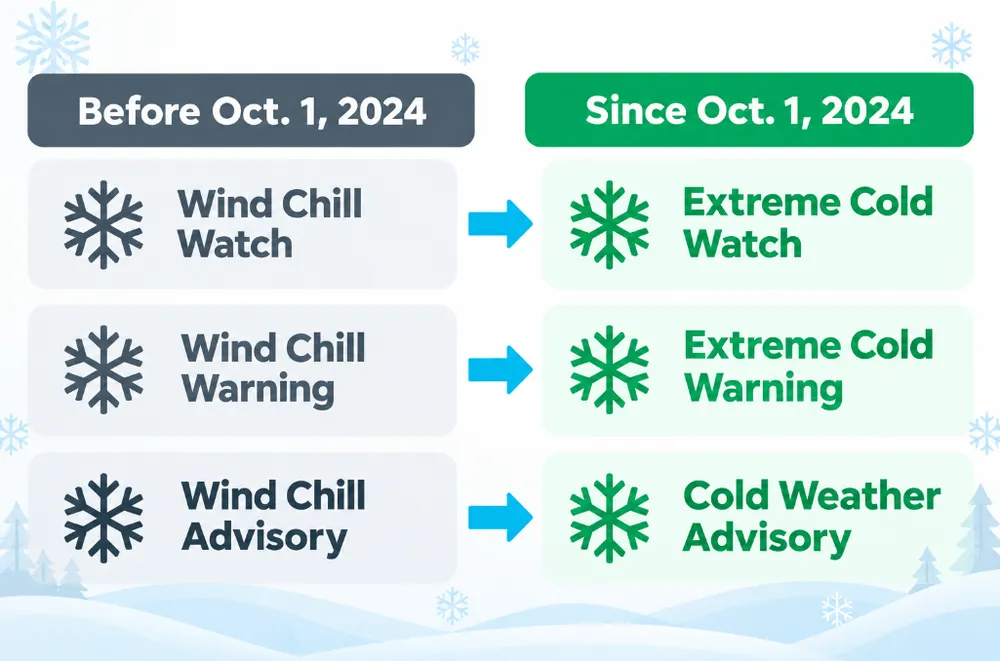
The rules changed, too. The NWS Amarillo office explains that the old alerts required a minimum wind speed, while the new ones have no wind threshold.
Did the NWS Get Rid of Wind Chill Warnings?
Yes. The NWS stopped issuing wind chill warnings, watches, and advisories on October 1, 2024. Wind chill itself remains; the NWS fact sheet confirms forecasts still report it.
Cold Weather Advisory vs. Extreme Cold Warning
A cold weather advisory means the cold is hazardous but manageable with precautions. An extreme cold warning means dangerously cold air is on the way. An extreme cold watch often comes first, typically 36 to 48 hours ahead, when dangerous cold is possible but not certain.
At Filterbuy, we treat the three alerts as one home plan: a watch means prep, an advisory means check, and a warning means protect.
Sources: National Weather Service; WOOD-TV; Gray News.
What Temperature Triggers a Cold Weather Advisory?
There's no single national number, because each NWS office sets criteria for local conditions. Filterbuy compared four office areas. NWS New Orleans says its thresholds reflect local impacts, so a 20°F alert there deserves the same respect as -20°F up north.
Values are temperature or wind chill. Criteria vary by NWS office; check your local office for current thresholds. Sources: NWS New Orleans/Baton Rouge, WOOD-TV, Scripps/WPTV.
What a Cold Weather Advisory Means for Your Home and HVAC System
During a cold weather advisory, your furnace or heat pump runs longer and cycles more often, pulling more air and dust through the filter. Cold snaps also raise the odds of frozen pipes and make blocked vents or careless heater use more dangerous.
"In our years of manufacturing filters and testing them under real-world conditions, we've found that winter is the season most homeowners underestimate. A filter that looks fine in October can be completely choked by December, and that's when we see the most avoidable furnace failures," says Filterbuy's manufacturing team.
Before temperatures drop, work through Filterbuy's checklist.
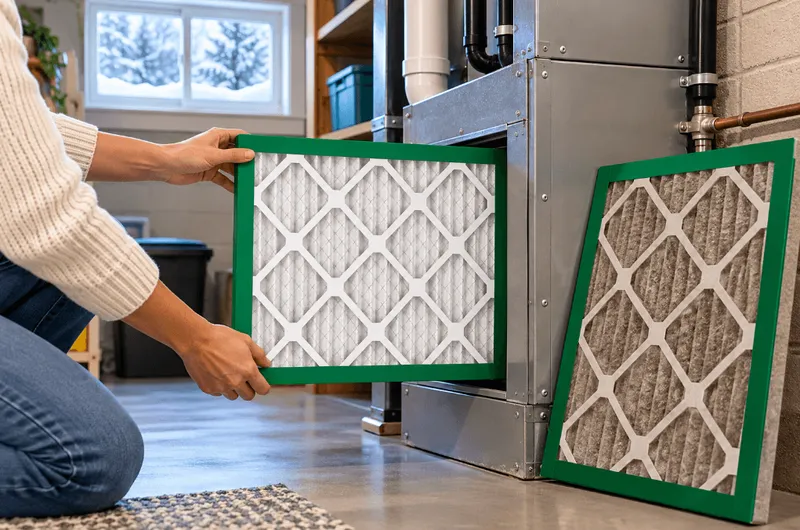
Check your air filter. A clogged filter restricts airflow and forces the system to work harder. Learn the signs of a clogged furnace filter, then replace a dirty one in your exact size and keep a spare.
Hold the thermostat steady. The American Red Cross frozen pipe guide recommends the same temperature day and night, and no lower than 55°F if you leave home. With a heat pump, a big morning jump can trigger backup resistance heat that's roughly three times less efficient, so building scientist Allison Bailes advises leaving it on "Heat," not "Emergency Heat."
Protect exposed pipes. Drip faucets on exterior walls and open sink cabinets so warm air reaches the plumbing. If a pipe freezes, the Red Cross says to thaw it with a hair dryer, never an open flame.
Clear outdoor vents and units. High-efficiency furnaces vent through exterior wall pipes, and snow or ice blocking them can shut the furnace down or push exhaust inside. Keep heat pump units clear, too.
Test CO detectors and use space heaters safely. The CDC recommends battery or battery-backup CO detectors near every sleeping area. Keep space heaters 3 feet from anything that can burn, and never heat with an oven or grill. CDC winter storm guidance says to run generators outdoors, at least 20 feet from windows, doors, and vents. See our space heater safety guide.
Watch indoor humidity. The EPA recommends 30% to 50% indoor humidity. In deep cold, aim lower if windows fog, since the EPA moisture guide lists 25% as a maximum when it's 0°F outside. When people call Filterbuy about stuffy winter air, dry air is often part of the problem.
Filterbuy Pro Tip: When an advisory is issued, hold your filter up to a light. If light barely passes through, swap it before the coldest night, and see how often to change it in winter. Also watch for a sign weather alerts never mention: a filter that turns dark gray or black within days can point to soot from a combustion problem. Treat it as a possible carbon monoxide warning and call a technician.
Why trust Filterbuy: We've manufactured air filters in our own factories in Alabama, Florida, Pennsylvania, and Utah since 2013. We stock 600+ sizes and have shipped to more than 2 million households, earning a 4.9 out of 5 across 85,000+ Google reviews.
Supporting Statistics: Why Cold Alerts Deserve Action
63% of U.S. weather-related deaths are cold-related, nearly double those tied to heat (CDC).
46% of home heating fires happen from December through February (NFPA).
400+ Americans die from carbon monoxide poisoning each year, often from furnaces or generators (CDC).
How to Stay Safe Outdoors During a Cold Weather Advisory
During a cold weather advisory, limit time outside and cover exposed skin. The American Red Cross recommends loose layers, a hat, mittens, and a face covering. Below zero with 10–20 mph winds, frostbite can set in within 15 minutes, WOOD-TV meteorologists report.
Check on older neighbors first. CDC data shows the cold-related death rate for people 85 and older runs roughly five times higher than for ages 65 to 74 (39.6 vs. 7.6 per million).
The CDC says frostbite shows up as numbness or white, grayish-yellow, firm, or waxy skin. Hypothermia brings shivering, confusion, slurred speech, and drowsiness. A body temperature below 95°F is an emergency, so get medical help right away.
Frequently Asked Questions
Is a cold weather advisory the same as a wind chill advisory?
Mostly, yes. The cold weather advisory replaced the wind chill advisory on October 1, 2024, but the new alert can be issued for low air temperatures alone.
What's the difference between a cold weather advisory and a winter weather advisory?
A cold weather advisory covers temperature and wind chill, while a winter weather advisory covers precipitation such as snow, sleet, or freezing rain. Both can be in effect at the same time.
What should I do if the power goes out during a cold weather advisory?
The CDC advises closing off unused rooms and covering windows at night. If your home gets too cold, the Red Cross suggests a warming center, library, or friend's house. Once heat returns, see Filterbuy's guide to the best MERV rating for winter furnace filters.
Which is worse, a cold weather advisory or an extreme cold warning?
An extreme cold warning is more serious. An advisory means the cold is manageable with precautions, while a warning means dangerously cold air is expected, so stay inside if you can.
Should I change my air filter during a cold weather advisory?
Check it as soon as the advisory is issued, since your furnace runs longer in the cold. Swap a gray, dusty filter before the coldest night, and Filterbuy air filter auto-delivery can keep a spare on hand.
Glossary
Filterbuy: A U.S. air filter manufacturer making filters since 2013 in company-run factories in Alabama, Florida, Pennsylvania, and Utah, with 600+ sizes.
National Weather Service (NWS): The U.S. agency, part of NOAA, that issues official forecasts and weather alerts.
Cold Weather Advisory: An NWS alert that air temperatures or wind chills are cold enough to be hazardous without precautions.
Extreme Cold Watch: An NWS alert that dangerously cold air, with or without wind, is possible in the coming days.
Extreme Cold Warning: An NWS alert that dangerously cold air, with or without wind, is expected.
Wind chill: How cold the air feels on exposed skin when wind and temperature combine.
Freeze Warning: An NWS alert that temperatures will drop to freezing or below during the growing season.
Frostbite: Freezing injury to skin and underlying tissue.
Hypothermia: Dangerously low body temperature from losing heat faster than the body makes it.
HVAC: Heating, ventilation, and air conditioning.
MERV: Minimum Efficiency Reporting Value, a 1–16 rating of how well a filter captures particles.
Carbon monoxide (CO): An odorless, colorless, poisonous gas produced by burning fuel.
About the Author and Reviewer
Michelle Wan is Brand Manager and Air Quality Writer at Filterbuy, working closely with its U.S. manufacturing team. "My job is to give you the straight answer, explain why it matters, and let you get back to your day," she says.
David Clark is an EPA-certified Licensed HVAC Technician and President of Filterbuy HVAC Solutions, with more than 10 years in HVAC installation and service.