April 28, 2026
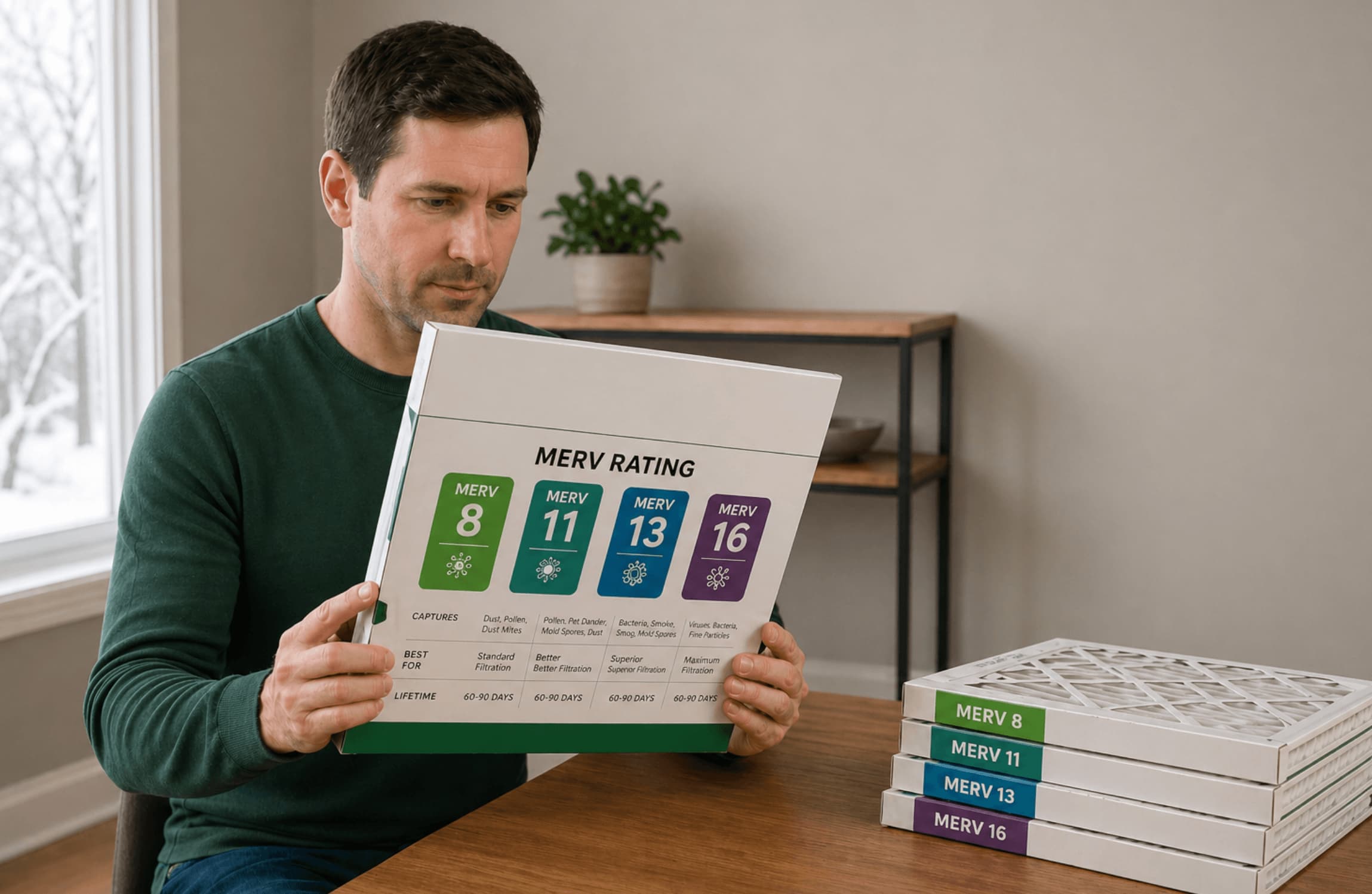
A clogged furnace filter pulls up to 15% off your heating system's efficiency, according to the U.S. Department of Energy. In a sealed-up winter house, that same filter is also the only thing actively cleaning the air your family is breathing 24 hours a day. The MERV rating you pick this October decides how both of those numbers play out through March.
We've been making pleated filters in Alabama since 2013 and shipping them to households across all 50 states. The pattern we see every winter is the same. Homeowners run a low-rated filter from spring through October, leave it untouched until February, and then call somebody when the furnace starts making a noise. The fix takes ten minutes and costs less than a tank of gas.
The best MERV rating for winter furnace filters in most homes is MERV 13. It catches the fine particles, smoke, and bacteria that build up when windows stay sealed through heating season. What you need to know first: pet households without allergies do well on MERV 11, and MERV 8 is the minimum any furnace-running home should accept.
Quick reference by household:
• MERV 8: minimum acceptable for standard homes with no pets or allergies
• MERV 11: the right upgrade for pet owners or mild seasonal allergies
• MERV 13: the EPA's recommended rating for asthma, smokers, or wildfire-smoke regions
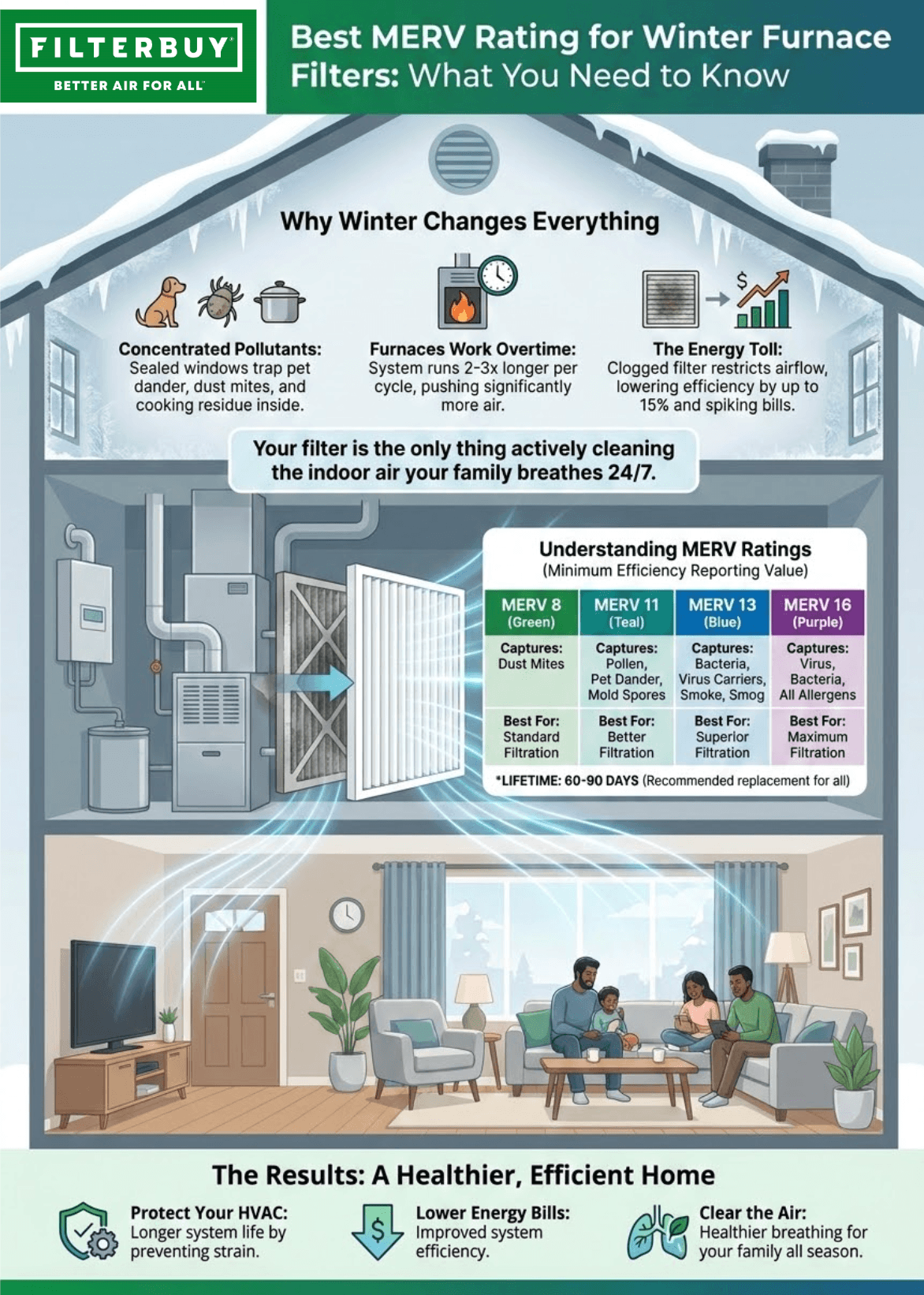
Winter is different from the rest of the year. Sealed homes concentrate indoor pollutants and your furnace runs two to three times longer per cycle, which makes the filter you pick now your home's only active defense for indoor air through March. Confirm your HVAC system supports the rating before upgrading. Most systems built after 2010 handle MERV 13 without issue.
• MERV 13 is the rating most U.S. authorities point to for residential heating systems, and it's the strongest all-around winter pick for homes without an undersized or 1990s-era furnace.
• Winter changes the math on your filter. Sealed windows, longer heating cycles, and concentrated indoor pollutants mean the same filter does two to three times the work it does in spring or fall.
• Match the rating to your household, not the highest number on the shelf. Most homes land on MERV 8 or MERV 11. MERV 13 is the right answer for asthma, smokers, or anyone in a region that gets seasonal wildfire smoke.
• A clogged filter shows up on your gas bill before it shows up anywhere else.
• Check your filter monthly through winter, and replace it when it loads up rather than when the calendar tells you to. We've watched calendar reminders fail more times than we can count, which is the entire reason we built auto-delivery in the first place.
• Confirm your HVAC system can handle higher MERV ratings before upgrading. Most systems built after 2010 handle MERV 13 fine.
• Filter size matters as much as rating. A loose-fitting filter lets unfiltered air slip past the media entirely, even if you bought the highest rating on the shelf.
Cold weather puts your filter under conditions it doesn't see the rest of the year. Your furnace runs two to three times longer per cycle than it does in milder months, which means more air passes through the filter every hour and the media loads up faster. Sealed homes also concentrate indoor pollutants like pet dander, dust mites, cooking residue, and combustion byproducts. With windows shut and no fresh air coming in, those particles have nowhere to go but back through the ductwork. The filter you put in last spring is the only thing actively cleaning that air.
There's a heating-bill consequence too. When airflow gets restricted, your furnace runs longer cycles to hit the thermostat setting. The U.S. Department of Energy attributes up to a 15% reduction in HVAC energy consumption to swapping a clogged filter for a clean one. We see that play out in customer behavior every January, when homeowners switch to auto-delivery after one bad gas bill.
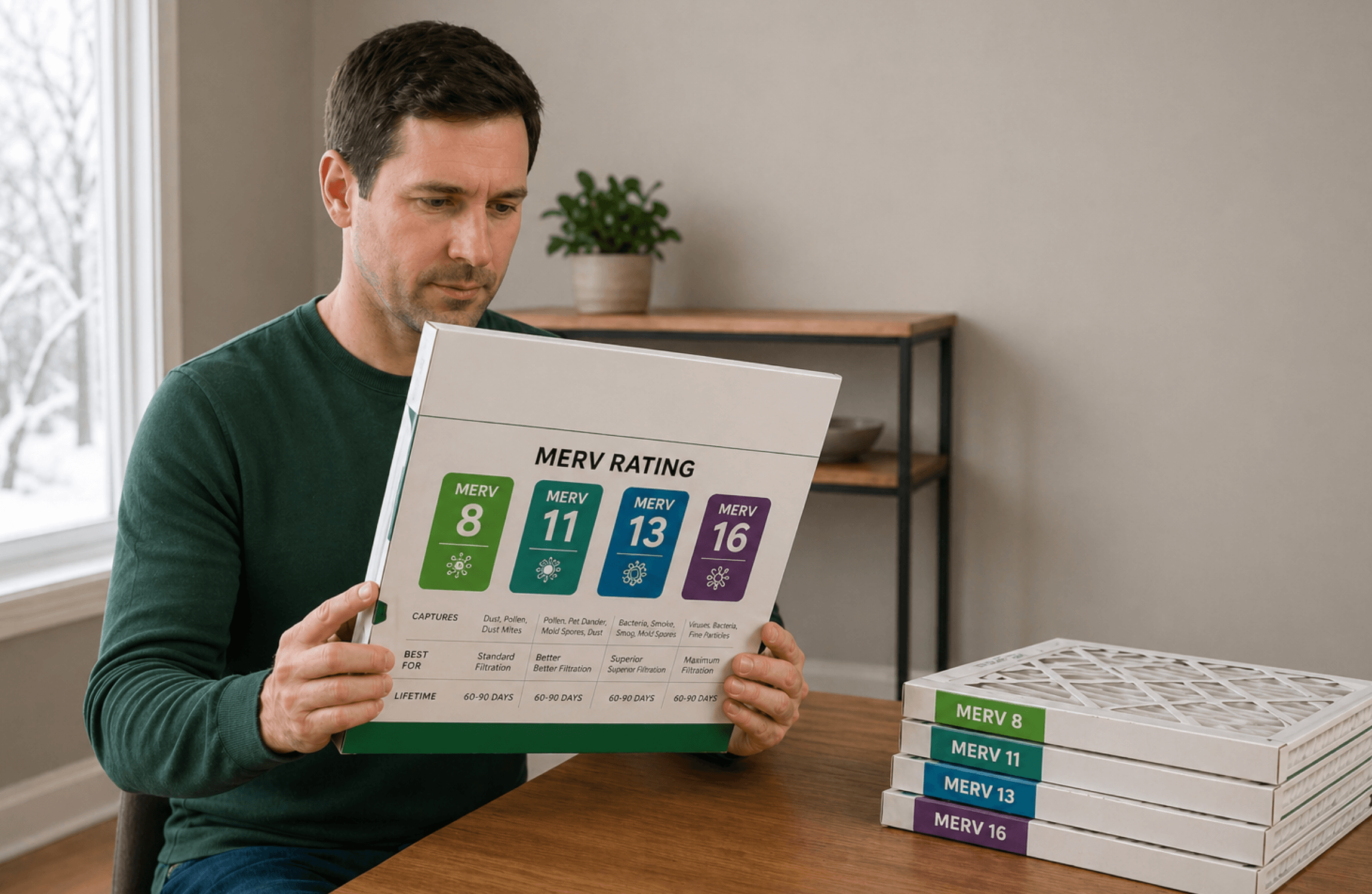
MERV is the Minimum Efficiency Reporting Value. ASHRAE developed the scale to standardize how filters get tested for particle capture in the 0.3-to-10-micron range. Residential filters run from MERV 1 to MERV 16. Higher numbers catch smaller particles.
If you want the longer explanation of how air filters work mechanically, this overview is a solid primer. For winter purposes, what matters is particle size. The smaller the particle a filter can grab, the better it performs in a sealed home.
Three ratings cover virtually every residential winter scenario. Here's how they actually behave once heating season hits.
• MERV 8: Captures dust, lint, pollen, and dust mites (3+ microns). Best for standard households without pets or allergies. Trade-off: won't catch pet dander, smoke, or fine particulates.
• MERV 11: Adds pet dander, mold spores, and fine dust (1–3 microns). Best for pet owners, or households with mild seasonal allergies. Trade-off: slightly higher airflow resistance than MERV 8.
• MERV 13: Adds bacteria, smoke, and virus carriers (down to 0.3 microns). Best for allergies, asthma, smokers, and wildfire-smoke regions. Trade-off: confirm system compatibility (most post-2010 systems are fine).
MERV 8 protects your furnace from large debris and handles the basics, which makes it the minimum acceptable rating in any home running a furnace. Don't confuse a minimum with a recommendation.
MERV 11 is where most pet-owning households should be. It catches the dander and finer dust that a MERV 8 lets pass through, and it does it without straining a properly-sized blower.
MERV 13 is what we recommend whenever asthma, smokers, or wildfire smoke are in the picture. It also happens to be the highest filtration rating most residential HVAC systems were ever designed to handle.
Two steps will get you to the right answer.
1. Confirm system compatibility. Check your HVAC manual or look for a "max MERV" label on the air handler. Most modern systems handle MERV 13 without issue. Older units may top out at MERV 11.
2. Match the rating to your household. Standard home with no pets and no allergies runs fine on MERV 8. Pets or mild allergies bump you to MERV 11. Anyone managing asthma, a smoker in the home, or seasonal wildfire smoke should be on MERV 13.
For a winter-specific walkthrough that covers edge cases like multi-pet homes, high-occupancy households, and combustion-heavy kitchens, see our complete winter MERV rating guide.
Higher isn't always better. MERV 14 and above were built for hospitals, surgical suites, and industrial cleanrooms. Drop one into a residential return and the static pressure mimics a clogged filter from the day you install it. The blower motor strains, airflow drops, and equipment that should last 15 to 20 years can die early. MERV 13 is the residential ceiling.
The "every 90 days" rule of thumb breaks down in winter when your furnace is running 18 hours a day. Use this schedule instead.
• No pets, no allergies (MERV 8): Every 60–90 days. Check monthly.
• Pets in the home (MERV 11): Every 30–60 days. Check monthly.
• Allergies, asthma, smokers (MERV 13): Every 30–45 days. Check every 2–3 weeks.
• Wildfire-smoke regions (MERV 13): Every 30 days during peak events.
"In our manufacturing data, winter behaves like a different season for your filter altogether. The homeowners who swap to a fresh, properly-rated MERV filter in October consistently report lower gas bills and fewer respiratory flare-ups by mid-February."
— Filterbuy Air Quality Team
These are the seven outside references we point homeowners to most when winter filter questions come up. Every link below goes to a primary, authoritative source.
1. EPA — What Is a MERV Rating? The federal government's plain-language explanation of MERV, including the EPA's own residential recommendation.
epa.gov/indoor-air-quality-iaq/what-merv-rating
2. EPA — Guide to Air Cleaners in the Home. Companion EPA guide covering furnace filters, portable air cleaners, and the trade-offs between them.
epa.gov/indoor-air-quality-iaq/guide-air-cleaners-home
3. U.S. Department of Energy — Air Conditioner Maintenance. DOE's Energy Saver page on filter maintenance and the efficiency consequences of skipping it. The principles apply identically to winter heating systems.
energy.gov/energysaver/air-conditioner-maintenance
4. ENERGY STAR — Heat & Cool Efficiently. Federal guidance on the recommended winter filter check schedule and the energy impact of running a clogged filter.
energystar.gov/saveathome/heating-cooling
5. ASHRAE — The Standards Body Behind MERV. ASHRAE developed the MERV rating system under Standard 52.2. Their site is the source of record for how the scale gets tested and updated.
6. Asthma and Allergy Foundation of America — Improving Indoor Air Quality. Patient-focused guidance on indoor air quality during heating season and how filtration choices affect respiratory symptoms.
aafa.org/asthma/asthma-triggers-causes/improving-indoor-air-quality
7. Building America Solution Center — High-MERV Filters. DOE-backed technical guide on specifying MERV 13+ filters in residential systems, including pressure-drop considerations homeowners often overlook.
basc.pnnl.gov/resource-guides/high-merv-filters
The numbers below are the ones that change how seriously homeowners take their winter filter. All three come from federal sources and link directly.
1. 90% / 2–5x. The EPA reports that Americans spend approximately 90% of their time indoors, and that concentrations of common indoor pollutants are typically 2 to 5 times higher than outdoor levels. In a sealed-up winter home, your furnace filter is the only thing actively pulling those pollutants out of the air on each pass through the ductwork.
Source: EPA — Indoor Air Quality
2. Up to 15%. The U.S. Department of Energy attributes up to a 15% reduction in HVAC energy consumption to replacing a clogged filter with a clean one. During winter, when heating is your biggest utility line item, that gap shows up directly on your gas bill.
Source: U.S. Department of Energy — Air Conditioner Maintenance
3. MERV 13. The EPA's filter-upgrade guidance is to choose at least MERV 13, or as high a rating as your system fan and filter slot can handle. That's the residential threshold federal authorities point to for managing fine particulates and airborne pathogens. It's also the rating we steer most winter-conscious homeowners toward.
Source: EPA — What Is a MERV Rating?
Most filter content avoids saying this part plainly. The air filter aisle at your local big-box store is built around margin, not air quality. The cheapest fiberglass filters on the bottom shelf are essentially lint screens. They protect the furnace motor from large debris and do almost nothing for what your family is breathing. They've been the default in American homes for forty years, and we've watched the consequences pile up in the customer data the whole time.
After a decade making filters in the U.S. and watching the data come back from millions of households, here's our opinion. The single highest-ROI move a homeowner can make for indoor air this winter is upgrading to a pleated MERV 11 or MERV 13 filter and putting it on a 30-to-60-day replacement schedule. You don't need an air purifier, a whole-house UV system, or a ductwork overhaul to fix indoor air. A properly-rated filter, swapped on time, does the work most people pay thousands trying to accomplish through other means.
The homeowners who skip this step and pay an HVAC technician $200 in February to diagnose a "weird furnace noise" almost always have the same problem waiting for them when the panel comes off: a neglected filter choking airflow and straining a blower motor that shouldn't be working that hard.
The fix isn't complicated. Match the rating to your household and change the filter on schedule.
Five things to do this week, in order.
1. Pull your current filter. Note the rating printed on the side and how dirty the media looks. If you can't remember the last time you swapped it, the answer is now.
2. Measure the slot. Write down the actual dimensions, including depth (1", 2", 4", or 5"). The size on the box is nominal. What actually fits is the measurement you take with a tape.
3. Confirm your max MERV. Check your furnace or air handler manual for a maximum MERV rating. If you can't find it, MERV 11 is a safe upgrade for almost any system built in the last 20 years.
4. Pick the rating that matches your household. A standard home with no pets or allergies runs fine on MERV 8. Pets or mild allergies bump you to MERV 11. Anyone managing asthma, a smoker, or seasonal wildfire smoke should be on MERV 13.
5. Set a 30-day check reminder, or skip the reminder problem entirely and put your filter on auto-delivery so a fresh one arrives before the old one is overdue.
MERV 13 for most homes. It captures the fine particles, smoke, and bacteria that build up when windows stay sealed all heating season. Pet households without allergies do well on MERV 11. Standard homes with no pets and no respiratory concerns can run MERV 8.
Probably not. Most residential HVAC systems built in the last 15 to 20 years handle MERV 13 without issue. To confirm, check your air handler manual for a maximum MERV rating. If your system is older or undersized, MERV 11 is the safe upgrade.
Every 30 to 90 days during heating season, depending on your MERV rating, household, and pets. Check it monthly. MERV 13 filters in homes with pets or active asthma may need replacement every 30 to 45 days. Standard MERV 8 filters in pet-free homes can stretch closer to 90.
A properly-sized MERV 11 or MERV 13 filter in a compatible system has minimal impact on energy use. The real driver of high bills is a neglected filter, regardless of its rating, that's been left in too long. Replace on schedule and the rating choice barely affects your bill.
Not safely. Even a low-resistance MERV 8 filter loads up over the heating season because your furnace runs far more hours than in milder months. Leaving the same filter in for four straight months restricts airflow, strains the blower, and stops removing pollutants long before you swap it.
MERV 8 captures large particles like dust, lint, and pollen. MERV 11 adds finer particles including pet dander, mold spores, and most dust-mite debris. In a sealed winter home where the same air recirculates dozens of times a day, that gap is what most pet-owning households actually feel: less dust on surfaces and fewer dander-driven allergy flare-ups.
Yes, if your system supports it. Many homeowners run MERV 8 or MERV 11 in shoulder seasons and step up to MERV 13 from October through March, when sealed windows and longer furnace cycles concentrate indoor pollutants. Just confirm your blower can handle the additional resistance before making the switch.
MERV is the standardized industry scale that ASHRAE developed and the rest of the filter industry adopted. FPR is a proprietary rating used by one large home-improvement retailer. The two scales overlap roughly but aren't identical. When you're comparing filters across brands, MERV is the consistent benchmark.
Filterbuy manufactures pleated, electrostatic MERV 8, MERV 11, and MERV 13 furnace filters in Alabama, in every standard size, plus custom dimensions for the slots big-box stores never stock. Every order ships free with no minimum, and auto-delivery drops 5% off each shipment and arrives before you'd remember to reorder.
Skip the hardware-store run. Pick the rating that matches your home and let the filter show up when it should.
