
What MERV Rating Do You Really Need in Winter?
April 16, 2026

Most homeowners don't touch their furnace filter between September and March. That's also when it's working the hardest.
Your house is sealed up tight, your furnace runs for hours every day, and the same air keeps cycling through. Whatever's floating in it — dust, pet hair, mold spores, fine particles from cooking or combustion — your filter is either stopping it or letting it go right back into the air you're breathing.
The number printed on that filter frame is your MERV rating. It tells you how small a particle the filter can actually catch. Pick too low in winter and you're breathing what it misses. Pick too high and you could restrict airflow, drive up your energy bill, or put extra strain on the furnace itself.
We've shipped filters to millions of homes across the country. The question we hear most in fall and winter: which MERV rating do I actually need? This guide gives you the straight answer — based on your home, your household, and your system.
TL;DR — Quick Answers
• What MERV rating should I use in winter? MERV 11 is the right call for most households during heating season.
• MERV 8 or MERV 11 — which is better in winter? MERV 11. It catches the finer particles that concentrate indoors when your home is sealed — pet dander, fine dust, smoke. MERV 8 holds up fine for newer homes without pets or allergy sensitivities.
• Is MERV 13 a good winter filter? Yes, if your HVAC system is built for it. It's the strongest option for allergy and asthma households. Check your furnace manual before switching.
• How often should I change my filter in winter? Every 30 to 45 days. Your system runs harder in cold weather, so filters fill up faster than they would in summer.
• Does a higher MERV always mean better filtration? Not always. The best rating is the highest one your specific system was designed to handle.
Top Takeaways
Six things worth knowing before you read on.
1. Winter seals your home — and that changes your air. Closed windows, constant furnace cycling, and dry air create conditions where airborne particles build up faster than at any other point in the year.
2. MERV 8 is a starting point, not the recommendation. It handles basic filtration well, but most winter homes — particularly those with pets, kids, or dust — are better served by stepping up to MERV 11.
3. MERV 11 is where most households land. It captures pet dander, fine dust, and mold spores without the airflow concerns that come with higher ratings.
4. MERV 13 is a strong choice — with one condition. It traps bacteria-sized particles and virus carriers, but it requires an HVAC system rated for the added resistance. Check before you switch.
5. Filters load up faster in winter. Something that runs clean for 90 days in mild summer use can be clogged within 30 to 45 days once your furnace is running hard.
6. Your household makes the call. Pets, allergies, older ductwork, and high foot traffic all push the recommendation toward a higher rating.
What Does MERV Actually Mean?
MERV stands for Minimum Efficiency Reporting Value. It's a scale developed by ASHRAE that measures how well an air filter captures particles at different sizes. The numbers run from 1 to 16 in residential and commercial use — the higher the number, the smaller the particle it can stop. A MERV 8 filter handles particles down to 3 microns. A MERV 13 goes to 0.3 microns, which is small enough to catch some bacteria.
A human hair is about 70 microns across. The particles that cause the most respiratory trouble — mold spores, pet dander, pollen, fine dust, airborne pathogens — land somewhere between 0.3 and 10 microns. That's the range your MERV rating is built to address.
Why Winter Makes Your MERV Rating More Important
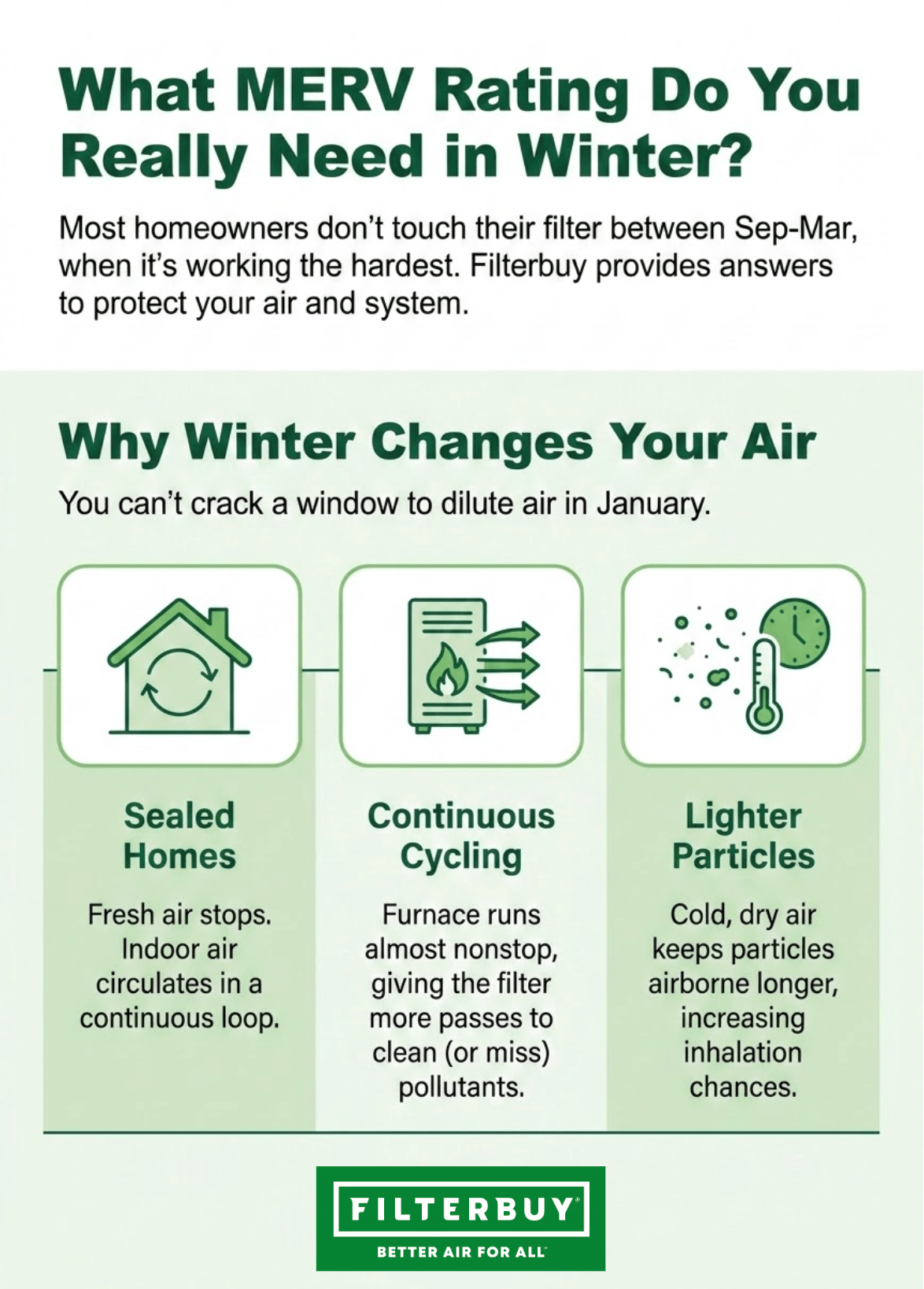
Crack a window in July and outdoor air dilutes whatever's built up inside. You can't do that in January. When your home is sealed against the cold, fresh air stops coming in — and whatever is circulating indoors just keeps moving through the same loop. Your furnace runs almost nonstop. Every pass through the system is another chance to filter out what's floating around, or miss it again.
Cold, dry air also makes particles lighter. They stay airborne longer instead of settling on surfaces, which creates more chances to inhale them before they ever reach your filter. By February, a home that started heating season with decent air quality can feel noticeably stuffier — not because something changed about the house, but because the filter hasn't kept pace with what winter demands.
The MERV rating you choose before winter, and how often you swap the filter, does more real work during these months than most homeowners give it credit for.
MERV 8 vs. MERV 11 in Winter: Where Most Households Land
This is the comparison we hear most, and the answer isn't one-size-fits-all — but it's close.
A MERV 8 filter handles particles in the 3 to 10 micron range: dust mites, pollen, mold spores, general household debris. In a newer home without pets, allergies, or occupants with respiratory sensitivities, MERV 8 gives you solid winter protection.
A MERV 11 filter catches all of that, plus particles down to 1 micron — pet dander, fine dust from cooking and combustion, smoke particles, and a wider range of mold spore types. In a sealed winter home, that extra coverage makes a real difference for anyone who deals with seasonal symptoms or has pets that shed year-round.
If you have pets, kids, mild allergies, or an older home that runs dusty, start with MERV 11 this winter. The impact on airflow is small across most residential systems, and the protection you gain is worth the small upgrade.
Should You Use a MERV 13 Filter in Winter?
MERV 13 is where we start recommending for households with real health considerations, not just comfort preferences.
At 0.3 microns, a MERV 13 filter catches fine smoke particles, bacteria-sized debris, virus carriers, and ultra-fine particulate matter that builds up indoors over a full heating season. For anyone in the home with asthma, severe allergies, compromised immune function, or a recent illness, the upgrade is worth serious consideration. Winter is the season when air recirculates most and outdoor ventilation is lowest — which makes fine-particle filtration more valuable than at any other time of year.
Higher filtration density means more airflow resistance. Not every residential furnace or air handler is built to push air through a MERV 13 filter efficiently — older equipment in particular can struggle, which leads to reduced airflow, higher energy draw, or faster component wear. Pull out your furnace manual or call your HVAC technician before making the switch. It's a five-minute check that can prevent a real headache.

Which MERV Rating Is Right for Your Home?
Use this as your quick guide:
• Average home, no pets, no allergies — MERV 8: Strong baseline protection, works well with most systems.
• Home with pets or mild seasonal allergies — MERV 11: Catches dander and finer particles that build up indoors in winter.
• Asthma, severe allergies, or immune-sensitive household — MERV 13: Fine-particle protection — confirm system compatibility first.
• High-traffic or older dusty home — MERV 11, replace monthly: Heavy particle load plus constant cycling means filters fill faster.
How Often to Replace Your Filter During Heating Season
The most common winter filter mistake isn't picking the wrong rating — it's keeping it too long. Your furnace runs far more hours per day in December than in June, which means the filter loads up much faster than your summer schedule accounts for.
A filter that runs clean for 90 days in a low-use summer household can be effectively clogged within 30 to 45 days once heating season kicks in. A gray, packed filter doesn't just let particles through — it restricts airflow, forces your furnace to work harder than it should, and can shorten equipment life in ways you won't see until it's expensive.
Check your filter every 30 days from November through March. If it looks gray, swap it. Households with pets or heavy use should plan on monthly replacements by default, not wait to see how the filter looks. Filterbuy's auto-delivery sends your next filter before you need to think about ordering — so you're never running on a clogged filter because it slipped your mind.
“We’ve been manufacturing air filters in the U.S. for over a decade, and we’ve heard from HVAC professionals from one end of the country to the other. They all say the same thing: homeowners consistently underestimate how much winter changes their indoor air. Seal a house, run a furnace for 10 hours a day, and strip the humidity out of the air — that combination pushes even a decent MERV 8 setup past its limits faster than most people expect. Stepping up to MERV 11, or MERV 13 where the system supports it, makes a difference you can actually measure.”
The Filterbuy Air Quality Team | U.S.-Based Manufacturing & Filter Engineering, 10+ Years
7 Essential Resources
Want to go deeper? These are the sources we trust.
1. EPA: Introduction to Indoor Air Quality
The EPA's core resource on indoor air pollutants — what they are, what causes them, and how ventilation and filtration affect what you're breathing at home.
2. ASHRAE Standard 52.2: Method of Testing General Ventilation Air-Cleaning Devices
This is the standard that created the MERV scale. Every MERV rating you see on a filter traces back to this document from the American Society of Heating, Refrigerating and Air-Conditioning Engineers.
3. American Lung Association: Dust, Mold, and Pet Dander
A practical breakdown of the indoor allergens that cause the most trouble — many of which spike in winter when homes stay sealed and ventilation drops.
4. U.S. Department of Energy: Heating and Cooling Efficiency
The DOE's guidance on HVAC efficiency, including why filter maintenance directly affects how much you spend running your system through heating season.
5. CDC: Indoor Environmental Quality
The CDC's resource on how indoor environments affect respiratory health — covering the intersection of ventilation, filtration, and real-world health outcomes.
6. NAFA: Understanding MERV Ratings
A clear explainer from the National Air Filtration Association on what each MERV level captures and how to pick the right rating for your setup.
7. Filterbuy: Winter Furnace Filter Guide — Replace This Before Temperatures Drop
Our step-by-step guide to getting your HVAC system ready for heating season — when to replace, what to look for, and what not to skip.
3 Statistics That Matter
The numbers behind why your winter filter choice matters more than most people realize.
Indoor Air Is 2 to 5 Times More Polluted Than Outdoor Air
Indoor air is 2 to 5 times more polluted than outdoor air, according to the EPA — and in some cases up to 100 times worse. That gap widens every winter when homes seal up and outdoor ventilation drops to near zero.
Source: U.S. Environmental Protection Agency — Indoor Air Quality
Heating and Cooling Account for 48% of Home Energy Use
Heating and cooling account for roughly 48% of a typical U.S. home's energy use, per the DOE. A clogged or mismatched filter makes your furnace work harder than it needs to — and you pay for that every month of heating season.
Source: U.S. Department of Energy — Energy Saver
Americans Spend About 90% of Their Time Indoors
Americans spend about 90% of their time indoors, the EPA reports. What's in that air — allergens, fine particles, pollutants — depends almost entirely on how well your system filters it. Your MERV rating is doing more work than most people give it credit for.
Source: U.S. Environmental Protection Agency — Indoor Air Quality
Our Honest Take
We've seen what most American homes are running: MERV 8, year-round, usually whatever came with the house or was last changed whenever someone remembered. In summer, that's probably fine. In winter, it usually isn't. Closed homes, continuous furnace operation, dry air, and the slow accumulation of dander, dust, and mold spores throughout heating season all add up to conditions where MERV 8 quietly falls short.
Our call: most households should step up to MERV 11 for winter. The airflow impact is minimal. The filtration improvement is real.
On MERV 13 — we'll be direct: if your system can handle it and anyone in your home has asthma, severe allergies, or immune sensitivities, the upgrade is worth it. Fine smoke, airborne pathogens, and ultra-fine dust are present in every home in winter, and they're harder to avoid when outdoor ventilation drops to near zero. MERV 13 catches what MERV 8 and MERV 11 let through.
What we'd push back on is the reflex to buy the highest rating available, regardless of what your system was built for. A MERV 16 filter in a unit designed for MERV 8 doesn't give you better air — it strains equipment, restricts airflow, and wastes money. The right answer is the highest rating your system actually supports, changed on a schedule that matches how hard your furnace is working.
Next Steps
Your home's heating season is already underway. Here's what to do today.
1. Pull out your current filter and look at it. Gray, packed with debris, or you can't remember the last change? Replace it today — no matter the season.
2. Find your filter size. It's printed on the cardboard frame of the existing filter — something like 16x25x1 or 20x20x2. If it's worn off, measure the slot in your furnace or air handler directly.
3. Match your MERV rating to your household using the table in this guide. If you're still weighing options, MERV 11 is the right starting point for most winter homes.
4. Check system compatibility before moving to MERV 13. Your furnace manual lists the filter ratings it's built for. If you don't have it, a quick call to your HVAC technician settles it in five minutes.
5. Set a 30-day reminder from November through March — or set up Filterbuy auto-delivery. Your next filter ships before you'd think to order it, so you're never running on a clogged filter because it slipped your mind.
6. Browse Filterbuy's full winter lineup. American-made, 600+ standard sizes, custom cuts available, free shipping, factory direct.
Frequently Asked Questions
What MERV rating filter should I use for winter?
MERV 11 is the right call for most homes during heating season. It handles the fine particles that build up when your house is sealed and your furnace runs constantly — pet dander, mold spores, fine dust. If your household includes someone with asthma, severe allergies, or immune sensitivities, and your HVAC system supports it, step up to MERV 13.
Is MERV 8 good enough in winter?
For newer homes without pets or allergy concerns, MERV 8 gives you solid baseline protection. For most other households, MERV 11 is worth the small price difference — especially in a season when your air is recirculating with no fresh outdoor air to dilute what's in it.
Can I use a MERV 13 filter in a standard home furnace?
Often yes, but not always. MERV 13 filters are denser and add more resistance to airflow than MERV 8 or 11. Some older furnaces and air handlers can't push air through them efficiently, which leads to reduced comfort, higher energy bills, or faster equipment wear. Check your furnace manual or ask your HVAC technician before making the switch.
How does winter affect indoor air quality?
When outside temps drop, you seal the house — and that stops fresh outdoor air from diluting what's building up inside. Your furnace cycles the same air through the system all day. Dust, pet dander, mold spores, and fine particles concentrate instead of clearing out. Cold, dry air keeps them lighter and airborne longer, which means more exposure before they ever reach your filter. By mid-winter, an under-filtered home can feel noticeably worse than it did in September.
How often should I change my furnace filter in winter?
Check it every 30 days, November through March. If it's gray and visibly loaded, swap it. Households with pets, young kids, or heavy use should plan on monthly changes by default rather than waiting to assess. Filterbuy's auto-delivery handles the timing — your filter ships before you'd think to order it.
What's the best air filter for a home with pets in winter?
MERV 11. It captures pet dander and fine hair particles at a level MERV 8 doesn't reach. Multiple pets in the home? Plan on monthly replacements — two or more animals loading a filter simultaneously means it fills faster than the standard 60 to 90 days.
Does a higher MERV rating always mean better air quality?
In terms of what the filter captures, yes. But in practice, it depends on your system. A filter that adds resistance your HVAC unit wasn't built for can reduce airflow and hurt performance — meaning worse air distribution and a harder-working furnace, not cleaner air. Match the highest MERV your system supports and you're in good shape.
Your Home Deserves Better Air This Winter
We make our filters right here in the U.S., ship them factory direct, and carry 600+ standard sizes alongside custom cuts for the hard-to-find ones. No retailer in the middle. No markup on the price. Just your filter, made right, at your door when you need it.