
Freeze Warning: What It Means and How It Differs From a Frost Advisory
October 8, 2026
What Is The Difference Between A Freeze Warning And A Frost Advisory?
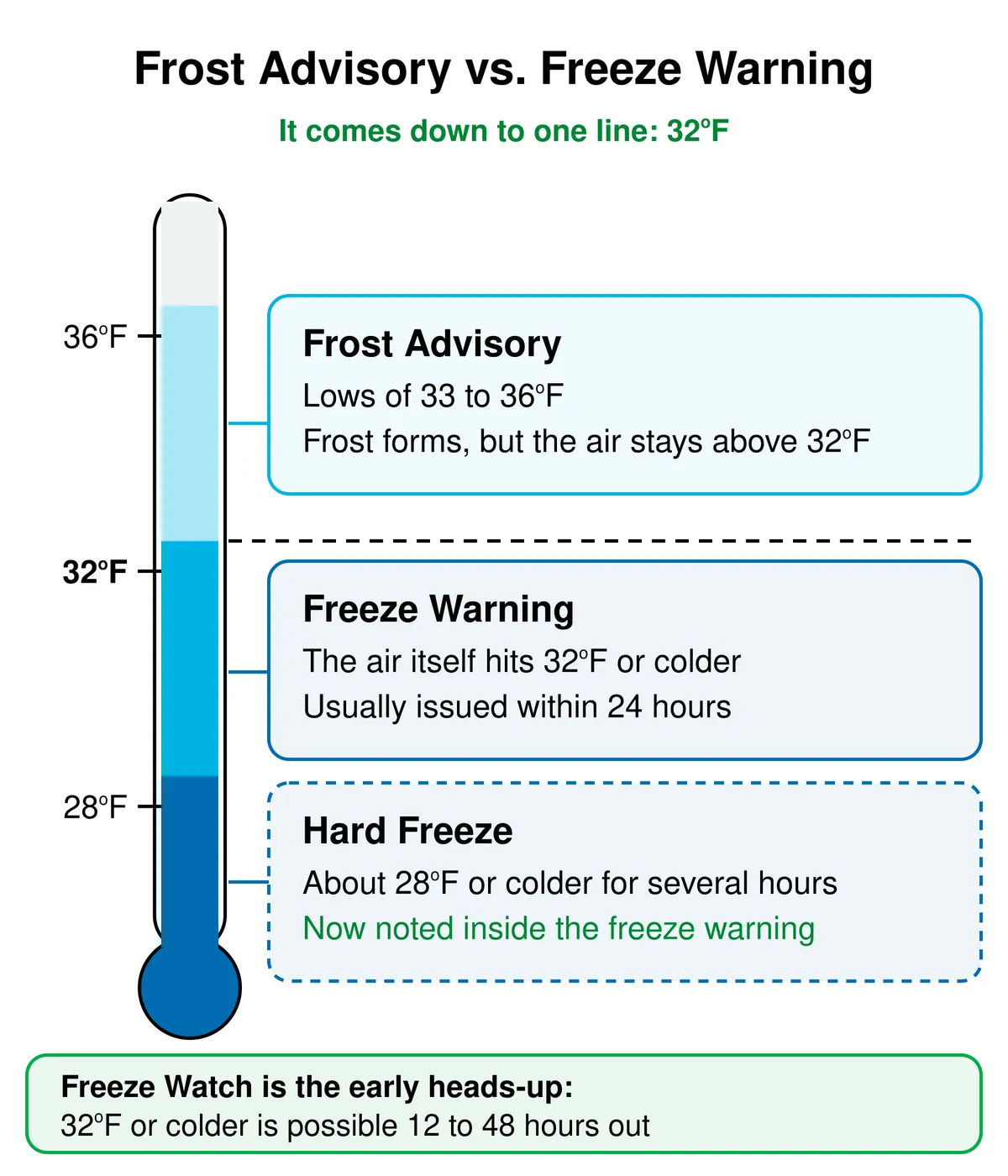
A frost advisory means lows of 33°F to 36°F, when frost can form while the air stays above freezing. A freeze warning means the National Weather Service expects the air itself to reach 32°F or colder, usually within 24 hours.
Frost advisory: Lows of 33°F to 36°F. Check your air filter and test your heat.
Freeze watch: 32°F or colder is possible 12 to 48 hours out. Run a full heating cycle.
Freeze warning: 32°F or colder is expected. Disconnect hoses and drip exposed faucets.
Hard freeze: About 28°F or colder for several hours, now noted inside the freeze warning. Open cabinets on exterior walls.
A clogged filter can make a furnace or heat pump overheat and shut off, so a fresh one belongs on your freeze checklist. Take the quick quiz below to find your filter before the first freeze.
Answer a few quick questions and we'll match you to the right filter for winter.
Already know your size? Shop air filters at Filterbuy.
TL;DR
A freeze warning means the National Weather Service expects temperatures at or below 32°F. A frost advisory means lows of 33°F to 36°F with frost likely, and a freeze watch is the heads-up a day or two earlier. Since October 1, 2024, a forecast hard freeze (about 28°F or colder) is issued as a freeze warning instead of a separate hard freeze warning.
Key Takeaways
A freeze warning means temperatures of 32°F or colder are expected, usually within 24 hours.
A freeze watch means a freeze is possible, typically 12 to 48 hours out.
The NWS folded the hard freeze warning into the freeze warning on October 1, 2024.
Freeze alerts usually end with the growing season, so a January without alerts can still freeze your pipes.
The freeze watch is the best time to change your air filter and order a spare, before long winter run times begin.
What Does a Freeze Warning Mean?
A freeze warning means the National Weather Service is confident the air temperature will reach 32°F or lower in your area, usually within 24 hours. Local NWS offices issue them during the growing season, so the alert is written for crops and gardens, not your house.
Freeze Warning vs. Frost Advisory vs. Freeze Watch: What's the Difference?
Temperature is the difference. A frost advisory covers lows of 33°F to 36°F, when frost can form even though the air stays above freezing. A freeze warning means the air itself is expected to reach 32°F or below. A freeze watch comes earlier, with less certainty.
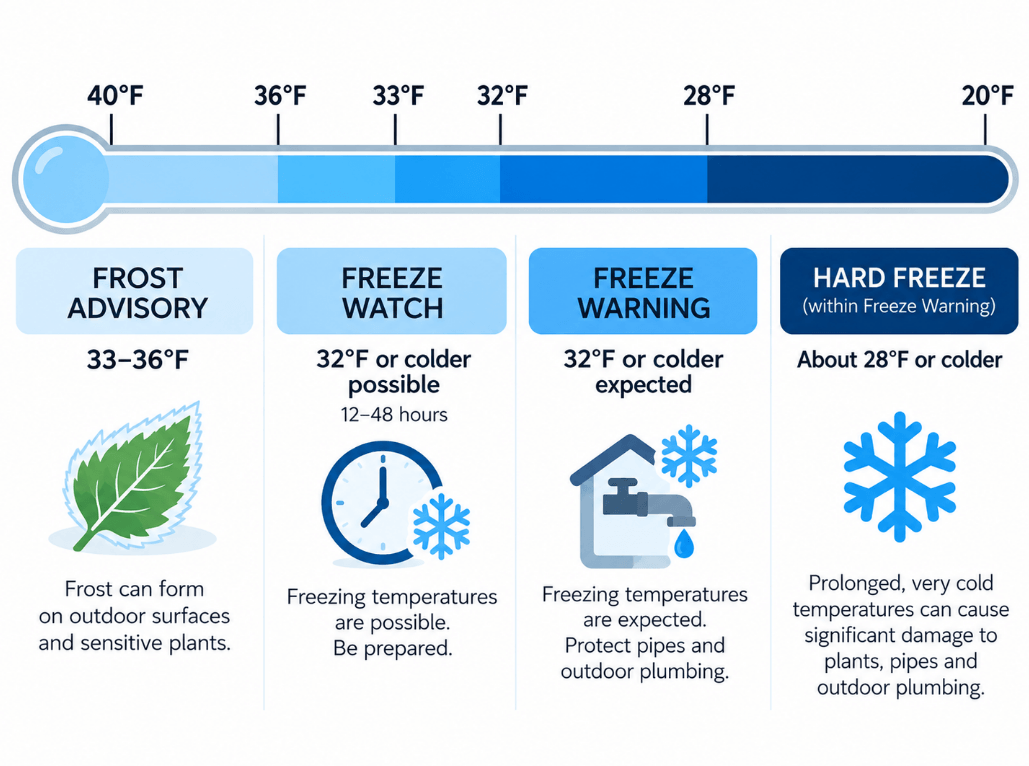
Thresholds and timing vary slightly by NWS forecast office.
What Happened to the Hard Freeze Warning?
The hard freeze warning is gone as a separate alert. On October 1, 2024, the National Weather Service folded it into the freeze warning and renamed the hard freeze watch a freeze watch (NWS). Forecasters now note a hard freeze in the "What" section of the warning text, so it pays to read past the headline.
A hard freeze generally means 28°F or colder for several hours, which is long enough to freeze pipes in unheated spaces. If you see "hard freeze" in the warning text, the Filterbuy team advises opening cabinets on exterior walls and dripping faucets that night.
Why Don't I Get Freeze Warnings in the Middle of Winter?
Most NWS offices stop issuing frost advisories and freeze warnings once the local growing season ends, after the first widespread hard freeze or on a set date. NWS Atlanta, for example, runs its program until November 20 or until a county has a widespread hard freeze (NWS Atlanta).
That means a quiet alert map in January is not a sign your pipes are safe. Winter cold is covered instead by the Cold Weather Advisory and the Extreme Cold Watch and Warning. Filterbuy's rule of thumb is to treat any forecast low near 20°F or below as a pipe-protection night, alert or not.
For snow and ice, Filterbuy's guides cover the winter weather advisory and the winter storm warning.
What Should Homeowners Do During a Freeze Warning?
During a freeze warning, protect anything that holds water and the system that heats the house, since a heating shutdown overnight puts every pipe at risk. Start outdoors with faucets and exposed pipes, then confirm the heat and filter are ready.
"Most people read a freeze warning as a gardening alert. I read it as the start of filter season. The first freeze is the night your furnace or heat pump starts running for hours, and that is the week a tired filter starts working against you."
— Michelle Wan, Brand Manager and Air Quality Writer, Filterbuy
Know your first-freeze date. In Atlanta, the average first 32°F freeze lands on November 13, although it has come as early as October 11 (NWS Atlanta). Look up your area's date and change your filter about two weeks ahead.
Protect your pipes. The American Red Cross recommends letting cold water drip from faucets fed by exposed pipes and opening sink cabinets so warm air can reach the plumbing (American Red Cross).
Shut down outdoor water. Close any indoor shutoff valve for the hose bib first. Then disconnect the hose and open the outdoor faucet to drain the line.
Leaving town? Keep the heat at 55°F or higher and put in a fresh filter, so a clogged one can't shut the system down while the house is empty. Show a neighbor where your main water shutoff is, too.
Test your heat early. Run a full heating cycle as soon as the freeze watch goes out. An afternoon problem leaves time to call a technician; a 2 a.m. problem does not.
Swap in a fresh air filter. A clogged filter restricts airflow, which makes a furnace or heat pump work harder and can cause it to overheat and shut off on a safety limit. We've seen filters pulled in February completely black after 30 days. Check how often to change your HVAC filter, then find your exact filter size. Filterbuy cuts every filter to order in its U.S. plants and ships within 24 hours, but order a spare at the freeze watch, not the night of the warning.
Don't panic over a steaming heat pump. In freezing weather, a heat pump runs a defrost cycle that briefly melts ice off the outdoor coil, so a puff of steam and a pause in the outdoor fan are normal. Many of the "my heat pump is broken" calls Filterbuy's team fields after a cold morning turn out to be a defrost cycle or a clogged filter. Never chip ice off the coil.
"The first cold snap brings the same service calls every year: a furnace short-cycling on a clogged filter, or a heat pump owner who thinks steam means a breakdown. Swap the filter first and most of those calls never happen."
— David Clark, Licensed HVAC Technician
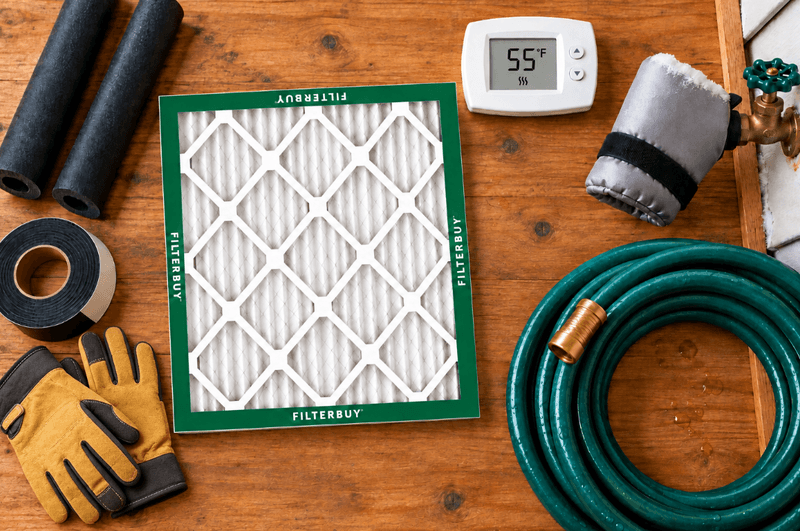
Filterbuy's Alert-to-Action Ladder
Does a Freeze Affect Indoor Air Quality?
A freeze affects indoor air quality indirectly. During a cold snap, windows stay shut and the heat runs for long stretches, so the same air cycles through your filter all day. Dust and pet dander build up faster in a sealed home, and a fresh, properly sized filter keeps that recirculated air cleaner.
If you have fuel-burning heat, test your carbon monoxide detectors as well. Filterbuy makes filters, and we'll be plain about their limits: air filters do not remove carbon monoxide. Check your local air quality on the live AQI map.
Supporting Statistics
1. About 1 in 60 insured homes files a water damage or freezing claim each year, and the average claim costs $15,400. Water damage and freezing made up 22.6% of homeowners insurance claims in 2023. Source: Insurance Information Institute (Triple-I), Facts + Statistics: Homeowners and Renters Insurance
2. Nearly half of the energy used in a U.S. home goes to heating and cooling. ENERGY STAR, the federal efficiency program, advises checking your filter monthly in winter and changing it at least every 3 months. Source: ENERGY STAR, Heat & Cool Efficiently
3. Each year, more than 400 Americans die from unintentional carbon monoxide poisoning not linked to fires, and more than 100,000 visit an emergency department. The CDC recommends a CO detector near every sleeping area. Source: Centers for Disease Control and Prevention, Carbon Monoxide Poisoning Basics
Frequently Asked Questions
Should I Turn the Heat Down at Night During a Freeze Warning?
No. The American Red Cross advises keeping the thermostat at the same temperature day and night. For heat pumps, a deep overnight setback can also trigger backup electric heat, which costs more to run.
What Should I Do If a Pipe Freezes?
Leave the faucet open and warm the frozen section with a hair dryer or heating pad, never an open flame. If you can't reach the frozen spot, call a licensed plumber (American Red Cross). If it bursts, shut off the main water valve first.
Should I Cover My Heat Pump or AC Unit During a Freeze Warning?
Don't fully wrap either one. A heat pump needs open airflow to heat your home, and a full wrap traps moisture against the coils. A top-only cover is fine for falling debris.
Do I Need to Drip My Faucets During a Freeze Warning?
Yes, for any faucet fed by pipes in an unheated space or along an exterior wall.
Stay Ahead of the First Freeze
Most of the first-freeze trouble reported to Filterbuy starts with a filter nobody checked. If remembering is the hard part, Filterbuy auto-delivery sends the next one before the cold arrives.
Sources: NWS cold hazard simplification; NWS Atlanta; NWS Raleigh; American Red Cross; Triple-I; ENERGY STAR; CDC.
Glossary
National Weather Service (NWS): The NOAA agency that issues U.S. weather alerts.
Freeze Warning: An NWS alert for expected temperatures of 32°F or colder.
Freeze Watch: An NWS alert that freezing temperatures are possible, usually 12 to 48 hours ahead.
Frost Advisory: An NWS alert for lows of 33°F to 36°F, when frost can form.
Hard freeze: Generally 28°F or colder for several hours.
Growing season: The local period between the last spring freeze and first fall freeze.
Cold Weather Advisory: The NWS alert for cold that calls for caution, formerly the Wind Chill Advisory.
Extreme Cold Warning: The NWS alert for dangerous cold, formerly the Wind Chill Warning.
Defrost cycle: A normal heat pump function that melts ice off the outdoor coil.
Filterbuy: A U.S. manufacturer of pleated HVAC air filters, made to order in 600+ sizes since 2013.