May 9, 2026
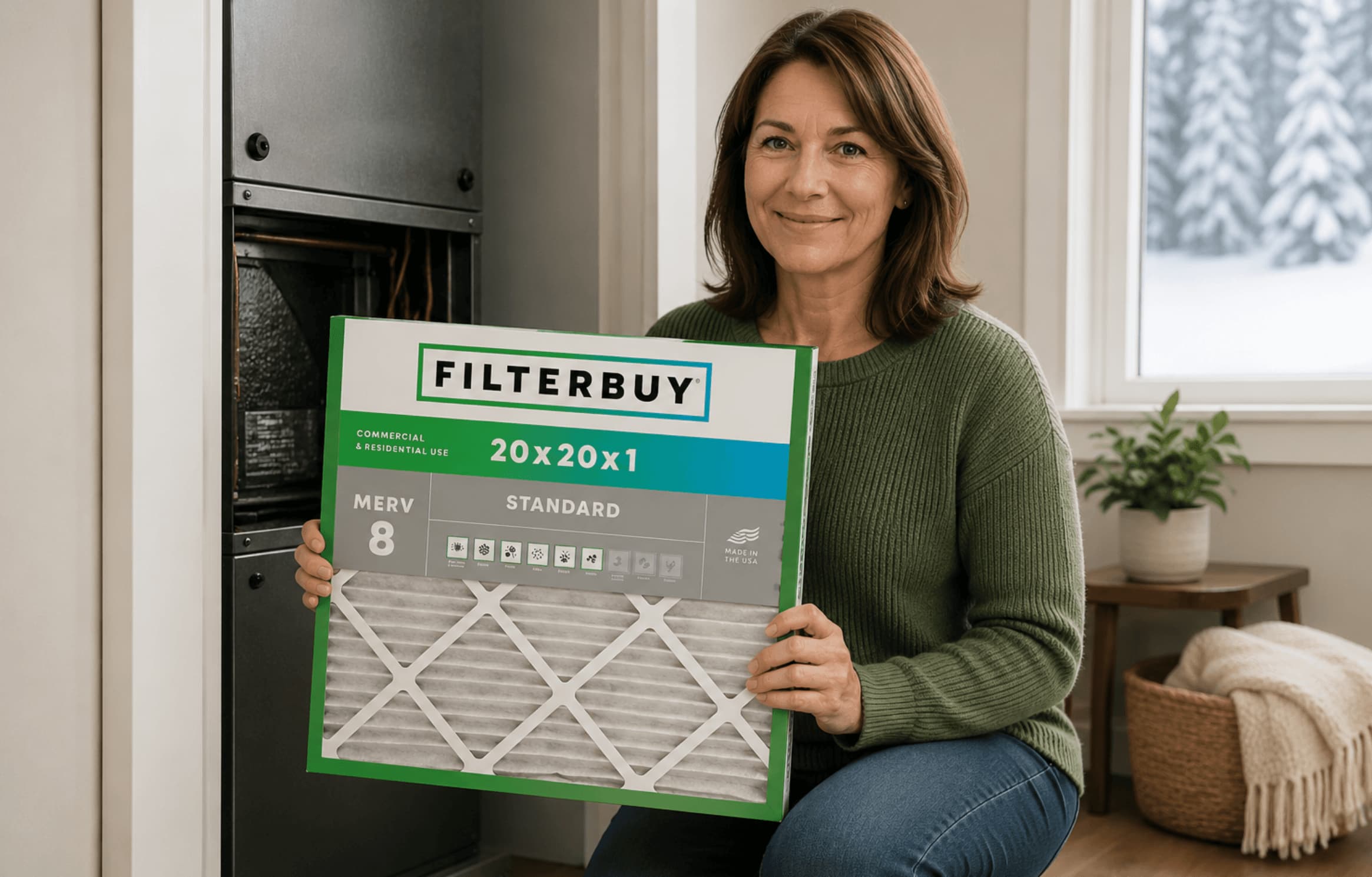
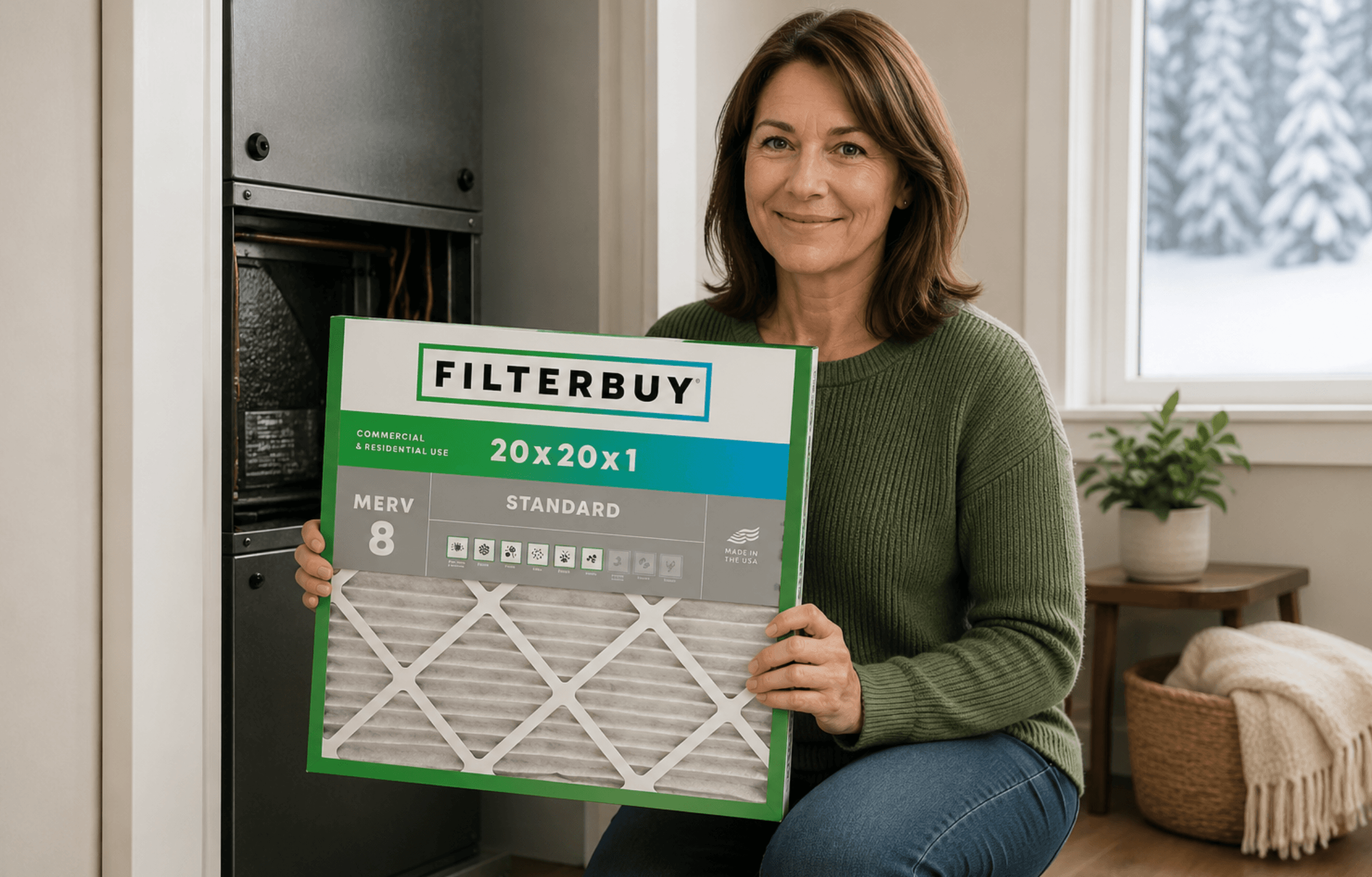
A frozen heat pump filter looks like a major equipment failure. Almost always, it isn't. Nine times out of ten the cause is restricted airflow from a clogged filter, and the fix takes about fifteen minutes once the ice is gone.
We've shipped filters to homes in all 50 states for more than a decade. The same pattern shows up every January: a wave of calls from homeowners who walked outside on a cold morning and found ice on the unit, the filter, or both. The right response is calmer than people expect. Turn the system off, let it thaw, and walk through what's actually happening so you can fix it tonight and stop it from happening again.
This page covers the four real causes, the steps that work, and the prevention habits we recommend. Same guidance we'd give a neighbor.
A heat pump filter freezes when restricted airflow drops the indoor coil below freezing, condensing moisture into ice that creeps upstream onto the filter. In roughly seven out of ten calls we field, the cause is a clogged filter the homeowner can replace in fifteen minutes. The remaining cases trace to closed return vents, a faulty defrost cycle, or low refrigerant.
What to do right now:
• Turn the system OFF at the thermostat. Don't run a heat pump on a frozen coil.
• Let it thaw 1 to 3 hours in fan-only mode. No chipping, no scraping, no hair dryers.
• Pull the old filter, install a fresh correctly sized one with the airflow arrow toward the unit, and restart in heat mode.
• If ice returns within hours, that's a service call.
Prevent it next year: Change the filter every 1 to 3 months in heating season, keep return vents clear, and book a fall tune-up before first frost.
1. Heat pump filter freezing almost always starts with restricted airflow, not equipment failure.
2. A dirty 1-inch pleated filter is the cause more often than every other reason combined.
3. Running a heat pump on a frozen coil is what turns a $20 problem into a four-figure compressor repair.
4. Most residential heat pumps run well on MERV 8 to 11. MERV 13 captures more, but only if your air handler is rated to handle the higher restriction.
5. Persistent icing after a fresh filter and clear returns is a service call. Refrigerant or defrost issues do not fix themselves.
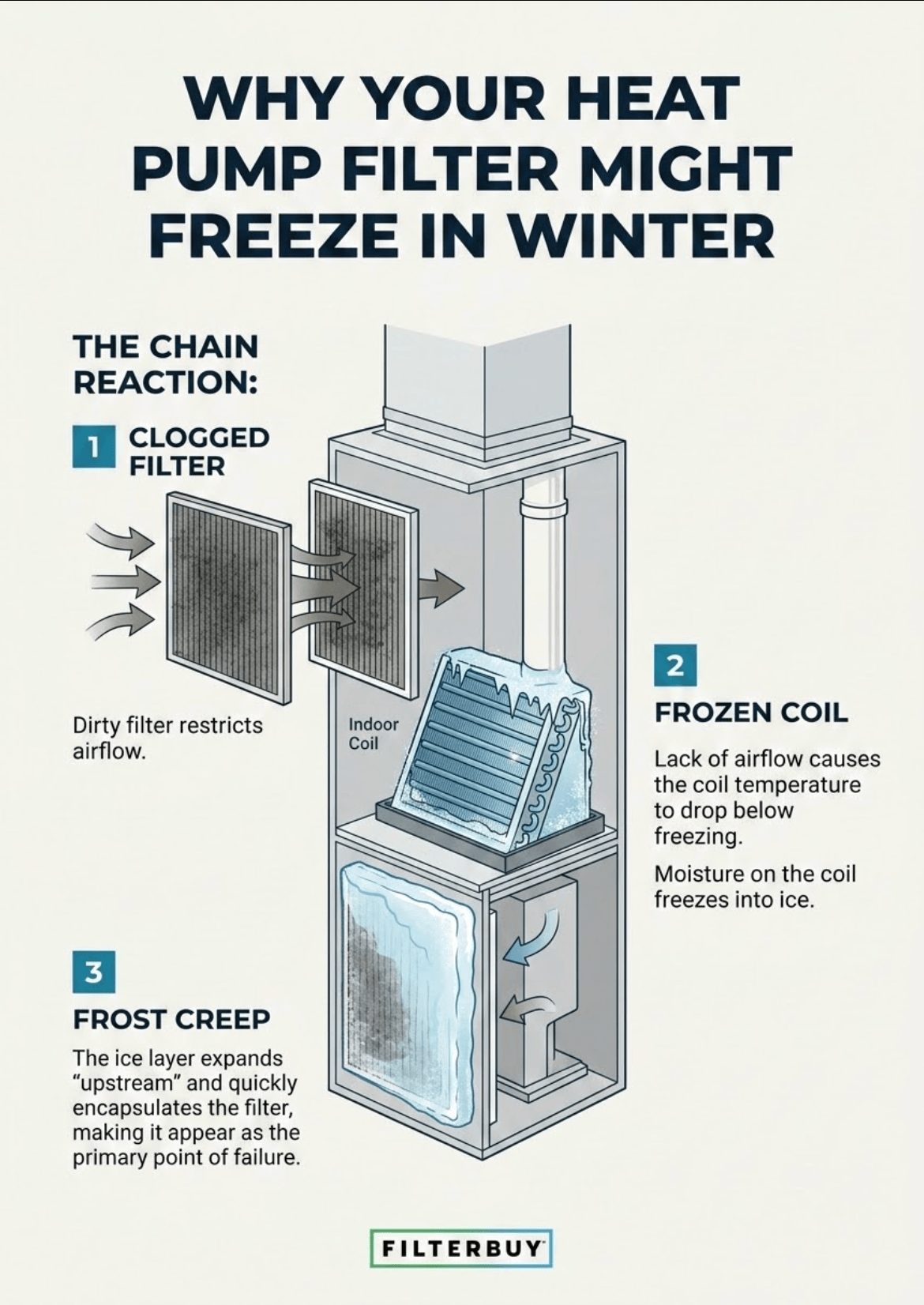
A heat pump moves heat instead of generating it. In winter, it pulls warmth out of the outdoor air and pushes it through the indoor coil and blower. Two things have to flow freely for that to work: refrigerant through the system, and air across the coil. When the air side gets choked, the indoor coil drops below freezing, moisture in the return air condenses on it, and that condensation turns to ice. The frost can creep upstream onto the filter, which is what most homeowners actually see first.
A small amount of frost on the outdoor unit is normal in winter. Heat pumps run a built-in defrost cycle to clear it. What is not normal: ice on the indoor side, ice that returns within hours of a thaw, or visible ice creeping onto the filter.
1. A dirty or clogged air filter. Pull the filter and hold it to a light. If light barely passes through, that's your problem. A clogged filter starves the coil of air, the coil drops below freezing, and ice spreads. This is the most common cause we see, and it's the easiest to fix.
2. Restricted return airflow. A clean filter cannot outrun a couch parked in front of the return vent. Closed registers in unused rooms, undersized ductwork, and rugs over floor returns all have the same effect.
3. Defrost cycle or outdoor coil trouble. Heat pumps are designed to ice up a little outside, then briefly run in reverse to clear it. When the defrost board, sensor, or reversing valve fails, the outdoor coil keeps icing and the indoor side suffers. This is service-call territory.
4. Low refrigerant or a failing reversing valve. Symptoms: long run times, weak heat output, persistent icing even after a filter change. Refrigerant stays sealed in the system for its life. Low charge means a leak, and leaks need a licensed tech.
Three things happen at once when ice forms on the filter or coil. Heating output drops, so the system runs longer trying to catch up. Energy use spikes. According to ENERGY STAR, airflow problems alone can reduce HVAC system efficiency by up to 15 percent. And the longer the unit runs against the restriction, the more wear lands on the compressor, which is the most expensive component in the system. A $20 filter that gets ignored is the cheapest way to end up with a $2,000 repair.
If your system is icing over, run this check before anything else.
1. Pull the filter and hold it to a light. If you can't see light through it, replace it.
2. Walk every return vent. Open registers. Move furniture. Don't shut doors in heated rooms unless your system was designed for zoning.
3. Look at the indoor coil. Visible frost confirms airflow restriction.
4. Look at the outdoor unit. Light frost is normal. A solid block of ice is not.
5. Note when the symptoms started. Gradual onset usually means a filter or duct restriction. Sudden onset after the last cold snap leans toward refrigerant or defrost.
1. Turn the system OFF at the thermostat. Don't keep heat-calling on a frozen unit.
2. Set the fan to the "on" position, or leave the system fully off, so the indoor coil can thaw safely. Don't chip, scrape, or use a hair dryer. The coil fins puncture easily.
3. Wait one to three hours for full thaw. Towels under the air handler will catch melt water.
4. Pull the old filter. If it's wet, soggy, or visibly clogged, throw it out. Wet filters can't be salvaged. They shed debris into the blower.
5. Install a fresh, correctly sized filter. Confirm the airflow arrow points toward the unit.
6. Walk your returns one more time and clear anything you missed.
7. Restart the system in heat mode and watch for 30 to 60 minutes. Steady supply-air temperature and no ice returning means you're back in business. Ice that returns within hours is a service call.
Consistency is what makes prevention work.
• Change the filter every 1 to 3 months in heating season. Monthly if you have pets, allergies, or run the system continuously.
• Keep return vents clear. No furniture, no rugs, no closed doors in heated rooms.
• Schedule a fall tune-up before first frost. NATE-certified techs catch refrigerant and defrost problems you can't see.
• Keep the outdoor unit clear of leaves, snow drifts, and 18 to 24 inches of clearance on every side.
• If remembering filter changes is the part that always slips, set up auto-delivery. The right filter shows up at the right time and you skip the errand.
For the full pre-winter walkthrough, see our winter prep checklist for heat pumps.
"In our experience shipping filters to American homes for more than a decade, roughly seven out of ten 'my heat pump is icing up' calls trace back to a clogged filter the homeowner can replace themselves in fifteen minutes. The other three are real service work, and the difference between the two is usually visible if you pull the filter first."
— Filterbuy HVAC Team. NATE-certified technicians. U.S.-based manufacturing since 2012.
These are the references worth bookmarking. Each is government-backed, current, and free.
1. U.S. Department of Energy. Operating and Maintaining Your Heat Pump. Federal source on filter cadence, coil cleaning, thermostat habits, and what a professional service should cover.
https://www.energy.gov/energysaver/operating-and-maintaining-your-heat-pump
2. U.S. Department of Energy. Heat Pump Systems. Plain-language overview of how heat pumps work, the major types, and what affects efficiency.
https://www.energy.gov/energysaver/heat-pump-systems
3. ENERGY STAR. HVAC Maintenance Checklist. Print this and bring it to your service appointment. The exact list a qualified tech should run during an annual visit.
https://www.energystar.gov/saveathome/heating-cooling/maintenance-checklist
4. ENERGY STAR. Heat & Cool Efficiently. Plain-language guidance on the highest-impact ways to lower heating and cooling costs, including filter swaps and duct sealing.
https://www.energystar.gov/saveathome/heating-cooling
5. U.S. EPA. Guide to Air Cleaners in the Home. Consumer guide to HVAC filters and portable air cleaners, including how to compare ratings and choose the right filter for your system.
https://www.epa.gov/indoor-air-quality-iaq/guide-air-cleaners-home
6. U.S. EPA. What is a MERV Rating? Straightforward explainer on MERV ratings, what each number actually catches, and when an upgrade pays off.
https://www.epa.gov/indoor-air-quality-iaq/what-merv-rating
7. Building America Solution Center (DOE / PNNL). High-MERV Filters. Technical resource on how filter selection affects system pressure drop. Useful before any MERV upgrade above your manual's recommendation.
https://basc.pnnl.gov/resource-guides/high-merv-filters
1. Airflow problems can cut HVAC system efficiency by up to 15 percent. That's the gap a clogged filter alone can create on the largest energy line item in most homes. Source: ENERGY STAR, HVAC Maintenance Checklist.
https://www.energystar.gov/saveathome/heating-cooling/maintenance-checklist
2. Indoor pollutant levels often run 2 to 5 times higher than outdoor levels. That comes from EPA exposure studies, and it's why HVAC filters matter every day, not just when something's wrong. A frozen filter is doing none of that work. Source: U.S. EPA, "The Inside Story: A Guide to Indoor Air Quality."
https://www.epa.gov/indoor-air-quality-iaq/inside-story-guide-indoor-air-quality
3. Heating and cooling account for about 43 percent of a typical American home's utility bill. That's why a $20 filter shows up on your power bill faster and more directly than almost any other home maintenance task. Source: U.S. Department of Energy, "Why Energy Efficiency Matters."
https://www.energy.gov/energysaver/why-energy-efficiency-matters
Most heat pump freezing calls don't need a technician. They need a homeowner who knows the filter is the first place to look and a clean spare in the closet. The reason this problem feels intimidating is that ice on a heating system looks dramatic. Mechanically, it's almost always the simplest issue restricted air can cause.
Here's the part that's harder to say plainly. The homeowners who get blindsided by winter freeze-ups usually aren't unlucky. They're a couple of months past a filter change, and they didn't notice. Filter changes are a habit problem, not a knowledge problem. The fix isn't reading more articles. The fix is putting the next change on a calendar you actually look at, or removing yourself from the equation entirely with auto-delivery.
One honest opinion worth flagging. If your unit is more than 12 to 15 years old and you're already fighting recurring ice issues, sometimes the right answer is a replacement quote alongside the repair quote. Modern cold-climate heat pumps perform at temperatures that would have stalled a unit from 2010. If a repair estimate tops half the cost of a new system, get a second opinion before you sign.
• Today: Pull your current filter and hold it to a light. If light barely passes through, you've already found the culprit.
• Tonight, if the system is iced: Turn it off, let it thaw for one to three hours, swap the filter, restart it. Watch for 30 to 60 minutes.
• This week: Walk every return vent. Move furniture. Open registers in rooms you'd been closing off.
• Before next cold snap: Order a spare filter so you're not caught short on a Sunday night.
• Going forward: Set a 60-day reminder on your phone, or set up auto-delivery so the right filter shows up automatically.
• Before next winter: Schedule a NATE-certified tune-up. Catches the refrigerant and defrost issues you can't see from the thermostat.
Most often, restricted airflow from a clogged filter has dropped your indoor coil below freezing. Moisture in the return air condenses on the coil and freezes, and that ice can spread back onto the filter. Less common causes are closed return vents, a malfunctioning defrost cycle, and low refrigerant.
Yes, and it's the cause we see most often. A clogged filter chokes airflow over the indoor coil, drops coil temperature, and triggers ice buildup. The fix usually runs under $20 and takes fifteen minutes.
Every 1 to 3 months for standard 1-inch filters during the heating season. Change more often if you have pets, allergies, or run the system continuously in cold weather. ENERGY STAR's rule of thumb: if it looks dirty after a month, change it.
Most residential heat pumps run well on MERV 8 to 11. MERV 13 captures more particulates and is ideal for indoor air quality, but only if your system's static-pressure rating supports it. Check your manual or call the pros before going higher.
No. Switch the system off, let the ice thaw for one to three hours, replace the filter, and then restart. Running with a frozen filter risks compressor damage and turns a $20 problem into a four-figure repair.
One to three hours with the system off or in fan-only mode. Don't chip or scrape the ice. The fins puncture easily. If ice returns within a few hours of restart, call a licensed HVAC pro.
Not directly. But a system running on a frozen coil burns extra energy, loses heating capacity, and stresses the compressor. The bigger risk is a future repair bill, not an immediate safety issue.
The filter is the cheapest piece of HVAC maintenance you'll ever do, and the one with the largest direct effect on your power bill. Filterbuy makes the filter step easier than the errand. American-made filters in 600+ sizes, including custom, shipped factory-direct and free. Auto-delivery so the next one arrives before you have to think about it.
